Hermès Colors Reference Guide: Tannage, Patina & Color Science
How dye chemistry, fibril density, and tannage method determine color depth, stability, and long-term patina behaviour across every major Hermès leather.
The Hermès colors guide most buyers encounter is a swatch library — a catalogue of named colorways sorted by family. What it rarely addresses is the more fundamental question: how does color behave in leather over time, and what determines whether a colorway deepens into museum-quality patina or shifts toward an unwanted tone? Color in Hermès leather is not a surface application. It is a chemical event locked into the fibril structure of the hide during the retanning and dyeing stages of production — and its long-term behaviour is determined by tannage chemistry, grain architecture, and fibril density, not by the color name on the order form.
This guide approaches Hermès color through a leather science lens. By the end, you will understand why vegetable-tanned leathers shift over time while chrome-tanned ones hold their colorway, why Togo reads differently from Epsom in the same colorway under the same lighting conditions, and what authentic color depth looks like at the cut edge of a genuine Hermès piece — versus the surface-only dye application visible on counterfeit production.
40+
Hermès leathers produced — each with distinct dye uptake and color behaviour
2
Fundamental tannage types: vegetable-tanned vs chrome-tanned — each with opposite color shift profiles
5–7yr
Typical patina development window for vegetable-tanned leathers in regular use
How Hermès Locks Color Into Leather: The Fibril Chemistry
Understanding the Hermès colors guide at a material level begins with a single principle: color is not painted onto Hermès leather — it is absorbed into it. After the initial tannage, hides enter the retanning and dyeing stages in drum vats where penetrating dyes are applied under mechanical agitation and controlled heat. The dye molecules enter the fibril structure of the hide through its open grain and bind chemically to the collagen fibrils — the protein chains that form the structural matrix of leather.
The depth of dye penetration is the most important variable in color quality. It is governed by fibril density: loose-grained leathers like Togo absorb dye more deeply, producing an even color throughout the leather cross-section — visible as consistent color at the cut edge of a genuine piece. Tight-grained leathers like Epsom receive less dye penetration because their compressed fibril architecture restricts dye molecule movement, but they develop a highly consistent surface color due to the uniformity of their compressed grain. This is not a quality deficiency in Epsom — it is a function of its structural design. But it does mean that Togo and Epsom will show different cut-edge color profiles even in identical colorways from the same production batch.
“Authentic Hermès color depth is not a surface quality. It is a penetration quality — visible at the cut edge, measurable under magnification, and entirely absent from counterfeit pieces that apply color as a topcoat rather than a fibril-locked dye.”
- Dye penetration depth varies by leather type — Togo absorbs deeper than Epsom in identical colorways
- Authentic cut edges show consistent color throughout the leather cross-section
- Counterfeit pieces typically show a dyed surface layer over undyed or differently-colored core leather
- Fibril density is the primary determinant of dye uptake and long-term color stability
- Retanning agents applied before dyeing open or close the fibril structure to control dye penetration
Tannage Method and Color Behaviour: Vegetable vs Chrome
The single most important variable in long-term Hermès color behaviour is tannage type. Hermès uses two fundamental tannage approaches — vegetable tannage and chrome tannage — and each produces a fundamentally different color profile over time.
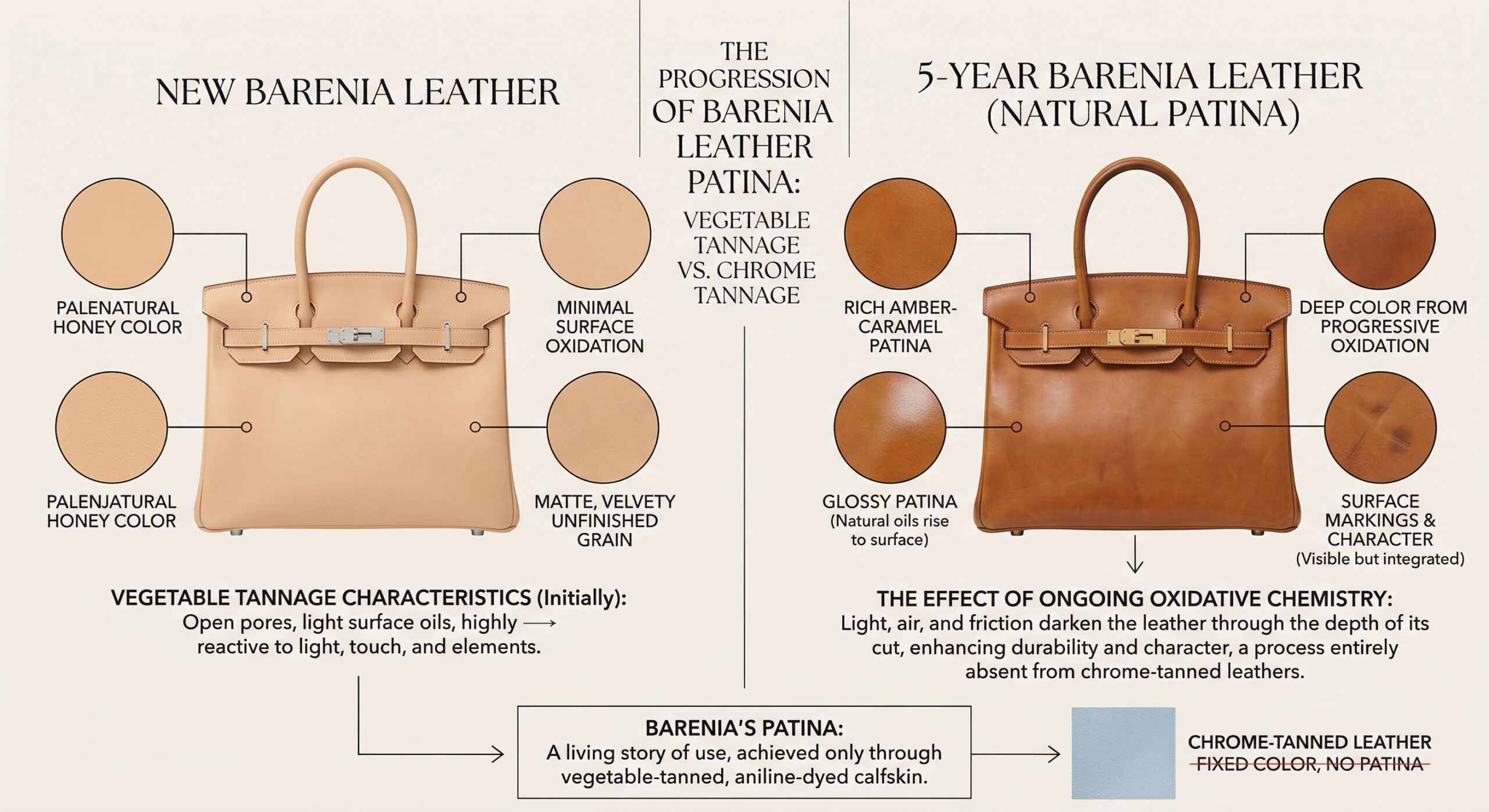
Vegetable-tanned leathers — including Barenia, Box Calf, and the Naturel colorway in several leathers — are tanned using plant-derived polyphenols, primarily from oak bark, chestnut, and quebracho. These polyphenolic tanning agents form a less chemically stable bond at the fibril level than chromium salts, which means the leather continues to undergo slow oxidative chemistry after leaving the tannery. The result is patina: a progressive deepening and warming of the color as the polyphenols oxidise in response to UV exposure, skin oil contact, and atmospheric oxygen. This is not degradation. It is the predictable, chemically explicable, and highly desirable result of a tannage method whose oxidative chemistry continues to enrich the leather’s color over years and decades of use.
Chrome-tanned leathers — including Togo, Clemence, Epsom, and Swift — are tanned using chromium sulphate salts that form a more chemically stable fibril bond. Chrome-tanned leathers hold their colorway with significantly greater stability over time, resisting the shift toward honey and amber tones that characterises vegetable tannage. The trade-off is that chrome-tanned leathers do not develop the same depth of patina. They age more predictably and more slowly, but the color evolution is subtle rather than dramatic.
Leather Expert Note
The collector community frequently describes Barenia patina as the most desirable aging process in the Hermès leather range — and the chemistry supports this. Barenia’s vegetable tannage and its relatively open grain produce one of the deepest and most visually dramatic patina progressions available in any luxury leather. A Barenia Constance carried daily will show visible honey deepening within 18–24 months of use. This is not a defect — it is evidence of correct material behaviour.
Reading Patina as a Quality Signal
Patina is one of the most misunderstood concepts in luxury leather assessment. In the general consumer market, any change from the original appearance of a leather good tends to be categorised as wear or degradation. In the leather science framework, patina is a specific and desirable phenomenon: the progressive development of a surface character that reflects the leather’s chemical and mechanical history in ways that enhance rather than diminish its visual and tactile quality.
On authentic Hermès leather, patina manifests in three distinct modes depending on the tannage type and the leather’s pattern of use. On vegetable-tanned leathers like Barenia and Box Calf, patina presents as color deepening — a progressive shift toward warmer, darker tones driven by polyphenol oxidation. On chrome-tanned pebbled leathers like Togo and Clemence, patina presents as grain softening — the pebbled surface gradually settling into a more relaxed texture as the fibril structure accommodates the mechanical stresses of regular use. On tight-grained chrome-tanned leathers like Epsom, patina presents as finish clarification — the cross-hatch embossed surface developing a subtle sheen at the grain peaks as contact abrasion polishes the compressed fibril surface over time.
- Vegetable-tanned patina — color deepening driven by polyphenol oxidation. Expected and desirable on Barenia, Box Calf, Naturel leathers
- Pebbled chrome-tanned patina — grain softening as fibril structure accommodates regular use. Normal on Togo and Clemence
- Embossed chrome-tanned patina — finish clarification and subtle sheen at grain peaks. Normal on Epsom
- Counterfeit pieces do not develop authentic patina — surface dye applications crack, peel, or fade rather than deepening
- Uneven patina on authentic pieces indicates storage issues or uneven use — not a production defect
The authentication value of patina cannot be overstated. Counterfeit Hermès pieces — which apply color as a surface coating rather than a fibril-locked penetrating dye — do not develop authentic patina. They fade, crack, or peel in patterns that diverge from genuine leather behaviour. A piece showing authentic patina progression — color deepening consistent with its tannage type, grain softening in the correct zones, finish clarification at the expected contact points — is providing material evidence of its authenticity that no visual inspection of hardware or stitching alone can offer. For a complete authentication framework, see our Hermès authentication guide.
Grain Architecture and Light Response: Why the Same Color Looks Different
One of the most frequently reported experiences among Hermès buyers is encountering a colorway in person that looks significantly different from its online representation. This is not photography error — it is grain architecture. The surface geometry of different Hermès leathers interacts with incident light in fundamentally different ways, producing genuinely different color readings from identical dye formulations.
Togo’s pebbled grain creates a surface of thousands of micro-peaks and micro-valleys. Light strikes the peaks directly and reflects toward the viewer; light enters the valleys and is partially absorbed before any reflection occurs. The result is a color reading that is richer and more saturated than the dye formulation alone would suggest — the micro-shadows created by the grain valleys deepen the perceived color. Under warm incandescent light, these micro-shadows intensify and the color appears at its most saturated. Under cool diffuse daylight, the shadows flatten and the color reads more closely to its actual dye formulation.
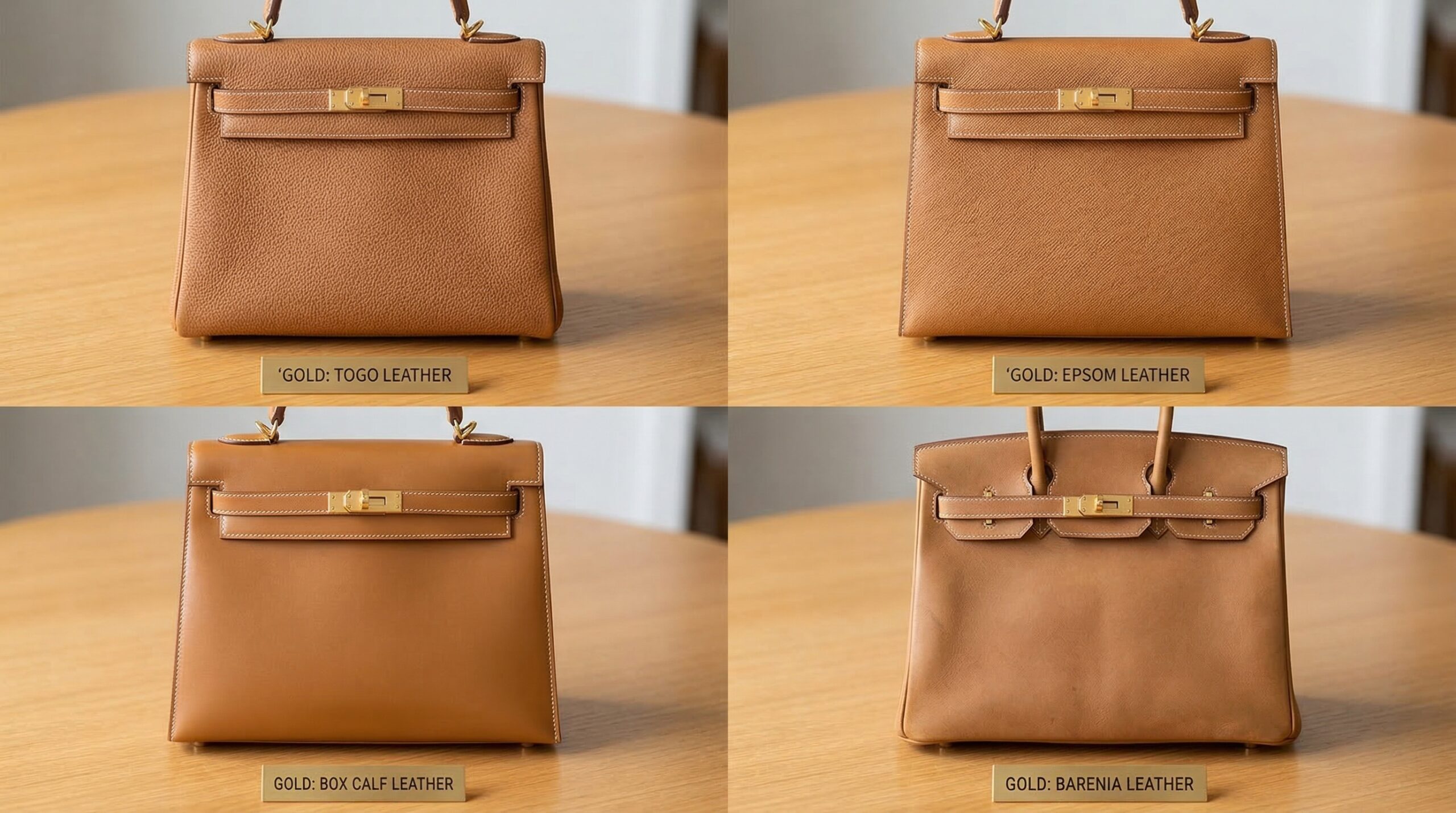
Epsom’s cross-hatch embossed grain distributes light more evenly across its flat, compressed surface. The absence of deep micro-valleys means less light absorption in shadow zones, producing a color reading that is more consistent across lighting conditions but less saturated than the same dye in Togo. This is why collectors sometimes describe Epsom as reading “flatter” than Togo in identical colorways — and why the same Etain, Etoupe, or Gold will photograph and appear differently depending on which leather carries it.
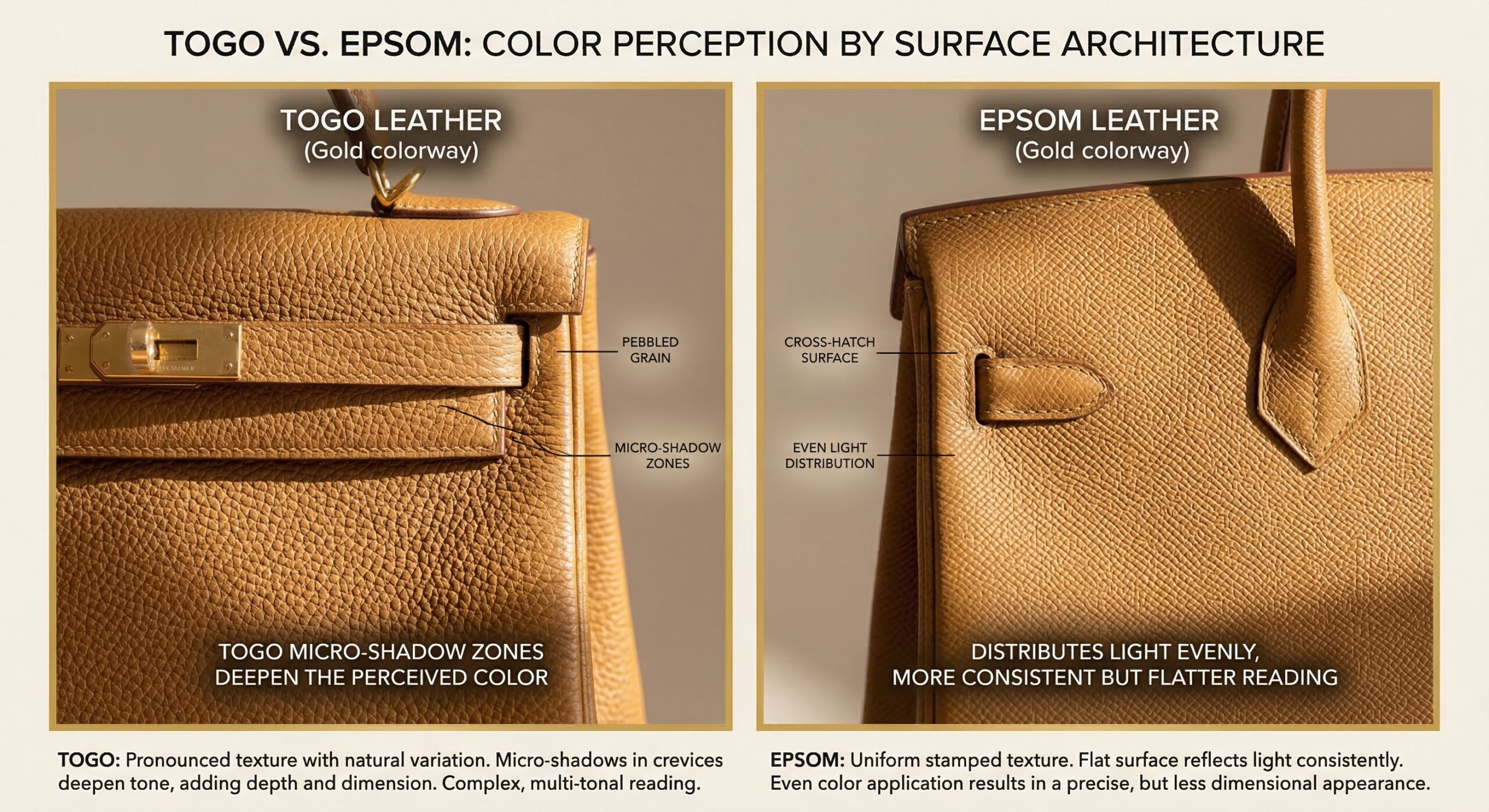
The following illustrates how selected Hermès colorways behave differently across leather types in terms of depth, saturation, and lighting response:
Gold
Deep on Togo
Etoupe
Warm Grey
Etain
Pewter Shift
Noir
Stable All Types
Barenia
Patina-Prone
Havane
Rich on Clemence
For collectors selecting a colorway, grain architecture is as important a variable as the color itself. A buyer seeking the deepest, most saturated expression of a given colorway should select Togo or Clemence. A buyer seeking the most consistent and lighting-stable color reading should select Epsom. A buyer seeking long-term patina development should select Barenia or Box Calf in the available colorway range. These are not aesthetic preferences — they are material science decisions with predictable outcomes.
| Leather | Tannage Type | Color Shift Over Time | Patina Character | Light Response |
|---|---|---|---|---|
| Barenia / Barenia Faubourg | Vegetable-tanned | Strong — deepens toward honey/amber | Color deepening + pellicule bloom | Warm, deepens under incandescent |
| Box Calf | Vegetable-tanned | Moderate — develops gloss patina at corners | Surface gloss intensification + color depth | High gloss under direct light |
| Togo | Chrome-tanned | Minimal — grain softens over time | Grain softening, slight sheen increase | Deep, micro-shadow saturation |
| Clemence | Chrome-tanned (vegetable retanned) | Minimal — slight color warming possible | Grain softening, handle darkening | Rich, consistent across lighting |
| Epsom | Chrome-tanned (embossed) | Very stable — holds colorway reliably | Subtle finish clarification at grain peaks | Flat, consistent across lighting |
| Swift / Veau Swift | Chrome-tanned | Minimal — surface scratches accumulate | Minor surface marring, recovers with buffing | Smooth, even, accurate color reading |
| Ostrich | Chrome-tanned | Moderate at follicle nodes — handle darkening | Follicle node darkening from skin oil | Node highlights shift in raking light |
Color as an Authentication Tool: What Counterfeit Production Cannot Replicate
For buyers approaching the pre-owned market, an understanding of Hermès color science is a direct authentication asset. The forensic signatures of authentic Hermès color — fibril-locked dye penetration, tannage-appropriate patina progression, grain-consistent light response — are not reproducible at counterfeit production scale. They require the actual leather production infrastructure of a major tannery operating to Hermès specifications, and they take years to develop. For a full authentication framework, see the Hermès authentication guide.
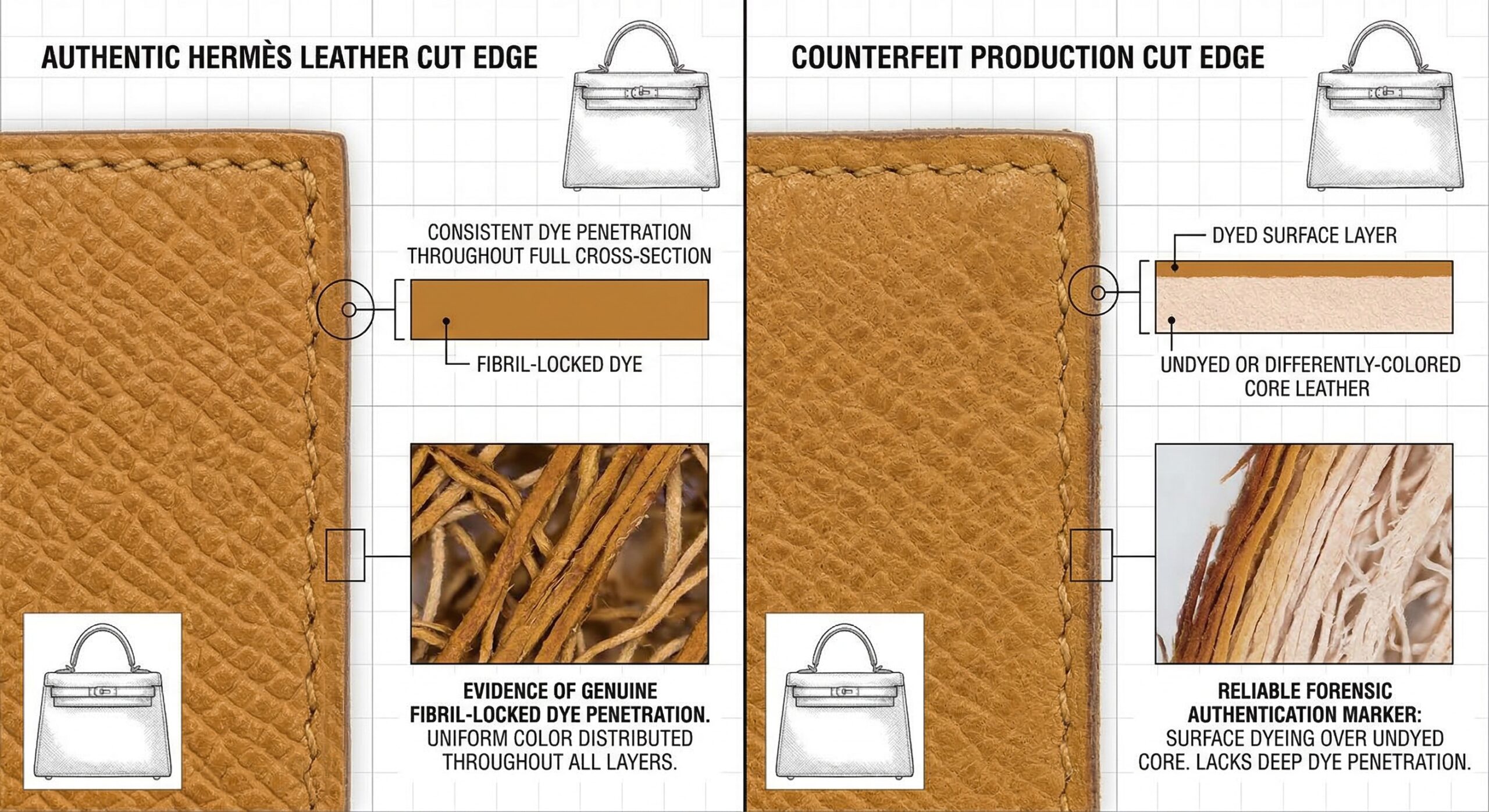
- Cut edge color consistency — authentic pieces show full-depth penetration; counterfeits show surface-only color
- Patina progression — authentic leather develops tannage-appropriate patina; counterfeit coatings crack, fade, or peel
- Grain shadow depth — authentic Togo grain has consistent micro-shadow depth; fake Togo embossing shows irregular or overly uniform shadow patterns
- Color behaviour under different lighting — authentic pieces shift color reading predictably with lighting; fakes often read identically under all conditions due to surface coating opacity
- Handle darkening on ostrich — authentic follicle darkening is gradual and contact-specific; counterfeit examples show uneven or accelerated surface discolouration
Color Is a Material Science Decision
The most common error in Hermès color selection is treating colorway and leather as independent choices. They are not. The same color in Togo reads differently from the same color in Epsom — not because photography is inaccurate, but because grain architecture determines how light interacts with the dye. The same color in Barenia will shift over five years in ways that the same color in Epsom will not — not because the dye is less stable, but because the tannage chemistry is fundamentally different.
Buyers who understand tannage type, fibril density, and grain light response will make color selections that deliver exactly the visual character they want — both at point of purchase and a decade into ownership. Buyers who treat color as a purely aesthetic choice, divorced from the material science of the leather that carries it, will encounter surprises — some welcome, some not.
Bottom Line: Select your colorway and your leather together, as a matched material system. The color you choose today and the color you live with in ten years are not the same color — and understanding which direction they will diverge is the foundation of an intelligent Hermès acquisition.
Popular Searches
Explore our most searched Hermès color and tannage topics
🔥 Most Searched
How Hermès Togo Leather Changes Color Over Time
A patina guide — what a 5-year Togo color progression reveals about chrome tannage dye stability and grain softening mechanics.
★ Collector Favourite
Why Hermès Ostrich Leather Handles Darken
The fibril density explanation — why follicle node geometry causes contact darkening and what can (and cannot) be done to slow it.
⬆ Trending
Hermès Barenia Faubourg Patina Progression
Month-by-month documentation of vegetable-tanned color shift — the most comprehensive patina guide for Hermès’s most coveted natural leather.
◆ Essential Reading
Hermès Authentication Guide
How color depth, cut-edge dye penetration, and patina progression function as forensic authentication markers — what counterfeit production cannot replicate.
⬆ Rising Demand
Hermès Noir vs Etain: Resale Color Comparison
Which neutral color holds its secondary market value better across Birkin and Kelly models — a data-driven analysis of color-specific resale performance.
🔥 Most Searched
Hermès Leather Types Guide
The central leather science reference — every major Hermès leather from Togo to alligator, analysed by tannage, fibril density, and long-term material behaviour.
Frequently Asked Questions
Vegetable-tanned leathers like Barenia undergo color shift because the tanning agents — plant-derived polyphenols, primarily from oak bark and chestnut — continue to oxidise at the fibril surface after the hide leaves the tannery. Exposure to UV light, skin oils, and atmospheric oxygen accelerates the oxidation of these polyphenols, progressively deepening the color toward honey and amber tones. This is patina, not degradation — it is the predictable, desirable result of a hide that was tanned using materials with ongoing oxidative chemistry. Chrome-tanned leathers like Togo do not undergo the same shift because the chromium salt tannage forms a more chemically stable bond at the fibril level.
Togo’s pebbled grain creates a surface with thousands of micro-shadow zones — small depressions between each grain peak where light is absorbed rather than reflected. Under warm incandescent light, these shadow zones read as deep, and the color appears richer and more saturated. Under cool fluorescent or overcast daylight, the micro-shadows flatten and the color reads more accurately against its dye formulation. This is why Togo photographs differently from Epsom in the same colorway — Epsom’s cross-hatch embossed grain distributes light more evenly across its surface, producing a more consistent color reading across lighting conditions.
Hermès leather color is applied during the retanning and dyeing stages of production — not as a surface coat. After the initial tannage, hides are placed in drum vats containing penetrating dyes that enter the fibril structure under mechanical agitation and heat. The depth of dye penetration depends on fibril density: loose-grained leathers like Togo absorb dye more deeply, producing a more even cut-edge color; tight-grained leathers like Epsom receive less dye penetration but develop a more consistent surface color due to their compressed fibril architecture. This is why cut edges on authentic Hermès pieces show color throughout the leather cross-section rather than only at the surface. See our Hermès leather types guide for full tannage comparisons.
Ostrich leather’s distinctive follicle bumps — the raised quill nodes — have a higher surface area per unit than flat-grained leathers, and the follicle zone itself is an area of compressed fibril density surrounded by more open tissue. Skin oil from hand contact deposits most heavily at the follicle nodes, which are the contact points of the raised surface. These oils penetrate the fibril structure at the nodes and oxidise, darkening the leather precisely where contact is most consistent. Handle darkening on ostrich is therefore a function of surface geometry and fibril architecture, not dye instability — and it cannot be prevented without significantly reducing the leather’s breathability and tactile character.
Articles in This Topic Group
The following articles link back to this hub. This list will be updated as each is published.