
Hermes Garden Party Negonda Leather: Why It's Different
A forensic analysis of Negonda's grain structure, temper, and fibril architecture — why this leather is specific to the Garden Party format, and why it performs differently from every other bovine leather in the Hermès range.
Negonda is the leather specification that most Hermès buyers encounter on the Garden Party without knowing what it is — and without understanding why it is the right leather for this specific bag format in a way that Togo, Clemence, or any other standard Hermès bovine leather would not be. Negonda is a softly pebbled, chrome-tanned bovine leather with a distinctively supple temper — softer and more relaxed in hand than Togo, approaching Clemence in suppleness but with a coarser grain character that gives the Garden Party its immediate casual confidence. It is not simply a Clemence substitute chosen for cost reasons. Negonda's specific fibril architecture and hide-section origin produce a leather that behaves differently from every other standard Hermès bovine leather under the specific conditions of tote carry — and understanding why it is different explains why Hermès chose it specifically for the Garden Party and why it produces the ownership experience this bag delivers.
This article provides the forensic detail behind Negonda's material differences, compares it directly against Togo and Clemence, and maps what those differences mean for the Garden Party owner over years of active carry.
What Negonda Is and Why It Belongs on the Garden Party Specifically
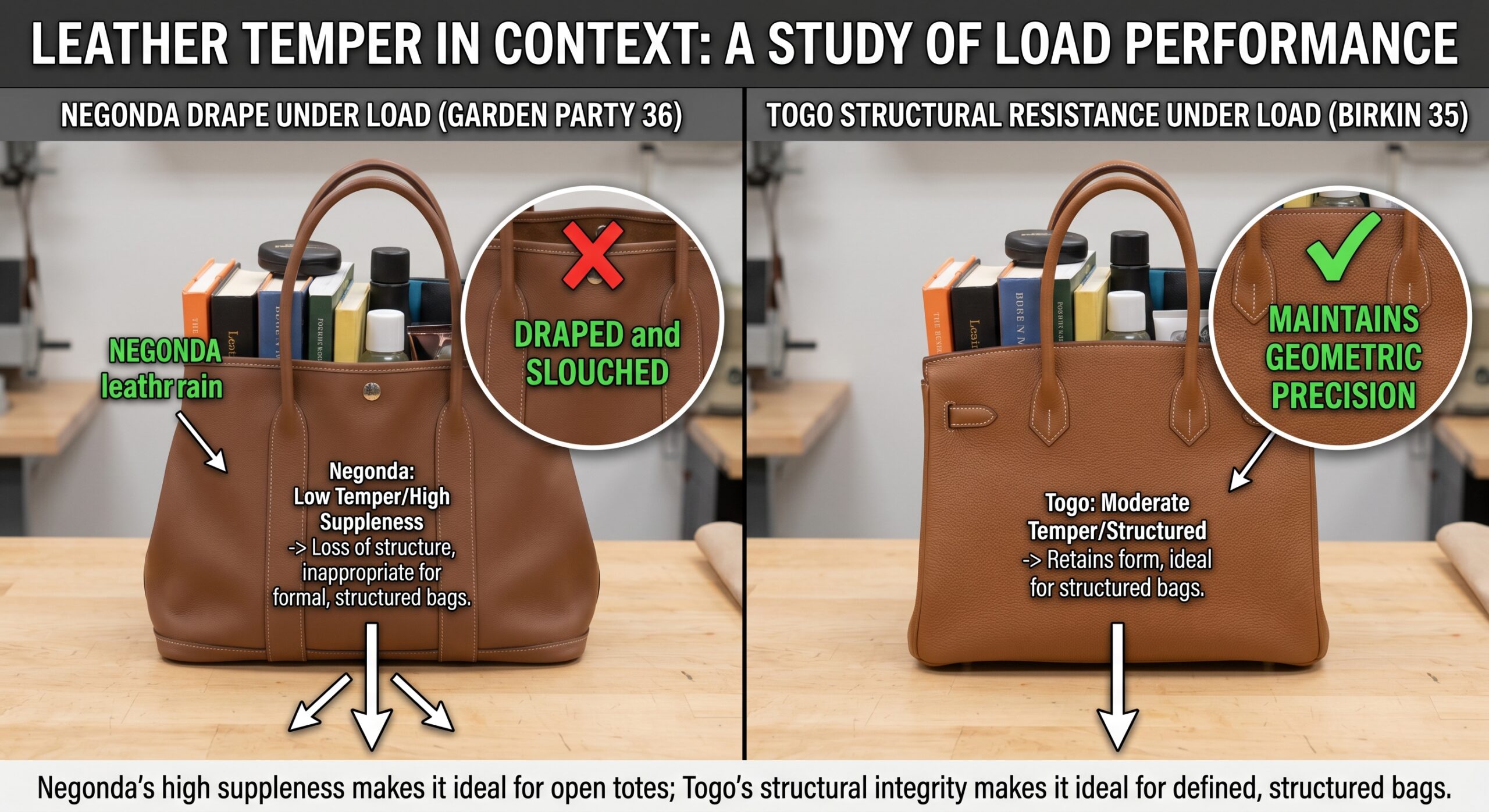
The Hermès Garden Party is a fundamentally different bag object from the Birkin or Kelly — not in prestige terms but in structural terms. The Birkin and Kelly are structured bags: their leather panels hold a specific geometry under load because the leather's temper, combined with internal construction elements, maintains the bag's dimensional stability over time. A Birkin in Togo holds its rectangular base-to-wall geometry across years of active carry because Togo's fibril density and temper provide the resistance to deformation that structured carry requires.
The Garden Party is an open-top tote. It has no rigid chassis, no structured base plate that determines its dimensional behaviour, and no construction requirement for the leather panels to maintain a fixed geometry under load. Its leather panels are required to be strong enough to carry the bag's contents securely — and they need to do so with a natural, relaxed drape rather than the precise geometric rigidity of a structured bag. For this requirement, Togo's firm-to-supple temper is actually over-engineered: it provides more structural resistance than the Garden Party's format needs, adding weight and a stiffness that is appropriate for the Birkin's requirements but unnecessary and slightly awkward for an open-top tote.
Negonda fills this format requirement precisely. Its softer temper allows the Garden Party's body panels to drape naturally under load, accommodating the variable contents of a working tote without the slight panel tension that stiffer leathers create when the bag is under-filled. Its coarser pebble grain provides scratch resistance comparable to Togo while delivering a more casual aesthetic character. And its chrome tannage provides the moisture resistance and low-maintenance ownership experience appropriate for a bag that is typically carried in more active, less precious contexts than the Birkin or Kelly. The full iconic collection context is at the Hermès Iconic Collections hub.
"Negonda is not a budget alternative to Togo on the Garden Party. It is the correct leather for this format — its soft temper is what makes the Garden Party feel like a garden party rather than a structured appointment."
Negonda's Grain, Temper, and Fibril Architecture: The Forensic Detail
Negonda is chrome-tanned bovine leather produced from a hide section that differs from Togo's flank origin and Clemence's belly origin — specifically a hide zone that is processed with drum-tumbling to produce its characteristic pebbled grain surface but whose initial hide characteristics (fibril architecture, thickness, natural suppleness) are distinct from both standard references.
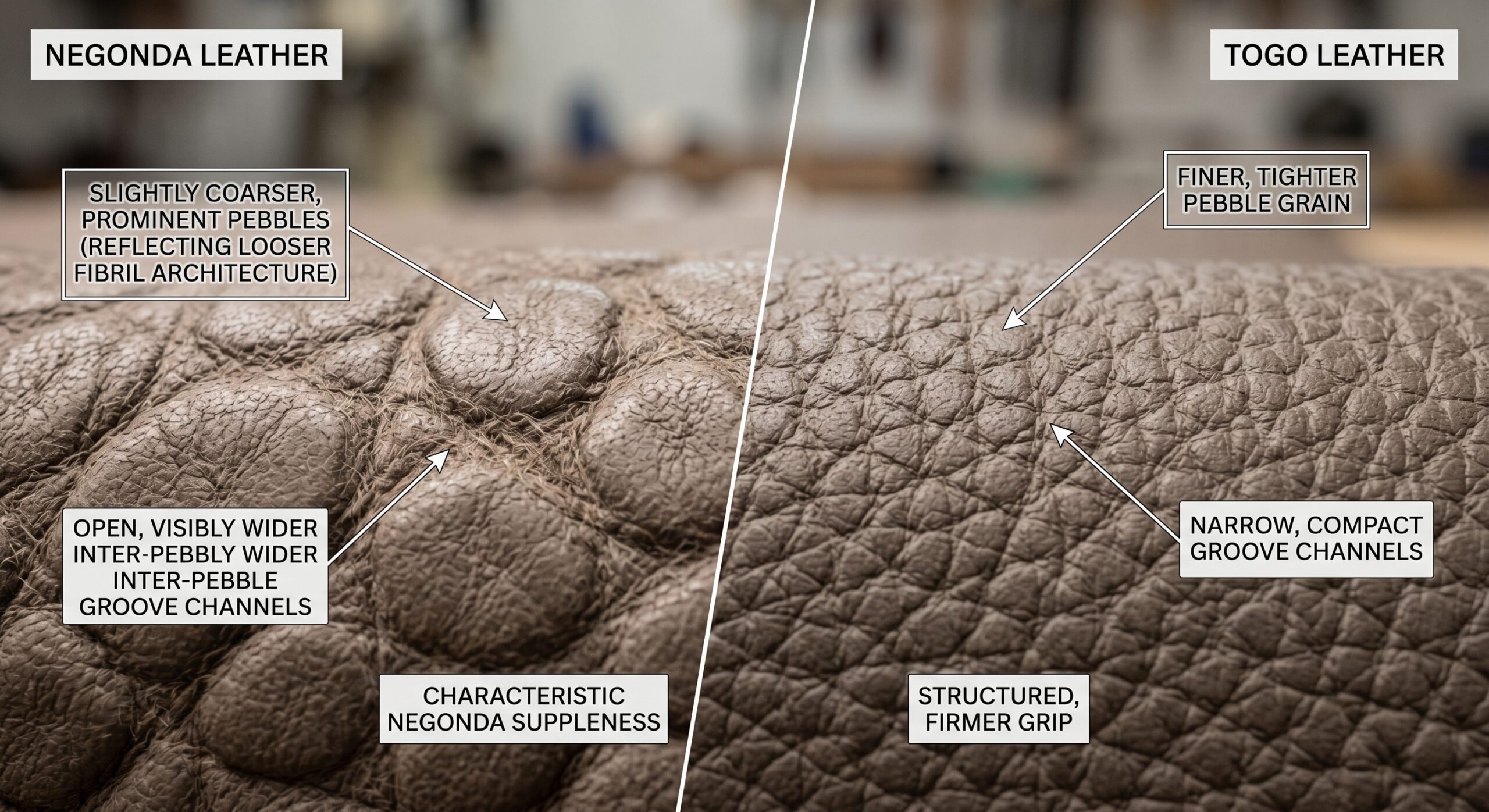
The most forensically notable difference between Negonda and Togo at the fibril level is the relative looseness of Negonda's fibril network per unit cross-section. Togo's flank-section hide has a moderately tight fibril architecture — tighter than Clemence's belly section but looser than the compressed Epsom surface. Negonda's fibril network is looser than Togo's, producing the leather's characteristic suppleness at the panel level. This looser architecture also contributes to Negonda's slightly coarser pebble character: the pebble formation during drum-tumbling responds to the fibril network's flexibility, and a looser fibril network produces larger, more open pebble geometry than the tighter Togo flank architecture. The result at the grain surface level is a pebble that is visually and tactilely distinct from Togo — slightly larger in individual pebble footprint, slightly more open in the inter-pebble groove channels, and noticeably warmer and more organic in hand feel.
- Hide section origin — distinct from Togo's flank and Clemence's belly; Negonda's specific section produces the combination of loose fibril architecture and moderate panel thickness that defines its temper
- Drum-tumbling grain production — same processing approach as Togo and Clemence but applied to a looser fibril substrate, producing a coarser pebble character than Togo's while maintaining similar surface depth to Clemence
- Temper — softer than Togo, approaching or comparable to Clemence; the critical difference from Togo that makes Negonda appropriate for open-top tote construction
- Grain character — slightly coarser pebble than Togo; inter-pebble grooves slightly more open, giving the surface a more relaxed visual character consistent with the Garden Party's aesthetic positioning
- Chrome tannage — same tannage approach as Togo and Clemence; provides moisture resistance, restrained patina development, and low-maintenance ownership consistent with active daily tote use
- Weight — comparable to Togo at equivalent panel area; slightly lighter than Clemence in the same format due to different panel thickness; the Garden Party's large-format construction benefits from Negonda's weight position
Negonda vs Togo vs Clemence: Where Each Leather Sits in the Hermès Bovine Range
The three-way comparison between Negonda, Togo, and Clemence maps the full range of pebbled bovine leather options in the Hermès range and clarifies why each is assigned to specific bag formats rather than being interchangeable.
Negonda
Togo
Clemence
Why Negonda's Loose Fibril Architecture Makes It Unsuitable for Birkin Construction — and Ideal for Garden Party
The Birkin's base geometry depends on the leather panels providing sufficient resistance to deformation under load to maintain the bag's rectangular cross-section without collapsing inward toward the contents. This resistance comes from the leather's temper — specifically the fibril network's density and cross-linking density per unit volume. Togo provides this resistance because its flank-section fibril density is high enough to resist deformation under the loads typical Birkin contents produce. Negonda's looser fibril architecture provides less deformation resistance at the same panel thickness — insufficient to maintain the Birkin's geometry under moderate loading without a rigid internal chassis (which Hermès does not use in the Birkin's leather construction). On the Garden Party, this same deformation compliance is an advantage: the panels that accommodate the tote's variable contents without stiffness are doing exactly what this format requires.
Owning a Negonda Garden Party: Performance, Patina, and Care Over Active Carry Years
The Garden Party Negonda is one of the most carry-practical bags in the Hermès range precisely because Negonda's material properties are aligned with the demands of an actively used tote rather than the demands of a prestigious structured piece. Understanding what "actively used" means for this leather over years of ownership converts the purchase from an impulse into a considered specification.
Under active daily tote carry with varied contents — laptop, documents, personal items at a total load of 2–4kg — the Negonda Garden Party performs in a way that consistently surprises owners who come to it from the Birkin or Kelly range. Where the Birkin holds its geometry under load with visible structural confidence, the Garden Party Negonda moves: the body panels flex inward under the weight of heavy contents, creating a natural, load-responsive silhouette that visually communicates the bag's contents weight. This is not a structural failure — it is the leather doing exactly what its temper and fibril architecture are designed to do in this format. The bag returns to its natural, relaxed geometry when unloaded. Owners who understand this as a feature rather than a problem consistently report high satisfaction with the Negonda Garden Party's carry performance over multi-year active use.
Patina development on Negonda follows the chrome-tanned pattern — restrained tonal deepening at contact zones driven by surface oil absorption and UV oxidation, similar to Togo but with a marginally faster rate at high-contact zones due to Negonda's slightly more open grain structure. The handles and the top edge of the body panels — the zones of highest skin contact during tote carry — show the most visible tonal deepening after 2–3 years of active carry. For comparison with the ten-year wear profile of the main Birkin leathers, see Which Hermès Birkin Leather Wears Best Over 10 Years. For the Togo vs Clemence comparison that frames Negonda's position in the temper range, see Hermès Togo vs Clemence: Which Slouches More Over Time. Browse the full leather science collection at Leather Science.
| Property | Negonda | Togo | Clemence |
|---|---|---|---|
| Hide section origin | Specific section producing loose fibril architecture — distinct from Togo flank and Clemence belly | Upper flank — moderately dense fibril architecture, the standard reference for structured Hermès bags | Belly section — loosest fibril architecture of the three; heaviest weight per panel area |
| Temper | Soft — noticeably more supple than Togo; comparable to or marginally softer than Clemence | Firm-to-supple — the most structured of the three; self-supporting under moderate load | Most supple — develops slouch under sustained heavy load over years of carry |
| Grain character | Coarser pebble than Togo — larger pebble footprint, more open inter-pebble channels; relaxed aesthetic | Tight pebble — the controlled, precise pebble character associated with structured Hermès bags | Large pebble — the most open pebble character in the standard range; tactilely warmest |
| Weight (Birkin 30 equivalent) | Comparable to Togo — slightly lighter than Clemence in the same format | ~880g empty — mid-weight reference | ~960g empty — heaviest standard leather in the Birkin range |
| Primary bag application | Garden Party tote — soft temper appropriate for open-top tote format; too soft for structured Birkin/Kelly | Birkin, Kelly, all structured formats — the all-round structured bag leather | Birkin, Kelly — used on structured formats but develops more slouch over time than Togo under heavy load |
| Scratch resistance | Good — pebbled grain distributes abrasion stress; comparable to Togo | Good — pebbled grain provides strong scratch resistance vs smooth leathers | Good — larger pebble provides similar scratch resistance to Togo and Negonda |
| Moisture resistance | Good — chrome tannage; same category as Togo and Clemence | Good — chrome tannage; significantly more moisture resistant than Barenia | Good — chrome tannage; same moisture resistance category as Togo and Negonda |
| Patina development rate | Marginally faster than Togo at contact zones — slightly more open grain absorbs skin oils slightly faster | Moderate — genuine tonal deepening at contact zones; the best-ageing standard bovine leather | Moderate-fast — slightly faster than Togo due to larger grain channels; similar character |
| Care requirements | Low — conditioning every 3–4 months; same approach as Togo; no special product requirements | Low — conditioning every 3–4 months; straightforward maintenance | Low — same conditioning approach; stuffed storage more critical due to soft temper |
Negonda Is the Right Leather for the Garden Party — Its Softness Is Not a Compromise, It Is the Specification
The most common misunderstanding about Negonda on the Garden Party is that it represents a cost-driven downgrade from Togo — that a "better" Garden Party would use Togo or Chevre instead of this softer, less structured alternative. This misreading fundamentally misunderstands the relationship between leather temper and bag format. Negonda's soft temper is not a limitation — it is the property that makes the Garden Party what it is. An open-top tote that carries two to four kilograms of daily work contents needs leather that flexes with the load rather than resisting it. Togo on the Garden Party would produce a bag that feels slightly uncomfortable under heavy loading — the temper resistance working against the format rather than with it.
Negonda delivers exactly what the Garden Party format requires: a pebbled, chrome-tanned, moisture-resistant bovine leather with enough natural drape to accommodate the tote's variable contents profile, enough scratch resistance to handle active daily carry conditions, and enough character to develop a natural, even patina over years of use that makes the bag more beautiful rather than merely more worn. For the buyer who wants a Hermès bag for genuine daily working use, the Garden Party Negonda is the most practically honest specification in the range.
Bottom Line: Negonda's softer temper and coarser pebble are not compromises — they are the material properties that make the Garden Party the most carry-practical Hermès bag in the range; condition every three to four months, carry without anxiety, and allow the chrome-tannage patina to develop naturally over years of active use.
Popular Searches
Explore our most searched Garden Party Negonda carry and care combinations
The Garden Party 36 in Negonda Noir is the most practical daily work Hermès specification in the range — the 36's volume accommodates full work load while Negonda's soft temper and Noir's forgiving tone make it the lowest-anxiety active carry.
⬆ TrendingThe compact Garden Party 30 in Negonda Etoupe is the medium-format daily carry specification — small enough to carry lightly loaded without the drape excess of an under-filled 36, large enough for city essentials plus a small document.
★ Collector FavouriteThe all-leather Negonda Garden Party versus the canvas-and-leather Toile version — Negonda wins on durability and moisture resistance for active daily carry; Toile offers the iconic two-tone aesthetic for less demanding carry contexts.
◆ Ultra RareNegonda Gold in the Garden Party 36 under heavy carry load (3–4kg) — how the soft temper accommodates full loading with natural drape rather than panel stress, and what the patina trajectory looks like at Year 3 with consistent active use.
⬆ Rising DemandThe most common Negonda comparison query — understanding that Negonda and Clemence occupy similar temper territory but different hide sections and grain characters, with Negonda being the Garden Party-specific specification.
🔥 Most SearchedNegonda conditioning follows the same three to four month chrome-tannage schedule as Togo — a standard leather cream or beeswax product applied across the full panel, no specialist products required, making Garden Party Negonda care the simplest in the Hermès range.
Frequently Asked Questions
Negonda is a supple, softly pebbled chrome-tanned bovine leather used by Hermès primarily for the Garden Party tote. It is produced from a hide section distinct from Togo's flank origin and Clemence's belly origin, with a looser fibril architecture that produces a softer temper than Togo and a slightly coarser pebble character. Its soft temper makes it appropriate for the Garden Party's open-top tote format but too soft for structured bags like the Birkin or Kelly. It is chrome-tanned, moisture-resistant, and low-maintenance. See the full iconic collections guide at the Hermès Iconic Collections hub.
Negonda is more supple and has a slightly coarser pebble than Togo. Togo's flank-section origin and processing produce a pebbled leather with a firm-to-supple temper that maintains the Birkin's structured silhouette under moderate loads. Negonda's softer temper means the Garden Party panels drape naturally with the bag's contents rather than holding a fixed geometry. Both leathers have comparable scratch resistance from their pebbled grain. Negonda's slightly more open grain absorbs skin oils marginally more readily than Togo, producing slightly faster contact-zone darkening in warm tones. See Togo vs Clemence: Which Slouches More Over Time for temper comparison context.
Yes — Negonda wears exceptionally well for an open-top tote in daily carry conditions. Its pebbled grain masks minor surface abrasion, chrome tannage provides moisture resistance and low-maintenance ownership, and soft temper accommodates varying load volumes without panel stress. The most common wear pattern under heavy daily loading is gradual softening and slight sag of the body panels — this is character development in an open-top tote format, not structural damage. For the ten-year leather wear comparison context see Which Hermès Birkin Leather Wears Best Over 10 Years.
Yes — the Garden Party has been produced in Toile/leather combinations (canvas exterior with leather trim, the most recognisable format), all-leather Negonda (most common for the all-leather version), and occasional limited production in Clemence, Togo, or other standard bovine leathers. The all-leather Negonda Garden Party is the most carry-practical version — no canvas maintenance concerns, fully leather construction, and Negonda's scratch and moisture resistance make it appropriate for active daily use. Browse all leather science context at Leather Science.
