
Which Hermes Birkin Leather Wears Best Over 10 Years?
A decade-spanning forensic ranking of every major Birkin leather — scored on temper stability, patina quality, scratch resilience, and real-world durability over ten years of active carry.
The question of which Hermès Birkin leather wears best over 10 years is one that the secondary market answers with prices but rarely explains with material science. A decade of carry subjects any Birkin leather to cumulative forces — cyclic fibril stress at the gussets, UV oxidation across the body panels, oil absorption at handle zones, base abrasion from surface contact — and the leather's tannage, temper, and grain structure determine how it responds to each of these forces over that span. The result is not random: the same leather in the same format will produce the same wear trajectory within a predictable range, year after year, owner after owner.
This article ranks the six major Birkin leathers by their ten-year performance across four forensic criteria: shape retention, patina quality, scratch and surface resilience, and secondary market presentation at decade's end. The ranking is not based on which leather is most popular or most prestigious — it is based on what the material science actually delivers across ten years of real carry.
The Four Criteria That Determine a Birkin Leather's 10-Year Score
Before ranking, establishing the scoring framework makes the results legible and disputable on material grounds rather than taste. Each of the four criteria maps directly to a measurable leather property — not to aesthetics, brand perception, or market fashion.
Shape retention measures how well the leather maintains the Birkin's factory base geometry under moderate daily carry (approximately 0.8–1.2kg contents, three to five carries per week). The primary failure mode is base-panel temper relaxation: the gradual softening and spreading of the base that produces the characteristic slouch most visible in softer-tempered leathers. A leather that maintains recognisable factory geometry at Year 10 scores highest; a leather that has developed pronounced base softening and corner rounding by Year 5 scores lowest.
Patina quality measures the desirability of the surface evolution the leather produces over ten years. A leather whose aging process produces a richer, more complex surface than it had at purchase scores highest; a leather whose aging process degrades its surface appearance scores lowest. This criterion explicitly rewards leathers whose material chemistry produces something worth having — it is not a penalty for change but an assessment of the direction of that change.
Surface resilience measures the leather's resistance to the everyday surface insults of active carry: minor scratches from keys and surfaces, scuffing at the base corners, and the micro-abrasion of regular handling. This criterion assesses both the rate at which damage accumulates and the leather's capacity for self-repair or graceful accommodation of minor damage. For the full Iconic Collections context and how each leather appears across the Birkin's specific construction demands, see the Iconic Collections hub.
Resale presentation at Year 10 measures how a ten-year-old piece in active use will present to a secondary market specialist — based on the combined effect of the above three criteria plus the leather's specific aging characteristics. This is not purely a financial criterion: it is a proxy for how much accumulated life the leather can absorb while still reading as a quality piece.
"The Birkin that looks the best at Year 10 is not the one that was babied — it is the one whose leather was correctly specified for the way it was actually carried."
The Ranked Leathers: Six Birkin Leathers Scored Over a Decade
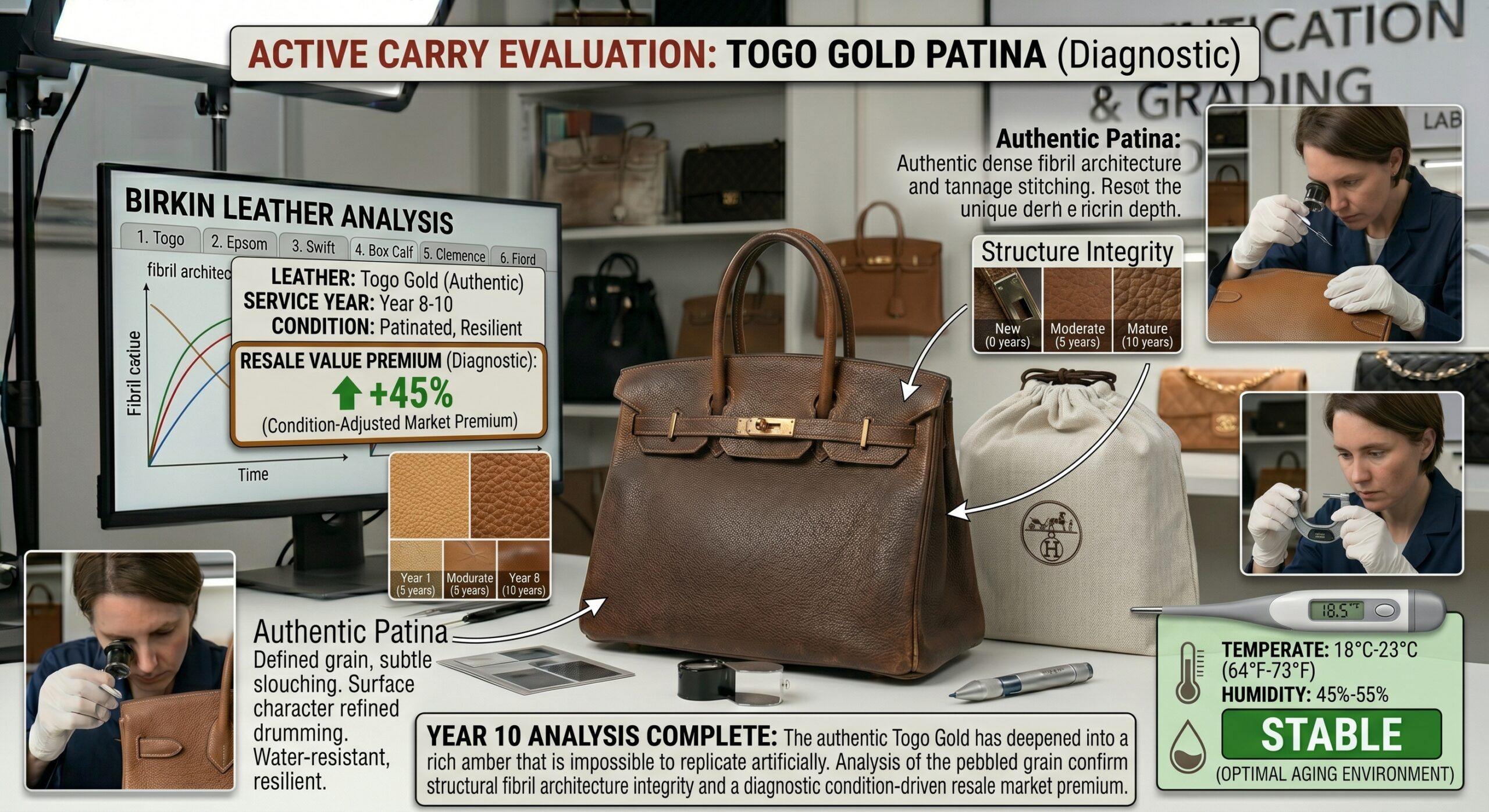
Togo's pebbled grain, dense fibril network, and chrome tannage produce the most balanced ten-year wear profile of any standard Birkin leather. Shape retention is strong under moderate load: the denser flank-section fibrils resist base-panel temper relaxation significantly better than Clemence while avoiding Epsom's corner-chipping vulnerability. Patina development is genuinely beautiful — warm mid-tones deepen into richly complex surfaces that most collectors consider among the finest aged leather available. Surface resilience is excellent: the pebbled grain deflects minor scratches across multiple grain peaks, distributing stress rather than concentrating it, and the resulting mark is less visible than on smooth leathers. Resale presentation at Year 10 is the strongest in the standard range for actively carried pieces.
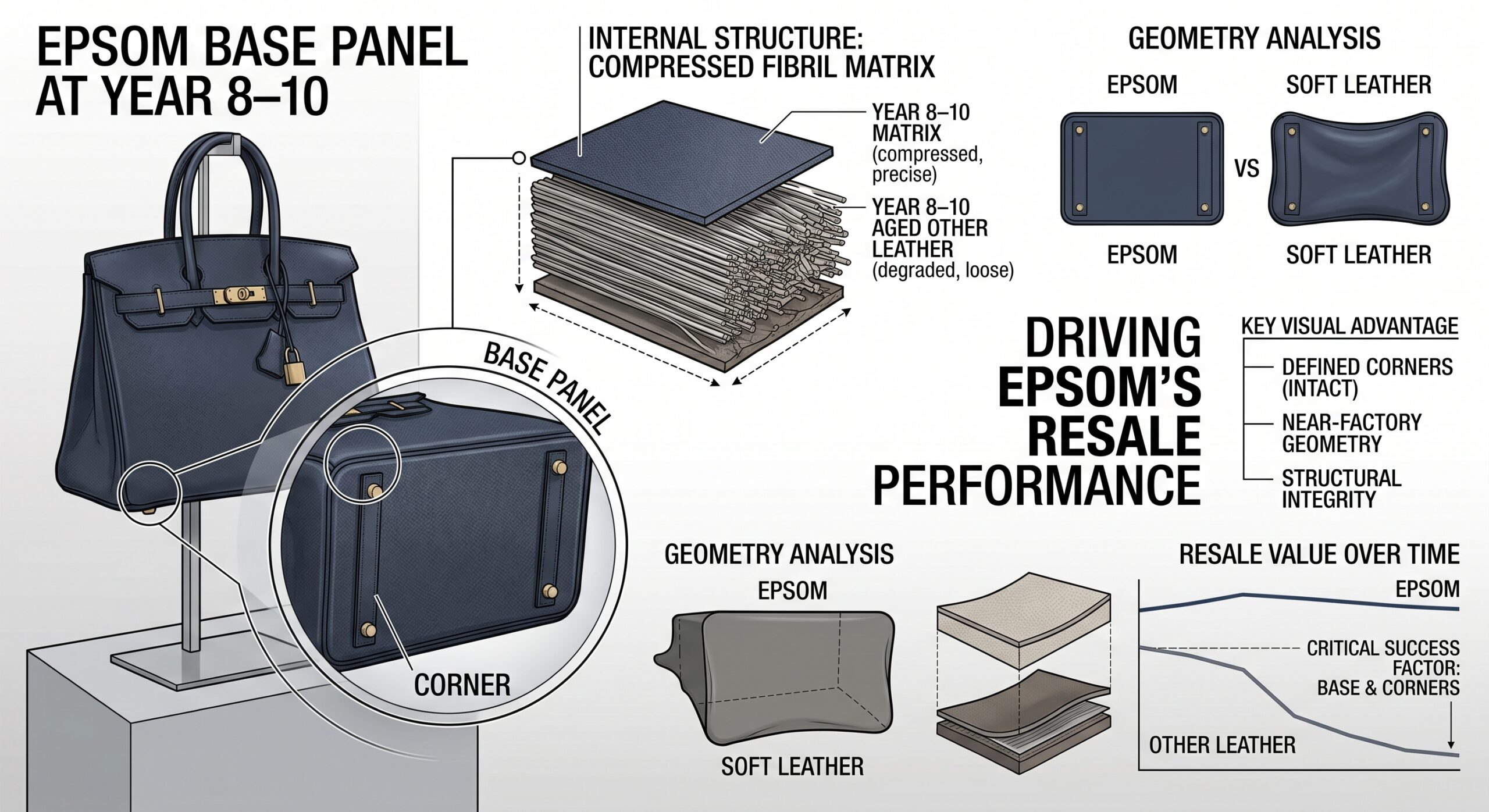
Epsom scores first on shape retention — its compressed fibril matrix resists base-panel temper relaxation more effectively than any other standard Birkin leather. Flat panels at Year 10 on a moderately loaded Epsom Birkin are often indistinguishable from a newer piece in terms of geometry. It falls to second overall because its patina development is minimal (contact sheen only, no tonal deepening) and its corner-chipping vulnerability is the most significant long-term maintenance concern in the ranking. For buyers who prioritise geometric precision above all other criteria, Epsom is the clear leader. For buyers who value patina development, Togo surpasses it.
Barenia Faubourg ranks third on the overall ten-year score — not because it underperforms, but because its care requirements are substantially higher than the leathers above it. In terms of patina quality at Year 10, Barenia is unrivalled: the vegetable-tanned fibril network, pellicule formation, and tannin migration produce a surface of extraordinary warmth and luminosity that no chrome-tanned leather can replicate. Shape retention is good — the supple temper means some base softening occurs under heavy load, but less than Clemence. Surface resilience suffers due to Barenia's moisture sensitivity and the softness of its finish. Owners who invest in consistent conditioning and careful water management will own the most beautiful ten-year Birkin in the ranking.
Swift's mobile fibrils and semi-matte finish produce a leather whose ten-year wear profile is defined by its scratch recovery capability — the defining advantage that places it ahead of Clemence and Box Calf despite its smooth surface. A carried Swift Birkin accumulates minor scratches that most Togo pieces would not show, but 70–80% of those marks respond to fingertip-heat buffing and conditioning, keeping the piece manageable across a decade of active use. Patina development is genuine and refined — a burnished contact-zone sheen in warm colour families. Shape retention is good for a smooth leather. Overall, Swift rewards consistent light care and penalises owners who neglect conditioning or carry carelessly.
Clemence ranks fifth not because it is a poor leather — it is an exceptional one — but because the base-panel temper relaxation that is inherent to its looser belly-section fibril architecture accumulates measurably over ten years of active carry. A heavily loaded Clemence Birkin 35 at Year 10 will show pronounced base softening that reduces its resale presentation relative to an intact Togo or Epsom piece. In the smaller 25 or 30 format under light carry, Clemence performs substantially better. Its patina development is beautiful, its tactile character is unmatched, and owners who are fully informed about its slouch trajectory and manage storage discipline accordingly can own a deeply satisfying ten-year piece.
Box Calf ranks sixth for active carry across a decade — not because the leather is inferior, but because its compressed gloss finish and permanent scratch recording make it the most demanding leather to maintain in pristine condition over ten years of real use. A Box Calf Birkin that has been carried carefully and stored correctly at Year 10 is among the most spectacular pieces in the entire Hermès range. A Box Calf Birkin that has been carried as a daily bag will show permanent scratch accumulation that significantly reduces its presentation and secondary market value. It rewards only the most disciplined owners, and for them, the reward is extraordinary.
Deep Dive: Togo vs Epsom vs Clemence at the Ten-Year Mark
The top three by secondary market volume — Togo, Epsom, and Clemence — warrant a deeper comparison because their ten-year trajectories diverge most clearly along the four scoring criteria, and understanding that divergence in material terms helps buyers choose correctly rather than defaulting to the most popular option.
At Year 10, a Togo Birkin 30 in Gold that has been actively carried three to four times per week with consistent conditioning and reasonable care will present with a surface of genuine material complexity: the pebbled grain slightly compacted at the most-handled zones, the base panel showing minimal geometric change, the overall tone two to three registers deeper than at purchase, and a surface luminosity that photographs with remarkable warmth. The secondary market will grade this piece highly — Togo's aging characteristics are well understood by specialist buyers, and its Year 10 patina is broadly considered desirable rather than damaging.
The Defining Difference Between Togo and Epsom at Year 10
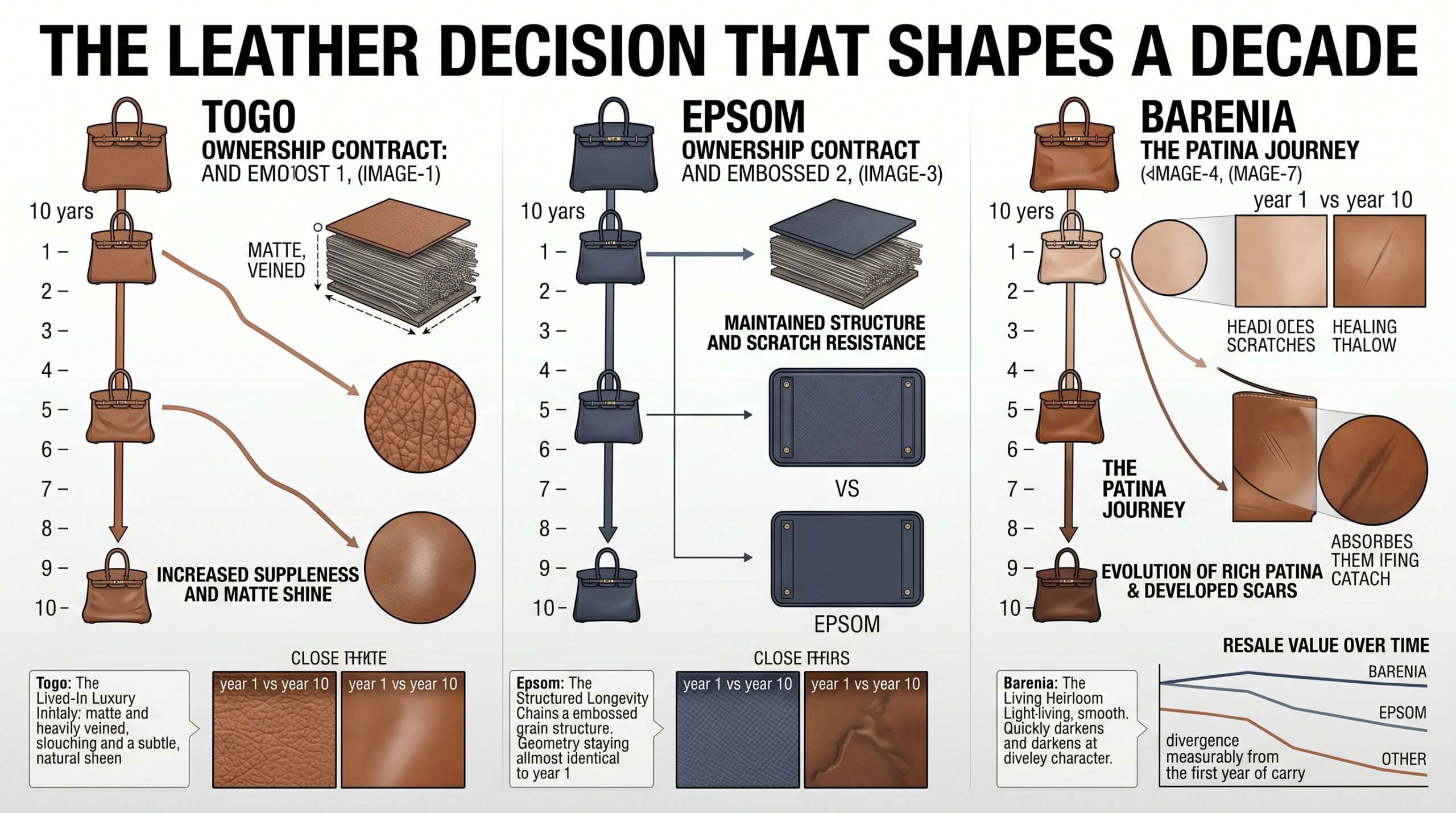
Place a Year 10 Togo Birkin and a Year 10 Epsom Birkin of the same size and colour side by side and the difference is immediately legible: the Togo has changed while the Epsom has largely not. The Togo's surface is richer, warmer, and more complex than at purchase. The Epsom's flat panels are nearly identical to factory condition, with only subtle contact-zone sheen and any corner history revealing its age. Neither outcome is objectively superior — they are the correct, predicted results of their respective material chemistries playing out over time. The buyer who will be satisfied at Year 10 is the one who chose knowing which outcome they wanted.
- Togo Year 10: body panels show 2–3 tonal registers of deepening from original; base geometry intact under moderate carry; handle zones rich amber in warm tones; pebble slightly compacted but structurally sound throughout
- Epsom Year 10: flat body panels near-factory-fresh in appearance; contact-zone sheen at handle attachment and base corners; corner glazing condition the primary variable in resale grading — intact corners present almost as new
- Clemence Year 10 (moderate carry): base panel shows measurable softening; corners rounded rather than sharp; body panel patina similar to Togo in distribution but slightly more diffuse; tactile quality and drape at their peak richness
- Clemence Year 10 (heavy carry in Birkin 35): base substantially softened; side walls showing outward bow; resale grade reduced relative to intact Togo or Epsom equivalent — but owners who love the relaxed aesthetic consider this the intended outcome
- Swift Year 10: surface shows accumulated minor scratch history partially recovered through conditioning; contact-zone burnish well established; shape retention good for a smooth leather; patina genuinely beautiful in warm tones
- Barenia Year 10 (well-managed): pellicule fully established; amber-cognac depth at handle zones; rich, even body panel patina; shape slightly softened from supple temper; one of the most beautiful ten-year leather surfaces available anywhere
Using the Ranking to Make Your Next Birkin Decision
The ranking resolves to a practical framework built on three questions: How much do you carry? How much do you care about patina? And how much care discipline can you realistically maintain?
For daily heavy carry with moderate care discipline — the most common ownership pattern — Togo is the correct answer for virtually every buyer. It tolerates heavy loading better than Clemence, develops better patina than Epsom, recovers from surface marks better than Swift, and requires less intensive care management than Barenia or Box Calf. This is why Togo consistently dominates secondary market volume: it is the leather that performs well across the widest range of ownership realities. Our companion piece Hermes Togo vs Clemence Leather: Which Slouches More Over Time provides the detailed fibril-level comparison for buyers deciding between the top two pebbled leathers.
For buyers who prioritise structural precision over patina and are willing to accept the corner-care responsibility, Epsom is the correct answer. Its decade-long geometric stability is genuinely remarkable — a well-kept Epsom Birkin at Year 10 is one of the few objects in the luxury market that visually resists the evidence of its age, which has specific value both personally and commercially. For the full decade-long Epsom study see our detailed piece on Does Hermès Epsom Leather Soften With Use?
For buyers with the care discipline and the aesthetic appetite for transformation, Barenia Faubourg produces the most extraordinary ten-year surface of any leather in the ranking. The caveat is real: it requires conditioning every six to eight weeks, careful water management at all times, and a tolerance for the dramatic month-by-month change of the first year that uninformed owners frequently mistake for damage. For buyers who understand and embrace that process, nothing else in the Hermès range produces a comparable result. Explore all ten-year leather science in the Leather Science category.
| Leather | Shape Retention | Patina Quality | Surface Resilience | Resale at Year 10 | Overall Rank |
|---|---|---|---|---|---|
| Togo | ★★★★☆ Strong — fibril density resists base softening | ★★★★★ Excellent — rich tonal deepening in warm tones | ★★★★☆ Good — pebbled grain distributes scratch stress | ★★★★★ Strongest in standard range | #1 |
| Epsom | ★★★★★ Best — compressed matrix holds factory geometry | ★★☆☆☆ Limited — contact sheen only, no tonal patina | ★★★★☆ Good — but corner chipping is key vulnerability | ★★★★☆ Strong when corners intact | #2 |
| Barenia Faubourg | ★★★☆☆ Moderate — supple temper allows gradual softening | ★★★★★ Finest in range — pellicule and tannin depth | ★★☆☆☆ Lower — moisture sensitivity and soft finish | ★★★★☆ Strong for well-managed pieces | #3 |
| Swift | ★★★☆☆ Good for smooth leather — better than Clemence | ★★★☆☆ Refined burnished patina — subtle but genuine | ★★★☆☆ Moderate — scratch recovery offsets vulnerability | ★★★☆☆ Good with consistent care history | #4 |
| Clemence | ★★☆☆☆ Base softening measurable under load over 10yr | ★★★★☆ Rich and distributed — beautiful in warm tones | ★★★☆☆ Good — rounder pebble deflects minor abrasion | ★★★☆☆ Reduced if slouch significant | #5 |
| Box Calf | ★★★★☆ Good — box-pressing adds structural stiffness | ★☆☆☆☆ Gloss reduction only — wear rather than patina | ★☆☆☆☆ Lowest — permanent scratch recording | ★★★★★ Highest if pristine; lowest if scratched | #6 |
Togo Wins the Decade — But the Right Leather Is the One Matched to How You Actually Carry
Across the four criteria and six leathers, Togo produces the most consistently excellent ten-year outcome for the widest range of owners and carry patterns. Its fibril density, pebbled grain, and balanced tannage deliver strong shape retention, genuine patina development, practical surface resilience, and the strongest resale presentation of any standard Birkin leather in active daily use. For buyers who cannot or will not make a leather-specific choice, Togo is the correct default.
But the ranking is not a single correct answer — it is a map of trade-offs. Epsom wins for structural precision. Barenia wins for patina beauty. Box Calf wins for visual authority when pristine. Each of these outcomes is available to buyers who choose with full knowledge of what the material science will deliver across a decade. The owners who regret their leather choice are almost always those who chose uninformed — selecting Clemence without understanding its slouch trajectory, or Box Calf without internalising its scratch permanence.
Bottom Line: Togo is the best all-round Birkin leather over ten years of active carry — but match your leather to your carry reality, and every leather in the ranking can produce an extraordinary result for the owner it suits.
Popular Searches
Explore our most searched Birkin leather and long-term wear combinations
The benchmark ten-year Birkin — Gold Togo's warm amber deepening over a decade produces a surface complexity that drives the strongest secondary market premiums in the standard range.
⬆ TrendingEpsom's sealed surface makes Craie more practical over a decade than any open-grain equivalent — the UV and oil resistance keeps the pale tone cleaner across years of carry.
★ Collector FavouriteFor buyers willing to invest in the care discipline, Barenia Faubourg at Year 10 produces the most extraordinary aged leather surface available in a Birkin format — unmatched by any chrome-tanned leather.
◆ Ultra RareThe most visually commanding Birkin specification — but only for buyers who can maintain the pristine surface discipline that Box Calf's permanent scratch sensitivity demands across a decade.
⬆ Rising DemandEtain's blue-grey Togo develops a subtly warmed, sophisticated patina over ten years — the compact 25 format ages beautifully because lower panel mass means more moderate temper change.
🔥 Most SearchedNoir Clemence's deep black minimises visible slouch progression over ten years — making this the most forgiving Clemence specification for buyers who love the supple temper but want presentable decade-end condition.
Frequently Asked Questions
Epsom holds its shape most reliably over a decade under normal carry conditions, followed closely by Togo. Epsom's compressed fibril matrix resists base-panel temper relaxation most effectively of any standard Birkin leather — most pieces retain recognisable factory geometry through five or more years of daily use. Togo's denser fibril network provides strong shape retention without Epsom's corner-chipping vulnerability. Clemence develops the most pronounced slouch of the three under equivalent load conditions. Full detail at the Iconic Collections hub.
Togo develops a richer, more visible patina over ten years. Its open pebbled grain allows gradual oil absorption into the fibril layer, producing genuine tonal deepening at contact zones that becomes increasingly complex over time. In warm mid-tones like Gold and Fauve, a ten-year Togo Birkin has a surface character that many collectors consider among the finest aged leather available. Epsom's compressed fibril surface resists oil absorption, developing only a subtle contact-zone sheen. For buyers who value transformation, Togo is the clear choice. See patina science at How Hermès Togo Leather Changes Color Over Time.
Swift is durable over ten years but requires more active care discipline than Togo or Epsom. Its smooth, semi-matte surface and thinner finish layer make it more susceptible to minor scratches than pebbled leathers, though Swift's mobile fibrils allow partial recovery from surface marks. For daily active carry, Swift is best paired with moderate load discipline and regular light conditioning. Buyers who carry heavily and inconsistently will find Togo or Epsom more forgiving across a decade. For scratch recovery detail see Hermès Swift vs Box Calf: Scratch and Scratch Recovery.
Togo consistently commands the strongest resale values among standard Birkin leathers after ten years of active use. Its pebbled grain masks minor surface wear more effectively than smooth leathers, its patina is broadly considered desirable, and its shape retention under moderate carry keeps the bag presenting cleanly. Epsom also produces strong resale results when corner glazing is intact — the primary risk is corner chipping, which is difficult to restore invisibly. Clemence with visible slouch grades more steeply on the secondary market than intact Togo or Epsom of comparable age. For full condition and value analysis see Does Leather Condition Affect Hermès Resale Price?
