
Hermes Kelly vs Birkin: Which Bag Construction Is More Durable?
A forensic examination of how each bag's architecture, saddle stitching, and leather selection determine long-term structural integrity.
The question of Hermes Kelly vs Birkin construction durability is one the secondary market grapples with in near-silence. Buyers spend years on waitlists, and authentication guides catalogue hardware codes — but few ask which bag's architecture will actually hold up better under the mechanical stress of daily use. The answer lies not in the logo, but in the leather: in tannage, fibril density, stitching geometry, and the way each design distributes load across its panels. After years of forensic examination of both models across multiple leather types and decades of wear, the structural differences are substantial — and consequential for anyone making a decision at this price point.
In this article, you will learn how the Kelly's rigid trapeze frame differs from the Birkin's open-top gusset construction at the leather-science level, which model places more stress on its stitching and base panel, and what these differences mean for the bag you'll still be carrying in 2040.
Construction Fundamentals: What Separates These Two Bags at the Material Level
Before the aesthetic differences matter, the structural ones do. Both the Kelly and Birkin begin from the same material premise: full-grain bovine or exotic leather, hand-cut by a single artisan, assembled using the saddle stitch — two needles drawing waxed linen thread simultaneously through pre-awled holes from opposite sides. This stitching method, unlike machine lock-stitch, does not unravel when one thread breaks. Each stitch locks independently, a critical advantage in bags that will absorb hundreds of openings and closings per year.
The divergence begins with the bag's structural chassis. The Kelly's design, originating in the 1930s as the Haut à Courroies, uses a rigid internal frame — a stiff interlining that gives the trapeze silhouette its fixed geometry. This frame means the leather panels are always held under consistent, low-level tension rather than allowed to flex freely. The tannage selected for Kelly production must therefore accommodate this fixed state: leathers with a firm temper, such as Epsom or Box Calf, translate naturally to the Kelly's format, while softer, more supple leathers like Clemence require more structural compensation from the internal build.
For a full breakdown of how Kelly and Birkin styles have evolved across decades, visit our Hermès Bag Styles Guide, which covers construction history alongside current model details.
"The Kelly doesn't ask its leather to hold the shape. The frame does that work. What the leather must do is survive the stitch tension and corner stress over decades — an entirely different demand."
Kelly: Structural Architecture Under Forensic Scrutiny
The Kelly's most significant durability feature is one rarely discussed: the way its rigid frame isolates the leather from structural load. When a Kelly is carried, the weight transfers through the top handle, down through the side walls and into the base — but because the internal chassis maintains the bag's geometry, the leather panels act more as a surface skin than a load-bearing structure. This has measurable consequences for long-term grain integrity.
In leathers with a vegetable tannage — Barenia Faubourg being the clearest example — the natural pellicule that forms as oils migrate through the fibril structure can develop evenly across a Kelly panel because the leather is not being continuously torqued. Stress cracking, which typically appears at bend points on bags carried with repeated flexion, is substantially less common on Kelly panels than on equivalent Birkin body leather over a ten-year use period.
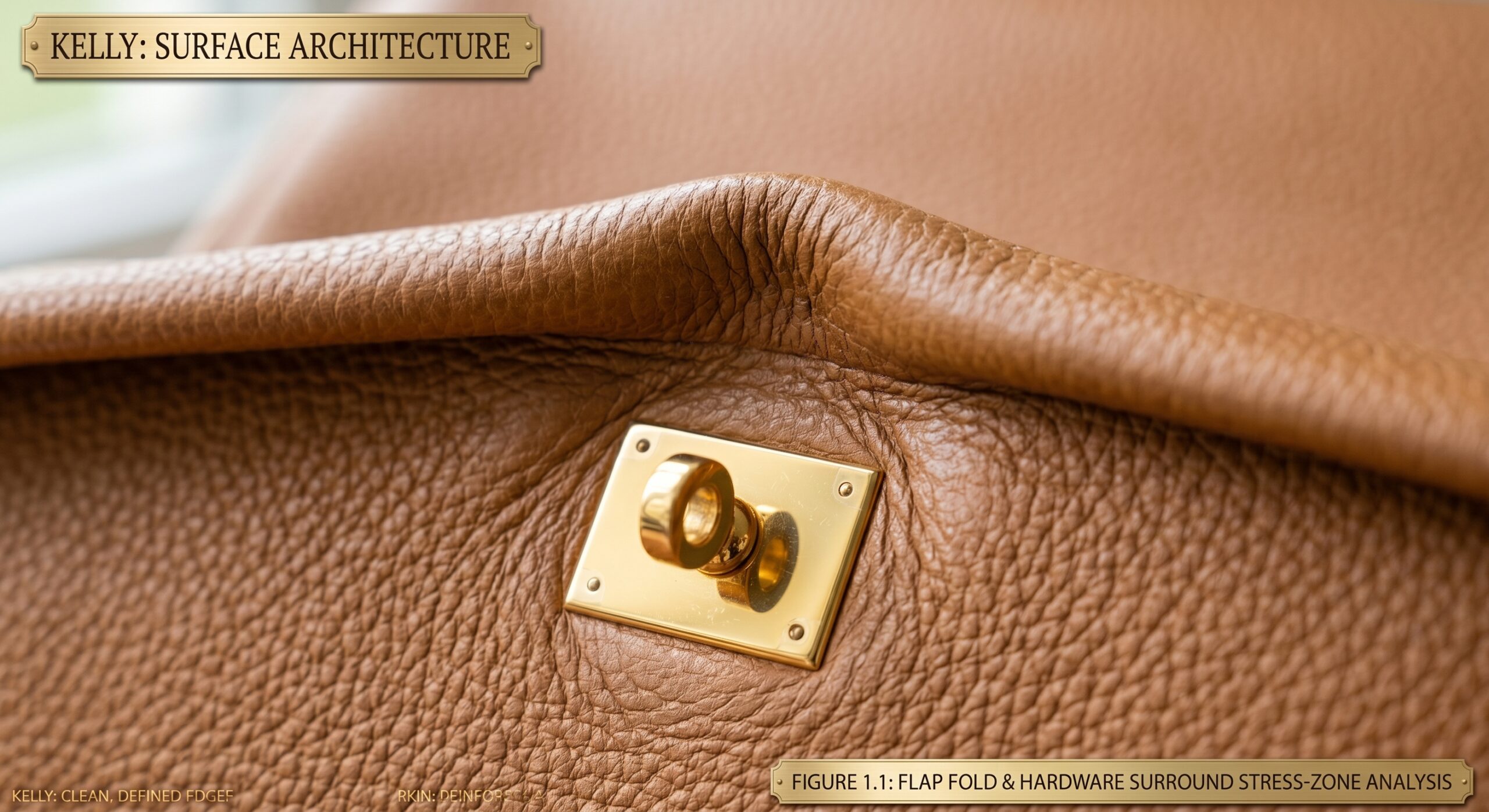
The Kelly's vulnerability is its closure hardware and the leather surrounding it. The turn-lock closure — the iconic Hermès toggle — requires the front flap to be lifted and rotated with each opening. Over time, this creates a specific wear pattern on the flap's leading edge: the finish layer at the fold point degrades first, followed by compression of the surface grain. On a box-pressed leather like Box Calf, this fold wear is particularly visible because the high-gloss finish bruises rather than scuffs — a different failure mode from the matte leathers used on Togo or Clemence versions.
- Internal rigid frame isolates leather panels from structural load — reduces long-term fibril stress compared to the Birkin's freestanding construction
- Saddle-stitched perimeter on sellier Kelly construction places seams on the exterior — more exposed to edge abrasion but more easily inspected for integrity
- Turn-lock flap mechanism creates a predictable wear point at the leading edge of the front panel — most visible in Box Calf and Swift leather versions
- Base corners on the Kelly absorb impact differently depending on construction variant: sellier corners are sharper and more exposed; retourne corners have more leather mass at the fold
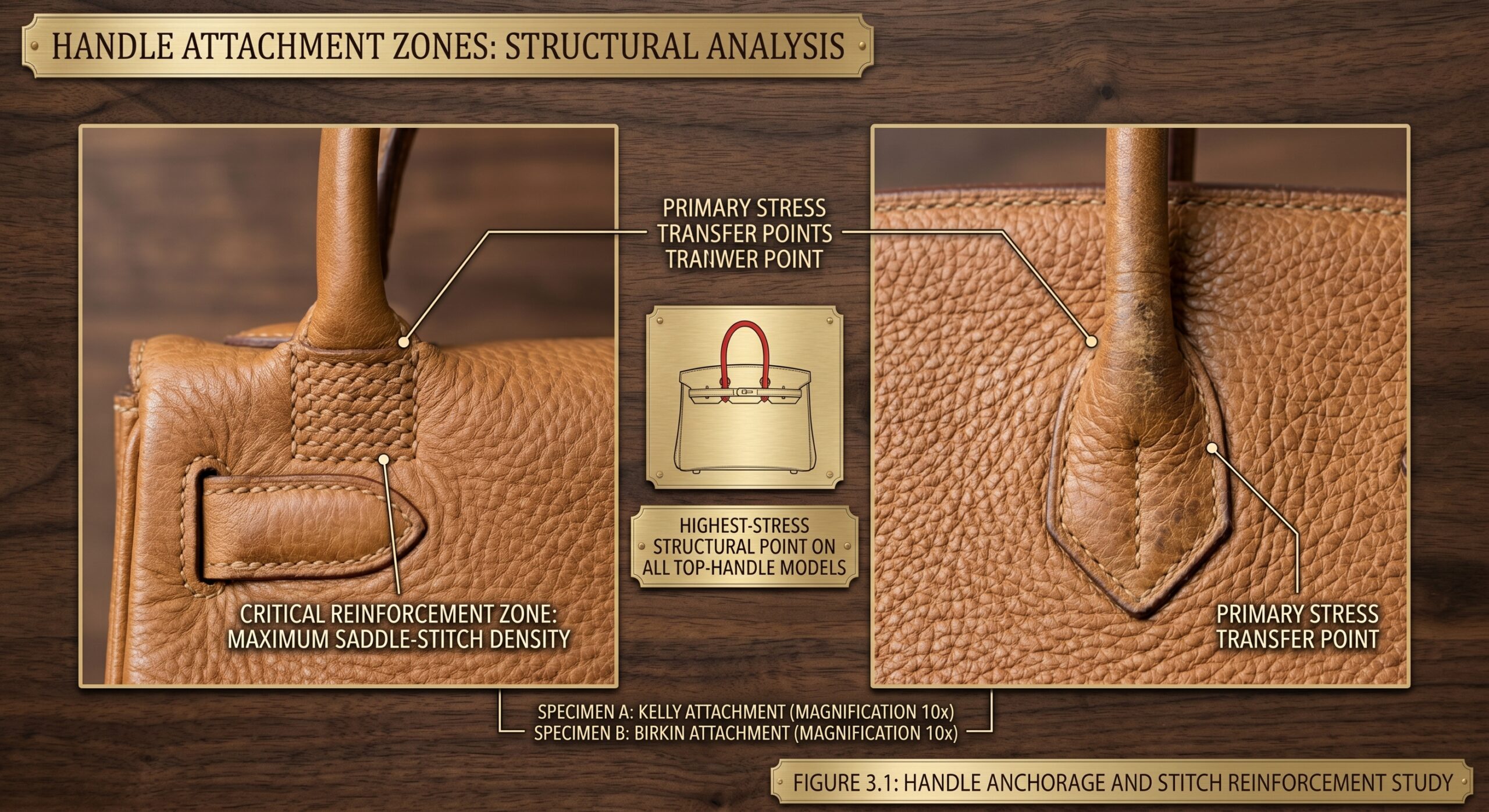
- Handle attachment points — where the top handle meets the side panels — are among the highest-stress zones on any Kelly; saddle stitch density here is visibly higher than on comparable Birkin handle drops
Birkin: Load-Bearing Mechanics and What They Demand of the Leather
The Birkin operates on a structurally different principle. Without a rigid internal chassis, the bag's shape is maintained by the leather's own temper — the stiffness imparted by its specific tannage and finishing process. A Togo Birkin holds its silhouette because Togo's pebbled, drum-tumbled grain creates a naturally resilient panel that resists compression without a supporting frame. A Clemence Birkin, whose leather has a softer temper from its tanning process, will slouch at the base and sides over time — this is not structural failure but a designed outcome of the leather's fibril compliance.
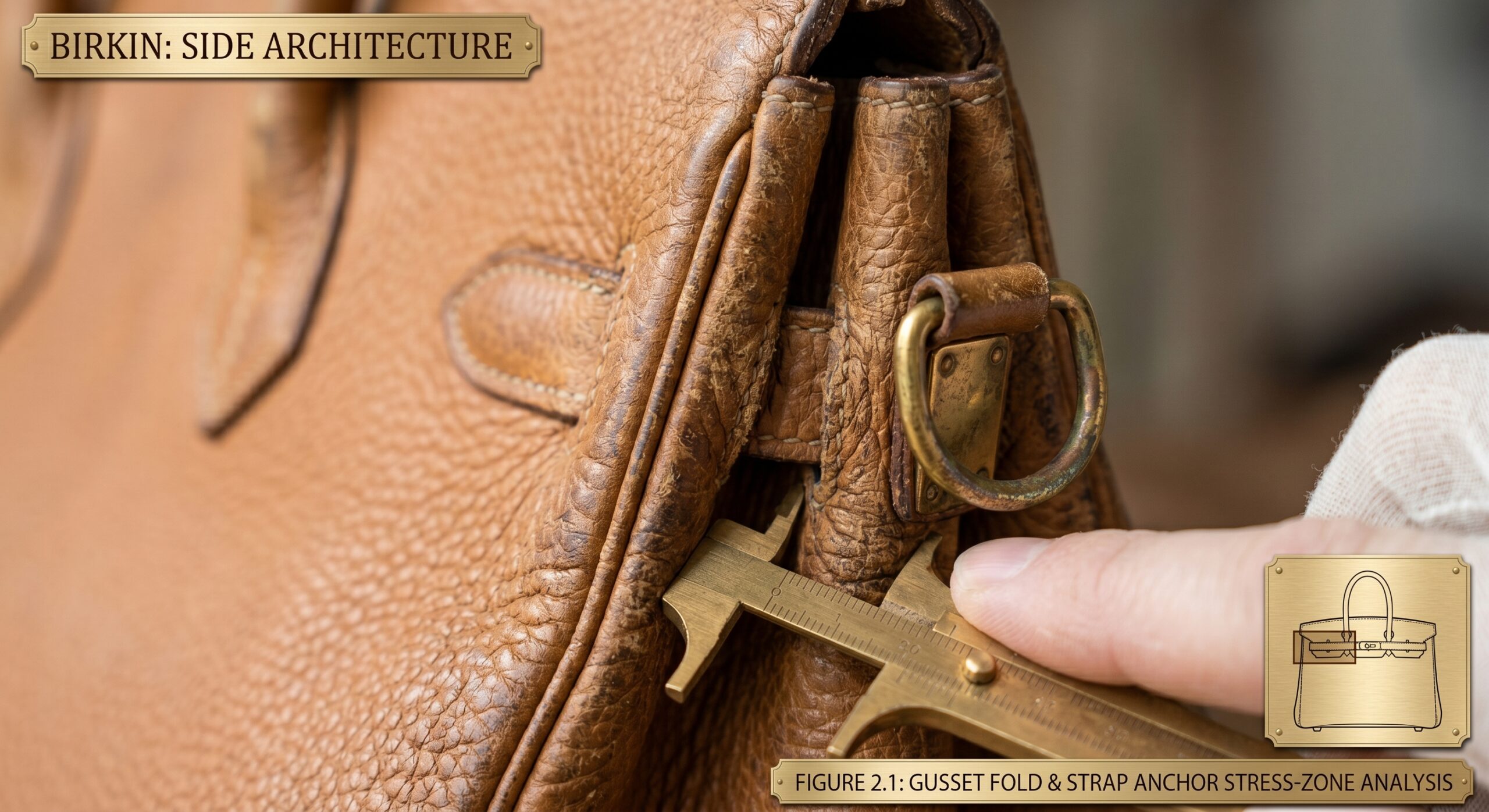
The critical load-bearing zones on a Birkin are the gusset panels — the side walls that expand to accommodate contents — and the base. The gussets flex every time the bag is opened or closed, meaning the leather at the side seam experiences cyclic stress: repeated tension and release. In Togo leather, the pebbled grain surface acts as a micro-expansion zone that accommodates this movement without surface cracking. In Epsom, whose cross-hatch embossed grain is stiffer and less fibril-compliant, gusset flex over years can occasionally produce faint creasing lines along the seam edge.
The Birkin Base: The Truest Test of Leather Quality
Among authentication specialists, the base of a Birkin is one of the first inspection points — not for marks, but for what the leather has done under stress. An authentic piece in Togo will show consistent micro-surface wear across the base panel with no crease lines radiating from the corner studs. Counterfeits typically use split leather or corrected-grain bovine that shows radial cracking from the stud point within two to three years of use, because the fibril structure cannot redistribute the contact load.
The Birkin's top straps — the two closures that fold over the front flap — create a different wear pattern to the Kelly's turn-lock. Because the straps are unbuckled and re-buckled with each opening, the leather at the buckle tongue hole experiences compression stress on every use cycle. In vegetable-tanned leathers used on rare Barenia Birkins, this compression actually polishes and darkens the hole surround over years, producing a desirable patina ring. In chrome-tanned leathers, the hole surround may stretch slightly and lose its crispness more quickly.
For a direct comparison of how specific Birkin leathers perform over a decade, our detailed analysis at Which Hermès Birkin Leather Wears Best Over 10 Years provides long-form data across Togo, Clemence, Epsom, and Swift.
What Construction Means for Long-Term Ownership: The Buyer's Framework
Translating construction analysis into purchasing decisions requires understanding one fundamental point: neither bag fails under normal use. What differs is how each bag ages, and in which zones wear first becomes visible. This has direct implications for care routines, leather selection, and resale value.
For buyers who carry heavily and frequently, the Kelly's rigid chassis provides a meaningful advantage: the leather is mechanically protected from the inside, meaning the surface finish and grain integrity are preserved longer under load. The bag ages from its specific stress points — the flap fold, the handle drops — rather than across its body panels. This produces a more predictable, zone-specific wear pattern that a skilled Hermès artisan can address in spa service.
The Birkin's construction rewards leather selection: choose a temper that suits your use pattern. If you carry the bag filled to capacity daily, Togo's self-supporting grain will maintain the silhouette longer than Clemence. If you prefer a more relaxed, lived-in aesthetic, Clemence's softer fibril compliance will produce a beautiful, characteristic drape over time — not degradation, but transformation. Understanding this distinction is what separates buyers who are disappointed by their Birkin from those who have owned theirs for twenty years and would choose nothing else. Our piece on Sellier vs Retourne Kelly: How Structure Changes Leather Behaviour explores how construction variant further shapes this equation on the Kelly side.
In terms of resale, construction integrity is a direct price input. A Kelly with a clean, structurally sound flap fold and uncompromised stitch lines at the handle attachments will command a higher secondary market price than one where the rigid chassis has been compressed or the corner glazing has lifted. See our full analysis of how leather condition intersects with value in our Hermès Birkin vs Kelly: Construction and Leather Comparison reference article. You can also explore our complete All Topics category for the full range of Hermès leather and construction guides.
| Construction Factor | Hermès Kelly | Hermès Birkin |
|---|---|---|
| Structural chassis | Rigid internal frame — leather acts as outer skin | No rigid chassis — leather's own temper holds shape |
| Primary wear zone | Flap fold and turn-lock surround | Gusset seams and base panel corners |
| Stitching exposure | Sellier: exterior seams more exposed; Retourne: interior seams protected | Side gusset seams exposed to flex stress |
| Leather temper requirement | Accommodates both firm and supple — frame compensates | Firmer temper preferred for shape retention |
| Patina development | Even across body panels; concentrated at flap fold | Concentrated at base, gussets, strap buckle zones |
| Closure stress on leather | Turn-lock fold cycle on front flap leading edge | Buckle tongue compression on top-strap leather |
| Spa repairability | Zone-specific — flap and corner restoration well-documented | Panel-wide — base and gusset restoration more involved |
Kelly Edges Birkin on Structural Longevity — But Leather Choice Determines the Real Outcome
The Kelly's rigid internal chassis provides a mechanical advantage that the Birkin cannot replicate: it isolates the leather from the structural work of maintaining shape, directing wear to predictable, spa-serviceable zones rather than distributing it across the body panels. For buyers who prioritise structural integrity over decades of active use, the Kelly is the more architecturally conservative choice.
That said, the Birkin's open construction is not a weakness — it is a design specification. A Birkin in Togo or Epsom, properly matched to its owner's carrying habits, will accumulate decades of use without structural failure. The difference is that the Birkin requires its leather to do more of the structural work, which means leather selection matters more acutely than it does for the Kelly.
Bottom Line: For maximum structural longevity across all leather types, the Kelly's rigid chassis gives it a measurable edge — but a correctly specified Birkin in the right leather for your use pattern will serve you just as faithfully over a lifetime.
Popular Searches
Explore our most searched Kelly and Birkin construction combinations
The definitive structured Kelly — Epsom's firm temper and the sellier chassis combine for maximum geometric precision and corner durability.
⬆ TrendingThe most replicated combination in the secondary market — Togo's pebbled grain self-supports the open-top silhouette through decades of daily carry.
★ Collector FavouriteBarenia's vegetable tannage builds a living pellicule over years — the retourne construction allows the supple leather to develop its patina without rigid constraint.
◆ Ultra RareBox Calf's box-pressed, high-gloss finish on the Birkin's larger format is exceptionally rare — the combination demands perfect leather handling and commands significant secondary premiums.
⬆ Rising DemandSwift's smooth, tight grain shows the sellier construction's precise stitching lines at their sharpest — a choice that rewards meticulous care with an exceptionally clean silhouette.
🔥 Most SearchedClemence's softer temper produces the Birkin's characteristic relaxed slouch in the compact 25 format — a lived-in aesthetic with the brand's full structural stitching integrity underneath.
Frequently Asked Questions
Both bags are extraordinarily durable, but their construction priorities differ. The Kelly's rigid sellier frame distributes stress mechanically across its trapeze chassis, meaning the leather itself absorbs less daily flexion. The Birkin's open-top design places more ongoing tension on the side gussets and base corners. For hard daily use across a wide range of leather types, the Kelly's structural envelope tends to maintain its geometry longer — though both will outlast virtually any other bag on the market. See our full breakdown at the Hermès Bag Styles Guide.
Yes, significantly. Sellier construction means the seams are stitched on the outside with the leather turned outward, creating a rigid silhouette. This exposes the saddle-stitched edges to direct contact with surfaces, so corner wear on a sellier Kelly is more visible than on a retourne version. However, the rigid temper of the structured panel means the leather's grain face remains largely untorqued — which slows patina development but also reduces stress cracking. Read more about how the two construction variants differ in leather behaviour at Sellier vs Retourne Kelly: How Structure Changes Leather Behaviour.
Togo and Epsom are the two most resilient leathers for the Birkin's open-top format. Togo's pebbled grain — produced by a tumbling finish applied to full-grain hide — absorbs minor impacts without permanent scarring, and its natural temper allows the bag to recover shape after compression. Epsom, with its cross-hatch embossed grain and stiffer temper, resists scratches and maintains structure without relying on fibril suppleness. Our long-term analysis at Which Hermès Birkin Leather Wears Best Over 10 Years covers each leather type in full.
The Birkin sits flat on its base by design — it lacks the Kelly's ability to stand upright on a structured frame or be hung from its closure. The base panel accumulates surface abrasion from repeated placement on surfaces, and the metal stud feet concentrate contact pressure at four specific points. The Kelly, when carried by its top handle or set on its structured base, distributes contact differently. The fibril structure of the base leather on both bags is identical — the difference is purely mechanical load distribution across the panel surface.
