
Hermes Leather Tanning Terms Every Buyer Should Know
The complete forensic vocabulary of Hermès leather science — every tanning, finishing, grain, and construction term defined with precision and annotated with direct buying implications.
Every conversation about Hermès leather tanning terms — whether at the boutique counter, in a secondary market assessment, or in reading a condition report — is only as useful as the vocabulary the buyer brings to it. The terms tannage, temper, grain, fibril, pellicule, and finish are not decoration: they are a precise technical vocabulary that describes the specific material properties of each leather with an accuracy that aesthetic descriptions cannot match. A buyer who can say "I want a firm-tempered, chrome-tanned pebbled leather with minimal patina development" has specified their requirements in material terms that leave nothing ambiguous. A buyer who says "I want something that won't slouch and doesn't need much looking after" has said the same thing — but in language that an associate may or may not translate correctly.
This glossary covers every tanning and leather science term that appears in Hermès leather discussions, each defined precisely and annotated with its specific buying implication. The terms are grouped by domain — tannage, structure, and behaviour — to show how they connect rather than how they stand alone.
Why Leather Vocabulary Is a Buying Tool, Not Academic Trivia
The vocabulary of leather science exists because the properties of leather are genuinely complex and genuinely variable — and because imprecise language about those properties leads to imprecise decisions. When a secondary market listing describes a piece as "showing natural wear consistent with age," that description is consistent with both a beautifully patinated Togo Gold and a water-damaged Barenia with permanent tide marks. Only the vocabulary of material science distinguishes between the two: the first is a fibril-level tonal deepening driven by oil absorption and UV oxidation; the second is a permanent tannin concentration event at a drying boundary. Same words in the listing; completely different material reality; completely different buying decision.
The terms in this glossary are not optional additions to a buyer's education — they are the foundational layer of informed Hermès buying at any level. They appear in every detailed leather assessment, every authentication report, and every serious boutique conversation about material specification. Mastering them converts what might otherwise be a language barrier into a competitive advantage. For the complete leather science reference that these terms unlock, the Hermès Terminology Glossary hub provides the full vocabulary context alongside construction and hardware terminology.
"Leather vocabulary is not about impressing associates. It is about precision — the ability to specify what you want and assess what you receive in language that leaves nothing to interpretation."
Tannage Terms: The Foundation Layer of Every Leather Property
Tannage is the chemical process by which a raw animal hide is converted into stable, usable leather. It is the single most consequential variable in determining the long-term behaviour of any Hermès leather. Every other property — patina trajectory, moisture sensitivity, temper, care requirements — flows from the tannage choice.
The chemical process used to stabilise an animal hide's collagen structure, converting it from a perishable material into durable leather. The two principal tannage methods relevant to Hermès production are vegetable tannage and chrome tannage. Tannage determines the leather's reactivity to moisture, UV light, and skin oils — and therefore its patina behaviour, care requirements, and long-term surface character. It is the most fundamental property description of any Hermès leather.
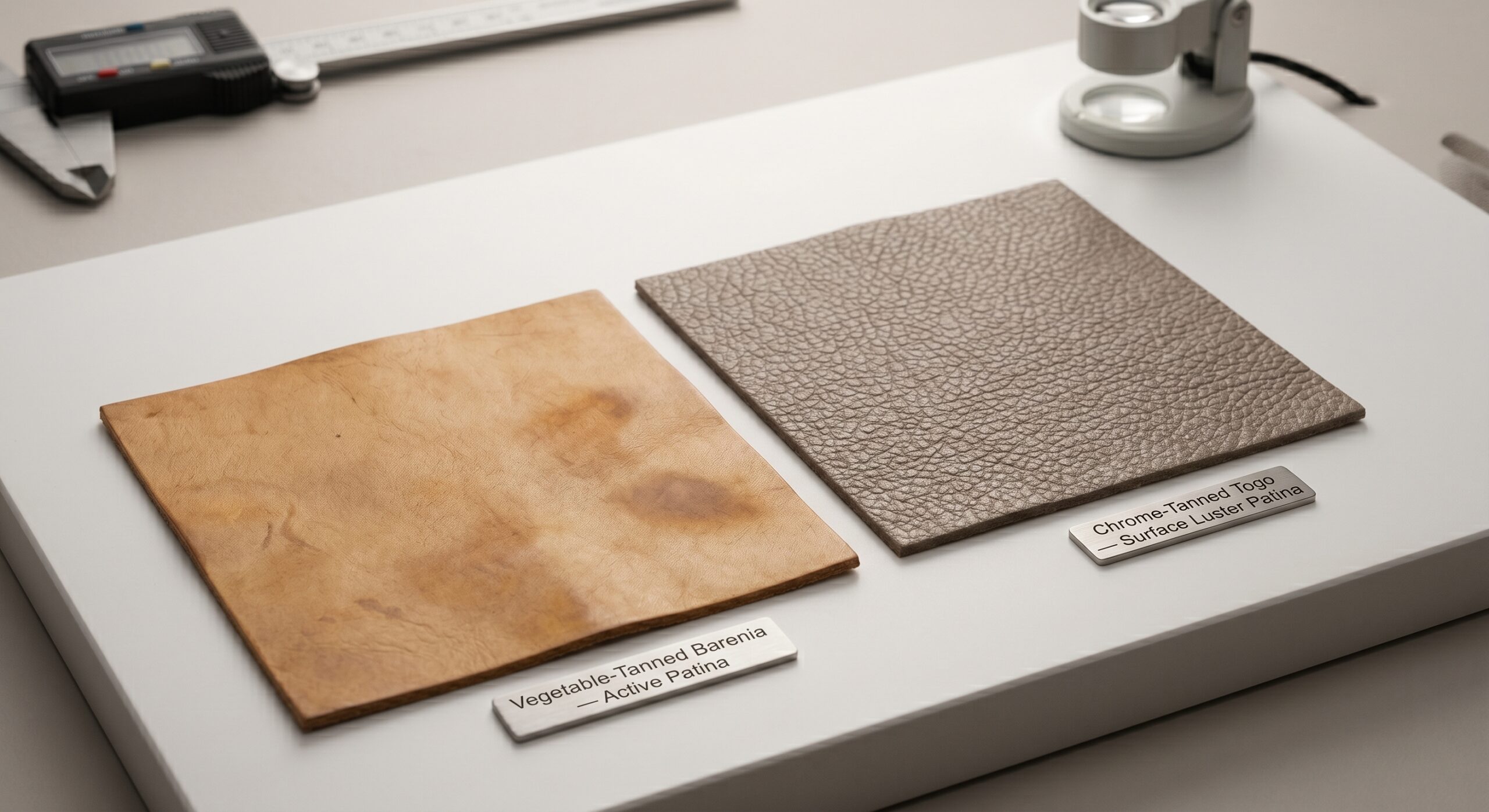
A tannage method using plant-derived tannin molecules — polyphenolic compounds from oak bark, quebracho, mimosa — to cross-link and stabilise the hide's collagen fibril proteins. Vegetable tannins remain chemically active within the fibril network after tanning, making the leather hygroscopic (moisture-attracting) and highly reactive to UV light. This reactivity drives the dramatic patina development of vegetable-tanned leathers — most notably Barenia Faubourg in the current Hermès range. Vegetable tannage takes weeks; chrome tannage takes hours. The slower process produces deeper, more organic chemistry in the fibril structure.
A tannage method using chromium salt compounds that form stable, irreversible chemical cross-links with the collagen fibril proteins. Chrome tannage is the method used for Togo, Clemence, Epsom, Swift, Box Calf, and the chevre leathers. The chromium cross-links are inert after tanning — they do not react with moisture or UV light in the way vegetable tannins do. Chrome-tanned leathers are significantly more moisture-resistant, develop more restrained patina, and require less intensive care than vegetable-tanned alternatives. The trade-off is that the dramatic, fibril-deep patina of vegetable-tanned leather is simply not achievable with chrome tannage.
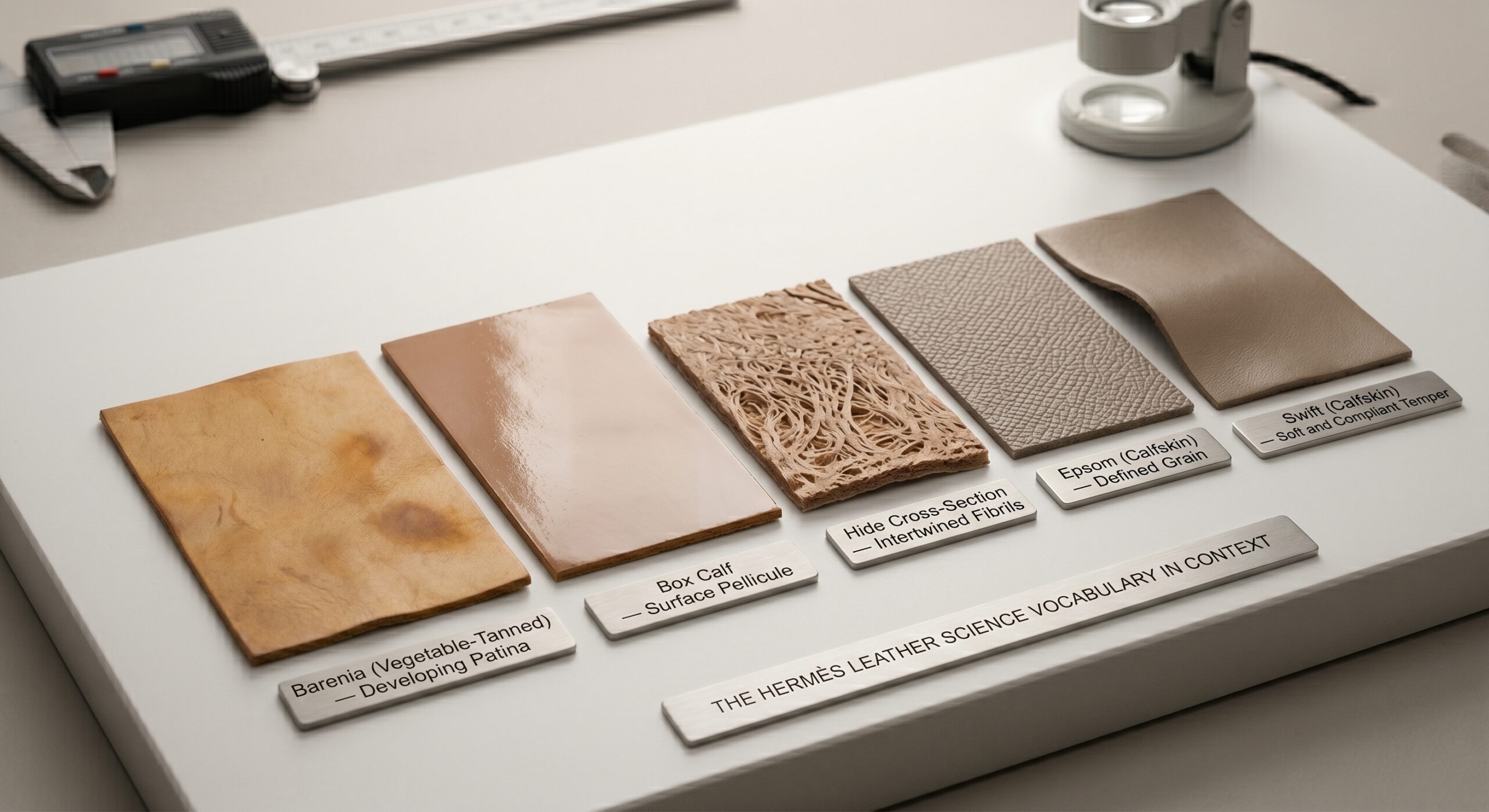
A post-tanning finishing process in which a leather hide is passed through high-pressure rollers that compress the grain surface to a high gloss — the defining process of Box Calf leather. The box-pressing compresses the upper fibril layer into a rigid, high-density matrix that produces the mirror-bright surface characteristic of Box Calf. The same compression principle — applied with an engraved rather than smooth roller — is used to create Epsom's cross-hatch embossed grain. Both processes produce their characteristic surfaces by exploiting the fibril compression response to mechanical pressure.
Structure and Surface Terms: The Architecture of Hermès Leather
The individual collagen fibre bundles that make up the three-dimensional matrix of a leather hide. Fibrils are the fundamental structural unit of leather — their density, orientation, and degree of cross-linking (set by tannage) determine virtually every property of the finished leather: temper, weight, scratch resistance, oil absorption, and patina behaviour. Tighter, more densely packed fibrils (as in Chevre Mysore or compressed Epsom) produce stiffer, lighter, more scratch-resistant leather. Looser, more widely spaced fibrils (as in Clemence's belly-section hide) produce softer, heavier leather with greater oil absorption capacity.
The surface pattern of a leather hide — whether natural (produced by the animal's own skin texture) or processed (produced by embossing, drum-tumbling, or other finishing techniques). Natural grain reflects the fibril tip pattern at the hide's outer surface and varies by animal species, age, and body section. Processed grain is mechanically imposed onto the natural surface: drum-tumbling creates Togo's and Clemence's pebbled grain; embossing rollers create Epsom's cross-hatch. Grain type determines scratch visibility, patina oil-absorption pathways, surface reflectivity, and the visual character of the finished leather.
The stiffness or suppleness of a finished leather — the degree to which it resists deformation under applied force. Temper is set primarily by tannage and finishing, and it determines how a bag holds its shape under load over years of carry. Epsom has the firmest temper of standard Hermès leathers (box-pressing + chrome tannage). Clemence has the most supple temper (belly-section hide + chrome tannage without embossing). Togo occupies a middle position — self-supporting under moderate load but supple in hand. Vegetable-tanned Barenia has a supple temper that softens slightly over time as the fibril network responds to use.
The surface treatment applied to a leather after tanning — including any topcoat, pigment layer, glazing process, or protective treatment that sits above the natural grain surface. Finish type determines the leather's sheen level (matte, semi-matte, glazed), its scratch visibility, its patina capacity, and its moisture resistance. Epsom's compressed cross-hatch grain is a finish in itself — the embossing process is the final surface treatment. Swift has a thin semi-matte topcoat finish. Box Calf's mirror gloss is achieved through the box-pressing process rather than an applied coating. Barenia's natural finish is minimal — the leather's surface is largely uncoated, which is why it is so reactive to oils and UV.
How the Core Terms Connect in a Single Leather Description
A complete material description of Togo leather using the vocabulary in this glossary would read: "Chrome-tanned full-grain bovine leather from the upper flank, with a drum-tumbled pebbled grain and a semi-matte finish. The tighter-than-Clemence fibril density produces a firm-to-supple temper that self-supports the Birkin's geometry under moderate load. Chrome tannage means no vegetable-tannin patina — colour deepening at contact zones is driven by surface oil absorption and UV oxidation rather than tannin migration. No pellicule forms; surface evolution is comparatively restrained. Moisture resistance is moderate; conditioning every 3–4 months is appropriate." That description — made possible entirely by the vocabulary in this article — conveys more buying-relevant information than a paragraph of aesthetic description.
Behaviour and Ageing Terms: How Leather Changes Over Time
The surface change that develops in leather over time through use, skin oil absorption, UV exposure, and — in vegetable-tanned leathers — tannin migration and oxidation. Patina is a quality signal, not a damage indicator: it represents the leather's authentic response to use and indicates genuine ownership history. In chrome-tanned leathers, patina manifests primarily as tonal deepening at contact zones and surface sheen development through friction. In vegetable-tanned leathers, patina is a deeper, fibril-level transformation driven by tannin chemistry. The desirability of patina varies by leather type: broadly considered positive in Togo and Barenia, neutral in Epsom, and read as wear rather than character in Box Calf.
The natural surface film that forms on vegetable-tanned leathers as tannin molecules migrate toward the grain surface through the fibril network and oxidise in contact with air and light. Exclusive to vegetable-tanned leathers — most notably Barenia Faubourg in the current Hermès range. The pellicule is not a product applied to the surface; it is generated by the leather's own chemistry. It is responsible for the characteristic depth and luminosity of aged Barenia — the sense that the leather is lit from within. It develops most visibly in the first twelve to eighteen months of active carry and continues building throughout the leather's life. Chrome-tanned leathers do not form a pellicule.
Describes leather with a soft, flexible temper that moves with the hand and body rather than resisting it. Suppleness is produced by a combination of looser fibril architecture (as in Clemence's belly-section origin) and the absence of rigid embossing processes (as in Togo versus Epsom). Supple leathers develop a more tactilely warm, organic character over time as the fibril network responds to carry and conditioning. The trade-off for suppleness is generally reduced shape retention under sustained load — supple leathers require more active storage discipline to maintain their factory geometry over years of carry.
The two-needle hand-stitching technique used on all authentic Hermès bags, in which a single length of waxed linen thread is drawn simultaneously through each pre-awled hole from both sides by two separate needles. The threads cross inside each hole, creating a stitch that is structurally independent — one broken stitch does not cause adjacent stitches to unravel, unlike machine lock-stitch. Saddle stitch runs at a consistent ~45-degree diagonal to the seam line on authentic pieces, at 4–5 stitches per centimetre on body seams and higher density at structural stress zones. It is a definitive authentication marker and the structural foundation of Hermès bag durability.
The impressed letter, symbol, or combination identifying the individual craftsperson who assembled the bag — present on every authentic Hermès piece since 1984. Applied using a heated metal die pressed into the interior leather surface. Distinguished from the date letter stamp (production year indicator) and the foil stamp ("HERMÈS PARIS MADE IN FRANCE" exterior text). The blind stamp's location, impression depth, and fibril response at the impression boundary are all forensic authentication markers. Its location has shifted in 2026 production pieces relative to prior years — a current authentication advantage for secondary market buyers.
Putting the Vocabulary to Work: From Glossary to Buying Decision
Understanding these terms individually is necessary but not sufficient for buying advantage — the advantage comes from using them together to build a complete material specification for the bag you want. A useful exercise before any Hermès purchase, whether at the boutique or the secondary market, is to write out your specification in material vocabulary terms and check whether each component of the specification is internally consistent.
For example: "I want a Birkin 30 in a supple, patina-developing leather that will age gracefully under heavy daily carry." This specification, unpacked with vocabulary, reveals a tension: supple-tempered leathers (Clemence, Barenia) are the most patina-developing but perform least well under heavy daily carry in terms of shape retention. The patina goal and the shape retention goal point toward different leathers. Translating "supple and patina-developing under heavy carry" into material vocabulary reveals the tension immediately — and the resolution is either to choose Togo (firm temper, genuine chrome-tannage patina, best shape retention under heavy carry) or to accept that patina richness requires either Barenia (vegetable-tanned, more demanding care) or a lighter carry with Clemence.
This is what the vocabulary does for the buyer: it converts a vague preference into a set of material requirements, identifies the tensions within those requirements, and points toward the specification that best resolves them. For a practical demonstration of how these terms combine in the boutique context, our piece on How Leather Knowledge Gives Hermès Buyers a Boutique Advantage walks through specific conversations where vocabulary produces measurable outcomes. Browse the complete leather science vocabulary in practice across all articles at Leather Science.
| Term | Definition in Brief | Buying Implication |
|---|---|---|
| Tannage | Chemical process converting hide to leather — vegetable or chrome | Single most important leather property; determines patina, moisture sensitivity, care needs |
| Vegetable tannage | Plant-derived tannins; reactive chemistry; drives dramatic patina and pellicule formation | Choose for transformation; accept higher care demands and moisture sensitivity (Barenia) |
| Chrome tannage | Chromium salts; stable cross-links; more moisture-resistant, more restrained patina | Choose for stability and lower maintenance (Togo, Epsom, Clemence, Swift, chevre) |
| Fibril | Individual collagen fibre bundles making up the hide structure | Denser fibrils = firmer, lighter, more scratch-resistant leather (Epsom, Mysore) |
| Grain | Surface pattern of the hide — natural or processed | Pebbled grain hides minor wear; embossed grain shows chips; smooth grain shows every scratch |
| Temper | Stiffness or suppleness of the finished leather | Firm temper = shape retention; supple temper = tactile warmth but requires storage discipline |
| Finish | Surface treatment applied after tanning — topcoat, glazing, or embossing | Thick finish = more protection but permanent when damaged; thin finish = patina development |
| Patina | Surface change through use, oils, and UV — a quality signal when even and desirable | Even patina adds secondary value in Togo/Barenia; uneven patina reduces value |
| Pellicule | Natural surface film formed by tannin migration in vegetable-tanned leather only | Exclusive to Barenia; develops over 12–18 months; the core of Barenia's value proposition |
| Supple | Soft, flexible temper that moves with the hand | Desirable tactile quality but requires storage discipline to maintain shape over years |
| Saddle stitch | Two-needle hand-stitching using waxed linen thread — ~45° diagonal, 4–5 stitches/cm | Primary authentication marker; check angle, density at handle drops, and reverse-face pattern |
| Blind stamp | Heated-die craftsperson identifier impressed into interior leather | Authentication marker; 2026 position shifted toward centre on both Birkin and Kelly |
These Twelve Terms Are the Minimum Vocabulary for Informed Hermès Leather Buying — Master Them Once, Use Them Forever
The twelve terms in this glossary are not twelve isolated facts — they are a connected vocabulary that describes a single coherent material system. Tannage determines fibril reactivity; fibril architecture determines temper and grain character; grain and finish determine scratch behaviour and patina capacity; patina chemistry in vegetable-tanned leather produces the pellicule that defines aged Barenia's value. Each term connects to the others in a web of material causation that, once understood, makes every leather comparison legible in precise, unambiguous terms.
The buyers who make the best Hermès leather decisions are not the ones who have handled the most pieces or spent the most time on waitlists. They are the ones who understand what they are asking for — in the boutique, on the secondary market, and in the storage room at home — with enough material precision to specify, assess, and care for their leather correctly at every stage of ownership. This vocabulary is the starting point for all of that. Use it.
Bottom Line: Master these twelve terms — tannage, vegetable tannage, chrome tannage, fibril, grain, temper, finish, patina, pellicule, supple, saddle stitch, blind stamp — and every Hermès leather decision you make will be grounded in material science rather than aesthetic guesswork.
Popular Searches
Explore our most searched Hermès leather vocabulary and specification combinations
The foundational vocabulary question — understanding vegetable tannage versus chrome tannage unlocks the explanation for virtually every behavioural difference between Hermès leather types.
⬆ TrendingThe pellicule is the most misunderstood term in Barenia ownership — buyers who understand it as tannin migration chemistry rather than surface product gain an entirely different relationship with their leather's development.
★ Collector FavouriteThe fibril density and temper pairing explains the entire Togo vs Clemence behavioural difference — buyers who understand these two terms never need to guess which leather will hold its shape under their carry pattern.
◆ Ultra RareSaddle stitch is both a construction term and an authentication marker — buyers who understand its two-needle mechanics can perform the reverse-face test that identifies the majority of counterfeits without any specialist equipment.
⬆ Rising DemandThe grain vocabulary question that determines scratch visibility and patina capacity simultaneously — buyers who can specify "pebbled natural grain" versus "embossed cross-hatch" have made a complete material specification without referencing a leather name.
🔥 Most SearchedThe two most commonly confused Hermès interior marks — the blind stamp identifies the craftsperson, the date letter identifies the production year, and they appear in different locations on both the Birkin and the Kelly.
Frequently Asked Questions
Vegetable tannage uses plant-derived tannin molecules to stabilise the hide's collagen fibril structure. These tannins remain chemically active within the leather, making it hygroscopic and reactive to UV light — which drives the dramatic patina development of Barenia Faubourg. Chrome tannage uses chromium salts that form stable, irreversible cross-links with the fibril proteins. Chrome-tanned leathers — Togo, Clemence, Epsom, Swift — are more moisture-resistant, develop more restrained patina, and require less intensive care. The tannage choice is the single most consequential material decision in Hermès leather production. For the full patina comparison see How Hermès Togo Leather Changes Color Over Time.
Temper refers to the stiffness or suppleness of a leather — the degree to which it resists deformation under applied force. It is determined primarily by the tannage process and the finishing steps applied after tanning. Epsom has the firmest temper of the standard Hermès leathers due to its box-pressing embossing; Clemence has the most supple temper due to its belly-section hide origin; Togo sits between the two. Temper is the property most directly linked to how a bag holds its shape over years of carry. For the full supple vs firm comparison see Togo vs Clemence: Which Slouches More.
The pellicule is the natural surface film that forms on vegetable-tanned leathers as tannin molecules migrate toward the grain surface and oxidise in contact with air and light. On Barenia Faubourg, this produces a thin, translucent film responsible for the depth and luminosity of aged Barenia — the sense the leather is lit from within. The pellicule is not a product applied to the surface; it is generated by the leather's own chemistry. It develops most visibly in the first twelve to eighteen months and continues building throughout the leather's life. For the month-by-month guide see Barenia Faubourg Patina Progression.
Grain refers to the surface pattern of a leather hide — natural (produced by the animal's own skin texture) or processed (embossed, drum-tumbled). Togo's pebbled grain is natural, produced by drum-tumbling. Epsom's cross-hatch grain is embossed — mechanically pressed. Swift and Box Calf have smooth fine natural grain. Chevre leathers have tight cross-hatched natural grain specific to their goat breed origin. Grain type determines scratch visibility, patina oil-absorption pathways, surface reflectivity, and visual character. Understanding grain type is foundational to understanding every other leather property. Browse all leather vocabulary at Leather Science.
