

Hermes Veau Volupto Leather: Characteristics, Care & Availability
A forensic examination of Hermès's rarest velvet-nap calfskin — the buffing process that creates its surface, the fibril architecture that makes it uniquely vulnerable, and the care protocol that preserves it.
Veau Volupto is among the most distinctive and most care-demanding leathers in the current Hermès range — a velvet-nap calfskin produced through a buffing process that raises the fibril tips at the grain surface into a consistent directional nap, creating a surface that reads with extraordinary visual depth and tactile warmth. It occupies a unique position in the Hermès leather hierarchy: technically a full-grain leather at its structural core — not suede, which is produced from the split side of the hide — yet with a surface character that requires an entirely different care approach from every other bag in the range. Understanding what Veau Volupto is at the material level, how it differs from both smooth and pebbled Hermès leathers, and what its nap surface demands from its owner is essential knowledge before any acquisition decision — because uninformed ownership of this leather produces costly, irreversible damage with remarkable speed.
This article covers the full material profile: the buffing process that creates the nap, the fibril architecture that makes it uniquely vulnerable, the three primary damage mechanisms to manage, and the precise care protocol that allows Veau Volupto to be owned with confidence rather than anxiety.

What Veau Volupto Is and How the Buffing Process Creates Its Defining Surface
Veau Volupto — literally "voluptuous calf" in French — is a chrome-tanned fine-grained calfskin that undergoes a specific surface buffing process after tanning and before finishing. Understanding this production sequence is essential to understanding why the leather behaves as it does.
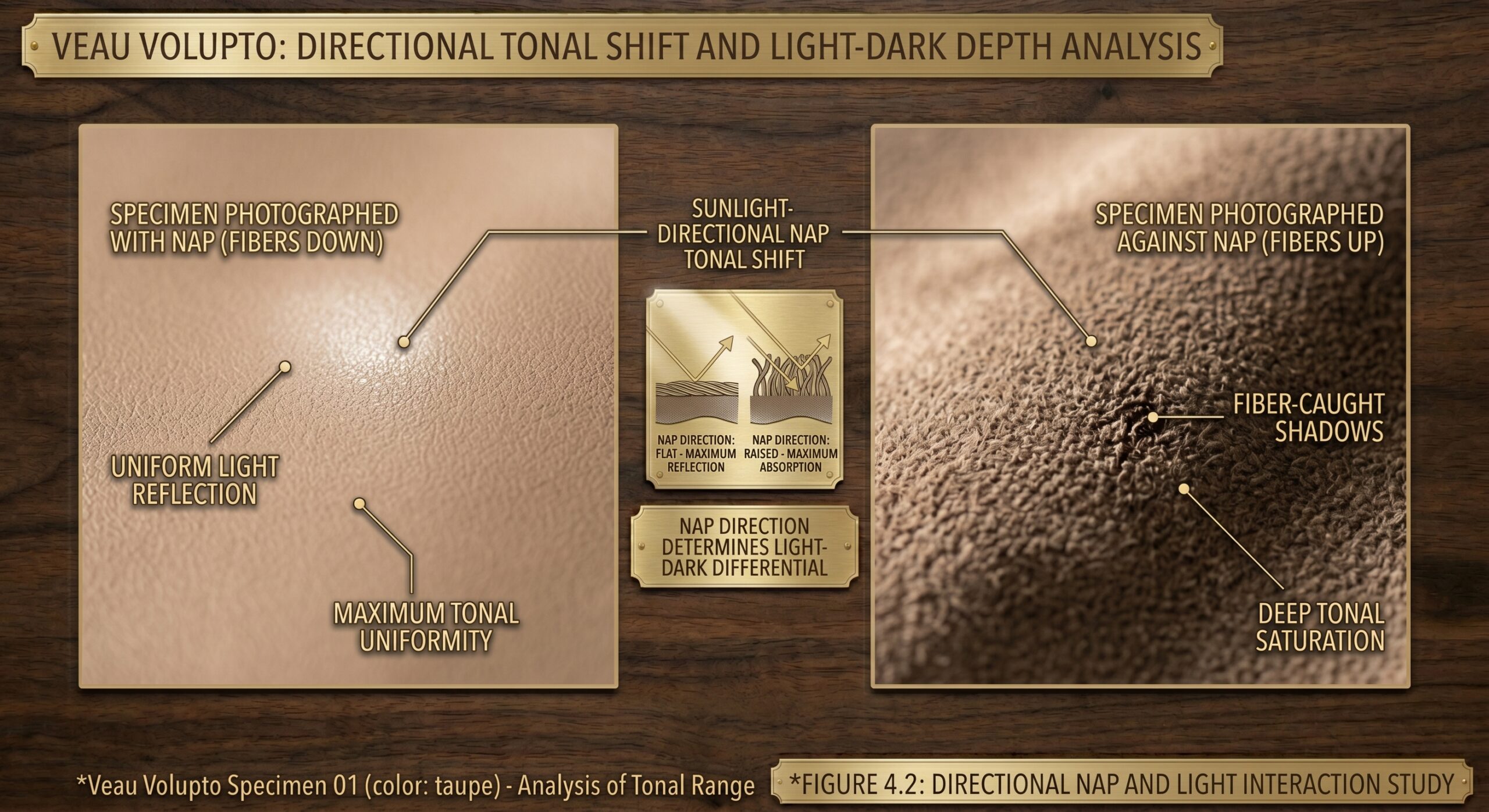
A standard smooth Hermès leather like Swift undergoes a series of finishing operations after chrome tanning: the grain surface is lightly corrected or preserved, a pigment and topcoat layer is applied, and the finished panel emerges with a smooth, semi-matte surface that seals the fibril tips beneath a thin protective finish. Veau Volupto's production sequence diverges at the finishing stage: rather than applying a protective topcoat, the hide's grain surface is buffed using fine abrasive rollers that break the fibril tips at the grain surface and raise them into a consistent, directional nap. The buffing direction determines the nap direction — the angle at which the raised fibril tips lie on the surface — and this directionality is what creates the characteristic light-shifting quality of the finished leather. Viewed in one direction, the nap appears lighter; viewed against the nap direction, it appears darker. This directional tonal variation gives Veau Volupto its characteristic visual depth that smooth and pebbled leathers cannot replicate.
Crucially, the buffing process does not penetrate deeply into the hide: it affects only the uppermost fibril tips at the grain surface. Beneath the nap layer, Veau Volupto retains the full-grain fibril structure of the original calfskin — which is why it has far greater structural integrity than suede (which is produced from the split layer of the hide, with no grain-face fibril density). The nap is the surface expression of the fibril tips raised by buffing; the leather's structural properties are determined by the full-grain body beneath. For the full context of where Veau Volupto sits in the Hermès leather range, the Leathers & Materials Guide covers all major skins from standard bovine through to exotic.
"Veau Volupto is not suede. It has the soul of a full-grain leather and the skin of a velvet. That distinction matters enormously for how it ages, how it is cared for, and what it rewards in its owner."
Surface Character, Fibril Architecture, and How Veau Volupto Displays Colour
Veau Volupto's most distinctive visual property — the directional tonal shift that makes it so immediately recognisable — is a direct consequence of the raised nap's interaction with light. The buffed fibril tips on the nap surface are not oriented perpendicular to the grain face; they lie at an angle determined by the buffing direction, typically around 30–45 degrees. When light strikes the surface in the nap direction (following the lie of the fibril tips), the tips reflect light back toward the viewer and the surface appears lighter. When light strikes against the nap direction, the tips shadow their own bases and the surface appears noticeably darker. This same property is observable in velvet fabric, in brushed suede, and in animal fur — all nap-surface materials exhibit the same directional tonal shift for the same physical reason.
The colour display of Veau Volupto is therefore fundamentally different from smooth or pebbled leathers. Rather than displaying a single, consistent surface colour that varies only with light angle (as Togo or Epsom does), Veau Volupto displays a colour range — lighter in the nap direction, darker against it — that gives the leather an apparent depth and richness that photographs cannot fully capture. In saturated colours like Rouge H, Bleu Saphir, or Vert Foncé, the tonal depth created by the nap direction difference is particularly pronounced and is among the most beautiful colour expressions available in any Hermès leather.
- Directional tonal shift — lighter when light follows the nap, darker when it opposes it; creates apparent depth that no smooth leather surface can replicate
- Saturated colours display maximum tonal depth — the nap direction contrast is highest in deep, saturated tones; pale tones show the shift but with less visual drama
- Full-grain structural integrity beneath the nap — the leather has genuine fibril density and structural performance below the nap layer; it is not fragile in the structural sense despite its surface vulnerability
- Chrome tannage throughout — Veau Volupto does not develop vegetable-tannage patina; any tonal change over time is driven by the nap's directional compression and oil absorption at the raised fibril tips
- Weight comparable to Swift — the fine-grained calfskin base at approximately 0.8mm produces a lightweight panel that adds minimal bag weight; one of the lighter standard Hermès leathers
- Temper moderately firm — the full-grain fibril body beneath the nap provides structural support similar to Swift; the nap adds no structural contribution and does not affect the leather's shape-holding properties
The Three Primary Vulnerabilities of Veau Volupto and Their Material Causes
Veau Volupto's nap surface creates three primary vulnerability categories that are absent from or substantially reduced in every other standard Hermès leather. Each vulnerability stems directly from the nature of the raised fibril tips — their lack of protective coating, their directionality, and their susceptibility to adhesion by moisture, oils, and abrasion.
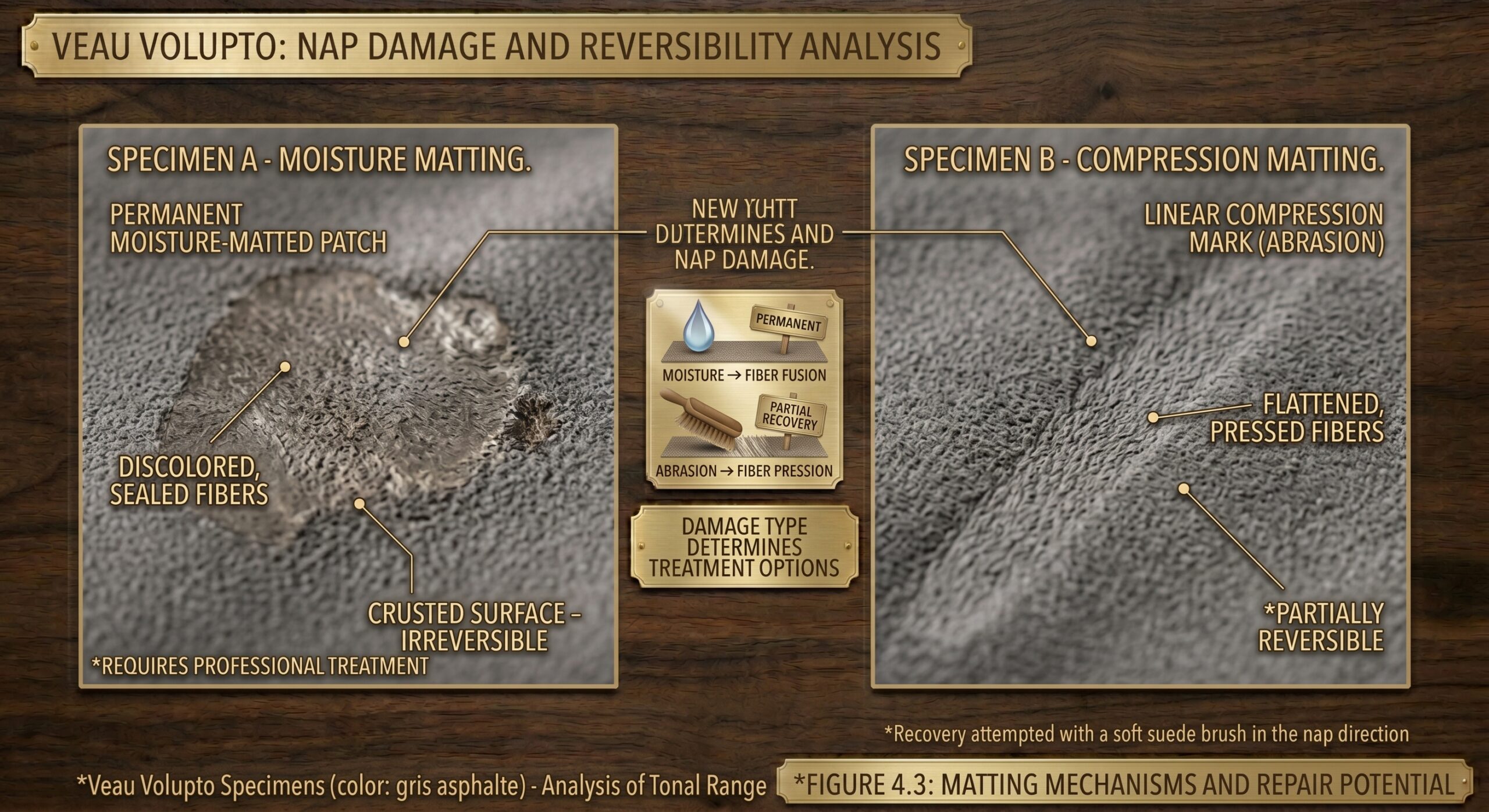
Moisture damage is the most acute vulnerability. Unlike smooth leather surfaces that repel or slowly absorb water at the grain face, Veau Volupto's raised fibril tips act as capillary wicks: water droplets are drawn immediately into the nap layer by capillary action between the raised tips. As the water dries, the fibril tips are drawn together by surface tension and mat flat — permanently altering the nap direction in the affected zone and producing a visible dark patch where the nap has collapsed. This damage is essentially irreversible at home: once fibril tips have been matted flat by moisture, they cannot be fully restored to their original raised position by brushing alone. The matted zone is both visually and texturally distinct from the surrounding intact nap.
Why Moisture Matting on Veau Volupto Is Permanent — and What Professional Treatment Can Achieve
The matting produced by moisture contact on Veau Volupto is the result of hydrogen bonds forming between adjacent fibril tips as surface tension draws them together during drying. These bonds are significantly stronger than the loose, non-bonded arrangement of the undamaged nap, which is why brushing alone cannot fully restore matted tips to their original position after drying. Professional treatment — steam conditioning applied by a specialist — can partially relax the hydrogen bonds and allow gentle brushing to restore more of the nap than dry brushing alone achieves. Hermès spa service includes this treatment for significant Veau Volupto moisture damage, but it is rarely a complete restoration: residual differences in nap density are typically still visible under angled light after treatment.
Oil absorption and darkening at contact zones is the second primary vulnerability. The raised fibril tips at the nap surface are much more accessible to skin oil absorption than the sealed surface of smooth leathers — skin contact repeatedly deposits small amounts of lipid material at the fibril tips, which both darkens them and partially mats them toward the contact direction. The handle attachment zones and any areas of regular skin contact develop a progressively darker, slightly matted appearance over time as oil accumulation compounds the directional matting from carry pressure. Unlike the desirable patina darkening of Togo or Barenia, this process is not evenly distributed and does not produce an aesthetically appealing result on most owners' pieces without disciplined care management.
Abrasion and nap direction compression is the third vulnerability. Any surface contact — the bag resting against a hard surface, contact with clothing, compression during storage — applies directional pressure to the raised fibril tips and causes them to lie flat in the direction of the compressive force. This produces visible nap direction disruption that creates lighter and darker zones on the surface — the same effect as stroking a velvet fabric against the nap direction. Unlike moisture matting, which creates permanent bonding between tips, compression matting from abrasion and storage can often be reversed by careful brushing with a soft suede brush in the correct nap direction. However, repeated compression events gradually reduce the nap's capacity for recovery as the fibril tips lose their elasticity over time. For comparison with how other leathers respond to surface abrasion and compression, see our piece on Hermès Swift vs Box Calf: Scratch and Scratch Recovery and our guide on Matte vs Shiny Alligator Hermès Bags: Maintenance Differences.
Care Protocol, Storage, and the Long-Term Ownership Discipline Veau Volupto Requires
Veau Volupto rewards a specific, disciplined care approach that differs from every other Hermès leather in the range. The core principle is prevention over remediation — because the primary damage mechanisms (moisture matting and progressive oil darkening at contact zones) are either irreversible or very difficult to address once they have occurred.
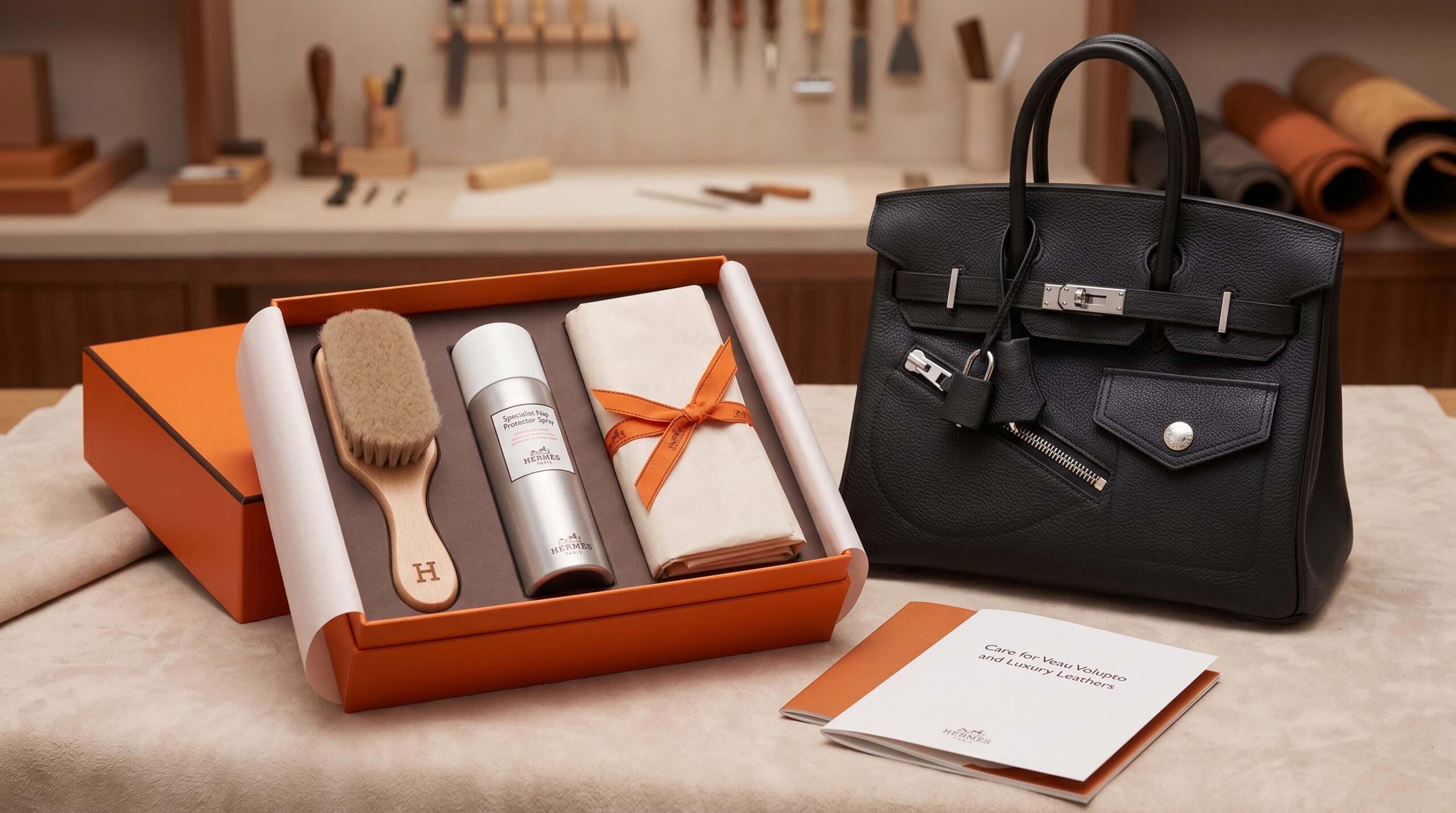
Pre-carry protection is the most important single intervention. Before first carry and before every carry in conditions where moisture contact is possible, a light application of a specialist suede and nap protector spray — applied from a distance of at least 30cm in even, overlapping passes — creates a temporary hydrophobic barrier over the raised fibril tips that slows moisture penetration. This treatment does not waterproof the leather, but it meaningfully extends the window between moisture contact and damaging capillary wicking. The spray should be reapplied every three to four carries, or after any moisture exposure event. Never apply standard leather conditioning creams or wax-based products to Veau Volupto: any liquid product applied directly to the nap will mat the fibril tips on contact and cannot be reversed.
Storage discipline is equally critical. Veau Volupto should always be stored with the bag fully stuffed with acid-free tissue to maintain its panel geometry, and stored in its dust bag with no surfaces in contact with the nap. If the bag is stored on a shelf, it should be positioned so that no leather-to-surface contact occurs — the bag should rest on the stuffed base rather than on any nap-covered panel. The dust bag interior should be brushed periodically to remove any accumulated particulate that could abrade the nap surface during storage movements. For general Hermès care and storage context, the Care & Storage Guide hub provides the full protocol framework. Browse all leather care content in the Leather Science category.
Routine nap maintenance uses a soft suede brush — natural bristle preferred over synthetic — applied in the direction of the nap with very light pressure. This lifts any minor compression matting from carry and restores the nap's directional alignment after storage or use. Brush before each carry and after any event where the nap surface has been compressed by contact. Never brush against the nap direction: this creates its own compression matting in the opposite direction, which is harder to reverse than forward-direction matting.
| Property | Veau Volupto | Swift | Togo | Barenia Faubourg |
|---|---|---|---|---|
| Surface type | Raised nap — buffed grain-face fibril tips | Smooth semi-matte — topcoat over grain face | Pebbled — drum-tumbled natural grain | Smooth natural — minimal finish over grain face |
| Tannage | Chrome | Chrome | Chrome | Vegetable |
| Primary vulnerability | Moisture matting (permanent); oil darkening at contact zones; compression matting | Surface scratches — partially recoverable | Minor surface scratches; uneven patina from inconsistent conditioning | Water tide marks — permanent tannin concentration at drying boundary |
| Water sensitivity | Very High — capillary wicking mats nap immediately on contact | Moderate — surface spotting, fades on drying | Moderate — surface spotting less dramatic than Barenia | Very High — tide marks from tannin concentration |
| Patina development | None — nap directional shift and oil darkening replaces patina | Subtle burnished sheen at contact zones | Genuine tonal deepening at contact zones | Dramatic — full pellicule formation over 12–18 months |
| Scratch resistance | N/A — nap compression replaces scratch as surface damage mode | Moderate — thin finish; some recovery possible | Good — pebbled grain distributes abrasion | Moderate — soft surface; scratch recovery very limited |
| Care complexity | Highest in standard range — suede brush + nap spray; no standard conditioner | Moderate — light conditioning every 3–4 months | Moderate — conditioning every 3–4 months | High — conditioning every 6–8 weeks; beeswax water protection |
| Active carry suitability | Low — requires protective carry conditions; not appropriate for heavy daily use | Moderate — daily carry with moderate discipline | High — most forgiving for active daily carry | Moderate — manageable with consistent care discipline |
Veau Volupto Is Among the Most Beautiful Hermès Leathers — and Among the Most Demanding. Own It Knowingly or Not at All.
Veau Volupto occupies a unique position in the Hermès range: it offers a visual and tactile character that no other leather in the catalogue can replicate — the directional nap shift, the apparent depth of colour, the velvet warmth under the hand — at the cost of a care discipline that is fundamentally different from every other Hermès leather. The buffing process that creates its extraordinary surface also creates an uncoated, directional fibril structure that is immediately vulnerable to the three damage mechanisms that standard leather care habits do not address.
The owners who are disappointed by Veau Volupto are almost universally those who carried it without pre-treatment protection or stored it in contact with surfaces — allowing moisture matting or compression events that produced irreversible surface changes within months of purchase. The owners who love it are those who treated the acquisition as a commitment to a specific, permanent care protocol from day one. For this leather, pre-carry suede spray, soft-brush maintenance, and disciplined storage are not optional additions — they are the purchase terms. Enter those terms knowingly and Veau Volupto rewards with a surface that justifies every precaution.
Bottom Line: Veau Volupto is Hermès's most visually distinctive leather and its most care-demanding — pre-carry nap protector spray before every wear, soft suede brush maintenance after every carry, and storage with no surface contact are the three non-negotiable disciplines that separate successful ownership from rapid irreversible damage.
Popular Searches
Explore our most searched Veau Volupto combinations and care queries
The retourne construction allows Veau Volupto's nap to develop its full directional depth without exposed exterior seams — Noir's deep black produces the most dramatic tonal shift in the nap direction range.
◆ Ultra RareRouge H in Veau Volupto reaches a depth and saturated warmth that makes this one of the most sought-after rare leather combinations in the secondary market — pristine examples command exceptional premiums.
⬆ TrendingThe most searched Veau Volupto care query — buyers who understand that this leather requires suede brush maintenance rather than conditioning cream approach ownership with the correct discipline from the first carry.
★ Collector FavouriteBleu Saphir's saturated blue in Veau Volupto produces one of the most visually commanding secondary market pieces available — the nap direction produces a depth of colour that no smooth blue leather can approach.
⬆ Rising DemandMoisture matting assessment and professional spa treatment for Veau Volupto — buyers who understand the permanent nature of moisture matting are better positioned to assess secondary market pieces accurately.
🔥 Most SearchedThe most common Veau Volupto misconception — it is not suede (split-side leather) but grain-side leather with a buffed nap: this distinction matters for structural integrity, resale value, and care approach.
Frequently Asked Questions
Veau Volupto is a velvet-nap calfskin produced by Hermès through a specific buffing process applied to the grain surface of a fine-grained calf hide. The buffing raises the fibril tips at the grain surface into a consistent directional nap — producing a surface that reads as velvet-like in its tactile and visual character while remaining a genuine full-grain leather at its structural core. Unlike suede, which is produced from the split side of the hide, Veau Volupto is made from the grain side — giving it the structural integrity of grain leather with the tactile character of a raised-nap finish. For the full leather types reference see the Leathers & Materials Guide.
Veau Volupto requires a fundamentally different care approach from smooth or pebbled Hermès leathers. The raised nap surface cannot be conditioned with standard leather creams — applying any liquid product directly to the nap will mat the fibril tips permanently. Care is limited to: gentle brushing with a soft suede brush in the nap direction to restore it after compression; immediate blotting of any moisture contact with a clean dry cloth (never rubbing); and professional treatment with a suede-specific protective spray applied before first carry. Standard leather conditioners, wax products, and cleaning solutions should never be used. For care protocol context see the Care & Storage Guide hub.
Yes, significantly. Veau Volupto is among the most care-demanding leathers in the Hermès range — substantially more delicate than Togo, Epsom, or Clemence for active daily carry. The raised nap surface is vulnerable to moisture (mats permanently without immediate blotting), abrasion (crushes nap direction), and skin oil from handle contact (progressive darkening and matting at contact zones). Veau Volupto rewards careful ownership and is not an appropriate choice for active daily carry in urban environments. See all leather durability comparisons at Togo vs Clemence: Which Slouches More Over Time.
Veau Volupto's rarity stems from three intersecting constraints: extremely exacting hide selection requirements (only perfect-surfaced fine-grained calf hides are suitable for the buffing process); a low yield rate from the buffing process itself (a proportion of hides are discarded due to uneven nap); and the leather's substantially greater vulnerability to production damage versus smooth alternatives. The combination produces a leather that appears in Hermès production in very limited volumes and typically only in specific seasonal allocations. Browse all rare leather types at Leather Science.
