Hermès Leathers & Materials Guide: Fibril Science, Tannage & Long-Term Behaviour
Why Togo slouches and Epsom does not. Why Barenia requires conditioning that would damage Clemence. Why Swift scratches more readily than Box Calf but recovers faster. These are not preferences — they are fibril-level realities.
Hermès leathers are differentiated at the fibril level — a fact that matters not only to the tanner but to the buyer who wants to understand why Togo slouches and Epsom does not, why Swift scratches more readily than Box Calf but recovers from light abrasion faster, and why Barenia Faubourg requires conditioning that would damage Clemence. These are not preference distinctions. They are structural and chemical realities determined by grain size, fibril density, tannage type, and finishing process.
This is the central leather science reference for hermesinsightshub.com — covering every major Hermès leather from the most common production grades to the rarest exotic skins, with analysis grounded in tannage chemistry and long-term material behaviour. For color behaviour across these same leathers, see the Hermès colors reference guide. For how construction method interacts with leather selection, see the Hermès bag styles guide.
40+
Hermès leathers in production — from common grades to exotic skins rarely available outside special order
2
Fundamental tannage approaches — vegetable and chrome — each producing opposite long-term behaviour profiles
3
Primary fibril variables: density, temper, and grain architecture — the trio that determines every material outcome
The Fibril Level: How Hermès Leathers Are Actually Different
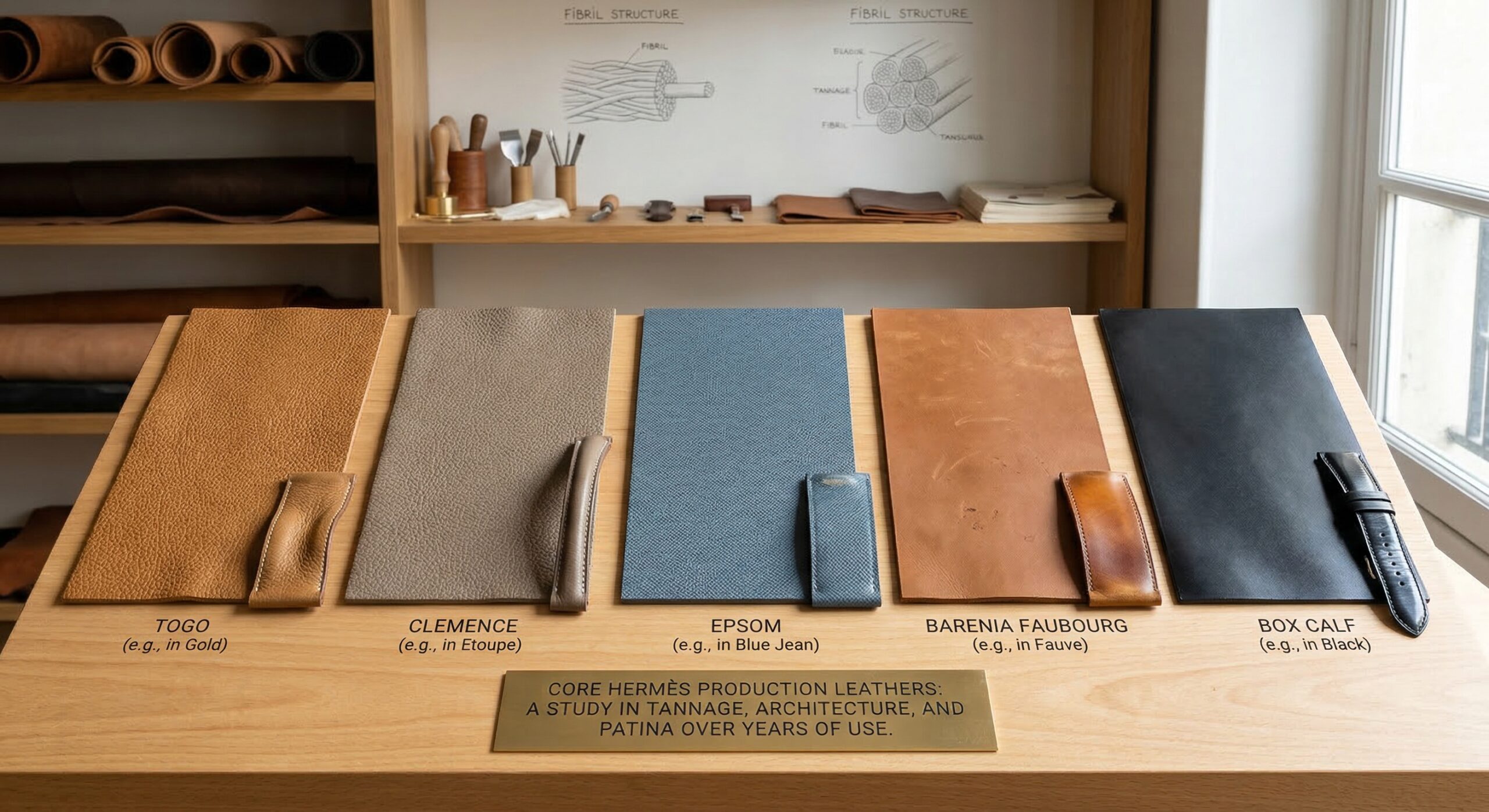
Every Hermès leather begins as animal hide — primarily calf, goat, and exotic skins — whose structural matrix is composed of collagen fibrils: protein chains that interweave in a three-dimensional network to form the leather’s fundamental architecture. The tanning process stabilises this fibril network against decomposition and determines its chemical properties. The finishing process — embossing, box-pressing, pebbling, buffing — modifies the surface geometry. The combination of tannage chemistry and finishing defines the leather’s temper: the balance of stiffness and suppleness that determines how it responds to load, flex, moisture, and time.
Understanding which Hermès leather to select for a given bag style and use pattern requires understanding three fibril-level variables: fibril density (how tightly the collagen chains are packed — low density produces softness and slouch; high density produces rigidity and structure), tannage type (vegetable or chrome — determining patina behaviour, moisture sensitivity, and long-term color stability), and grain architecture (pebbled, embossed, smooth, or exotic — determining light response, abrasion resistance, and surface character). Every material outcome that buyers experience — slouch, scratch, patina, stiffness, color shift — is traceable to these three variables.
- Fibril density — the primary driver of temper: low density = supple and slouch-prone; high density = rigid and structure-retaining
- Tannage type — determines patina behaviour, moisture sensitivity, and color stability over time
- Grain architecture — controls light response, abrasion profile, and surface character
- Finishing process — embossing, box-pressing, and buffing modify grain geometry without changing the underlying fibril chemistry
- Temper — the balance of stiffness and suppleness; the single most important variable for buyers selecting a leather for a specific construction type
Togo vs Clemence: Pebbled Leathers and Slouch Mechanics
Togo and Clemence are the two most widely produced pebbled calf leathers in Hermès’s range, and they are frequently compared — correctly, because they share a tannage family (both are chrome-tanned) and a grain character (both pebbled), but incorrectly, because their fibril density and temper are meaningfully different in ways that produce different structural outcomes over time.
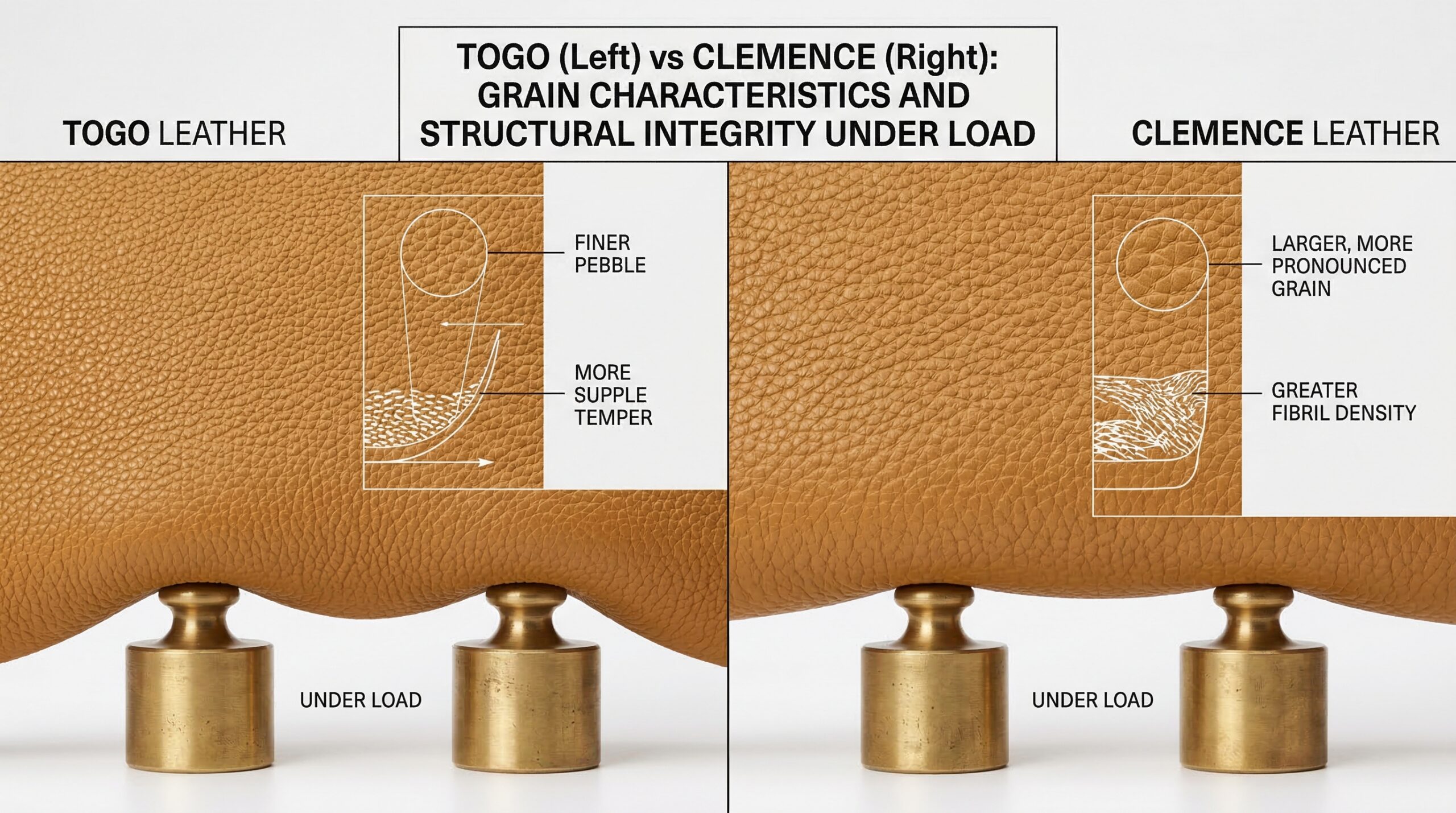
Togo is a chrome-tanned calf leather with a loose, relatively open pebbled grain and a supple temper. Its fibril density is moderate, producing a leather that is soft and accommodating under load. Under the weight of bag contents, Togo’s fibrils slide against each other along their grain planes — the mechanical process that produces the characteristic slouch that Togo develops over seasons of use. This slouch is not structural failure. It is the natural outcome of a leather designed with high suppleness and moderate fibril cross-linking. Togo’s scratch resistance is good — the pebbled grain distributes abrasion across its surface facets rather than concentrating it at any single point — and its color reads with the deep, micro-shadow saturation described in the colors guide.
Clemence is also chrome-tanned with pebbled grain, but its fibril structure is heavier and its temper stiffer than Togo. Clemence is produced from bull calf rather than the younger calf used for Togo, which accounts for its heavier weight and larger, more pronounced grain. Its greater fibril density means it resists slouch more effectively than Togo — a Clemence Birkin will maintain its silhouette under load longer than an equivalent Togo piece, though both will soften and settle over time. Clemence’s larger grain produces more pronounced micro-shadows and a richer, more textured color reading than Togo’s finer pebble.
“The distinction between Togo and Clemence is not aesthetic preference — it is fibril density and temper. Buyers who want a bag that holds its shape under daily loading should select Clemence. Buyers who want a bag that develops a relaxed, lived-in character should select Togo.”
Epsom and Swift: Structured Leathers, Scratch Profiles, and Surface Behaviour
Epsom is a chrome-tanned calf leather that has been subjected to a high-pressure embossing process that stamps a cross-hatch pattern into its surface under heat. This embossing dramatically compresses the fibril structure, increasing its density and rigidity far beyond the natural state of the hide. The result is a leather with an exceptionally stiff temper that resists deformation under load — a Birkin in Epsom will maintain its original silhouette far longer than an equivalent Togo piece, and will show virtually no slouch even after years of daily use. Epsom’s embossed surface also provides excellent abrasion resistance: the cross-hatch pattern distributes contact abrasion across its compressed grain peaks, making it the most scratch-resistant of the common Hermès production leathers.
The trade-off is that Epsom’s compressed fibril structure limits its ability to develop patina. Without the open fibril pathways that allow skin oils and atmospheric chemistry to penetrate and alter the leather’s surface over time, Epsom holds its original color and finish with high stability but without the depth of character development that vegetable-tanned leathers achieve. For buyers who prioritise structural integrity and color stability over patina, Epsom is the correct choice. For buyers who want their leather to develop a distinctive personal character over years of use, it is not.
Swift (also known as Veau Swift) is a chrome-tanned calf leather with a smooth, fine-grained surface and a supple temper. Its smoothness is its primary vulnerability: without the grain texture that distributes abrasion across multiple facets, any surface contact concentrates at a single point, producing marks more readily than pebbled or embossed leathers. However, Swift’s supple fibril structure means that light surface marks can often be resolved through gentle buffing — the displaced surface finish can recover because the fibrils beneath are not rigidly compressed. Deep scratches on Swift are more permanent than on Epsom, but light marks are more reversible.
Leather Expert Note
Epsom is frequently recommended for buyers new to Hermès leather because its embossed surface conceals minor handling marks and its stiff temper maintains the bag’s structure under variable loading. These are legitimate advantages. But Epsom’s compressed fibril structure also means it has the least capacity for the kind of long-term material character development that defines the finest Hermès leather experiences. Both properties are real — buyers should select based on which they actually want.
Barenia Faubourg and Box Calf: The Vegetable-Tanned Leathers
Hermès’s vegetable-tanned leathers occupy a different category of material experience from its chrome-tanned range — one defined by ongoing chemical activity, patina development, and the progressive deepening of character that only polyphenolic tannage chemistry can produce. Two leathers define this category in Hermès production: Barenia Faubourg and Box Calf.
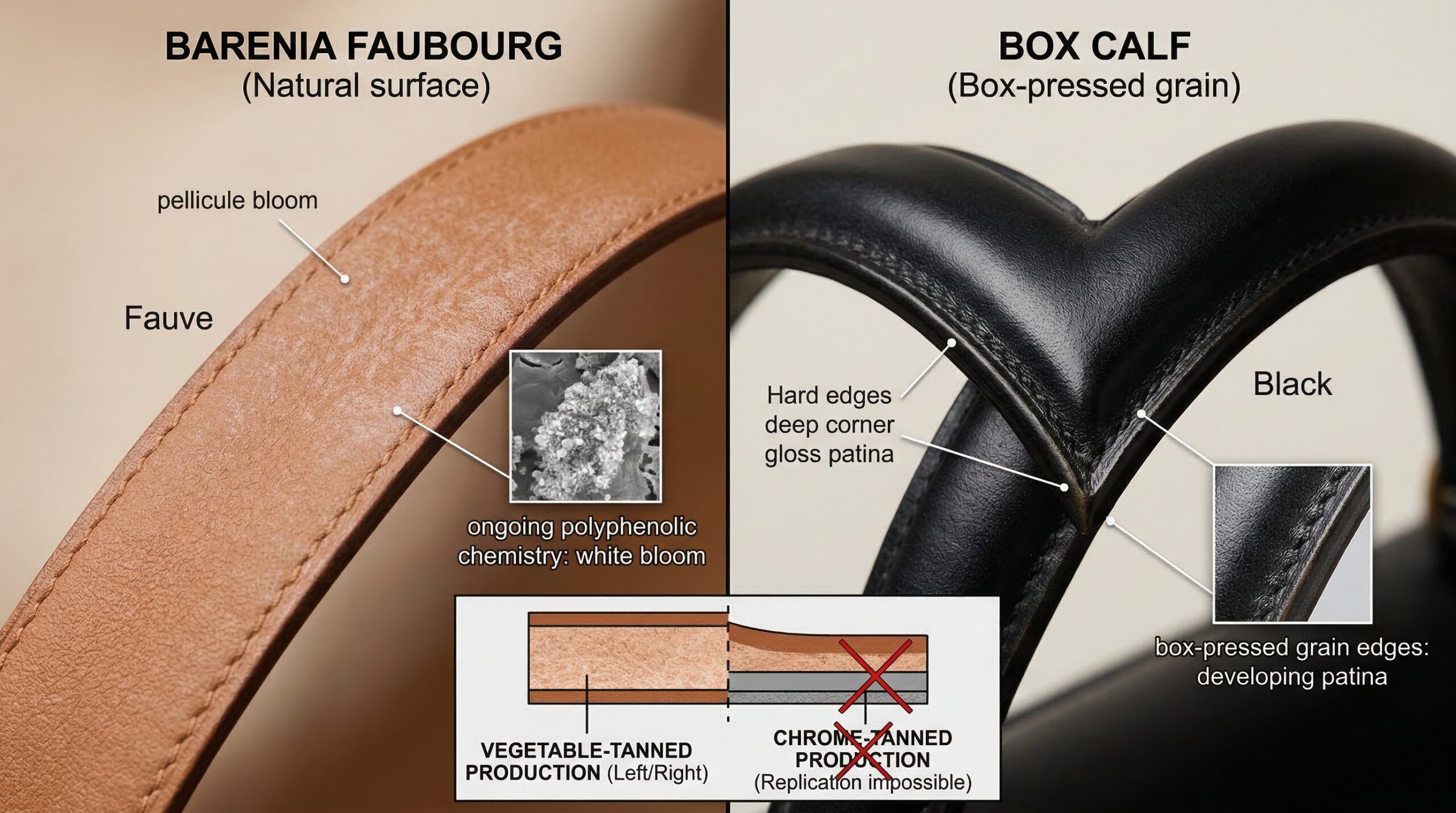
Barenia Faubourg is a vegetable-tanned calf leather with a smooth, natural surface and a medium-supple temper. It is tanned using traditional plant-derived polyphenols — primarily oak and chestnut bark extracts — that form a less chemically stable fibril bond than chromium salts. The practical consequence is that Barenia’s surface continues to undergo slow oxidative chemistry throughout its working life. Exposure to UV light, skin oil, and atmospheric oxygen progressively deepens the color from its natural pale honey tone toward warm amber and caramel, forming a pellicule — a natural surface bloom of oxidised polyphenols — that gives aged Barenia its distinctive depth and warmth. Barenia requires regular conditioning with products specifically formulated for vegetable-tanned leather: oil-based conditioners that replenish the hide’s natural moisture without disrupting the polyphenolic chemistry. Water-based conditioners appropriate for Clemence or Togo would introduce moisture incompatible with Barenia’s tannage chemistry.
Box Calf is a vegetable-tanned calf leather that has been box-pressed: subjected to a finishing process that compresses the grain surface under heat and heavy pressure to produce its characteristic mirror-gloss finish. The box-pressing does not alter the underlying vegetable tannage chemistry — Box Calf continues to develop patina over time — but it modifies the surface geometry, creating the high-polish finish that makes aged Box Calf corner patina one of the most visually distinctive material characters in Hermès production. Box Calf’s surface is more abrasion-resistant than Barenia’s natural finish, and its pressed grain provides a more consistent color reading, but it shares Barenia’s sensitivity to moisture and its requirement for vegetable-tannage-appropriate conditioning.
Exotic Skins: Alligator, Ostrich, and Chevre
Hermès’s exotic skin production represents the apex of its leather range — leathers whose fibril architecture, scale geometry, and surface character are structurally distinct from calf production in ways that create unique material properties, unique maintenance requirements, and unique aging profiles.
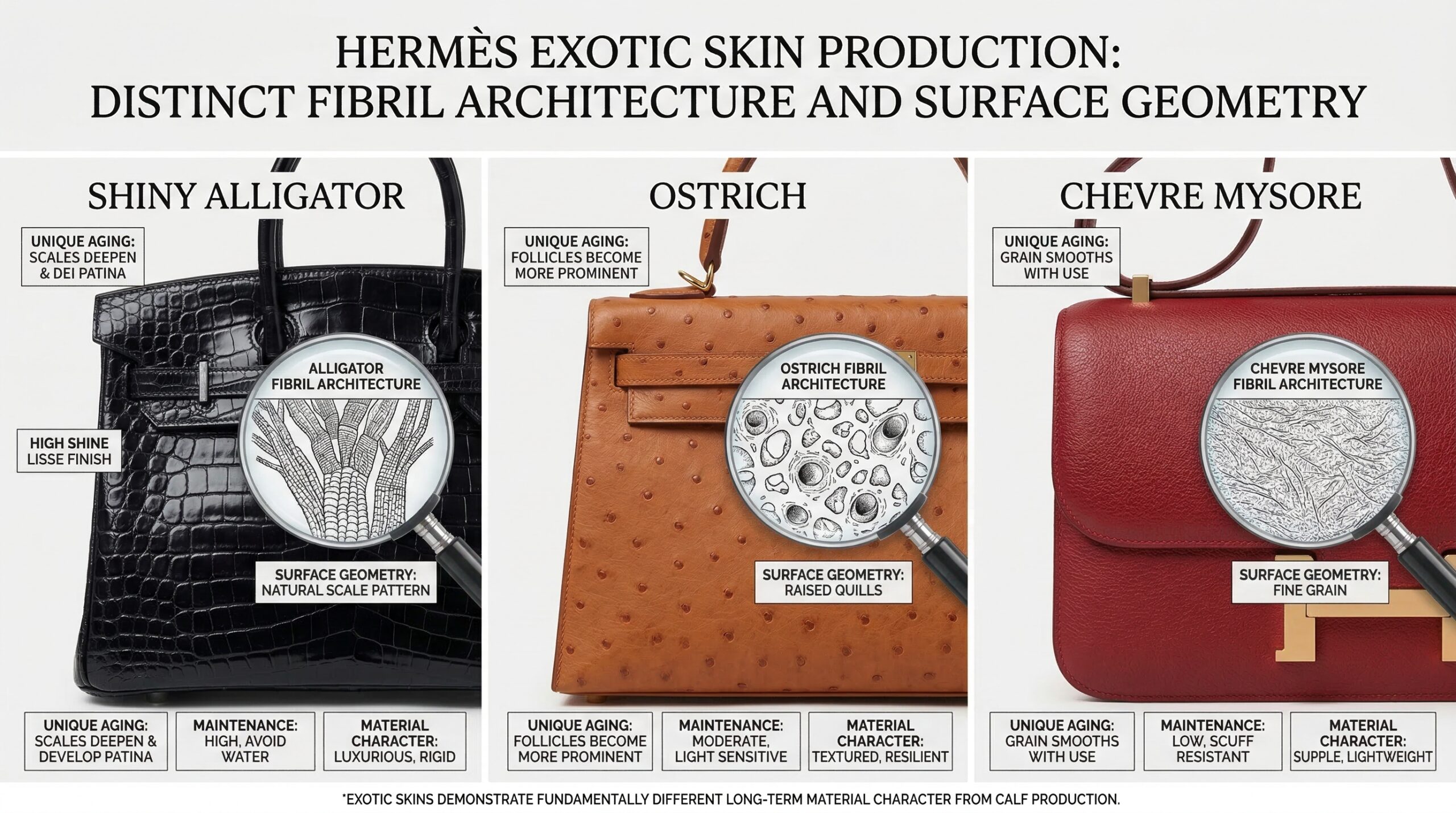
Alligator (Porosus Crocodile and Mississippiensis Alligator) is produced in both matte and shiny finishes. Shiny alligator is lacquered — a clear coat applied over the scale surface that produces the high-gloss reflectivity characteristic of the finest exotic skin production. Matte alligator forgoes the lacquer, allowing the scale surface to read in its natural state. The maintenance implications are significant: shiny alligator’s lacquer layer is the primary wear zone — it scratches and dulls before the leather itself is affected, and restoration requires professional re-lacquering. Matte alligator’s unlacquered surface is more breathable and develops a subtle natural polish through use, but is more sensitive to moisture marks that can be difficult to remove without professional spa treatment.
Ostrich is produced from the back skin of the bird, where the distinctive quill follicle nodes — the raised bumps that define ostrich’s appearance — are concentrated. The follicle zones have a compressed fibril density surrounded by more open tissue, producing a leather with excellent suppleness and a naturally high resistance to cracking and surface failure. Ostrich’s maintenance challenge is handle darkening: skin oil deposits at the raised follicle nodes, where it oxidises and darkens the leather. This is a function of the follicle’s surface geometry — it is not preventable without fundamentally altering the leather’s breathability — and experienced collectors regard it as a natural aging characteristic rather than a defect.
Chevre Mysore and Chevre de Coromandel are goatskin leathers with distinctly different fibril architectures. Chevre Mysore has a fine, tight grain with high fibril density, producing a leather with excellent abrasion resistance, clean color reading, and good structural rigidity for its light weight. Coromandel has a more pronounced grain and a slightly more supple temper. Both are chrome-tanned and share the color stability of the chrome-tanned calf leathers, but their lighter weight relative to calf makes them particularly suitable for smaller bag formats where weight is a meaningful consideration.
Leather Expert Note
Veau Volupto — Hermès’s ultra-supple calfskin — represents the extreme supple end of the temper spectrum. Its extraordinarily low fibril cross-linking density produces a leather with an almost fabric-like drape, making it among the most tactilely distinctive in the range. Its maintenance profile is demanding: the low fibril density that produces its character also makes it highly sensitive to surface abrasion, moisture, and structural distortion under heavy loading. Veau Volupto is a leather for restrained use and meticulous care — not daily high-load carrying.
| Leather | Tannage | Fibril Density | Temper | Key Behaviour | Daily Use Suitability |
|---|---|---|---|---|---|
| Togo | Chrome | Moderate | Supple | Slouches over time; good scratch resistance | Excellent |
| Clemence | Chrome | Moderate–High | Medium-stiff | More structure than Togo; heavier weight | Excellent |
| Epsom | Chrome (embossed) | High (compressed) | Stiff | Minimal slouch; best scratch resistance; no patina | Excellent |
| Swift / Veau Swift | Chrome | Moderate | Supple | Scratches readily; light marks often buffable | Good (care required) |
| Barenia Faubourg | Vegetable | Moderate | Medium | Strong patina / pellicule; moisture-sensitive | Moderate (low-stress use) |
| Box Calf | Vegetable (box-pressed) | High (pressed) | Medium-stiff | Mirror gloss; corner patina; moisture-sensitive | Moderate (occasional use) |
| Chevre Mysore | Chrome | High | Medium-stiff | Fine grain; light weight; excellent abrasion resistance | Good |
| Veau Volupto | Chrome | Low | Very supple | Extreme drape; highly sensitive to abrasion and moisture | Low (occasional, careful use) |
| Ostrich | Chrome | Variable (follicle zones) | Supple | Follicle node darkening; excellent crack resistance | Good (handle darkening expected) |
| Shiny Alligator | Chrome (lacquered) | High (scale structure) | Stiff | Lacquer wear at scales; professional restoration required | Low (occasional, museum-quality care) |
| Matte Alligator | Chrome | High (scale structure) | Stiff | Natural scale polish develops; moisture mark risk | Low (occasional, careful use) |
Leather Selection Is a Material Science Decision
The most common error in Hermès leather selection is treating leather type as an aesthetic preference rather than a material specification. It is not. Togo and Epsom produce different structural outcomes under identical loading conditions — not because one is better, but because their fibril architectures are engineered for different purposes. Barenia and Clemence require different conditioning chemistry — not because one is higher maintenance, but because their tannage chemistry is fundamentally incompatible with the same products.
Buyers who understand fibril density, temper, and tannage type will select leathers whose long-term behaviour aligns with their actual use patterns — and will avoid the disappointment of a Togo that slouched more than expected, an Epsom that developed less character than hoped, or a Barenia that was damaged by the wrong conditioning product.
Bottom Line: Match your leather to your construction type, your use pattern, and your maintenance commitment. Every other consideration — color, size, hardware — is secondary to getting this fundamental material decision right.
Popular Searches
Explore our most searched Hermès leather science topics
🔥 Most Searched
Togo vs Clemence: Which Slouches More Over Time?
A grain architecture and fibril density comparison — why both pebbled leathers soften over time but at different rates and in different structural patterns.
★ Collector Favourite
Does Hermès Epsom Leather Soften With Use?
A long-term study — the fibril science of why Epsom’s compressed structure resists softening and what minimal change looks like over decades of use.
⬆ Trending
Hermès Swift vs Box Calf: Scratch and Recovery
Which smooth leather scratches more easily and which recovers better — the surface finish and fibril structure explanation for two leathers often conflated.
◆ Deep Dive
Barenia Faubourg Patina: Month-by-Month Guide
Month-by-month documentation of vegetable-tanned color shift — the most comprehensive patina progression guide for Hermès’s most coveted natural leather.
⬆ Rising Demand
Hermès Veau Volupto: Characteristics, Care & Availability
The ultra-supple calfskin explained — why its extreme low fibril density produces unmatched drape and why its maintenance demands are equally extreme.
🔥 Most Searched
Matte vs Shiny Alligator Hermès: Maintenance Differences
Lacquered versus unlacquered exotic skin — the structural and maintenance differences between Hermès’s two alligator finish options, and how each ages under real-world use.
Frequently Asked Questions
Togo is a chrome-tanned calf leather with a loose, open pebbled grain and a supple temper — meaning its fibril structure has relatively low inter-fibril cross-linking density. Under the weight of bag contents, the fibrils slide against each other along their grain planes, producing the characteristic slouch that Togo develops over time. Epsom is a chrome-tanned calf leather that has been heavily embossed under high pressure and heat, compressing its fibril structure and dramatically increasing the rigidity of its temper. The compressed fibrils resist deformation under load, maintaining the bag’s silhouette even when heavily filled. The difference is not a quality distinction — it is a structural design choice with opposite material outcomes.
Epsom leather softens very minimally and very slowly — far less than Togo or Clemence. The cross-hatch embossing process compresses the fibril structure under high pressure, creating a mechanically stable matrix that resists deformation. Over many years of heavy use, the grain peaks may flatten very slightly and the temper may become marginally more pliable at flexion zones, but this is a decades-long process rather than the season-to-season softening visible in pebbled leathers. Buyers who want a bag that maintains its original silhouette across many years of active use should consider Epsom as the most structurally stable of the common Hermès production leathers.
Swift is a chrome-tanned calf leather with a smooth, fine-grained surface and a supple temper. It scratches relatively easily because its smooth surface has no grain texture to absorb abrasion — but light scratches can often be buffed out because the fibril structure beneath is not damaged, only the surface finish displaced. Box Calf is a vegetable-tanned calf leather that has been box-pressed to produce its characteristic high-gloss mirror finish. Box Calf develops patina over time and its pressed surface resists surface abrasion better than Swift, but scratches that do occur tend to be more permanent. See our full Swift vs Box Calf comparison for detailed analysis.
For daily use under high load and frequent handling, Togo and Epsom are the most suitable Hermès leathers for different reasons. Togo’s loose grain and supple temper accommodate the flex cycles of daily use without cracking — it will slouch and soften, but will not fail structurally. Epsom’s compressed fibril structure and embossed surface resist abrasion and maintain silhouette even under heavy daily loading, though it will not develop the same patina depth as vegetable-tanned leathers. Clemence is a viable alternative to Togo for daily use. Swift, Box Calf, and Barenia are less suitable for high-frequency daily use because their surface finishes are more sensitive to abrasion, moisture, and load-induced deformation.
Articles in This Topic Group
The following articles link back to this hub. This list will be updated as each is published.
- Hermès Togo vs Clemence Leather: Which Slouches More Over Time?
- Does Hermès Epsom Leather Soften With Use? A Long-Term Study
- Hermès Swift vs Box Calf Leather: Scratch and Scratch Recovery
- Hermès Barenia Faubourg Patina Progression: Month-by-Month Guide
- Hermès Veau Volupto Leather: Characteristics, Care & Availability
- Matte vs Shiny Alligator Hermès Bags: Maintenance Differences