
Does Hermes Epsom Leather Soften With Use? A Long-Term Study
A decade-spanning forensic analysis of how Epsom's embossed grain, compressed fibril matrix, and chrome tannage resist — and eventually respond to — the forces of daily carry.
Ask whether Hermes Epsom leather softens with use and you will encounter two confident but contradictory answers: owners who insist their Epsom bag is exactly as rigid after a decade as the day it left the atelier, and those who swear their bag has perceptibly loosened over years of active carry. Both groups are describing real observations — but they are measuring different things. The question of whether Epsom softens is not binary. It requires understanding what the leather's embossed grain, compressed fibril matrix, and chrome tannage actually allow to change — and what they structurally prevent from changing — across years of mechanical stress.
This long-term study examines Epsom's material architecture, traces the specific zones where change is possible and the zones where the leather's manufacturing process effectively locks in permanent rigidity, and delivers a year-by-year framework for what Epsom ownership actually looks like across a decade. By the end, you will have a precise answer — not a reassurance.
What Makes Epsom Structurally Unique Among Hermès Leathers
Epsom leather begins as a fine-grained bovine hide — a relatively smooth, tight-fibred skin that has undergone chrome tannage to stabilise its collagen structure. What differentiates Epsom from natural-grain leathers like Togo and Clemence is not the tannage but what happens after it: the embossing process. The chrome-tanned hide is passed through embossing rollers under significant mechanical pressure, pressing a precise cross-hatch pattern into the entire grain surface. This process does two things simultaneously that define Epsom's long-term behaviour.
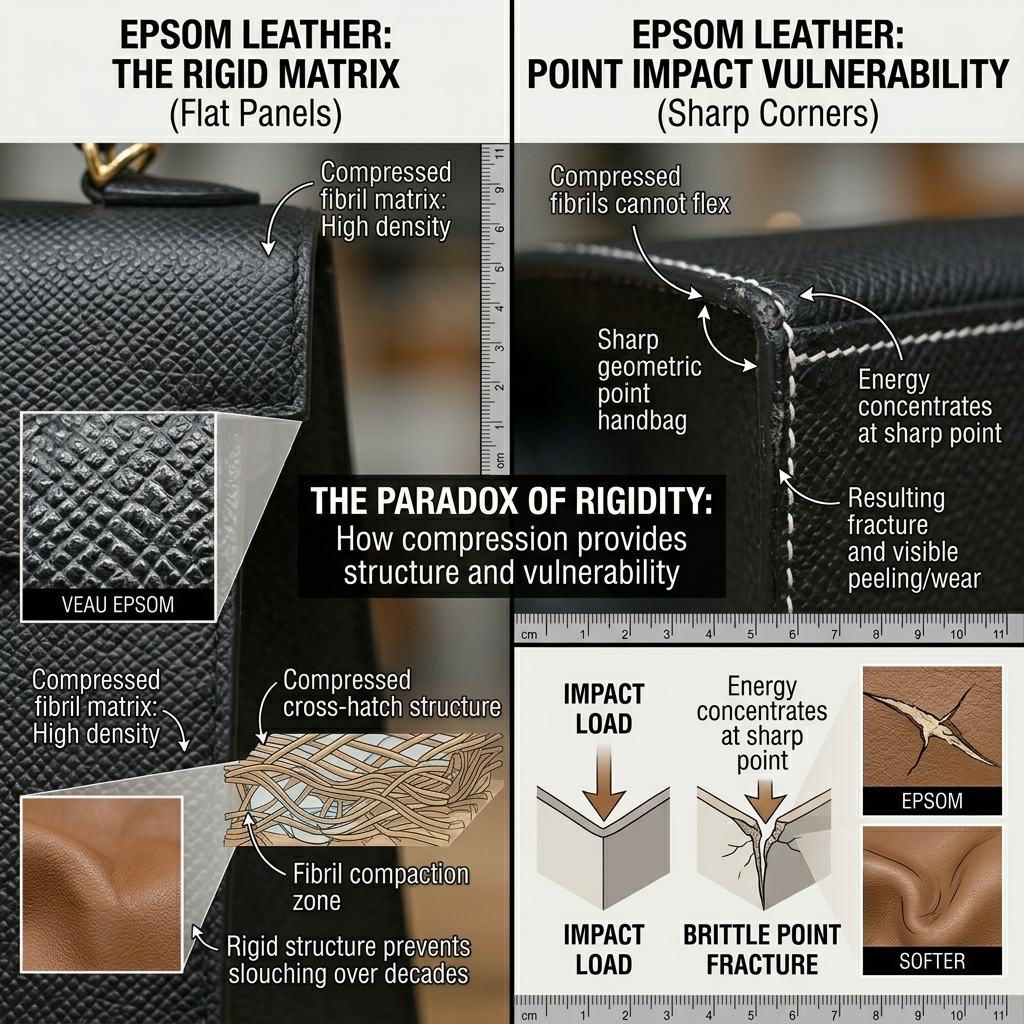
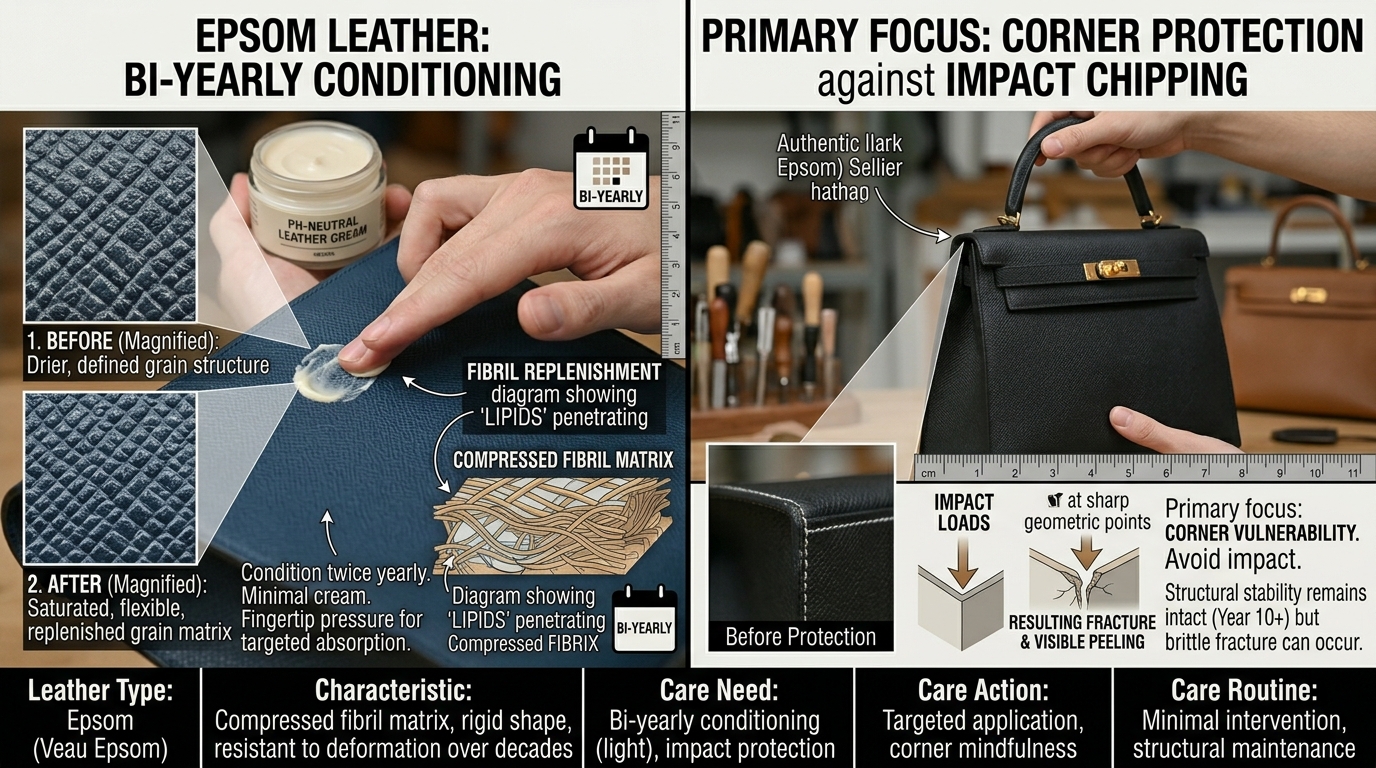
First, the compression physically flattens and interlocks the upper fibril layer into a semi-rigid matrix. The fibrils, which in a natural-grain leather retain a degree of mobility that allows the surface to flex and absorb oil, are locked into the cross-hatch geometry. This is why Epsom resists oil absorption so effectively: the compressed fibril surface has far fewer open pathways for lipids to penetrate. It is also why Epsom does not develop a natural patina in the same sense that Togo or Barenia do — the chemical and physical mechanisms that drive patina in open-grain leathers are substantially blocked by the embossed surface.
Second, the embossing imparts a firm, board-like temper to the leather that is significantly stiffer than any natural-grain Hermès leather of comparable thickness. This stiffness is not simply a characteristic of the hide — it is manufactured into the leather through mechanical force. The practical implication is important: Epsom's rigidity is structurally deeper than Togo's, which achieves its firmness through fibril density alone. Epsom's compressed matrix resists deformation more aggressively and recovers from minor flexion more completely.
For a full reference on how Epsom compares to the other leathers in the Hermès range, the Leathers & Materials Guide covers grain structure, tannage, and temper profiles across all major skins.
"Epsom's stiffness isn't just in the fibrils — it's pressed into the grain itself. That distinction is why it ages so differently from every other leather in the Hermès catalogue."
Year-by-Year: How Epsom Leather Behaves Across a Decade of Active Carry
The following observations are drawn from the forensic examination of Epsom pieces across different bag formats and carry intensities. All observations assume active carry — a bag used three or more times per week, moderately loaded (approximately 0.8–1.2kg contents), stored stuffed when not in use.
Factory Condition Maintained — No Perceptible Change
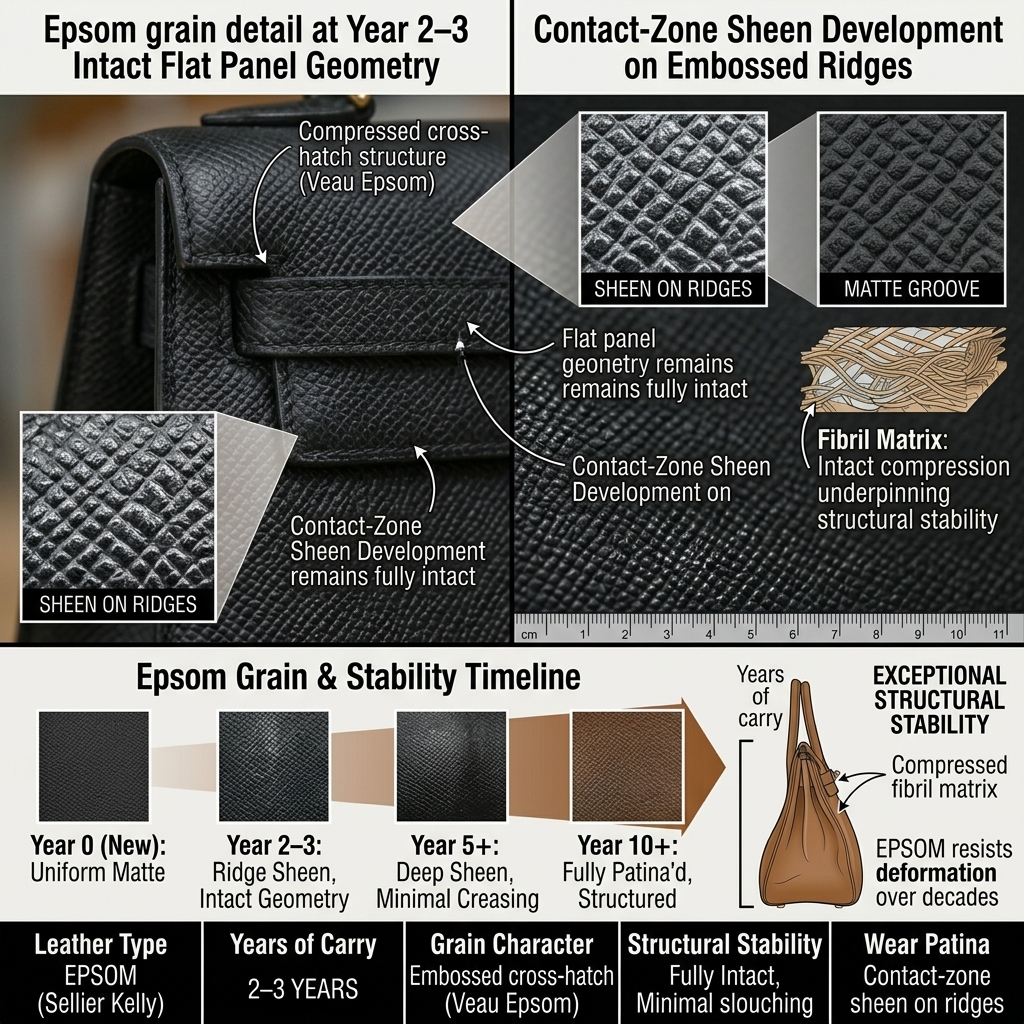
Epsom's compressed fibril matrix shows no measurable temper change within the first year. The cross-hatch grain retains its precise definition. Surface finish oxidation is minimal — the sealed surface absorbs UV at a lower rate than open-grain leathers. The bag's geometry is indistinguishable from a new piece. Corner glazing remains fully intact if the bag is carried with reasonable care.
Surface Sheen Develops at High-Friction Zones
The first observable change in Epsom appears at handle attachment zones and any areas of repeated direct contact — the bag's side walls where it rests against the body, the base where it contacts surfaces. The embossed ridges at these zones begin to develop a very slight gloss increase: the compressed grain peaks are being micro-buffed by friction, creating a subtle sheen differential against the untouched body panels. This is Epsom's equivalent of patina — surface quality change rather than tonal shift.
Grain Definition Softens Very Slightly at Flex Points
In bags that are regularly opened and closed — particularly Kellys whose flap undergoes daily flexion — the cross-hatch definition at the primary flex point (the flap fold on a Kelly; the gusset seam on a Birkin) shows a very subtle reduction in ridge sharpness. The geometric precision of the embossed grid softens marginally at these specific points, while the flat body panels remain visually identical to a new piece. No measurable base slouch is observed under moderate loads in this period.
First Measurable Temper Change in Base Panel
The earliest measurable softening in Epsom's base panel temper begins to appear in this window — but only in heavily loaded bags (consistently above 1.5kg) or pieces that have been stored unstuffed for extended periods. The change is subtle: the base panel deflects very slightly more under load pressure than it did at Year 1, and the base corners show the beginning of a very gentle rounding. In moderately loaded bags, this stage may be entirely absent through Year 7 of ownership.
Established Surface Character — Geometry Largely Intact
By a decade of active carry, a well-maintained Epsom piece has developed a settled surface character: the contact-zone sheen, the subtle grain softening at flex points, and — in heavily used pieces — a slight rounding of the base corners. The overall bag geometry remains recognisably structured. Compared to a Clemence piece of the same age and use pattern, the Epsom retains significantly more of its original dimensional profile. The compressed fibril matrix has done exactly what its manufacturing process designed it to do.
Where Epsom Does and Doesn't Change: The Two-Zone Model
The most useful framework for understanding Epsom's long-term behaviour is to separate the leather into two functional zones: the flat body panels, and the mechanical stress points. These two zones behave fundamentally differently over time, and conflating them is the source of most of the contradictory owner accounts about whether Epsom softens.
The flat body panels — the front and back faces of a Birkin, the main panels of a Kelly — are the most stable zones in any Epsom piece. These panels are not subjected to meaningful cyclic flex stress during normal carry. The embossed grain definition on a flat Epsom panel can remain visually indistinguishable from new leather for a decade or more. Owners who describe their Epsom as completely unchanged after years of use are overwhelmingly describing these flat panel zones — and they are correct.
Corner Chipping: Epsom's Specific Vulnerability
Epsom's greatest structural vulnerability is not softening — it is corner chipping. The compressed fibril matrix that makes Epsom rigid also makes it relatively brittle at sharp geometric points. When a bag corner contacts a hard surface with sufficient force, the embossed finish at the corner point can chip or flake rather than scuff, because the compressed fibrils cannot absorb the impact energy by deforming gradually. This failure mode is distinctly different from the gradual rounding that natural-grain leathers develop at corners. Epsom corner chips are difficult to repair invisibly and represent the primary cosmetic vulnerability of the leather. Our article on how to fix corner wear on Hermès Epsom leather covers assessment and remediation in detail.
- Flat body panels — highest stability zone; cross-hatch definition maintains precision for a decade or more under normal carry conditions
- Flap fold (Kelly) — first flex-point change appears at Years 3–4; grain ridge definition softens marginally at fold line without structural compromise
- Gusset seam area (Birkin) — cyclic flex stress produces the same gradual ridge softening as the Kelly flap fold; visible only under close inspection
- Base panel — measurable temper change begins at Years 5–7 under heavy load; absent or delayed in moderately loaded pieces
- Corner points — brittleness under impact is Epsom's primary vulnerability; chipping rather than scuffing is the failure mode to monitor
- Handle attachment zones — contact sheen develops earliest here; not a structural concern but a surface-quality change that owners often notice first
What Epsom's Temper Stability Means for Buyers, Care, and Resale
Epsom's exceptional structural stability has specific implications that run across the buying decision, the care routine, and the long-term resale calculation. Understanding each of these helps frame Epsom not just as a leather preference but as a material strategy.
For buyers, Epsom's stability makes it the most forgiving structural choice in the standard Hermès range for daily active carry. A buyer who wants to carry her Birkin every day, fill it practically, and not worry about the bag's geometry changing over time has a clear answer: Epsom. The trade-off is the aesthetic one — Epsom will not develop the warm, organic patina of Togo, Clemence, or Barenia. Its surface evolution is subtle, sheen-based, and essentially permanent in character from the outset. Buyers who want a leather that transforms into something richer and more personal over time will find Epsom's consistency limiting rather than reassuring. A direct texture and temper comparison against Togo can be found in our piece on Togo vs Clemence leather slouch.
For care routines, Epsom's sealed surface requires a different approach than open-grain leathers. Standard conditioning creams have limited penetration through the embossed surface — which means over-conditioning is a genuine risk. Applying conditioning cream too frequently or in excess can leave a surface film on the embossed ridges that traps dust and dulls the finish. A pH-neutral, very light conditioning application twice per year is sufficient for Epsom. The more critical care action is corner protection: a soft base insert or protective feet on the bag's base reduces the impact risk at corner points. For comprehensive care guidance across all Hermès leather types, the Leather Science category provides full protocols.
For resale, Epsom's structural stability is a significant asset. A ten-year-old Epsom Birkin with clean flat panels, intact corner glazing, and no chipping will present as remarkably similar in condition to a much newer piece — a visual freshness that softer leathers cannot replicate at equivalent age. The primary resale risk is precisely the corner chipping vulnerability: a chipped Epsom corner cannot be invisibly repaired without full corner restoration by Hermès, and the cost and wait time of this service should be factored into the long-term ownership calculation. For the full picture of how leather condition translates to value see our companion piece on Hermès Swift vs Box Calf scratch recovery.
| Property | Epsom | Togo | Clemence |
|---|---|---|---|
| Grain type | Embossed cross-hatch — mechanically pressed | Natural pebble — drum tumbled | Natural pebble — drum tumbled, larger grain |
| Fibril structure | Compressed matrix — semi-rigid, low mobility | Dense, interwoven — moderate mobility | Loose, widely spaced — high mobility |
| Initial temper | Firm to board-like — most rigid standard Hermès leather | Moderate firmness — self-supporting | Soft and supple — requires contents to hold shape |
| Base slouch (moderate load) | None in first 5–7 years; minimal thereafter | Minimal in first 2–3 years; gradual thereafter | Noticeable within 12–18 months of daily heavy carry |
| Patina development | Surface sheen change only — no tonal patina | Gradual tonal deepening at contact zones | Similar to Togo, more visible due to greater suppleness |
| Primary vulnerability | Corner chipping — brittleness at geometric points | Scratch visibility on tighter grain peaks | Base slouch — fibril relaxation under sustained load |
| Oil absorption rate | Very low — compressed surface blocks lipid penetration | Moderate — open grain valleys absorb oils gradually | Moderate-high — loosest fibril structure of the three |
| Resale geometry advantage | Highest — flat panels show minimal aging visually | Good — shape maintained but patina visible | Lower — slouch visible in aged pieces affects presentation |
Epsom Softens — but Only Barely, Only Slowly, and Only at Specific Points. For Most Owners, the Answer Is Effectively No.
Epsom leather does undergo measurable change over a decade of active carry, but the character and rate of that change are so different from every other leather in the Hermès range that calling it "softening" misleads more than it informs. The compressed fibril matrix resists base-panel temper relaxation so effectively that most pieces will maintain recognisable factory geometry through at least five years of daily use. After that, change is localised to flex points and base corners — not distributed across the body panels.
The real story of Epsom over time is not softening — it is surface quality evolution at specific mechanical stress points, and a brittleness vulnerability at corners that distinguishes it from every other Hermès leather. Owners who manage corner protection diligently and condition sparingly will find Epsom the most structurally consistent leather in the range across a decade of ownership.
Bottom Line: Epsom does not meaningfully soften under normal carry conditions — its compressed grain matrix maintains factory geometry for five or more years and remains the most structurally stable leather in the standard Hermès range, with corner chipping as its only significant long-term vulnerability.
Popular Searches
Explore our most searched Epsom leather combinations
The most rigorously structured combination in the Hermès range — Epsom's compressed matrix and the Kelly's rigid chassis produce an architectural precision that holds decade after decade.
⬆ TrendingEpsom Gold's warm tone develops a subtle contact-zone sheen over years rather than a tonal patina — a clean, consistent aging profile that appeals to buyers who want long-term presentability.
★ Collector FavouriteEpsom's sealed surface slows the warm UV shift that affects pastel tones in open-grain leathers — making it the most practical choice for preserving pale pink tones over time.
⬆ Rising DemandEpsom Craie's sealed grain resists the handle-contact darkening that makes Togo Craie so patina-active — the most practical choice for buyers committed to maintaining a pale, clean aesthetic.
🔥 Most SearchedEpsom's precise cross-hatch definition brings out the full saturation of vivid colors — Bleu Electrique's electric blue reads with remarkable clarity against the controlled grain geometry.
◆ Ultra RareEpsom's structural rigidity in the larger 35 format maintains the clean silhouette that Clemence or Togo would gradually lose — Vermillion's saturated red stays clean and bright without warm-shift risk.
Frequently Asked Questions
Epsom undergoes a very gradual temper change over many years of use, but it does not soften in the way that Togo or Clemence do. The cross-hatch embossed grain is pressed under significant mechanical pressure during production, compressing the upper fibril layer into a semi-rigid matrix that resists relaxation. Over five or more years of active carry, some owners report a marginal reduction in base-panel stiffness — but the structural change is subtle enough that most pieces retain recognisable factory geometry for a decade or more. See the full leather reference at the Leathers & Materials Guide.
Epsom's cross-hatch embossed grain creates a grid of raised ridges and valleys. When a sharp object contacts the surface, the raised ridges receive the impact and distribute the stress across multiple contact points rather than concentrating it. Minor scratches on Epsom typically appear as dulled or compressed ridge segments rather than clean cut lines. However, deeper impacts that breach the compressed fibril matrix leave marks that are harder to address than equivalent scratches on natural-grain leathers like Togo, because the embossed pattern cannot be re-formed without specialist equipment. For direct leather comparison see Togo vs Clemence leather behaviour.
Epsom is an excellent choice for the Kelly, particularly in the sellier construction. The leather's firm temper works in harmony with the Kelly's rigid internal chassis, reinforcing the structured silhouette from both inside and outside. The cross-hatch grain holds its precise definition within the sellier's flat panels, and Epsom's scratch and moisture resistance make it one of the most practical choices for an actively carried Kelly. Corner wear is the primary long-term consideration: Epsom's embossed finish can chip at sharp corner points more visibly than natural-grain leathers, which round rather than chip. For corner care guidance see How to Fix Corner Wear on Hermès Epsom Leather.
Epsom develops a very different surface evolution from natural-grain leathers. Because the embossed finish seals the upper fibril layer under a compressed cross-hatch matrix, oil absorption — the primary driver of patina in open-grain leathers — is substantially reduced. What Epsom develops over time is a surface sheen change at contact zones: the compressed ridges at handle attachment areas develop a slight gloss increase as the finish is micro-buffed by repeated friction. This is more accurately described as wear gloss than patina, and it is considerably more subtle than Togo or Clemence's tonal shift. Explore full patina comparisons in the Leather Science category.
