
Weight Difference Between Togo and Epsom Birkin 30
A material-science breakdown of why Togo and Epsom produce different Birkin 30 empty weights — and what that difference means across a full day, a full week, and a decade of carry.
The weight difference between Togo and Epsom in the Birkin 30 is a buying consideration that most buyers discover after purchase rather than before — and it is a consideration driven entirely by material science rather than aesthetics. Both leathers come from bovine hide, both undergo chrome tannage, and both produce bags of identical external dimensions in the 30 format. The weight difference arises from the specific section of the hide each leather originates from, the panel thickness that results, and in Epsom's case, the structural effect of the box-pressing embossing process on the leather's density per unit volume. Understanding exactly what produces the gap — and what it means in practical carry terms — is the knowledge that converts a casual size preference into an informed lifestyle specification.
This article maps the material origins of the Togo-Epsom weight differential in the Birkin 30, places it in context against the full leather weight spectrum across the standard Birkin range, and provides a practical framework for how much the difference matters — and to whom.
Why Leather Type Creates Weight Differences in the Same Bag Format
The intuitive assumption about leather weight is that stiffer equals heavier. Epsom is significantly stiffer than Togo — anyone who has handled both leathers recognises this immediately. The assumption would therefore suggest that Epsom is heavier. The material reality is the opposite: Epsom is lighter than Togo in the Birkin 30, and the reason is both counterintuitive and instructive about how leather properties interact.
The weight of a leather panel in a finished bag is determined by three factors: the area of the panel (fixed by the bag's design specification), the thickness of the leather used for that panel, and the density of the leather material per unit volume. All three factors differ between Togo and Epsom, and they interact in a way that produces Epsom's lighter empty weight despite its greater rigidity.
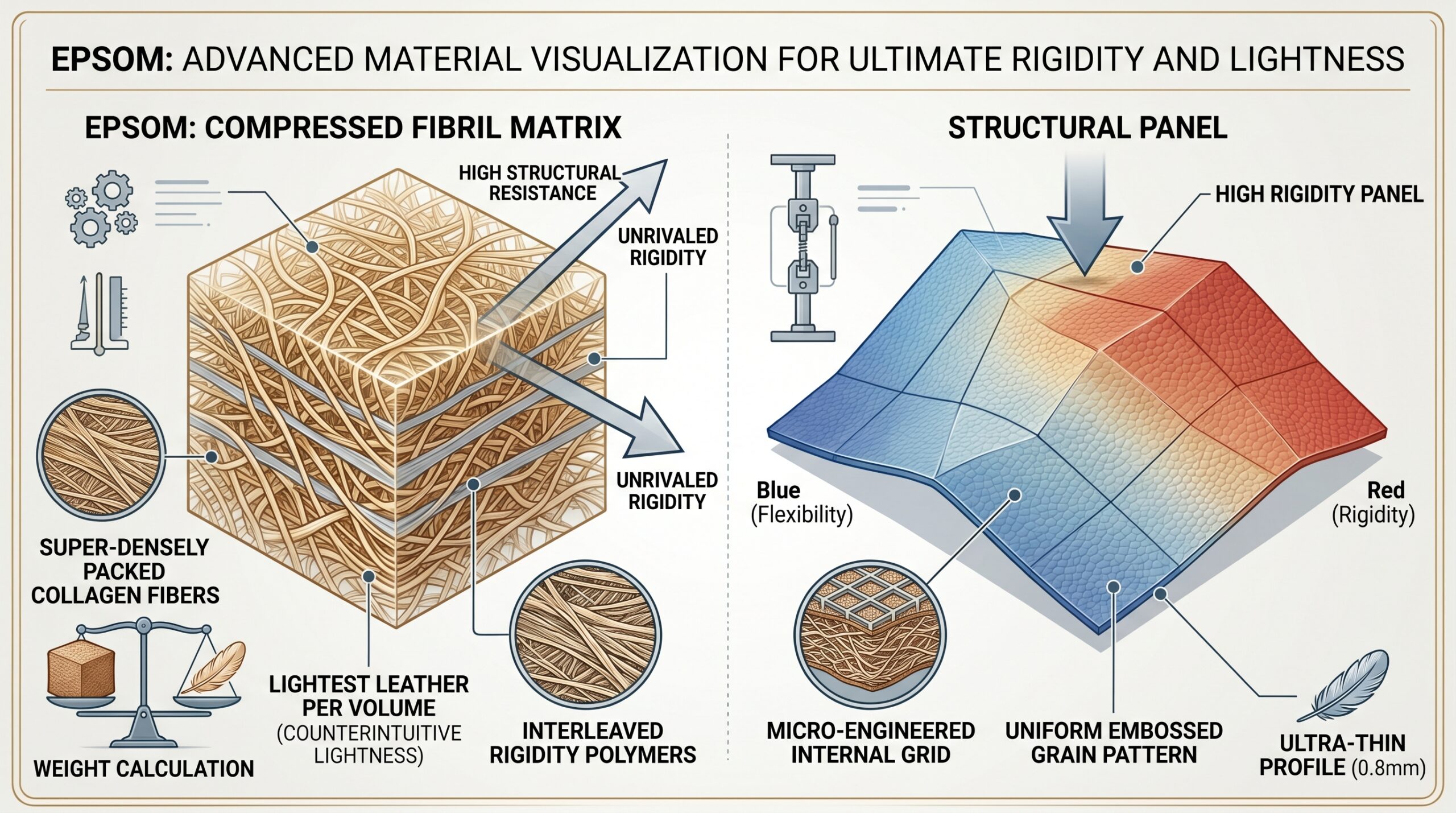
Panel area is identical between Togo and Epsom versions of the Birkin 30 — the bag's design dimensions are fixed regardless of leather. The weight differential must therefore arise from thickness and density. Togo's panel thickness averages approximately 1.0mm; Epsom's averages approximately 0.9mm — a 10% thickness differential across every leather panel in the bag. Over the multiple panels that make up a Birkin (front, back, base, two gussets, flap, handle drops, closure straps), this 10% thickness differential accumulates into a meaningful total mass difference. Additionally, Epsom's box-pressing process compresses the surface fibrils into a denser matrix — but this compression slightly reduces the total leather volume by consolidating air pockets within the fibril network, further reducing the mass of each panel relative to its pre-compression state. For the full size and lifestyle matching framework, the Size & Lifestyle Matching Guide hub covers format, leather, and weight considerations across the full range.
Note: weights are approximate ranges based on multiple verified examples. Individual pieces vary by approximately ±30g due to natural hide variation. Hardware type (gold/palladium/ruthenium) adds a consistent additional weight across all leather types.
"The stiffer the leather, the heavier the bag — is the intuition. Epsom is the counterexample: its compression process produces a lighter panel than Togo despite its far greater rigidity."
Togo's Weight Profile: Hide Origin, Panel Thickness, and the Pebbled Grain's Contribution
Togo leather's weight in the Birkin 30 format is a direct consequence of its hide origin and the drum-tumbling process that produces its characteristic pebbled grain. Togo is cut from the upper flank of a young bull — a zone of moderate hide thickness with a relatively tight fibril density. The finished panel averages approximately 1.0mm in thickness, which, across the full panel area of a Birkin 30, translates to a total leather mass that places Togo solidly in the mid-weight position among standard Hermès leathers.
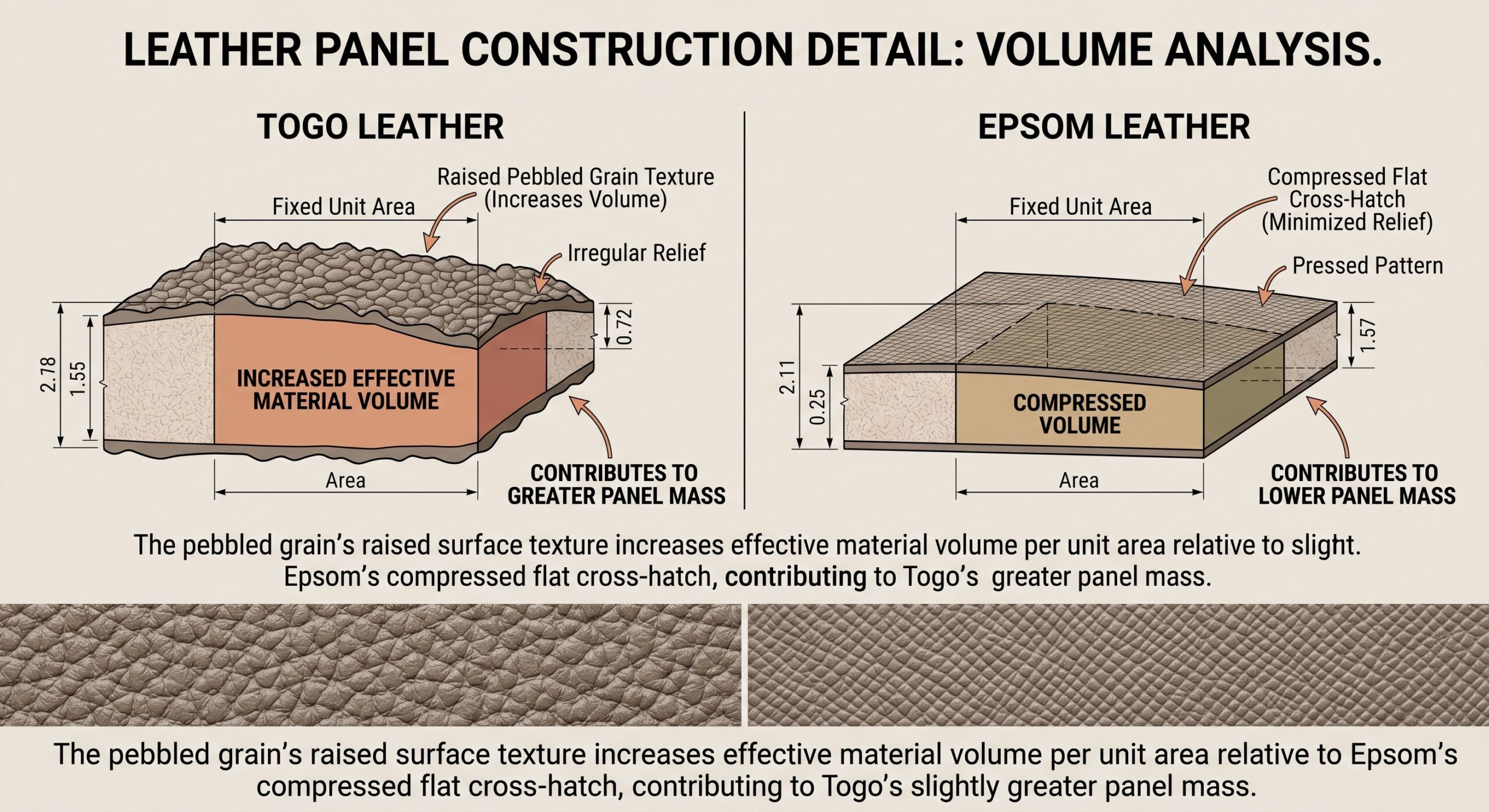
The drum-tumbling process that creates Togo's pebbled surface contributes to its weight in a specific way. The tumbling action softens the leather and creates the contracted, raised pebble texture — but this pebbling increases the effective surface area per unit of flat panel area, meaning more leather material exists in any given square centimetre of Togo surface than in the same square centimetre of Epsom's compressed flat grain. This marginal increase in effective material volume per unit area contributes to Togo's slightly higher weight relative to Epsom's compressed flat surface.
- Hide origin (upper flank of young bull) — moderately thick, dense fibril network that produces a panel averaging ~1.0mm in finished thickness
- Drum-tumbling process — softens the leather and creates pebbled surface texture; the contracted pebble raises effective surface area per unit of flat panel, adding marginal material mass
- Natural fibril density at the flank section — tighter than Clemence's belly-section fibrils but looser than the compressed matrix of Epsom; produces the moderate weight position that places Togo between the lightest and heaviest standard leathers
- Hardware weight is identical — gold, palladium, and ruthenium hardware in the same format adds consistent additional weight across all leather types; hardware does not contribute to the Togo-Epsom differential
- Interior lining weight is identical — the cotton or canvas lining in the Birkin 30 is the same regardless of exterior leather; not a factor in the leather weight comparison
Epsom's Weight Profile: The Compression Paradox and Its Practical Result
Epsom's counterintuitive weight position — lighter than Togo despite its far greater rigidity — is explained entirely by the box-pressing embossing process and its effect on the leather's panel thickness. To understand why this produces a lighter bag requires understanding what embossing compression actually does to the fibril architecture.
Before embossing, a Epsom hide panel and a Togo hide panel of the same area and pre-process thickness would weigh approximately the same amount — they originate from similar bovine hide sections with similar fibril density. The embossing rollers compress the Epsom surface under high pressure, reducing the panel's overall thickness by consolidating the fibril matrix. The fibrils that were previously occupying a volume with some interstitial air space are now packed more tightly together — the same fibril mass now occupies a smaller volume. The result is a thinner, denser panel rather than a thicker, less dense one.
Why Epsom's Stiffness and Lightness Are Produced by the Same Process
The box-pressing embossing process that makes Epsom lighter than Togo also makes it stiffer — and these two outcomes are produced by the same physical mechanism. Compression increases fibril packing density, which reduces panel volume (thinner panel = lighter) while simultaneously increasing the cross-linked contact points between fibrils (more contacts = more resistance to deformation = greater stiffness). This is the same principle that makes compressed wood denser, lighter per unit volume, and harder than uncompressed wood of the same species. The Epsom buyer therefore receives both lightness and rigidity from a single processing choice — a combination that is physically consistent even if it seems paradoxical at first encounter.
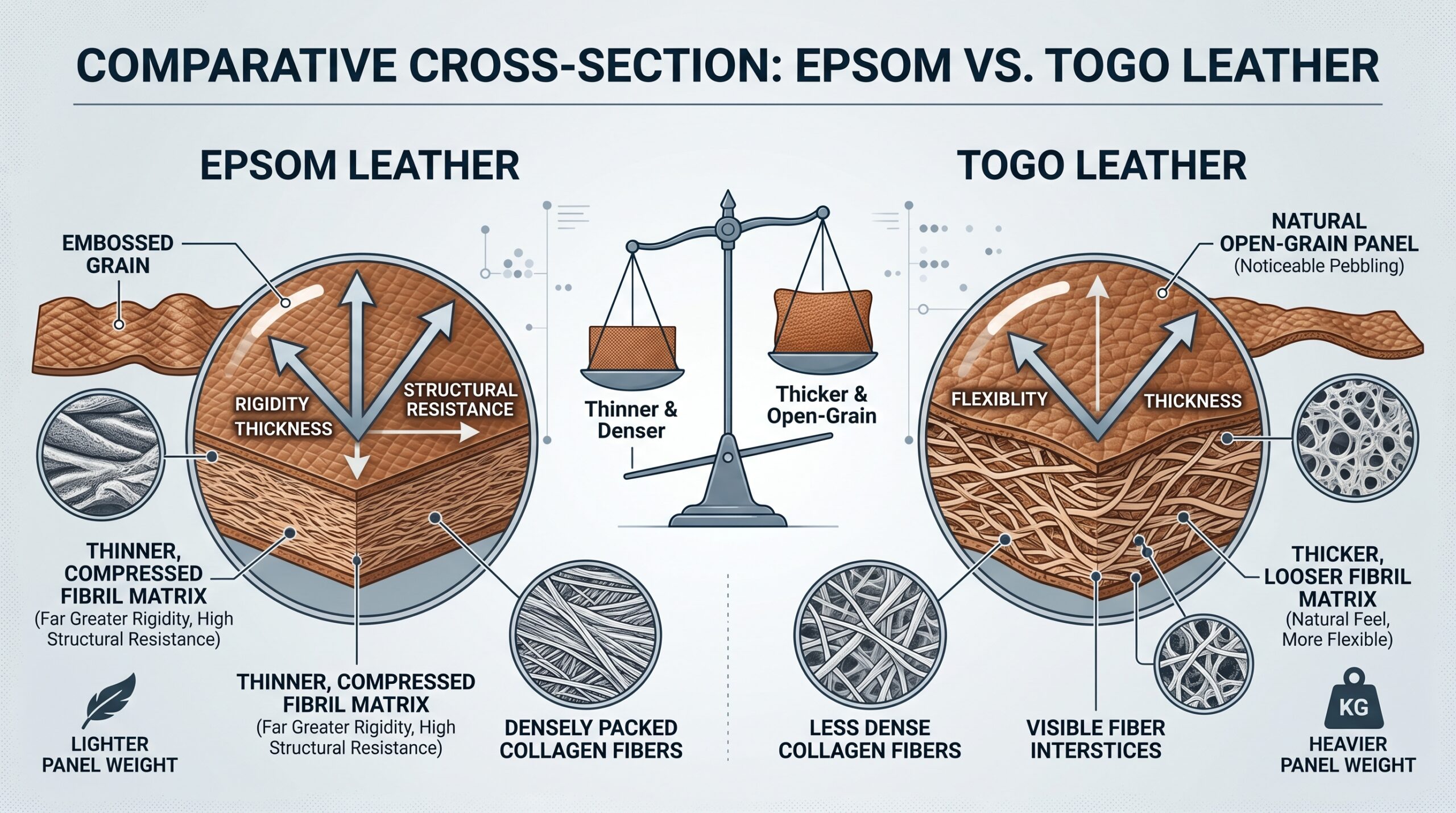
In the Birkin 30 format, the accumulated effect of Epsom's 0.9mm average panel thickness versus Togo's 1.0mm average across all leather components produces an empty bag weight advantage of approximately 30–60 grams for Epsom. This is the measurable physical consequence of the fibril compression that also produces Epsom's structural rigidity, scratch resistance, and sealed-surface patina behaviour — the full set of Epsom's distinctive properties that our dedicated long-term study covers in detail at Does Hermès Epsom Leather Soften With Use? For comparison with Clemence's substantially heavier weight profile — the inverse of Epsom's compression story — our piece on Togo vs Clemence leather slouch covers the hide-origin weight drivers that make Clemence the heaviest standard Birkin leather.
What the Weight Difference Means for Daily Carry and Lifestyle Matching
The 30–60 gram empty weight advantage of Epsom over Togo in the Birkin 30 occupies an interesting position in practical carry terms: it is below the threshold of conscious perception in casual handling — a brief side-by-side comparison of an empty Togo and Epsom Birkin 30 will not allow most buyers to reliably identify which is heavier — yet it becomes perceptible in extended carry with contents, and it is consistently meaningful over the course of a full carry day.
The mechanism by which a small weight differential becomes perceptible over time is cumulative muscular load rather than instantaneous weight sensation. When a bag weighing approximately 880g (Togo) plus 900g of contents is carried for six hours, the total force applied to the shoulder and handle-grip muscles over that period is substantially greater than the same carry duration with a bag at 840g (Epsom). The differential in total muscular work performed — approximately 4.5% more for the Togo carry — is not consciously noticed during the first two hours but accumulates as marginal additional fatigue by the end of a six-hour carry day. Buyers with existing shoulder sensitivity, those who commute long distances with the bag, or those who carry it in high-contents configurations will find the 30–60 gram differential more practically significant than buyers who carry lighter loads over shorter periods.
For buyers who are not weight-sensitive and who carry the Birkin 30 casually or intermittently, the 30–60 gram differential is not a meaningful buying factor — the leather choice should be driven entirely by the patina trajectory, structural properties, and care requirements that differentiate Togo from Epsom. The weight consideration becomes a genuine decision factor for daily commuters, buyers with existing shoulder or neck sensitivity, and those who consistently carry heavy loads. For the full ten-year performance comparison across all these properties, see our definitive ranking at Which Hermès Birkin Leather Wears Best Over 10 Years. Browse the full leather science category at Leather Science.
| Leather | Approx. Empty Weight (B30) | Panel Thickness | Weight Driver | Best For |
|---|---|---|---|---|
| Swift | ~780g (lightest standard) | ~0.8mm — thinnest standard leather | Fine calfskin with minimal panel mass; semi-matte finish adds negligible weight | Weight-sensitive owners who want a smooth leather — most demanding in terms of scratch care |
| Epsom | ~840g | ~0.9mm — compressed, dense matrix | Box-pressing reduces panel thickness despite increased rigidity; thinner panel = lighter bag | Buyers wanting maximum structural rigidity with a lighter-than-Togo weight profile |
| Togo | ~880g | ~1.0mm — pebbled grain adds effective material volume | Flank-section hide at 1.0mm; pebbled surface adds marginal effective material mass | Broadest range of buyers — best all-round weight, patina, and structural balance |
| Barenia Faubourg | ~870g (similar to Togo) | ~1.0mm — smooth, vegetable-tanned surface | Similar panel thickness to Togo but smoother surface; weight comparable but slightly variable due to full-grain variation | Patina-priority owners who can manage water sensitivity; similar weight to Togo |
| Clemence | ~960g (heaviest standard) | ~1.2mm — belly-section hide; greater fibril mass | Belly-section hide with looser, heavier fibril network; thickest standard panel in the Birkin range | Buyers who accept weight for tactile luxury and relaxed aesthetic; worst choice for weight-sensitive carry |
| Box Calf | ~820g | ~0.85mm — fine calfskin, box-pressed | Fine calfskin at slightly thinner specification than Epsom; box-pressing produces similar density effect | Buyers who want a lighter smooth leather and can maintain the pristine surface Box Calf demands |
Epsom Is Lighter Than Togo — by a Margin That Matters Only to Specific Carry Profiles
The 30–60 gram empty weight advantage of Epsom over Togo in the Birkin 30 is real, material-science-explainable, and consistently measured across multiple examples. It is produced by the compression process that also gives Epsom its structural rigidity — a counterintuitive pairing that is physically coherent once the fibril-compression mechanism is understood. For buyers who carry for six or more hours daily with substantial contents, or who have existing shoulder sensitivity, the differential is worth factoring into the specification decision alongside the far more consequential differences in patina trajectory, corner-care requirements, and structural behaviour over time.
For buyers who carry casually or with light loads, the weight difference between Togo and Epsom is not a meaningful decision factor. The leather should be chosen for its material behaviour over a decade: Togo if you want genuine patina development and forgiving surface wear; Epsom if you want geometric stability, sealed-surface consistency, and the counterintuitive lightness that compression provides. Weight is a supporting criterion, not the primary one — and in this case, the lighter leather happens to be the structurally more demanding one to care for.
Bottom Line: Epsom is 30–60g lighter than Togo in the Birkin 30 due to its compressed, thinner panel — a difference perceptible only in extended daily carry, but worth factoring in for weight-sensitive buyers alongside the patina and structural properties that should drive the primary specification decision.
Popular Searches
Explore our most searched Birkin weight and leather specification combinations
The benchmark daily carry specification — Togo Gold's ~880g empty weight plus typical 900g contents produces a carry load that the majority of active owners manage comfortably for full working days.
⬆ TrendingEpsom in the compact 25 format delivers the lightest weight specification in the structured Birkin range — the combination of Epsom's compressed panel and the 25's reduced panel dimensions produces the most carry-comfortable Birkin available.
★ Collector FavouriteThe in-boutique side-by-side weight comparison — most buyers cannot reliably detect the 30–60g gap in a brief empty-bag comparison, but experienced collectors who carry daily consistently identify Epsom as the lighter of the two.
◆ Ultra RareSwift in the compact Birkin 25 is the lightest daily carry specification in the standard range — for buyers who prioritise carry comfort above all other leather properties, this is the material specification that delivers it.
⬆ Rising DemandIn the larger 35 format, Clemence's ~1.2mm panel produces a significantly heavier empty bag than Togo — the weight gap at this size is consistently perceptible even in casual handling, making leather weight a more prominent decision factor.
🔥 Most SearchedEpsom Gold in the Birkin 30 is the most practical commuter specification in the standard range — the 30–60g weight advantage over Togo, geometric stability, and sealed surface combine for the most active-carry-friendly configuration.
Frequently Asked Questions
In a Birkin 30, Togo is typically 30–60 grams heavier than Epsom in the empty bag weight. This differential arises from Togo's slightly greater panel thickness — approximately 1.0mm versus Epsom's ~0.9mm — and the pebbled grain surface which adds marginally more leather mass per unit area than Epsom's compressed flat cross-hatch. While this gap sounds modest, over a full day of carry at an average contents weight of 800g to 1.2kg, the cumulative effect becomes perceptible in the shoulder and handle zones by the end of a long carry day. See the full size and lifestyle guide at the Size & Lifestyle Matching hub.
Among the standard Birkin leathers, Swift and Epsom are the lightest options in the Birkin 30 format. Swift's thin semi-matte calfskin panel has the lowest mass per unit area of any standard smooth Hermès leather. Epsom's compressed fibril matrix is thinner in its finished panel (~0.9mm) making it slightly lighter than Togo's ~1.0mm panels. Clemence is the heaviest standard leather, with its belly-section hide and ~1.2mm panel thickness. For the full Togo vs Clemence weight and slouch comparison see Togo vs Clemence: Which Slouches More Over Time.
The 30–60 gram empty weight difference is below the threshold of conscious perception in casual handling — most buyers cannot reliably identify which leather is heavier in a brief comparison. However, in extended daily carry with contents, the cumulative effect becomes perceptible. Buyers who carry a Birkin 30 for six or more hours per day, five days per week, will notice a slight fatigue differential over a full week. For buyers with specific weight sensitivity — shoulder conditions or long commutes — the difference is worth considering alongside structural and patina factors. For the long-term wear comparison see Which Hermès Birkin Leather Wears Best Over 10 Years.
The Birkin 25 in Togo runs approximately 150–200 grams lighter than the Birkin 30 in the same leather — a difference clearly perceptible in casual handling and substantial over a full day of carry. This weight reduction comes from smaller panel dimensions across all leather components, with the same leather thickness and material throughout. The Birkin 25 is a meaningfully more comfortable carry for weight-sensitive owners while delivering the same leather character and patina trajectory. The trade-off is interior volume — the 25 accommodates significantly less. Browse all size and leather science guidance at Leather Science.
