
Hermes Birkin vs Kelly: Construction and Leather Comparison
The definitive forensic comparison of how the Birkin and Kelly differ at the construction level — and how those structural differences determine which leathers belong on each bag and why.
The Hermès Birkin vs Kelly comparison is the most frequently asked question in the Hermès buying universe — and the most consistently answered at the wrong level. Most discussions focus on aesthetics: which looks more formal, which photographs better, which is more versatile. These are real considerations, but they are downstream of the more fundamental question: how does each bag's construction architecture interact with the leather specification, and what does that interaction produce over years of active carry? Understanding the Birkin and Kelly at the construction level — how each bag is built, what provides its structural integrity, and what properties each format demands from its leather — converts what would otherwise be a taste preference into an informed material specification.
This article provides the construction forensics that underlie every leather recommendation for both formats, maps the specific leather-format pairings that produce the most characteristic results, and delivers the decision framework that should follow from understanding both bags at the material level.
Construction Architecture: How the Birkin and Kelly Are Structurally Different at the Build Level
The Birkin and Kelly share the same saddle stitch construction method, the same waxed linen thread, the same range of leathers, and the same production standards. Their structural difference lies entirely in how the bag's geometry is established and maintained — what provides the architectural integrity that holds the bag's shape under load and over time.
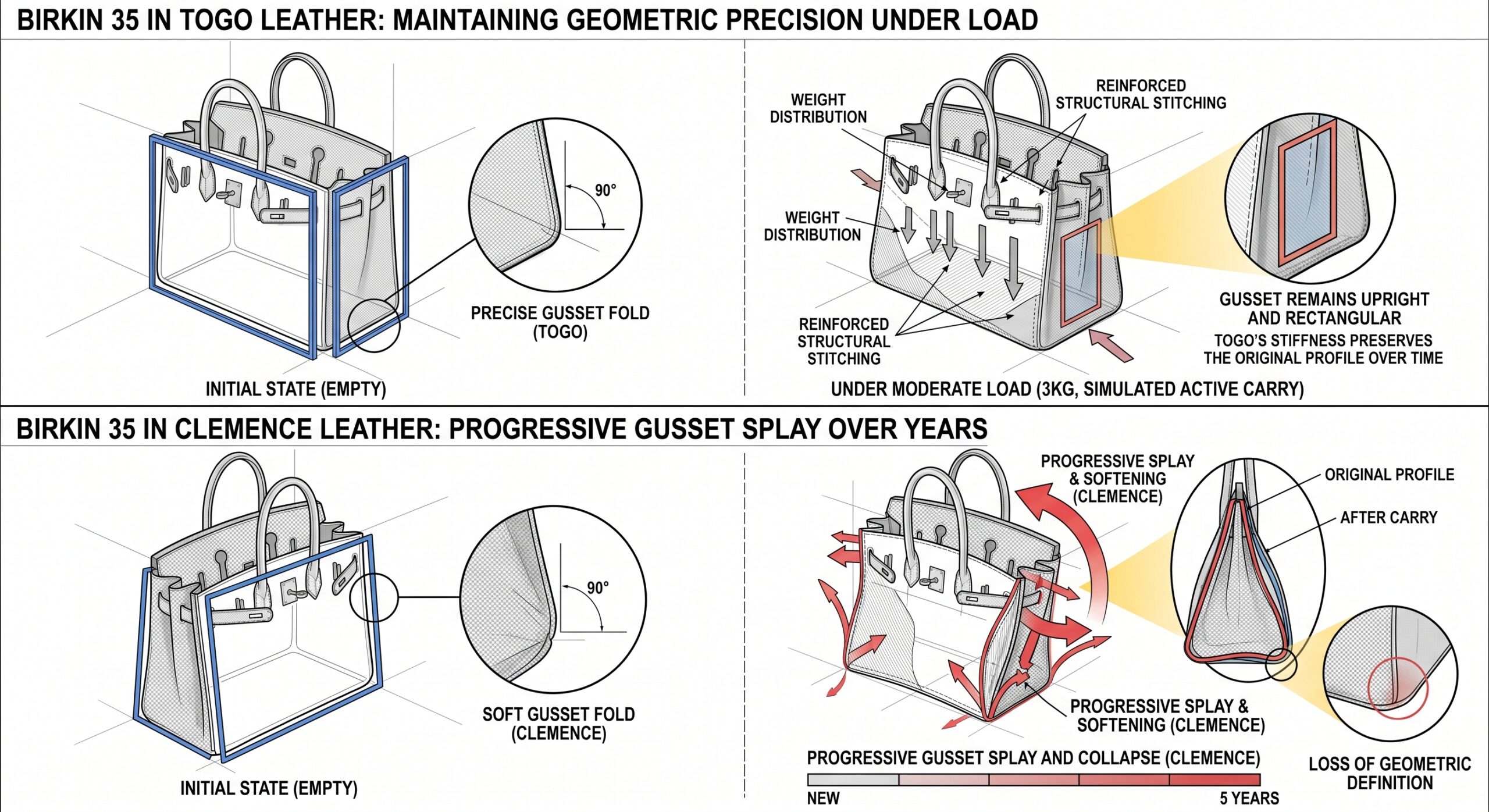
The Birkin is a self-supporting structured bag: its geometry is determined entirely by the leather panels and their saddle-stitched seam relationships. The front panel, back panel, base, and two gussets are joined by external seams (Birkin construction is analogous to the Kelly sellier in seam placement) and the turn-lock closure hardware — but there is no rigid chassis, no internal stiffening, and no structural element beyond the leather panels themselves. This means that the Birkin's shape under load is a direct function of its leather's temper: a firm-tempered leather like Togo or Epsom resists deformation under the bag's contents weight and maintains the rectangular silhouette. A supple-tempered leather like Clemence allows the base to flex and the gussets to splay under heavy loading. The leather is the structure.
The Kelly's structural logic is the opposite. The Kelly's flap closure creates a closed, self-bracing construction: the front flap, folded down and fastened, locks the front panel, the gussets, and the back panel into a rigid geometric relationship independent of the leather's temper. Additionally, the Kelly's internal construction — either sellier (external seams, double-stitched edge, maximum rigidity) or retourne (seams turned inward, softer profile, more relaxed geometry) — provides an independent structural chassis that the leather panels inhabit rather than constitute. A Clemence Kelly in retourne construction holds its shape under load because the Kelly's construction provides the structure, not because Clemence's temper is adequate to the task on its own. The full sellier vs retourne distinction is mapped in detail at Sellier vs Retourne Kelly: How Structure Changes Leather Behaviour. For the full comparison context, the Bag Comparisons hub covers all structural and leather pairings.
Birkin
Kelly
"The Birkin is held up by its leather. The Kelly holds its leather up. This single structural difference determines every leather recommendation that follows."
Which Leathers Work Best in the Birkin — and the Structural Reason Why
Because the Birkin's shape depends entirely on its leather's temper, the leather specification for a Birkin is a structural decision as much as an aesthetic one. The leathers that perform most characteristically in the Birkin format are those whose temper provides enough panel resistance to maintain the bag's rectangular silhouette under the loads typical Birkin owners carry — without being so rigid that the leather feels board-like in hand or adds unnecessary weight.
Togo is the Birkin's most naturally suited standard leather precisely because its temper sits at the ideal point for this format: firm enough to self-support the base-to-gusset geometry under moderate loads (800g–1.2kg contents), supple enough to feel luxurious in hand, and light enough at approximately 880g empty not to impose a carry burden. The pebbled grain provides the scratch resistance appropriate for a bag that receives daily handling, and Togo's chrome tannage produces the warm, even patina at contact zones that makes an aged Togo Birkin one of the most beautiful objects in the used luxury market. For the full ten-year Birkin leather wear analysis see Which Hermès Birkin Leather Wears Best Over 10 Years.
Epsom also performs characteristically in the Birkin because its box-pressed fibril matrix provides exceptional panel rigidity — arguably superior to Togo for maintaining the Birkin's geometry under heavy loading, at the cost of Epsom's corner vulnerability that the Birkin's active carry mode amplifies. For owners who carry very precisely and maintain Epsom's corners with discipline, an Epsom Birkin produces a geometric precision at Year 10 that Togo cannot quite match. For owners who carry actively without corner protection attention, Epsom's chipping vulnerability in a daily carry format is a care burden. The full Epsom long-term study is at Does Hermès Epsom Leather Soften With Use?
Clemence works in the Birkin but is not the format's most natural leather because Clemence's belly-section temper is softer than the Birkin's open-top architecture benefits from. A Clemence Birkin carries beautifully when moderately loaded — the leather's supple character produces a tactile warmth in hand that Togo and Epsom cannot replicate — but under heavy loading the base softens and the gussets splay, producing the characteristic Clemence slouch that diminishes the Birkin's geometric precision over time. For owners who prioritise tactile luxury over geometric precision and carry moderate loads, Clemence is a beautiful Birkin choice. For those who prioritise shape retention, it is the wrong temper for this format.
Which Leathers Work Best in the Kelly — and Why the Construction Changes the Answer
The Kelly's construction-supported structure fundamentally expands the leather options that work well in this format compared to the Birkin. Because the Kelly's flap closure and internal build provide geometric rigidity independent of leather temper, supple leathers that would develop problematic slouch in the Birkin can achieve their full aesthetic potential in the Kelly's self-supporting architecture.
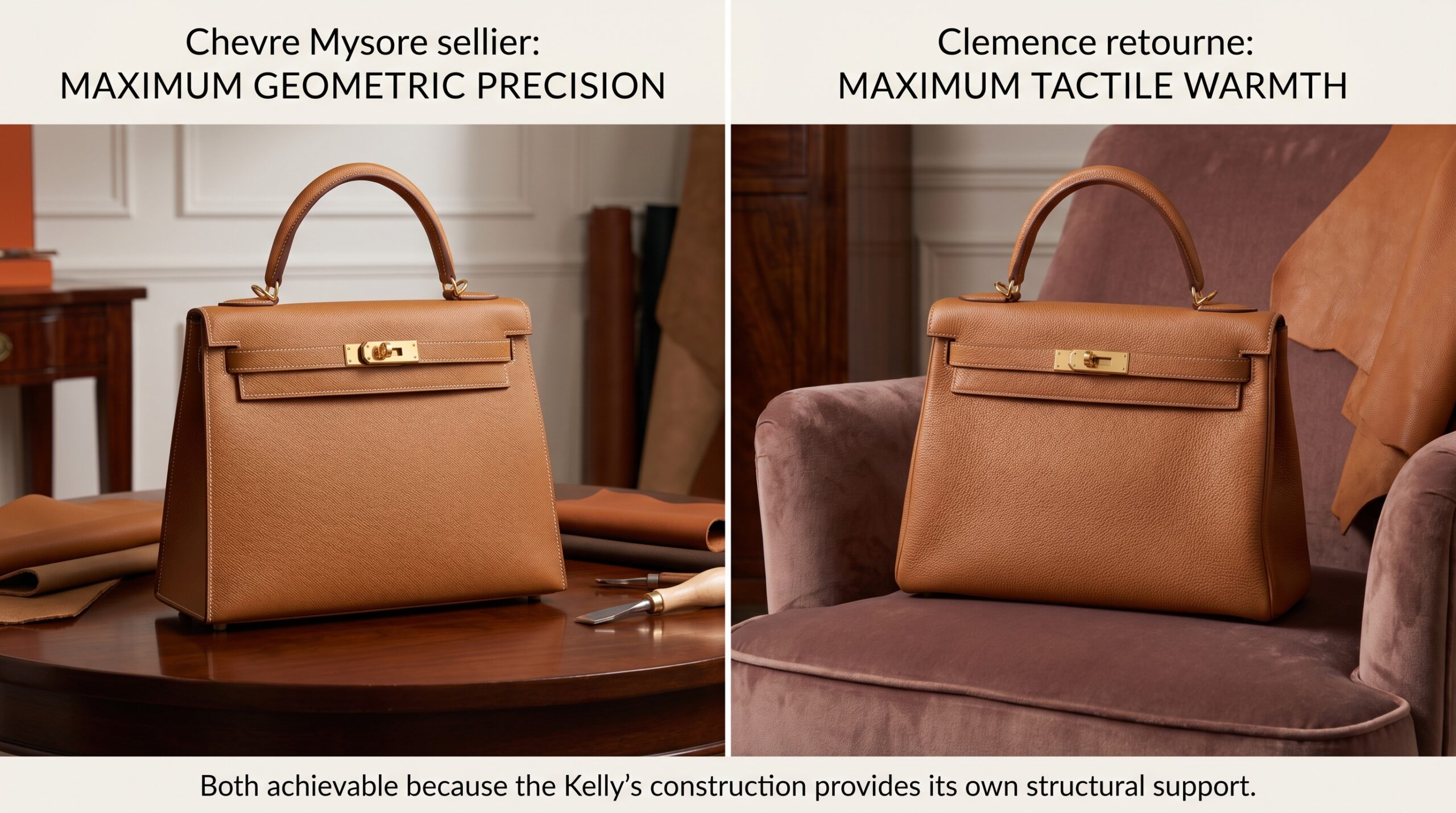
This is why the Chevre Mysore sellier Kelly is considered one of the most iconic leather-format pairings in the Hermès range — a pairing that has no equivalent on the Birkin. Chevre Mysore's board-like temper is genuinely advantageous in the Kelly's sellier construction because the extreme rigidity that would feel slightly uncomfortable in the Birkin's open-top self-supporting format becomes a perfect complement to the sellier Kelly's own rigid geometry. The Mysore-sellier combination produces a bag of extraordinary architectural precision — flat panels, perfect corner angles, and surface that shows no distortion at any fill level — that is only achievable when both the leather's temper and the construction's own rigidity are pointing in the same direction. This pairing is explored in full at our Sellier vs Retourne guide.
- Chevre Mysore sellier Kelly — the most architecturally precise pairing in the Hermès range; Mysore's board-like temper complements the sellier's own rigidity to produce geometric perfection that no other leather-format combination matches
- Clemence retourne Kelly — the most tactilely warm pairing; Clemence's supple temper and larger pebble produce a relaxed, rounded silhouette in the retourne construction that reads as luxuriously lived-in without the shape-retention concern of a Clemence Birkin
- Togo retourne Kelly — the all-round Kelly pairing; Togo's firm-to-supple temper works with the retourne construction to produce a bag with genuine geometric structure and the beautiful patina development that makes Togo the decade's best-ageing standard leather
- Epsom sellier Kelly — a highly practical pairing; Epsom's panel rigidity reinforces the sellier's own geometry; corner care is required but the sealed surface and geometric stability over years of use produce a bag that maintains its factory precision longer than most other specifications
- Barenia retourne Kelly — the most beautiful ageing pairing for buyers committed to full ownership engagement; Barenia's vegetable tannage produces extraordinary pellicule development in the retourne's rounded profile; water protection discipline is non-negotiable
Temper maintains rectangular silhouette under load; pebbled grain hides wear; chrome tannage patina at contact zones makes Year 5–10 Togo Birkins among the most beautiful objects in the secondary market.
Mysore's extreme rigidity complements the sellier's own geometry rather than fighting the format; colour saturation and scratch resistance are unmatched; the defining example of construction amplifying leather character.
Maximum panel rigidity for shape retention; corner care discipline required; sealed surface maintains colour precision over years; best for owners who carry precisely and maintain corners proactively.
Supple temper produces rounded retourne silhouette without Birkin's shape-retention concern; construction provides the structure Clemence's temper cannot; tactile warmth and relaxed aesthetic fully realised in this pairing.
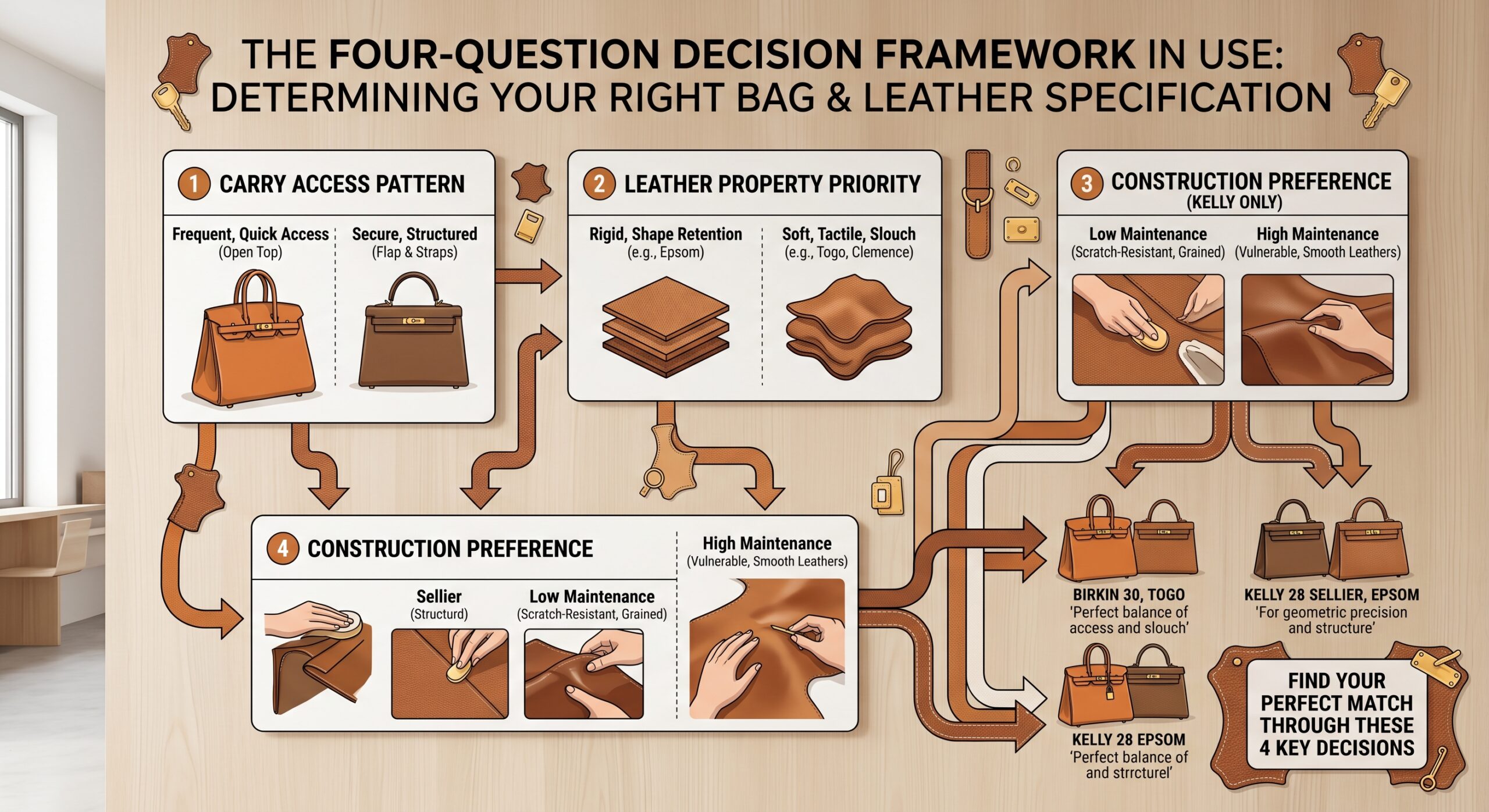
Choosing Between Them: The Four-Question Decision Framework
The Birkin vs Kelly choice is ultimately not a competition — both bags are exceptional objects whose differences reflect genuine design philosophy divergences rather than quality differences. The framework below converts the choice from a preference into a material decision grounded in carry style, leather preference, and ownership reality.
Question 1 — How do you access your bag during carry? If you reach into your bag frequently during the day — phone, keys, wallet, without stopping to unfasten a closure — the Birkin is the practical choice. Its open-top format allows immediate access to contents with zero closure friction. The Kelly requires the flap to be unfastened for each access — a small discipline that is entirely manageable for owners who reach in infrequently but noticeable for those who access their bag constantly. This single factor drives more Birkin purchases than any leather consideration.
Question 2 — Which leather property matters most to you? If temper and shape retention over a decade of heavy carry are your primary leather concerns, the Birkin amplifies these properties most directly — choose Togo or Epsom and know that your leather is doing the structural work. If surface character, colour depth, and the aesthetic of an exceptional leather is your primary concern — and you are willing to carry the closure discipline the Kelly requires — the Kelly's construction-independent structure allows you to choose any leather in the range, including the most supple and most visually extraordinary, without the temper compromise that same leather might represent in the Birkin.
Question 3 — Which construction do you want in the Kelly, if choosing a Kelly? Sellier if you want maximum architectural precision and are prepared for the corner and surface care discipline that firm-tempered leathers in external-seam construction require. Retourne if you want the Kelly's structure within a softer, more rounded silhouette that accommodates supple leathers and a more relaxed aesthetic. This question has no wrong answer — it is a preference question whose material consequences are mapped in full at our Sellier vs Retourne Kelly guide. For how the Kelly and Birkin compare in the context of the broader range, see our Kelly vs Birkin: Which Bag Construction Is More Durable? analysis. Browse all comparison resources at All Topics.
Question 4 — What is your leather care commitment level? Both bags demand conditioning and storage discipline. The Birkin demands more active temper protection — a neglected Clemence Birkin develops shape issues that a neglected Clemence Kelly does not, because the Kelly's construction compensates for what the leather's temper cannot deliver. The Kelly demands more closure hardware maintenance — the turn-lock and associated fittings receive more mechanical use than the Birkin's lighter toggle and padlock system. Neither demand is onerous, but they fall on different components of the ownership experience.
| Factor | Birkin | Kelly Sellier | Kelly Retourne |
|---|---|---|---|
| Structural principle | Leather-supported — panels and seams provide all geometry | Construction-supported — external seams and flap closure provide rigid chassis | Construction-supported — internal seams and flap closure provide softer chassis |
| Temper requirement | Firm-to-supple minimum — soft temper produces shape loss under load | Any — construction compensates for soft temper; firmer leathers amplify sellier precision | Any — construction provides structure; supple leathers amplify retourne's rounded aesthetic |
| Ideal leather | Togo — optimal temper, patina, and scratch resistance for self-supporting format | Chevre Mysore — board-like temper complements sellier rigidity; maximum colour precision | Clemence or Togo — both produce beautiful retourne silhouette; Togo for longevity, Clemence for warmth |
| Foil stamp location | Exterior front panel — visible during carry | Interior leather panel — visible only when bag is opened | Interior leather panel — visible only when bag is opened |
| Access to contents | Open-top — immediate access with no closure unfastening | Closed flap — requires unfastening for each access; three-point turn-lock closure | Closed flap — same closure mechanics as sellier; more relaxed daily discipline due to softer silhouette |
| Carry modes | Double handle — hand carry or crook of arm; no standard shoulder strap | Single handle — hand carry, crook of arm, or optional shoulder strap; most formal carry mode | Single handle — same carry options as sellier; slightly more relaxed in hand due to softer profile |
| Best size for first purchase | 30 — the all-round Birkin format; accessible volume without Birkin 35's weight penalty | 28 — the classic sellier Kelly proportion; matches the formal character of the construction | 25 or 28 — both suit the retourne's softer profile; 25 for lighter carry, 28 for practical volume |
| Ten-year leather outcome | Togo: excellent — warm patina, maintained shape under moderate load, strongest secondary value | Chevre Mysore: excellent — minimal wear, maximum colour precision, rarity premium | Togo: excellent — same decade-long performance as Birkin Togo with less shape-retention stress |
The Birkin and Kelly Are Not Competitors — They Are Different Solutions to Different Ownership Briefs, Each Perfect for Its Own Context
The Birkin vs Kelly question has no correct answer because both bags are genuinely excellent — and their differences reflect genuine design philosophy distinctions rather than quality differences at any tier. The Birkin is the most practical of the two for active daily carry: open access, double handles, and a leather-dependent structure that rewards the owner who chooses their leather with the format's structural requirements in mind. The Kelly is the more architecturally ambitious: a closed-flap construction with internal structural integrity that liberates the leather specification from temper constraints and allows extraordinary leathers like Chevre Mysore to achieve their most spectacular expression.
The thirty articles in this series have mapped every dimension of Hermès leather science that bears on this decision — from the fibril-level differences between Togo and Clemence through the tannage chemistry of Barenia, from the construction mechanics of sellier versus retourne through the authentication markers that protect the investment, and from the conditioner chemistry that maintains vegetable tannage to the CITES documentation that enables international liquidity in exotic skins. Every article in this collection has been built toward the moment when a buyer stands in front of a Birkin or Kelly and makes a specification decision that will define the next ten years of their leather relationship. The knowledge exists. Use it.
Bottom Line: Choose the Birkin if you want open access and a bag whose shape is your leather's direct expression; choose the Kelly if you want a closed-format structural chassis that liberates your leather choice from temper constraints — and in either case, choose your leather based on the material science that this site has mapped across thirty articles, not on aesthetics alone.
Popular Searches
Explore our most searched Birkin vs Kelly specification combinations
The direct comparison most first-time buyers face — same leather, same colour, different format. Birkin for open-access daily carry; Kelly for structured formal carry and the construction-supported shape retention that sellier provides.
⬆ TrendingEpsom Noir in the compact 25 format — the Birkin 25 Epsom is the most geometrically precise small Birkin; the Kelly 25 Sellier Epsom is the most architecturally severe Kelly; both extraordinary, both demanding of corner care discipline.
★ Collector FavouriteThe most iconic leather-format pairing in the Hermès range — Mysore's board-like temper amplified by the sellier's external seam rigidity produces a bag of geometric precision that no other specification achieves.
◆ Ultra RareThe exotic skin format decision — Porosus crocodile in both Birkin and Kelly 25, where the scale matching, CITES documentation, and finish maintenance requirements are identical but the construction interaction with the exotic skin's rigid scale surface differs meaningfully.
⬆ Rising DemandThe supple leather format decision — Clemence Gold in both bags, where the Kelly retourne's construction support eliminates the shape-retention concern that makes Clemence a qualified choice in the Birkin; the clearest illustration of how format changes leather performance.
🔥 Most SearchedThe foundational question — answered through carry access pattern, leather preference, temper requirements, and construction understanding rather than aesthetics: the four-question decision framework that converts a preference into a material specification.
Frequently Asked Questions
The fundamental construction difference is their structural principle. The Birkin is self-supporting — its geometry is determined entirely by the leather panels and saddle-stitched seams, with no rigid internal chassis. The Kelly has construction-supported structure — the flap closure and internal build (sellier or retourne) provide geometric rigidity independent of leather temper. This means the Birkin's shape depends on its leather's temper, while the Kelly's shape is maintained by its own construction regardless of what leather it uses. For Kelly construction detail see Sellier vs Retourne Kelly: How Structure Changes Leather Behaviour. See the full comparison at the Bag Comparisons hub.
Both bags can use the same leather types, but each format amplifies different leather properties. The Birkin amplifies temper — firm-tempered leathers like Togo and Epsom maintain its open-top silhouette under load. The Kelly amplifies surface character — because the Kelly's construction provides its own structural rigidity, any leather including supple Clemence or uniquely textured Chevre Mysore can achieve its full aesthetic potential in the Kelly's supported architecture. Chevre Mysore sellier Kelly and Togo Birkin are the two most iconic leather-format pairings because each combination amplifies its leather's best properties. For ten-year leather wear context see Which Hermès Birkin Leather Wears Best Over 10 Years.
Durability over ten years depends more on leather choice than bag format — both are built to last decades when maintained correctly. In comparable leathers and equivalent carry intensity, the Kelly's rigid construction provides a slight durability advantage because the leather panels are not the sole structural element. The Birkin's leather panels bear all structural load, meaning leather temper and conditioning discipline have a larger impact on long-term shape retention. A Togo Birkin maintained with regular conditioning performs as well as a Togo Kelly; a neglected Clemence Birkin develops shape issues faster than an equivalently neglected Clemence Kelly because the Kelly's construction compensates for Clemence's temper limitations. Browse all topics at All Topics.
No — the two bags have fundamentally different carry mechanics. The Birkin is carried open or with the flap loosely closed, offering immediate access through the open top. The Kelly requires the flap to be unfastened to access contents, making it less practical for frequent access during carry. The Birkin is typically carried by double handles in hand or elbow crook. The Kelly offers single handle, crook of arm, or optional shoulder strap — a more formal, composed carry mode. Both can be carried the same hours per day, but their access mechanics and carry modes suit different carry styles and contexts. Browse all bag comparisons at All Topics.
