
Hermès Birkin Size Guide: 25 vs 30 vs 35
A forensic breakdown of dimensions, capacity, weight and resale liquidity across the three standard Birkin sizes — and which one actually fits the life you live.
Choosing between the Hermès Birkin 25, 30 and 35 is rarely a question buyers get to sit with — quota allocation, boutique availability and waitlists usually mean you take the size you're offered, in the leather you're offered, when you're offered it. But understanding the real dimensional, weight and lifestyle differences between the three sizes before that moment arrives is what separates a purchase you'll carry for a decade from one that sits in a dust bag by year two. The three sizes are not simply "small, medium, large" scaled versions of the same bag — each occupies a genuinely different position in daily life, and the differences compound once leather choice enters the equation.
This guide maps the dimensional and capacity differences across Birkin 25, 30 and 35, places weight in the context of leather choice covered in our Togo vs Epsom Birkin 30 weight study, and closes with a practical framework for matching size to the life you actually live — not the life you imagine carrying a handbag in.
The Three Birkin Sizes at a Glance
Hermès measures the Birkin by its width across the base — the "25," "30" and "35" refer to approximately 25cm, 30cm and 35cm of front-panel width, not the bag's full external footprint. Height and depth scale alongside width but not in strict proportion, which is why the jump in usable capacity between sizes feels larger than the centimetre differences imply. A Birkin 30 is not "20% bigger" than a Birkin 25 in the way that matters to a buyer — it is roughly 40–50% more voluminous, because capacity scales with the product of three dimensions, not one.
- Birkin 25 — approximately 25 × 20 × 13cm (W × H × D), roughly 9–10 litres of usable interior capacity, the most structured and evening-adjacent of the three sizes
- Birkin 30 — approximately 30 × 22 × 16cm, roughly 13–14 litres, the size Hermès produces in the greatest volume and the size most boutique staff recommend as a first Birkin
- Birkin 35 — approximately 35 × 25 × 18cm, roughly 17–18 litres, closer to a structured tote than a handbag and the size most associated with the bag's original 1984 travel-luggage brief
These measurements vary by a centimetre or two depending on leather stiffness and hardware generation — a Clemence 30 will measure marginally larger at the base than an Epsom 30 due to the softer leather's natural give — but the proportional relationships between the three sizes hold consistently across leather types.
Birkin 25 — Who It's Actually For
The Birkin 25 is the most divisive size among long-term owners, and the divide comes down almost entirely to what you expect from a daily bag. At roughly 9–10 litres, it comfortably holds a compact wallet, phone, keys, sunglasses and a slim cosmetics pouch — but a standard-sized tablet, a water bottle, or a bulky zip cardholder will visibly strain the corners and gussets. Buyers who already carry light, or who use the 25 as a going-out bag layered over a daytime tote, consistently rate it as the most comfortable and elegant of the three sizes to wear on the forearm or shoulder.
The trade-off is capacity discipline. Owners who buy the 25 as their only bag and try to carry a full daily-use kit report the most frequent regret among Birkin buyers — not because the bag is poorly made, but because the size mismatch between lifestyle and specification becomes a daily friction point. If you are shopping for a single, do-everything Birkin, the 25 is rarely the right answer unless your daily carry is already minimal. If you are building a rotation and want the most photogenic, most versatile-with-outfits size, the 25 earns its reputation.
"The Birkin 25 rewards buyers who edit their carry to the bag. The Birkin 35 rewards buyers who need the bag to carry their life. Most people, most of the time, actually live in the 30."
Birkin 30 — The All-Rounder
The Birkin 30 is the size Hermès produces most, boutique staff recommend most often, and secondary-market data shows changes hands most liquidly — and all three facts point to the same underlying reality: it is the size that fits the widest range of daily-carry needs without becoming a visual or physical burden. At roughly 13–14 litres, it holds a phone, wallet, keys, sunglasses case, a light cardigan or scarf, and a slim water bottle without the silhouette bulging or the gussets straining.
Proportionally, the 30 also reads correctly on the widest range of heights and frames — a genuine consideration Hermès designers account for, since a bag scaled too large for a petite frame or too small for a tall frame disrupts the visual balance the house is known for. For buyers choosing a single, working Birkin that needs to function across office, travel and social contexts, the 30 is the size that requires the least compromise across all three.
Birkin 35 — Built for Volume and Work
The Birkin 35 is the closest the line comes to a genuine work bag. At roughly 17–18 litres it accommodates a laptop sleeve, a folded jacket, a full cosmetics bag and the accumulated contents of a full working day — the specification range the bag was originally engineered for when Jean-Louis Dumas designed it as a structured travel piece in 1984. Owners who commute with documents, travel frequently with cabin-only luggage, or use the bag as a diaper bag consistently cite the 35 as the only size that removes the need for a second carry item.
The trade-off is scale and weight. A loaded Birkin 35 in a mid-weight leather can carry a genuinely substantial total load, and its proportions favour taller frames — on a petite buyer, the 35 can visually dominate rather than complement. It is also the size most likely to be carried by handle rather than worn on the shoulder for extended periods, since the depth and width make shoulder-carry less comfortable than with the 25 or 30. Buyers considering the 35 as a first and only Birkin should honestly assess whether their daily contents genuinely require that capacity, or whether a 30 with better internal organisation would serve the same purpose with less bulk.
Note: weights are approximate ranges for Togo leather with gold hardware; individual pieces vary by roughly ±40g due to natural hide variation. For the material-science reasons different leathers add or remove weight within the same size, see our dedicated Togo vs Epsom Birkin 30 weight breakdown.
How Leather Choice Shifts the Size Equation
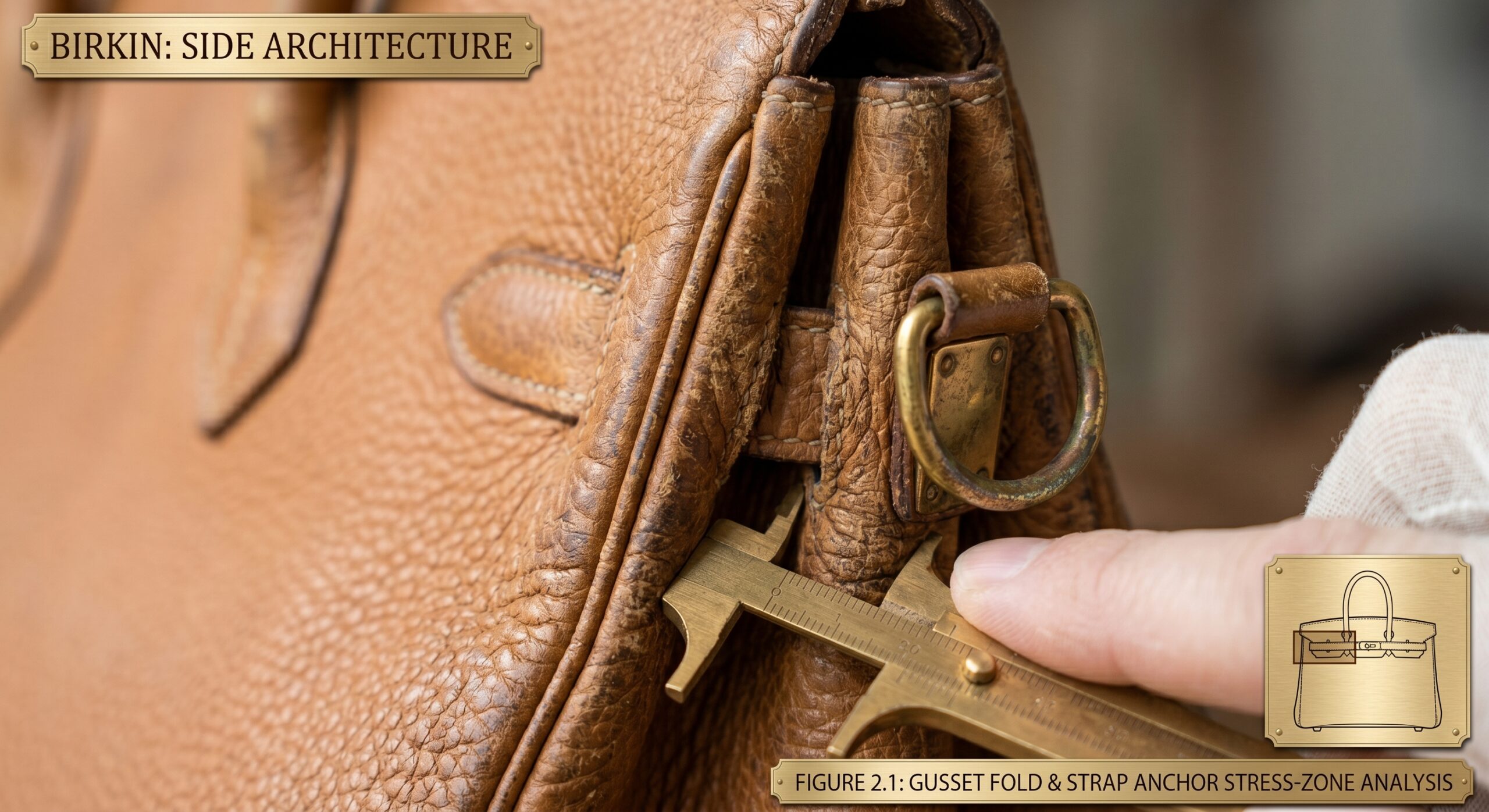
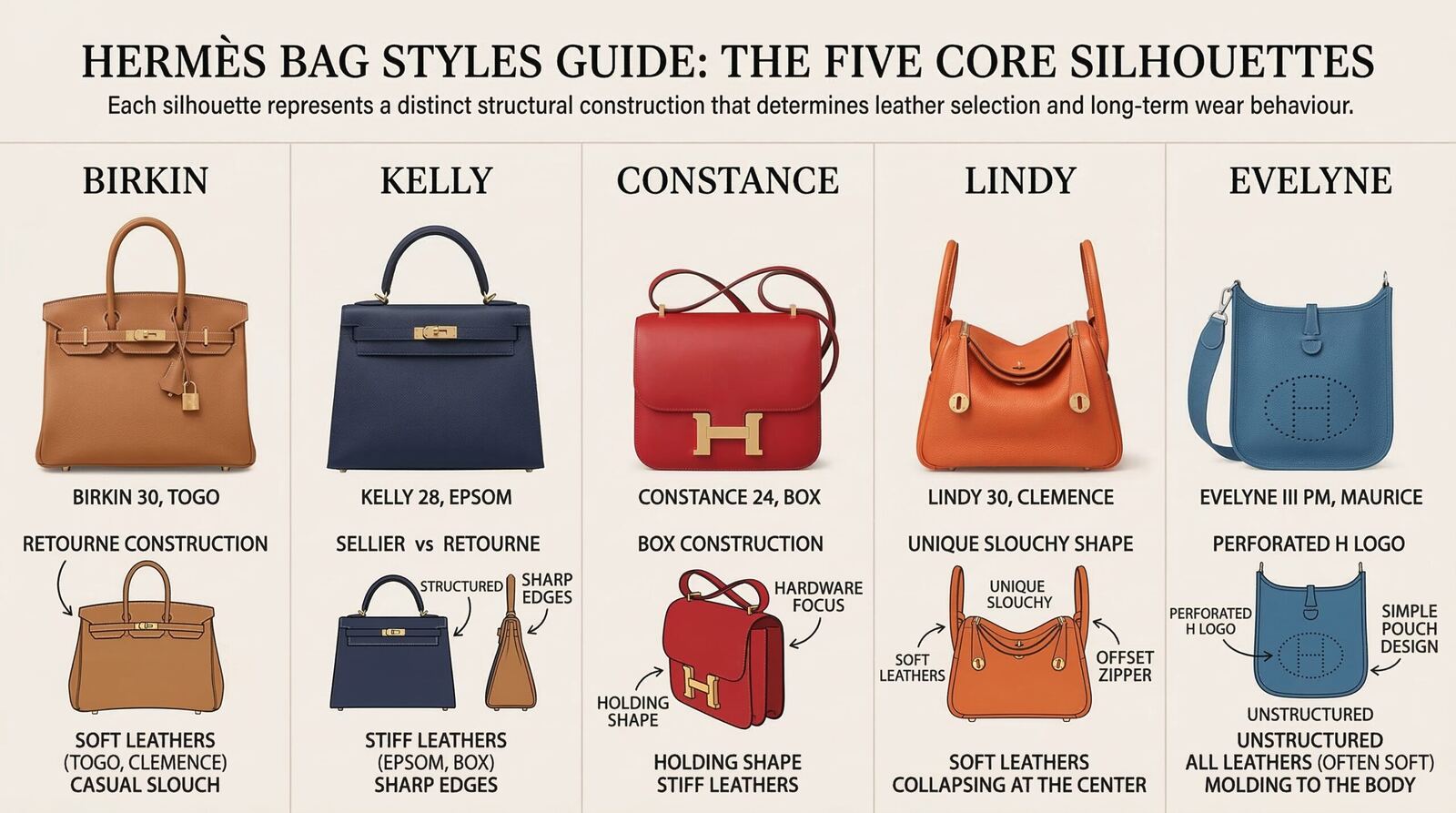
Size and leather are not independent decisions — the same 30cm width behaves differently depending on what it's made from, and this interaction is one of the most underappreciated factors in choosing a specification. A structured leather like Epsom holds its geometric shape regardless of size, so a Birkin 25 in Epsom looks and carries almost like a scaled-down 30 — crisp corners, minimal slouch, consistent silhouette whether empty or loaded. A softer, more supple leather like Clemence behaves very differently at small sizes: the 25's compact frame doesn't give the leather enough surface area to develop its characteristic relaxed slouch, so much of what makes Clemence desirable in a 35 is muted in a 25. Our full breakdown of this dynamic is covered in Togo vs Clemence: Which Slouches More Over Time.
Togo, the most broadly recommended all-purpose leather, sits between these two extremes at every size — enough structure to hold shape in a 25, enough natural give to develop a lived-in character in a 35. This versatility across the full size range is a significant reason Togo remains the most commonly recommended leather for a first Birkin, regardless of which size a buyer ultimately settles on. For the construction-level comparison between Birkin and Kelly leathers more broadly, see Hermès Birkin vs Kelly: Construction and Leather Comparison.
A Quick Proportional Guide
Boutique stylists commonly use a rough height-to-size heuristic, though personal preference and how the bag is carried (handle vs shoulder) matter more than height alone. Under roughly 160cm, the Birkin 25 or 30 tends to read most proportionally; between 160–175cm, the Birkin 30 is the most universally balanced choice; above 175cm, the Birkin 30 or 35 both work, with the 35 suiting buyers who want the bag to visually anchor a taller frame rather than get lost against it. Treat this as a starting point for trying bags in person, not a rule — proportion is ultimately a visual judgement, not a formula.
Resale Liquidity by Size
Size measurably affects how quickly and at what premium a Birkin resells, independent of leather and colour. The Birkin 25 and Birkin 30 consistently show the strongest resale liquidity because they match the largest pool of interested buyers and the most common daily-carry use case — a bag sized for wide appeal simply has more people bidding on it when it re-enters the market. The Birkin 35, while offering the most usable capacity, draws from a smaller pool of buyers who want or can comfortably carry that scale day to day, which typically translates to a longer time-to-sell and marginally softer premiums outside of rare colourways or exotic skins, where the calculus shifts toward collector demand rather than daily-use demand.
It's worth stressing that condition and leather type outweigh size as resale drivers in absolute terms — a pristine 35 in a desirable colour will always outsell a heavily worn 25 — but size is a meaningful secondary factor once condition and leather are held constant. For the complete framework on how leather condition specifically moves resale price, see Does Leather Condition Affect Hermès Resale Price?
| Size | Approx. Dimensions | Capacity | Empty Weight (Togo) | Best For |
|---|---|---|---|---|
| Birkin 25 | 25 × 20 × 13cm | ~9–10L | ~700–780g | Evening-to-day carry, petite frames, buyers who edit their contents tightly |
| Birkin 30 | 30 × 22 × 16cm | ~13–14L | ~840–960g | The all-purpose daily bag; broadest proportional and resale appeal |
| Birkin 35 | 35 × 25 × 18cm | ~17–18L | ~980–1,080g | Work, travel, laptop or diaper-bag capacity; taller frames |
The Birkin 30 Is the Right Default — Size Up or Down Only for a Specific Reason
Across dimensions, capacity, weight and resale liquidity, the Birkin 30 consistently occupies the position of least compromise: large enough for genuine daily use, small enough to wear comfortably on the shoulder, and liquid enough on resale that it remains a defensible purchase even if your needs change. Buyers should treat the 25 and 35 as intentional deviations from that default — the 25 for those who already carry light and prioritise silhouette and evening versatility, the 35 for those with a genuine capacity need such as laptop carry, travel, or family logistics.
Leather choice should be decided in tandem with size, not after it — a structured leather like Epsom makes a 25 feel more capable than its litres suggest, while a soft leather like Clemence only fully expresses itself at 30 or 35. If you're choosing your first Birkin and have no strong capacity requirement pulling you toward the 35 or no strong style requirement pulling you toward the 25, the 30 remains the size with the fewest ways to get the decision wrong.
Bottom Line: Default to the Birkin 30 unless a specific capacity need (35) or a specific style priority (25) pulls you in that direction — and match leather structure to size, since the same specification behaves differently at each scale.
Popular Searches
Explore our most searched Birkin size and leather specification combinations
The complete framework for matching Hermès bag size and leather to lifestyle, covering weight, carry comfort, format and material factors across the full range.
⬆ TrendingA material-science breakdown of why Togo and Epsom produce different empty weights in the same Birkin 30 format — and what it means for daily carry.
★ Collector FavouriteWhich bag construction holds up better over a decade of wear — a structural comparison that complements this size guide for buyers weighing Kelly against Birkin.
◆ Ultra RareOur definitive ten-year performance ranking across Togo, Epsom, Clemence, Swift and Box Calf — essential reading once you've settled on a size.
⬆ Rising DemandThe full resale framework covering how condition, leather type and — as this guide shows — size interact to determine secondary-market value.
🔥 Most SearchedA full construction-level comparison between the two flagship silhouettes, useful context for buyers deciding on size before deciding on model.
Frequently Asked Questions
For most buyers, the Birkin 30 is the best everyday size. It holds roughly 13–14 litres, carries a phone, wallet, keys, sunglasses case and a light layer without visibly bulging, and its proportions read correctly on the widest range of heights and frames. The Birkin 25 suits buyers who travel light or want an evening-to-day piece, while the Birkin 35 suits buyers who need laptop or diaper-bag capacity. See the full Size & Lifestyle Matching Guide for the complete framework.
The Birkin 25 is not too small for daily use, but it demands disciplined editing of what you carry. At roughly 9–10 litres it fits a compact wallet, phone, keys and a small cosmetics pouch comfortably, but a standard tablet, water bottle or bulky cardholder will strain the gussets. Buyers who already carry light — or who use the Birkin 25 as a going-out bag rather than a work bag — find it the most elegant and comfortable size to wear on the shoulder or forearm.
An empty Birkin 35 typically runs 120–200 grams heavier than a Birkin 30 in the same leather, a difference driven by larger panel dimensions across the front, back, base and gussets rather than any change in leather thickness. In Togo, a Birkin 30 averages roughly 880g empty while a Birkin 35 averages roughly 1,000–1,080g empty. For the material-science detail behind leather-driven weight differences, see our Togo vs Epsom Birkin 30 weight study.
The Birkin 25 and Birkin 30 consistently show the strongest resale liquidity because they match the widest base of buyers and the most common daily-carry use case. The Birkin 35, while roomier, has a smaller pool of buyers who want or can comfortably wear that scale, which typically means a longer time-to-sell outside of rare colours or exotic skins. Condition and leather type still outweigh size as resale drivers — see Does Leather Condition Affect Hermès Resale Price? for the full framework.
No. Hermès restricts certain leathers and hardware combinations by size, and boutique and special-order availability shifts season to season. Stiffer, thicker leathers such as Clemence are less commonly offered in the 25 because the smaller frame does not showcase the leather's characteristic slouch, while structured leathers like Epsom and Togo are broadly available across all three sizes. Always confirm current availability with a boutique, as allocation policies change.
