

Does Leather Condition Affect Hermes Resale Price?
A forensic breakdown of how patina, grain integrity, structural soundness, and finish condition translate directly into secondary market grading and price — leather type by leather type.
The answer to whether leather condition affects Hermès resale price is not just yes — it is emphatically yes, and the magnitude of the impact is larger than most owners realise until they are standing in front of a specialist reseller's grading table. After model, size, leather type, colour, and hardware combination are fixed, leather condition is the single largest remaining variable in secondary market pricing. The difference between a pristine and a heavily used piece of the same specification can be 30–50% of market value. Within the used category, the difference between a well-maintained piece with desirable patina and one showing structural damage is another 20–35%. These are not marginal adjustments — they are the difference between a strong return and a significant loss on a major investment.
This article maps exactly how specialist resellers read leather condition at the material level — how grain integrity, finish quality, structural soundness, and patina character each contribute to the condition grade that determines your price. It concludes with concrete, material-science-based guidance on the interventions that protect resale value and the condition failures that are most expensive to allow.

How the Secondary Market Reads Leather Condition: The Grader's Eye
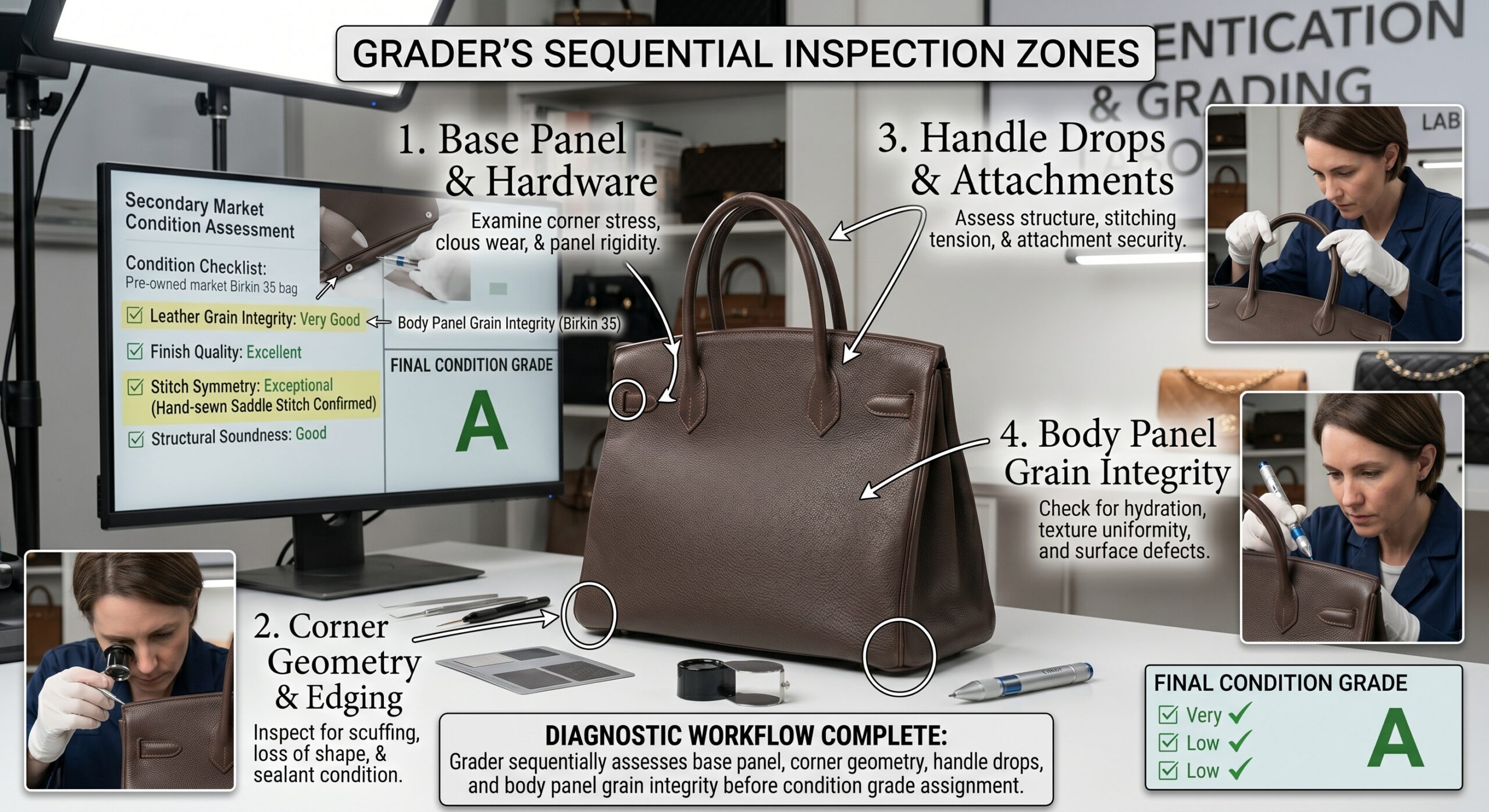
When a specialist reseller assesses a Hermès piece for grading, they are not making aesthetic judgments — they are conducting a forensic inspection of the leather's material state across a systematic series of zones. Understanding the inspection framework is the first step toward understanding what drives the price you receive.
The inspection begins at the base — the first surface to contact the ground, table, or floor and the zone that accumulates the most incidental abrasion. The grader assesses the base leather for surface abrasion depth, corner geometry, hardware feet condition, and glazing integrity at the base edges. From the base, the inspection moves to the body panels: grain integrity across the full face, finish condition, any staining, scratch accumulation, and — critically in supple leathers — whether the panel shows structural deformation that indicates temper relaxation. The handle drops, hardware zones, and closure hardware are assessed next, followed by the interior lining, the clochette, and the lock.
At every zone, the grader is making a material assessment: not "does this look old" but "what has happened to the leather at the fibril level, and is that change reversible or permanent?" A well-developed patina on Togo, for example, is not read as damage — it is read as evidence of genuine use that has produced a desirable material outcome. A water tide mark on Barenia is read differently: as evidence of a tannin-concentration event in the fibril network that has permanently altered the surface chemistry and cannot be remediated. The distinction drives meaningfully different price outcomes for two pieces that a non-specialist might assess as similarly "used." For the full investment context and what drives Hermès value over time, the Investment Guide hub covers the complete secondary market framework.
"A grader isn't asking whether your bag looks old. They're asking whether what happened to the leather is reversible — and if the answer is no, the price reflects it immediately."
The Condition Grade Scale and Its Price Implications
Specialist Hermès resellers use a five-category condition scale that maps directly to price position within each specification tier. The categories below represent the framework used by major secondary market platforms, with price impact stated as a range relative to the top-grade price for the same specification.
Leather-by-Leather: How Condition Grading Plays Out Differently Across Skin Types
The grade scale above applies universally, but the specific condition factors that determine which grade a piece receives — and how steeply each condition issue is penalised — vary significantly between leather types. This is where material knowledge produces directly actionable investment insight.
Togo is the most forgiving leather for condition grading at equivalent use levels. The pebbled grain masks minor surface abrasion more effectively than smooth leathers — a scratch that would be a visible Grade D marker on Swift or Box Calf is often invisible within Togo's natural grain texture. The patina that Togo develops over active carry is broadly considered desirable by specialist buyers, meaning a well-developed even patina on a Gold or Fauve Togo piece may actually attract a modest premium within the Grade C tier relative to an equivalent-age piece without patina history. The primary Togo condition risks are: uneven or blotchy patina from inconsistent conditioning (reads as neglect rather than natural aging), and water tide marks which concentrate tannin-analogous surface oils into permanent ring staining.
Epsom has a binary condition dynamic that distinguishes it from all other standard leathers. Its flat body panels age almost imperceptibly under normal carry — a Grade B Epsom piece can present nearly identically to a never-carried piece across its flat surfaces at Year 5. The entire condition grade pivot for Epsom rests on two factors: corner glazing integrity and the presence or absence of corner chipping. An Epsom piece with clean, intact corner glazing and no chipping will grade strongly regardless of its carry history. The same piece with even minor corner chipping drops immediately to Grade D or below — because chipping is permanent, visually prominent on the precise geometry, and cannot be invisibly repaired.
The Single Most Expensive Condition Failure in the Hermès Resale Market
Across all leather types and all condition categories, finish cracking on the handle drops is consistently the most severely penalised condition failure relative to its visual size. A crack in the leather finish at the handle drop fold — typically caused by the leather being subjected to temperature extremes, prolonged dryness, or bending stress beyond the finish layer's flex tolerance — represents a Grade E condition issue regardless of the bag's otherwise excellent state. The crack cannot be invisibly repaired: the finish layer's molecular structure has fractured, and any repair product applied will not match the original finish chemistry. On a Birkin or Kelly in an otherwise strong condition, handle drop cracking alone can reduce the resale price by 40–55% compared to an equivalent piece without the crack. Prevention — regular conditioning to maintain finish layer flexibility, avoidance of extreme temperature storage — is entirely within the owner's control.
- Togo — primary risks: uneven patina from inconsistent conditioning; water tide marks; handle drop finish cracking from dehydration. Primary asset: grain masks minor surface wear better than any other standard leather
- Epsom — primary risks: corner chipping (binary grade impact); handle drop finish cracking. Primary asset: flat panels age imperceptibly; pristine Epsom presents almost as new at any age
- Clemence — primary risks: base slouch in larger formats under heavy carry (structural, irreversible); handle drop cracking. Primary asset: surface patina reads well in warm tones; scratch marks less visible than smooth leathers
- Barenia Faubourg — primary risks: water tide marks (severe: permanent tannin concentration); uneven conditioning producing blotchy patina. Primary asset: well-maintained pieces command highest premiums in the used-condition tier of any standard leather
- Swift — primary risks: accumulated scratch history (partially recoverable but visible); finish layer oxidation unevenness. Primary asset: recovery capability keeps Grade C pieces more presentable than equivalent Box Calf
- Box Calf — primary risks: any scratch accumulation (permanent, high contrast against gloss); gloss reduction at contact zones. Primary asset: pristine box calf commands the highest Grade A premiums of any standard leather — and the steepest Grade D discount
What Owners Can Do to Protect Resale Value Before It Erodes
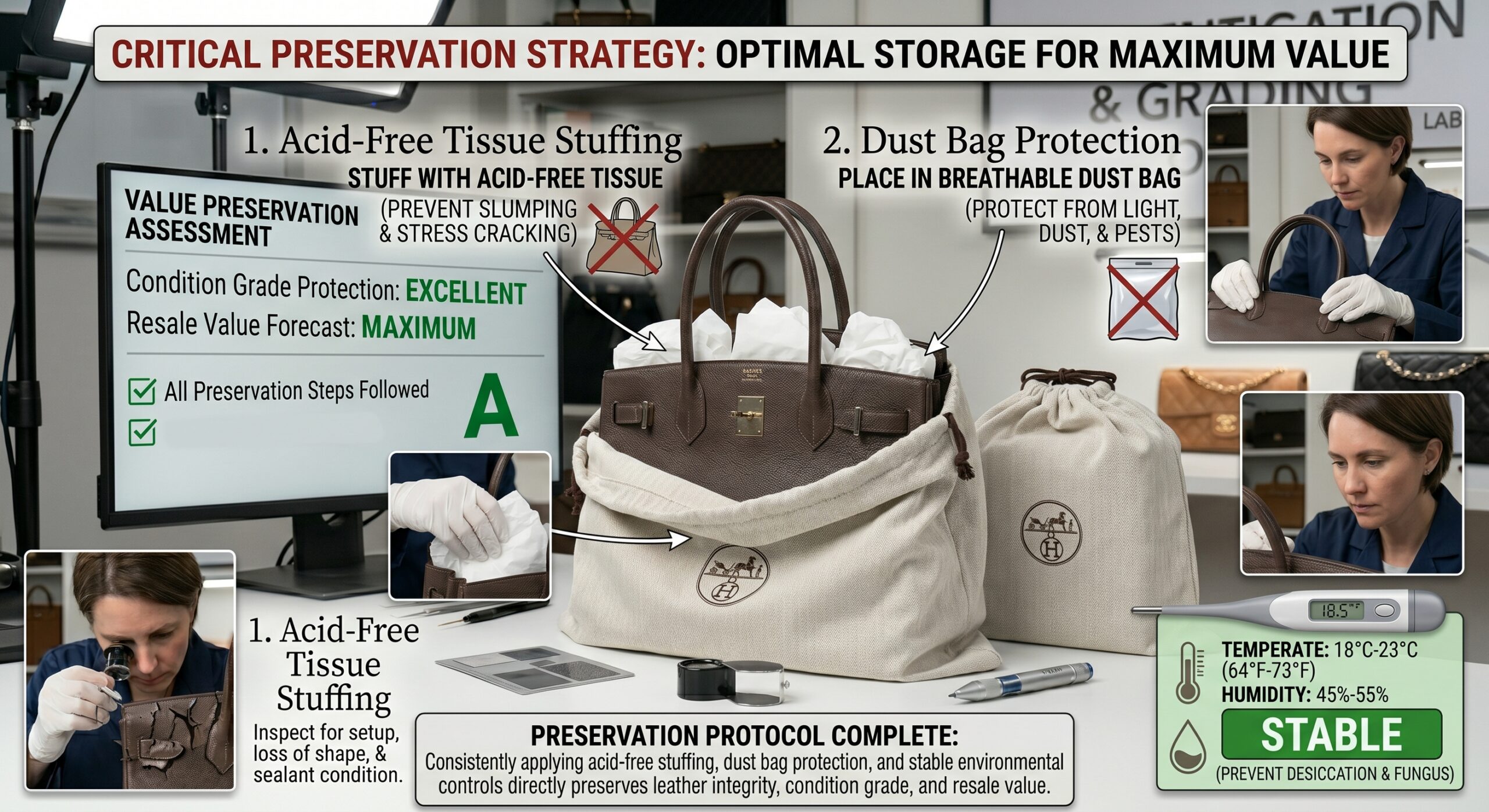
The material science of Hermès leather condition maps directly to a set of owner interventions with measurable resale impact. None of these require specialist equipment — they require only the knowledge of what the leather's chemistry demands and the discipline to supply it consistently.
Conditioning is the highest-return maintenance investment available to any Hermès owner. A pH-neutral conditioning cream applied at the correct frequency — every three to four months for Togo and Clemence, every six to eight weeks for Barenia, twice yearly for Epsom — maintains the finish layer's flexibility, prevents dehydration cracking at handle drops and fold points, and ensures even lipid distribution through the fibril network that prevents blotchy patina. The cost of a quality conditioning cream applied correctly across a decade of ownership is negligible relative to the resale value it protects. For comprehensive leather conditioning guidance covering Barenia specifically, our piece on Hermès Leather Tanning Terms Every Buyer Should Know provides the scientific vocabulary for evaluating product ingredients.
Corner protection is the second most impactful intervention — specifically for Epsom and Box Calf owners, for whom a single corner chip represents a Grade D condition event regardless of all other factors. A soft base insert or small foam corner protectors used during storage prevent the incidental impact events that cause most corner damage. The bag should never be placed directly on hard surfaces at an angle — always flat or on a protective base. For Togo and Clemence owners, corner protection is less critical because the natural-grain leathers round rather than chip, and the resulting wear is less catastrophic to condition grade.
Storage discipline has a direct and measurable impact on the condition outcomes that the secondary market penalises most severely. Storing a bag without its stuffing — acid-free tissue filling the interior to maintain panel geometry — allows the leather panels to settle under gravity into a permanently deformed position, particularly in Clemence and other supple-tempered leathers. UV exposure during storage accelerates the oxidation of pale tone leathers beyond the natural carry rate, widening the tonal differential between panels and producing uneven patina. Temperature extremes during storage — whether in a very cold exterior cupboard or near a heat source — are the primary cause of finish-layer cracking at handle drops. For the full investment value framework including exotic skin CITES considerations, see our companion article on Hermès Exotic Skin CITES Certificates and Resale. Browse the full investment and value category at All Topics.
| Leather | Most Damaging Condition Issue | Grade Impact | Preventable? | Desirable Patina Premium? |
|---|---|---|---|---|
| Togo | Uneven / blotchy patina; water tide marks | C → D (−15 to −30%) | Yes — consistent conditioning and water protection | Yes — even warm-tone patina can support value |
| Epsom | Corner chipping — irreversible finish loss | B → D/E (−35 to −55%) | Yes — corner protection and soft storage base | No — contact sheen not valued as patina |
| Clemence | Base slouch in Birkin 35 under heavy carry | C → D (−20 to −35%) | Partial — stuffed storage and load discipline slow rate | Moderate — warm-tone patina valued but outweighed by slouch |
| Barenia Faubourg | Water tide marks — permanent tannin concentration | B → D/E (−30 to −50%) | Yes — beeswax pre-treatment and dry carry discipline | Yes — highest patina premium of any standard leather |
| Swift | Accumulated scratch history — partially recoverable | B → C/D (−20 to −35%) | Partial — conditioning enables recovery; care limits accumulation | Moderate — burnished patina valued in warm tones |
| Box Calf | Any surface scratching — permanent gloss disruption | A → D/E (−40 to −60%) | Yes — only through exceptional carry and storage discipline | No — gloss reduction reads as wear, not patina |
| All leathers | Handle drop finish cracking — most severe single failure | Any grade → E (−40 to −55%) | Yes — regular conditioning; temperature-stable storage | N/A — structural damage category |
Leather Condition Is the Most Controllable Variable in Hermès Resale Value — and Most Owners Underinvest in Controlling It
The secondary market price impact of leather condition is not abstract — it is measured in grade steps that translate directly to thousands of dollars in resale value on pieces worth five figures or more. The five condition failures that produce the steepest grade drops — corner chipping on Epsom, handle drop cracking on any leather, water tide marks on Barenia, base slouch on large-format Clemence, and accumulated scratching on Box Calf — are all substantially preventable through conditioning discipline, storage practice, and carry awareness. None of them require specialist equipment or expensive restoration services. They require only the knowledge of what is at risk and the habit of acting on it consistently.
The owners who achieve the strongest resale outcomes are not those who avoided using their bags — they are those who used their bags knowledgeably, conditioned consistently, stored correctly, and chose leathers whose natural aging trajectories produced outcomes the specialist buyer pool values. Material knowledge converts directly to preserved equity. The investment case for understanding your leather is as strong as the investment case for buying the right bag in the first place.
Bottom Line: Leather condition is the largest controllable variable in Hermès resale pricing — consistent conditioning, corner protection, proper storage, and water discipline are the four interventions that protect the most value, and all are within every owner's reach.
Popular Searches
Explore our most searched Hermès condition and resale value combinations
The most liquid resale specification — Grade B Togo Gold commands the most consistent secondary market premiums, with well-developed even patina often sustaining value at or above original retail.
⬆ TrendingCorner glazing integrity is the single pivotal condition factor for Epsom Kellys — intact corners at any age sustain strong Grade B pricing; any chipping triggers an immediate multi-grade drop.
★ Collector FavouriteWell-managed Barenia with full pellicule and no water marks commands the highest used-condition premiums of any standard leather — the patina itself is the value proposition at resale.
◆ Ultra RareNever-carried Box Calf in the compact Kelly 25 commands the highest Grade A premium of any standard specification — pristine gloss on a rare format drives collector-tier secondary market pricing.
⬆ Rising DemandCraie's pale tone amplifies every condition variable — consistent conditioning and UV management are more critical for this specification than any other, making Grade B Craie command significant premiums.
🔥 Most SearchedNoir minimises visible slouch progression on Clemence 35 — the dark tone is the most resale-protective Clemence colour choice for large-format bags where base softening is an inherent risk.
Frequently Asked Questions
Leather condition is the single largest variable in Hermès secondary market pricing after model, size, leather type, and hardware combination are fixed. The difference between a pristine-condition piece and a heavily used one of the same specification can be 30–50% of market value. Within the actively used category, the difference between a well-maintained piece with desirable patina and one showing significant structural damage — pronounced slouch, corner chipping, or finish cracking — can be 20–35%. See the full investment reference at the Investment Guide hub.
Patina can either increase or decrease resale value depending on the leather type and the character of the patina. In Togo and Barenia, a well-developed, even patina in a warm mid-tone colour is broadly considered desirable by specialist buyers and can support or slightly enhance value relative to a same-specification piece without patina history. Uneven, blotchy patina — from inconsistent conditioning or water damage — is treated as damage and reduces value. In Epsom and Box Calf, any visible surface evolution beyond minor contact sheen is read as wear rather than patina by specialist graders. For leather-specific patina science see How Hermès Togo Leather Changes Color Over Time.
The five conditions that most severely reduce Hermès secondary market prices are: corner chipping on Epsom or Box Calf (difficult to restore invisibly); pronounced base slouch on Clemence in larger Birkin formats (structural and irreversible); finish cracking on handle drops or flap fold (indicates temperature extremes or severe dehydration); water tide marks on Barenia or Togo (permanent tannin or oil concentration); and pen or ink marks on any leather (almost impossible to address without visible residue). Each produces a steeper price reduction than general wear of equivalent visual severity because they are either irreversible or require costly specialist intervention. For care protocols see the Care & Storage Guide.
Togo consistently holds resale value best among the standard Birkin and Kelly leathers over multi-year ownership. Its pebbled grain masks minor surface wear more effectively than smooth leathers, its patina trajectory is broadly considered desirable, and its shape retention under moderate carry keeps the bag presenting cleanly at resale. Epsom holds value exceptionally well when corner glazing is intact. Barenia Faubourg commands strong premiums in well-maintained condition but grades steeply when water marks or uneven conditioning are present. For the full ten-year leather performance ranking see Which Hermès Birkin Leather Wears Best Over 10 Years.
