Hermès Iconic Collections: Birkin, Kelly, Constance & Beyond
What each model’s structural design reveals about the leathers it is built to carry — and how each silhouette ages based on its engineering.
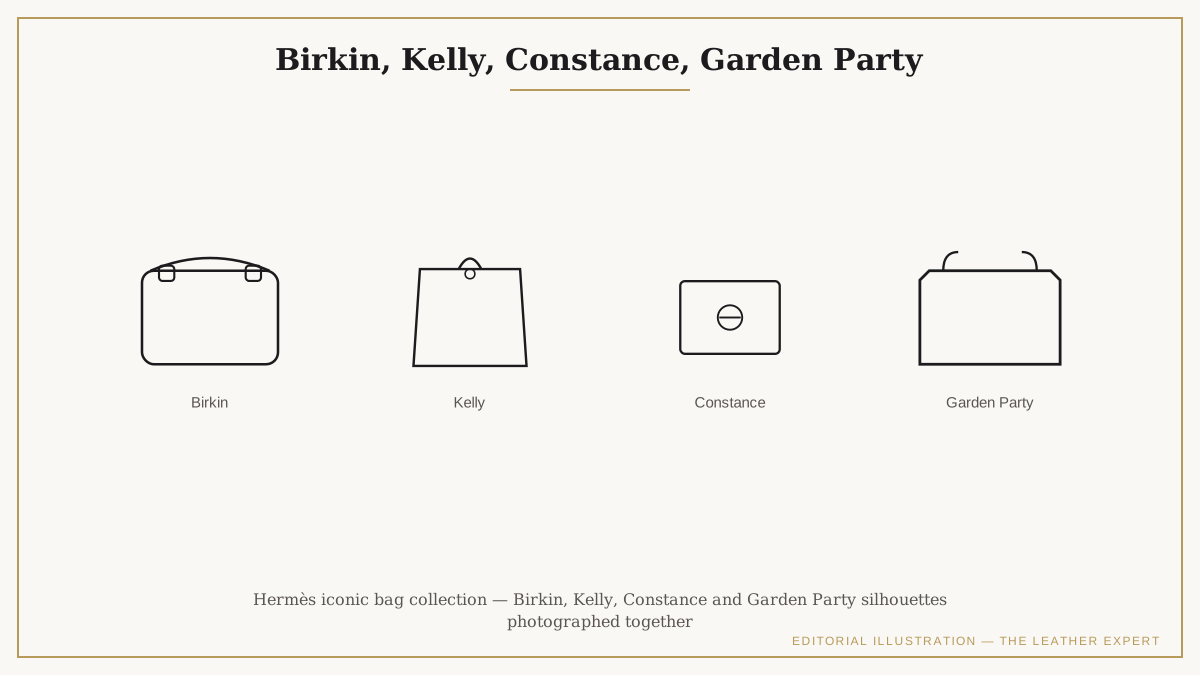
The most important question a leather-literate buyer asks when evaluating an iconic Hermès model is not which one is more popular — it is which leather grades each model was designed to carry, and how each silhouette’s structural logic interacts with the specific leathers Hermès pairs with it in production. The Birkin’s four base feet are not decorative — they are a structural response to the mechanical demands of the gusseted trapezoid under load. The Garden Party’s Negonda leather is not a cost decision — it is a material engineering choice for a bag designed to flex.
This hub covers the iconic Hermès collection through a construction and materials lens — what each model’s structural design reveals about the leathers it is built to carry, and how each silhouette ages based on its engineering. For every iconic model covered here, the central question is the same: what does this bag’s architecture demand from its leather?
4
Iconic models analysed through construction and material logic
10+
Years of documented leather ageing data used in this analysis
40+
Hours of hand-craftsmanship in a single Birkin or Kelly bag
Reading Iconic Hermès Models Through a Construction Lens
Most buyers approach iconic Hermès models through a market lens — which model holds value best, which is most recognisable, which has the longest waitlist. These are legitimate questions, but they do not address the more fundamental issue: which model’s structural logic is compatible with your intended use pattern and your leather preference.
Every iconic Hermès model is a resolved structural solution. The Birkin resolves the problem of carrying significant load in a soft bag — its gusseted trapezoid distributes weight across a broad base with articulated side panels that flex without concentrating stress. The Kelly resolves the problem of a formal bag that holds its shape under compression — its rigid frame chassis maintains silhouette integrity even when under-filled. The Garden Party resolves the problem of a high-capacity everyday tote — its open-top, flat-base construction distributes load vertically rather than concentrating it at a single carry point.
“Every structural decision in an iconic Hermès bag is also a leather selection decision. The construction determines which leathers can perform in that bag — and which will fail.”
- Birkin: gusseted trapezoid — demands leathers with cyclical flex tolerance and consistent fibril density
- Kelly: rigid frame — demands leathers with angular stress resistance and controlled patina capacity
- Constance: envelope fold — demands leathers with low-stress patina development capability
- Garden Party: flat-base tote — demands leathers with body and vertical load tolerance
- All iconic models: construction logic determines leather selection — not the reverse
The Birkin: Gusseted Engineering and the 10-Year Leather Question
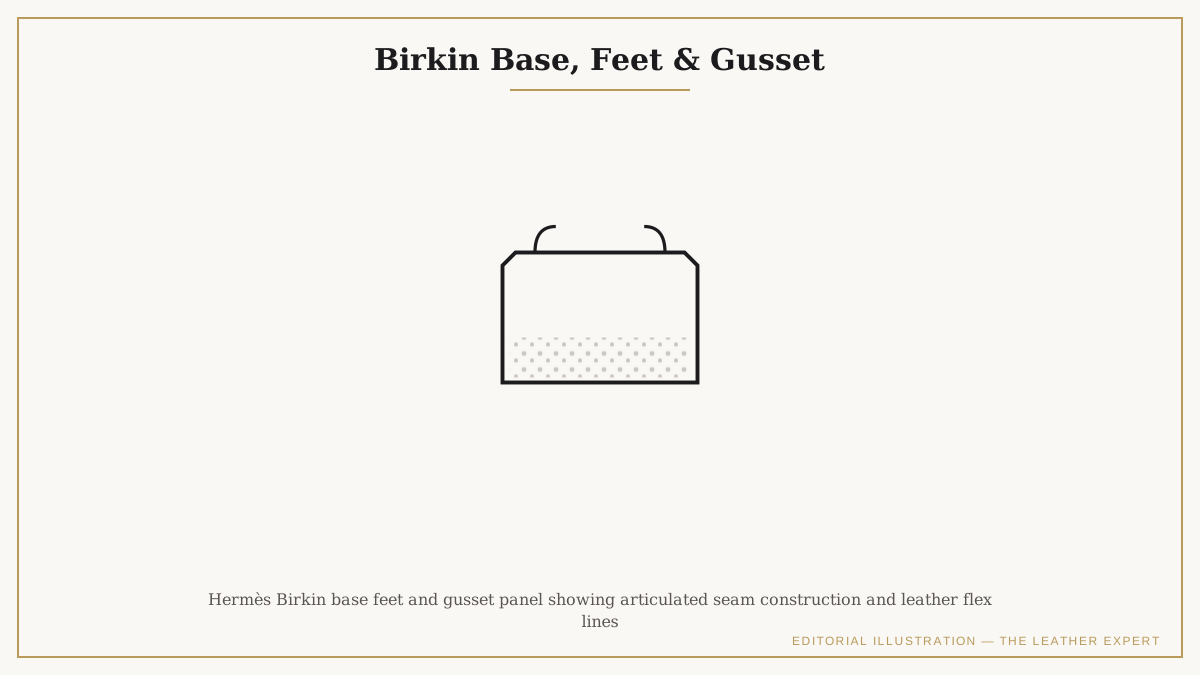
The Birkin is the most structurally sophisticated bag in the Hermès production range. Its gusseted trapezoid construction — four articulated side panels joined to a broad base by saddle-stitched gusset seams — distributes load across a larger leather surface area than any frame or envelope construction. When fully loaded, the gusset panels flex outward to accommodate fill volume, absorbing the expansion stress that would otherwise concentrate at the base corners. The four base feet — set at specific angles and protrusions from the base panel — protect the base leather from contact compression when the bag is set down.
The leather that performs best in Birkin construction over a 10-year daily use period is not the one that looks best in the boutique — it is the one whose fibril structure is most compatible with the gusseted construction’s cyclical flex demands. Togo, with its loose pebbled grain and chrome tannage, has natural elasticity that accommodates thousands of gusset flex cycles without fibril cracking. Epsom, with its compressed cross-hatch surface, resists corner abrasion at the base feet and maintains grain definition under heavy loading. Box Calf develops the most characterful patina — but its tighter fibril structure is less forgiving of daily loading cycles than Togo or Epsom, and it requires more careful conditioning to prevent surface crazing at the gusset fold lines over time.
Leather Expert Note — Birkin Leather for 10-Year Wear
The answer to “which Birkin leather wears best over 10 years” depends entirely on use pattern. For daily carry under significant load: Togo for maximum flex tolerance, Epsom for maximum shape retention. For occasional use with careful conditioning: Box Calf for maximum patina character. For buyers in humid climates: Clemence, whose heavy vegetable-chrome combination tannage handles moisture better than Togo. For the full 10-year leather analysis, see our article on which Birkin leather wears best over 10 years.
- Togo: best daily-use Birkin leather — flex tolerance, elasticity, moisture resistance
- Epsom: best shape-retention Birkin leather — compressed grain resists corner abrasion and loading deformation
- Box Calf: best patina character — but requires careful conditioning and moderate use intensity
- Clemence: best humid-climate Birkin leather — heavy tannage handles moisture and condensation
- Base feet: authentication marker — check angle, protrusion, and screw condition on pre-owned pieces
The Kelly: Rigid Frame Construction and Leather Tension Logic
The Kelly operates on a fundamentally different structural principle from the Birkin. Its rigid trapezoidal frame — achieved through internal blocking and the sustained tension of its perimeter saddle stitch — holds the silhouette under compression. Unlike the Birkin’s gusseted system, which accommodates expansion under load, the Kelly’s frame resists expansion: the bag’s contents are held under lateral compression by the rigid walls, and the turnlock exerts additional point-load pressure on the front flap leather at every open-and-close cycle.
This compression logic demands a different leather profile than the Birkin’s flex logic. The Kelly’s leather must resist sustained lateral compression without deforming, hold its surface definition under the turnlock’s point-load contact, and — in the case of sellier construction — sustain the angular stress of exterior stitching at the corner seam zones. Box Calf meets all three requirements: its fine grain resists lateral compression, its vegetable tannage produces a surface that responds to turnlock contact by developing a localised patina rather than a depression, and its fibril structure handles corner stitch stress without cracking. For buyers considering a Kelly in retourne construction, Togo and Clemence are appropriate — the concealed seam removes the exterior stitch stress requirement, and both leathers have sufficient body to hold the Kelly’s frame shape under compression.
- Kelly sellier: Box Calf (optimal), Epsom (functional), Crocodilian (premium)
- Kelly retourne: Togo, Clemence, Veau Swift — supple enough for turning, sufficient body for frame compression
- Turnlock contact zone: develops patina first — examine this area on pre-owned Kelly bags
- Corner stitching (sellier): highest-stress zone — patina appears here earliest and deepest
- For full construction analysis: see the Sellier vs Retourne construction guide
Garden Party & Negonda: Why the Leather Is a Material Engineering Choice
The Garden Party is the most structurally underestimated bag in the Hermès production range. Its open-top tote format — a flat-base construction with two handles and minimal internal structure — appears simple, but its leather demands are specific. A flat-base tote carries load vertically: the base panel bears the full weight of contents pressing downward, the side panels must flex outward to accommodate fill volume, and the handles must transfer the combined load to the carry point without concentrating stress at the attachment seam.
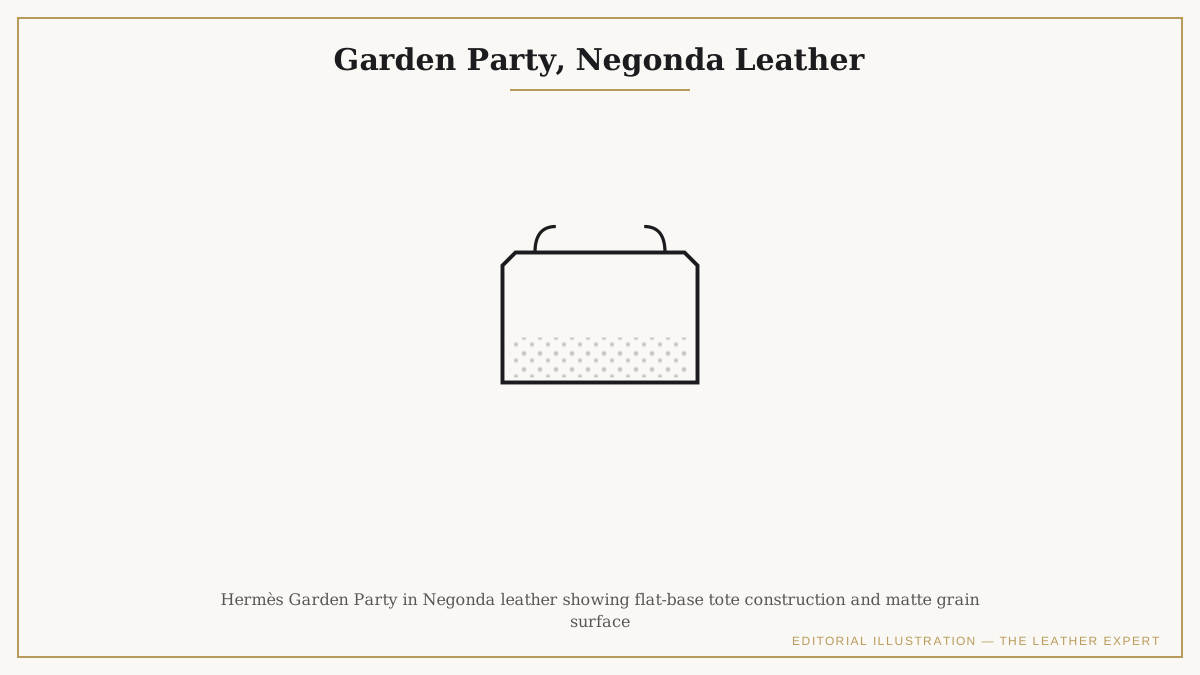
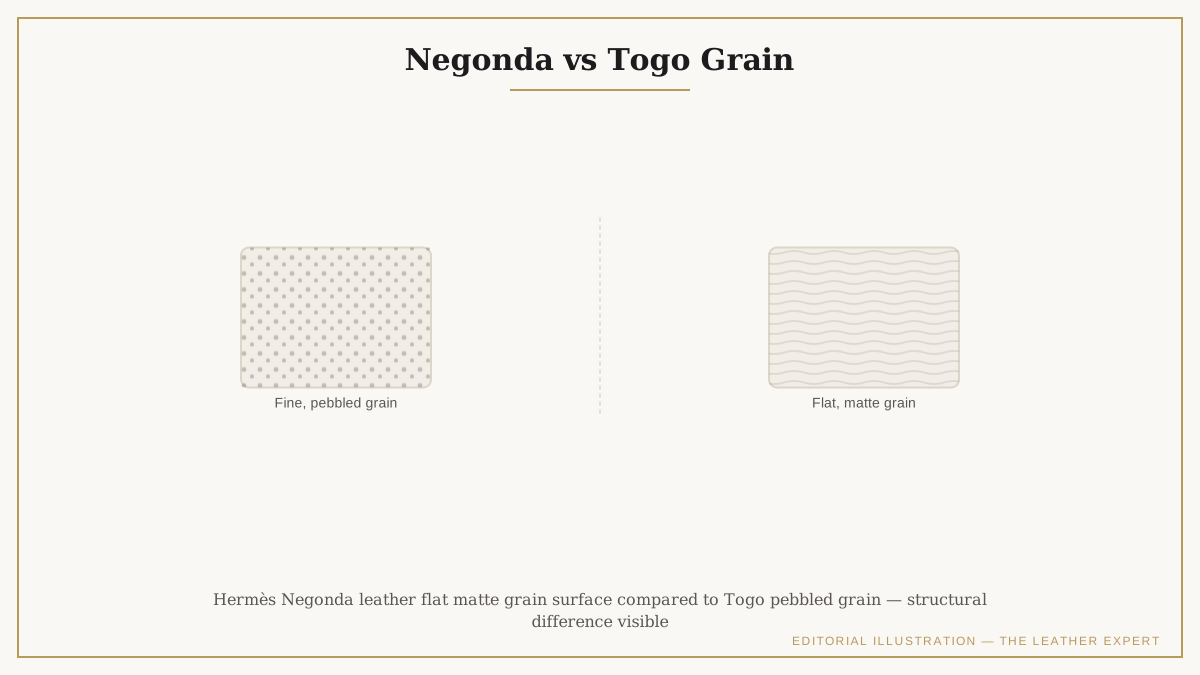
Negonda is Hermès’s material engineering answer to these demands. It is a supple calf leather with a flat, matte grain and a moderate chrome tannage that gives it sufficient body to hold the base shape under vertical load without the stiffness that would cause the side panels to crack under flex. Its flat grain surface — unlike the pebbled surface of Togo or Clemence — lies flat against the internal canvas lining without creating pressure points that would, over time, emboss the lining pattern onto the leather face. And its matte finish is appropriate for a bag designed for active use: it does not show handling marks or minor surface abrasion as clearly as a high-gloss or box-pressed finish would.
Leather Expert Note — Garden Party Negonda
Negonda is not a substitute for Togo or Clemence in Garden Party production — it is the correct leather for the construction. Its specific combination of body, flex tolerance, and flat grain surface is what makes the Garden Party’s open-top tote format work over years of active use. Buyers who encounter Garden Party bags in other leathers should examine the base panel carefully: alternative leathers may not distribute vertical load as evenly, and the base panel is the first area to show compression wear in a flat-base tote. For the full Negonda analysis, see our article on why Garden Party Negonda is different.
| Model | Construction Type | Best Leathers | Key Stress Zone | 10-Year Wear Profile |
|---|---|---|---|---|
| Birkin 25/30/35/40 | Gusseted trapezoid (retourné) | Togo, Epsom, Clemence, Box Calf | Base panel + gusset fold lines | Even grain softening; gusset flex lines; base feet protection marks |
| Kelly Sellier | Rigid frame, exterior seam | Box Calf, Epsom, Crocodilian | Corner stitching + turnlock zone | Deep corner patina; turnlock impression; stitch line lustre |
| Kelly Retourné | Rigid frame, interior seam | Togo, Clemence, Veau Swift | Rounded corner seams + turnlock | Soft corner rounding; body drape; turnlock contact sheen |
| Constance 18/24 | Envelope fold, minimal frame | Barenia, Box Calf, Veau Swift | H-clasp contact zone + flap fold | Pellicule bloom; clasp impression; even flap patina |
| Garden Party 30/36 | Open-top flat-base tote | Negonda, Toile + leather combo | Base panel + handle attachment seams | Base panel compression softening; handle darkening at carry point |
| Lindy 26/30 | Open hobo, zip divider | Clemence, Togo, Veau Swift | Zip divider crease + handle joints | Longitudinal body crease; handle darkening; zip pull wear |
Every Iconic Model Has a Material Logic. Learn It Before You Buy.
The most common error buyers make when selecting an iconic Hermès model is choosing the bag first and the leather second — as if these were independent decisions. They are not. The Birkin’s gusseted construction created the conditions under which Togo became the dominant production leather. The Kelly’s rigid frame created the conditions under which Box Calf became its historically correct pairing. The Garden Party’s flat-base tote format created the conditions under which Negonda was developed as a specific material solution.
Understanding this relationship does not make the buying decision more complicated — it makes it more precise. A buyer who knows that Togo belongs in a Birkin and Box Calf belongs in a Kelly sellier has already answered the most important material question. Everything that follows — colour, size, hardware — is secondary to the leather-construction pairing.
For buyers approaching the pre-owned market, this knowledge is equally valuable as an authentication tool. Authentic Hermès bags show wear patterns that correspond precisely to their construction logic. A Birkin will show gusset flex lines. A Kelly sellier will show corner patina. A Garden Party will show base panel compression. Counterfeits age generically — they do not replicate the construction-specific wear profiles that decades of structural logic produce.
Bottom Line: Read the construction first. The leather follows from the construction. The colour follows from the leather. In that order — every time.
Popular Searches
Most searched iconic Hermès model and leather pairing topics
🔥 Most Searched
Which Birkin Leather Wears Best Over 10 Years?
Togo vs Epsom vs Box Calf vs Clemence — a structural and tannage analysis of the four dominant Birkin leathers over a decade of documented use.
★ Expert Reference
Garden Party Negonda: Why It’s Structurally Different
Why Negonda is not a substitute for Togo or Clemence — the material engineering logic behind Hermès’s flat-base tote leather selection.
⬆ Trending
Sellier vs Retourne: Construction Guide
The full structural analysis of sellier and retourne construction — seam mechanics, leather compatibility, and 10-year ageing profiles for both methods.
◆ Full Reference
Hermès Leathers & Materials Guide
Every major Hermès production leather analysed by fibril density, tannage, temper, and construction compatibility — the reference companion to this iconic models guide.
⬆ Rising
Hermès Bag Styles Guide
Birkin, Kelly, Constance, Lindy, Evelyne — structural analysis of every core silhouette with leather suitability ratings and long-term wear predictions.
🔥 Most Searched
Hermès Investment Guide
How leather condition grades translate to resale price differentials — and which iconic model and leather combinations maintain condition most reliably over time.
Frequently Asked Questions
Togo and Epsom are the two leathers that perform most consistently in a Birkin over a 10-year daily use period. Togo’s loose pebbled grain and chrome tannage give it natural elasticity that accommodates the gusseted construction’s cyclical flex without cracking. Epsom’s cross-hatch embossed grain and compressed fibril surface resist corner abrasion and maintain shape under heavy loading. Box Calf ages most beautifully in terms of patina depth — but requires more careful use and conditioning. For buyers who carry daily and prioritise durability, Togo is the benchmark. See the full analysis at which Birkin leather wears best over 10 years.
Negonda is a structurally specific choice for the Garden Party, not a cost decision. The Garden Party’s open-top flat-base tote construction requires a leather with enough body to hold the base shape under vertical load, enough flexibility to accommodate side panel flex, and a flat grain surface that lies cleanly against the internal canvas lining. Negonda provides all three. For the full explanation, see our article on why Garden Party Negonda is structurally different.
Both models hold value exceptionally well, but they age differently and that affects resale condition grades differently. Birkin bags in Togo or Epsom are highly forgiving of daily use and typically maintain B+ or better condition grades through years of regular carry. Kelly bags in Box Calf, when properly maintained, develop the most valuable patina of any Hermès leather-construction combination — but corner stitch condition is the primary determinant of resale grade and requires more careful monitoring. For investment analysis by leather type, see our Hermès investment guide.
The Birkin’s four base feet are a structural response to the mechanical demands of the gusseted trapezoid under load — not decorative. When a Birkin is set down fully loaded, the concentrated point-load of the base corners on a hard surface would, over time, compress and deform the leather at those corners without the feet’s protection. The feet distribute contact load across a small metal surface, protecting the base leather panel from compression wear. On authentic Hermès Birkins, the feet are set at a specific angle and protrusion from the base — both are measurable authentication markers examined in our authentication guide.