
Hermes Authentic Saddle Stitch Angle vs Machine Stitching
A forensic guide to the exact thread angle, hole spacing, tension markers, and structural logic that separate authentic Hermès hand-stitching from machine-produced counterfeits.
The Hermès saddle stitch is not simply a design choice — it is the structural backbone of every authentic bag the maison produces, and it is the single craftsmanship marker that counterfeit manufacturers have struggled most consistently to replicate. The reason is not the thread, the color, or even the stitch count: it is the angle. Authentic Hermès saddle stitch runs at a consistent 45-degree diagonal to the seam line, created by a two-needle hand-stitching method whose mechanical process leaves signatures in the leather that machine stitching cannot reproduce. Learning to read those signatures is among the most reliable authentication skills available to any secondary market buyer, because it requires no specialist equipment — just a loupe, a good light, and the forensic vocabulary this article provides.
This guide maps the exact physical markers of authentic saddle stitching across every critical inspection zone on a Birkin and Kelly, explains the structural reasons why machine lock-stitch produces a fundamentally different result, and provides a systematic inspection protocol that you can apply immediately to any piece under assessment.
What Saddle Stitch Is and Why Hermès Uses It — The Structural Argument
The saddle stitch is a two-needle hand-stitching technique in which a single length of waxed linen thread is threaded through two needles simultaneously — one at each end. The craftsperson draws both needles through the same awl-pierced hole from opposite sides of the leather, crossing the threads within the hole itself. Each completed stitch thus consists of two thread segments crossing inside the leather, with each thread anchored independently on both sides of the seam. This is the fundamental structural characteristic that distinguishes saddle stitch from every machine-produced alternative.
The practical consequence of this construction is critical to understanding why Hermès uses it: saddle stitch does not unravel when a single stitch breaks. In machine lock-stitch — the method used in every industrial sewing machine and in virtually all counterfeit bag production — a top thread and a bobbin thread are locked together at each stitch point. When one stitch breaks, the locking mechanism at adjacent stitches is compromised and the seam can run — unravelling progressively from the break point. In saddle stitch, each stitch is structurally independent: a broken stitch weakens two thread segments at one point but does not affect the adjacent stitches' integrity. On a bag that may be opened and closed hundreds of times per year, this structural difference is not aesthetic — it is functional, and it is the primary reason Hermès has used the technique continuously since the firm's founding.
The process begins before any thread is applied: the craftsperson draws a stitching groover along the seam path to create a shallow channel that both guides the stitch line and recesses the finished thread below the leather surface. A pricking iron — a tool with evenly spaced tines — is then stamped along the grooved channel, pre-marking the hole positions at consistent intervals before the awl is used to pierce each hole individually. This sequence — groove, mark, pierce, stitch — is what produces the dimensional and angular consistency that authenticate Hermès stitching under inspection. For the complete authentication framework covering all markers from stitching to hardware, the Authentication Guide hub is the essential reference.
"The saddle stitch doesn't just look hand-made. It is structurally different from machine stitching at the thread-crossing level — and that difference is readable in the leather if you know where to look."
The Markers of Authentic Hermès Saddle Stitching: Angle, Tension, Spacing, and Thread Quality
Four measurable characteristics define authentic Hermès saddle stitching, and each one is a direct product of the hand-stitching process. Understanding what produces each characteristic makes them far easier to verify under inspection — and makes the corresponding failures in counterfeit stitching immediately legible.
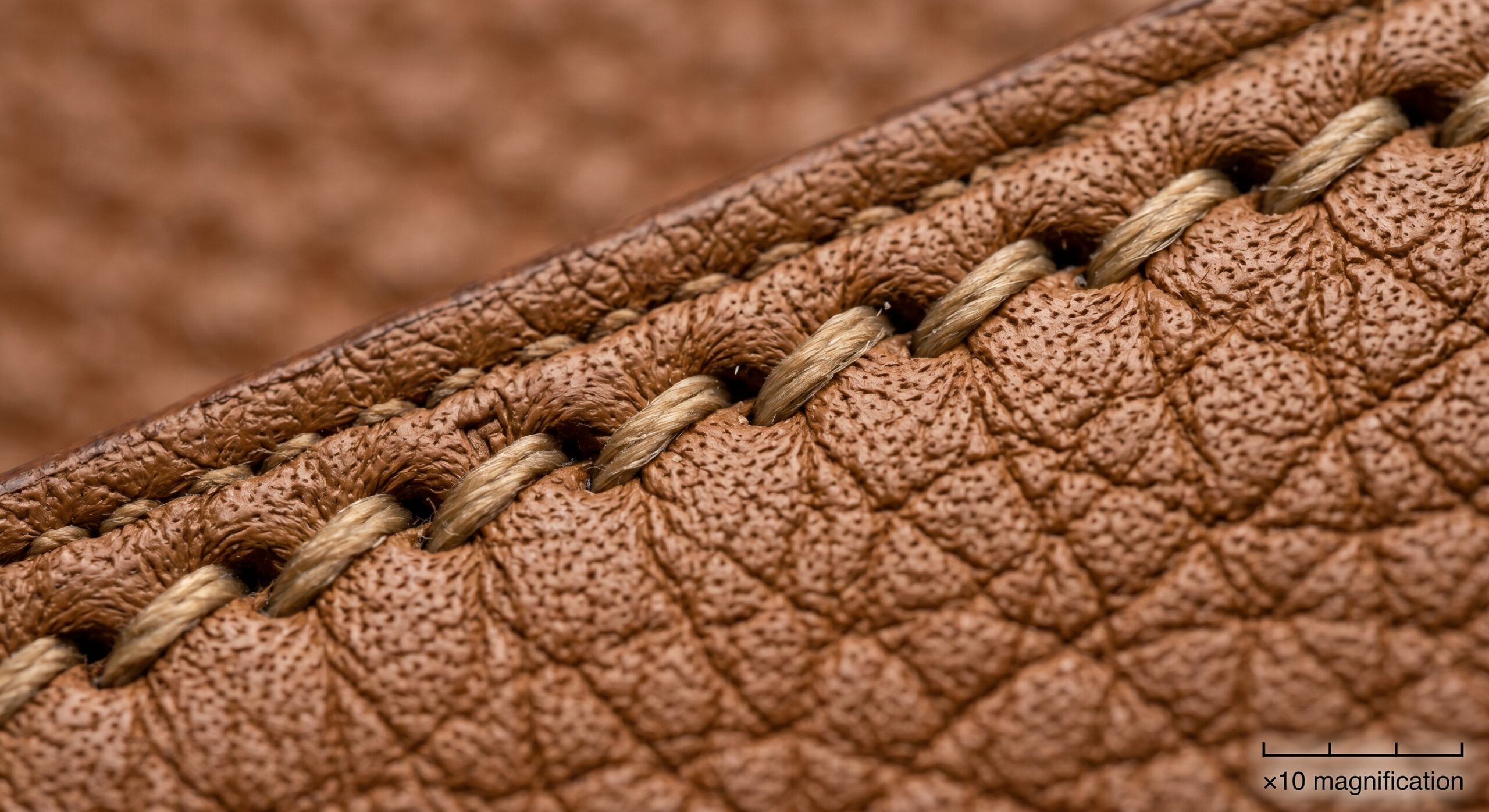
Thread angle consistency is the primary marker. The two-needle saddle stitch produces a thread path in which each thread crosses the seam surface at a diagonal angle — typically around 45 degrees relative to the seam direction — because the needles are drawn through the awl hole from opposing sides at the same angle. This diagonal is set by the craftsperson's needle entry angle and maintained through muscle memory across hundreds of stitches per seam. On an authentic piece, this diagonal is consistent throughout the entire seam run — every stitch shows the same angle, the same rhythm, the same relationship between thread segments on the surface. Under a loupe at ×10 magnification, the thread pattern reads as a series of parallel diagonal lines with no variation in angle, spacing, or tension — a visual rhythm that is deeply satisfying precisely because it is the product of trained, consistent human movement.
Hand Saddle Stitch
Two needles, one per side. Threads cross inside each hole. Consistent diagonal throughout. Independent stitch integrity — one broken stitch does not run.
✓ Authentic MarkerMachine Lock-Stitch
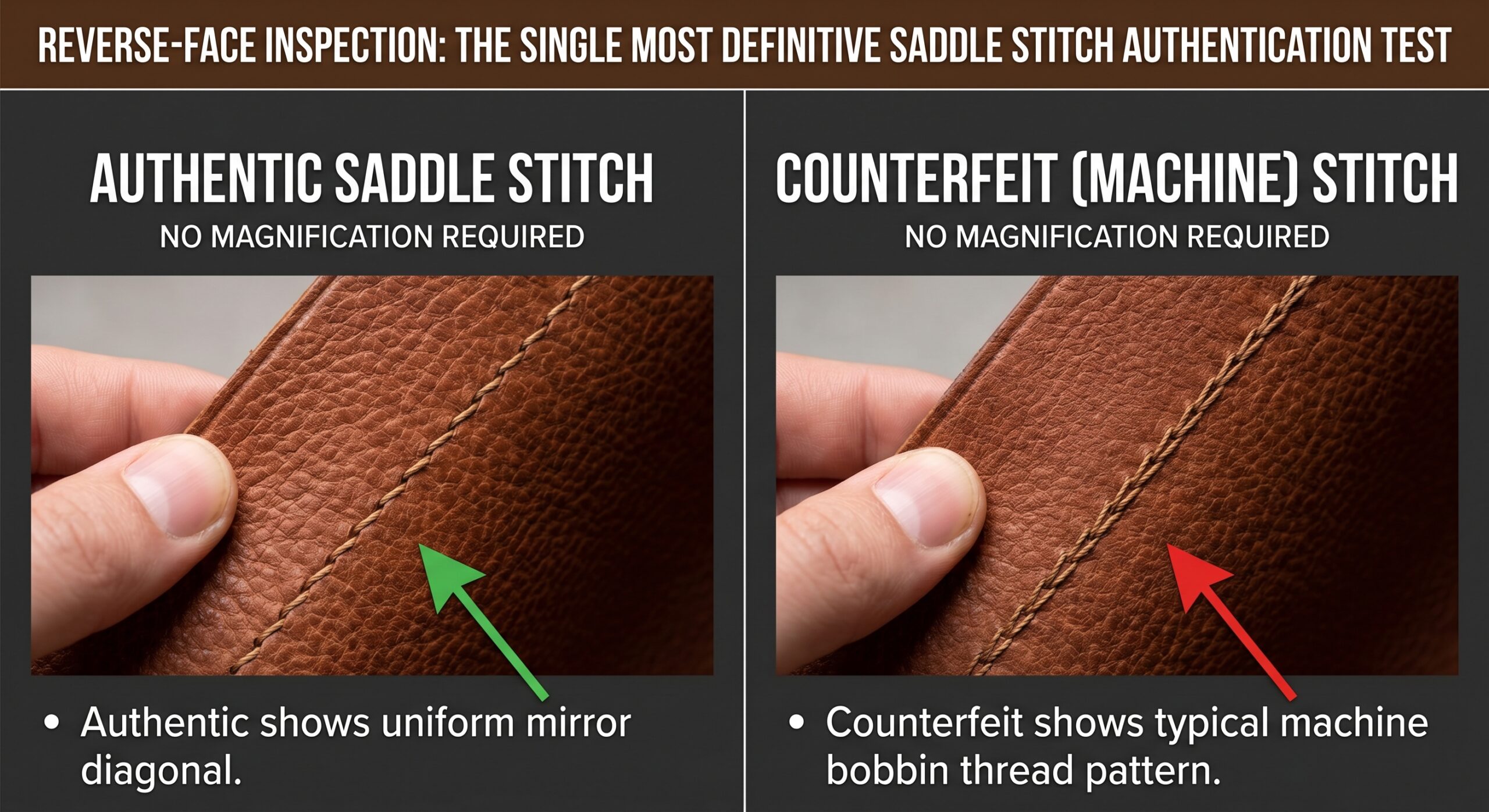
Single top thread locked by bobbin below. Perpendicular entry angle. Lock points visible under magnification. One broken stitch can run the seam.
✗ Counterfeit Indicator- Thread angle — authentic: consistent ~45° diagonal throughout every seam run; counterfeit: perpendicular or inconsistently angled, often varying within the same seam
- Hole spacing — authentic: perfectly even intervals set by pricking iron before piercing; counterfeit: slight variation in spacing visible under ×10 loupe even in highest-quality fakes
- Thread tension — authentic: each stitch pulled to consistent tension; thread sits slightly proud of the leather surface in the grooved channel with no puckering; counterfeit: uneven tension produces micro-puckering between stitches or flat, over-tightened sections
- Thread material — authentic: waxed linen thread with visible wax sheen under magnification; thread strands are visibly twisted in a consistent direction; counterfeit: polyester or nylon thread lacks the wax sheen and twisted-strand texture of linen
- Reverse surface — authentic: the reverse face of an authentic saddle-stitched seam shows the mirror image of the front face diagonal, with the same consistent angle; counterfeit machine stitching shows the bobbin thread lock points rather than a clean diagonal mirror
- Stitch termination — authentic: the last stitch of a seam is double-backed and hand-knotted within the leather, leaving no visible knot on either face; counterfeit: machine back-stitching produces a doubled thread cluster at the seam end that is visible under inspection
How Machine Stitching Fails to Replicate Saddle Stitch — and Where the Failure Is Most Visible
The counterfeit leather goods industry has invested heavily in replicating the appearance of saddle stitching, and at casual viewing distance the best current fakes produce a stitch line that passes superficial scrutiny. Thread color, weight, and approximate stitch count can all be matched. The failure appears under magnification and at structural stress zones — precisely because the mechanical process that produces machine lock-stitch cannot be modified to replicate the geometric and structural properties of hand saddle stitching.
The most fundamental failure is the thread angle. Machine lock-stitch enters the leather perpendicular to the seam surface — the needle moves vertically through the fabric in all standard sewing machine geometries. The resulting top thread sits across the seam at a perpendicular or near-perpendicular angle rather than the 45-degree diagonal of authentic saddle stitch. Some high-end counterfeit operations use modified stitch plates that tilt the needle entry slightly, producing a diagonal that approximates the authentic angle at casual inspection — but the consistency fails under magnification and across the full seam length, because the mechanical driver cannot maintain the exact human-muscle-memory consistency of the authentic process across hundreds of stitches.
The Handle Attachment Zone: Where Machine Stitching Fails Most Consistently
Authentic Hermès handle attachment stitching is the most demanding saddle-stitch work on any bag — it combines a tight corner radius with increased stitch density and the structural requirement to stitch through multiple leather layers simultaneously. The pricking iron cannot be used at the curved junction of handle and body panel; each hole must be individually placed by the craftsperson's judgment. The result is that authentic handle attachment stitching, while visually precise, shows the micro-variations of individual human judgment across the curved path — no two adjacent stitches are at precisely identical angles when measured to the second decimal degree, but all are within the consistent range that trained hands produce. Machine stitching at this zone either maintains mechanical uniformity that reads as too perfect under magnification, or degrades at the curve as the feed mechanism struggles with the leather thickness change — a failure mode that authentication specialists identify immediately.
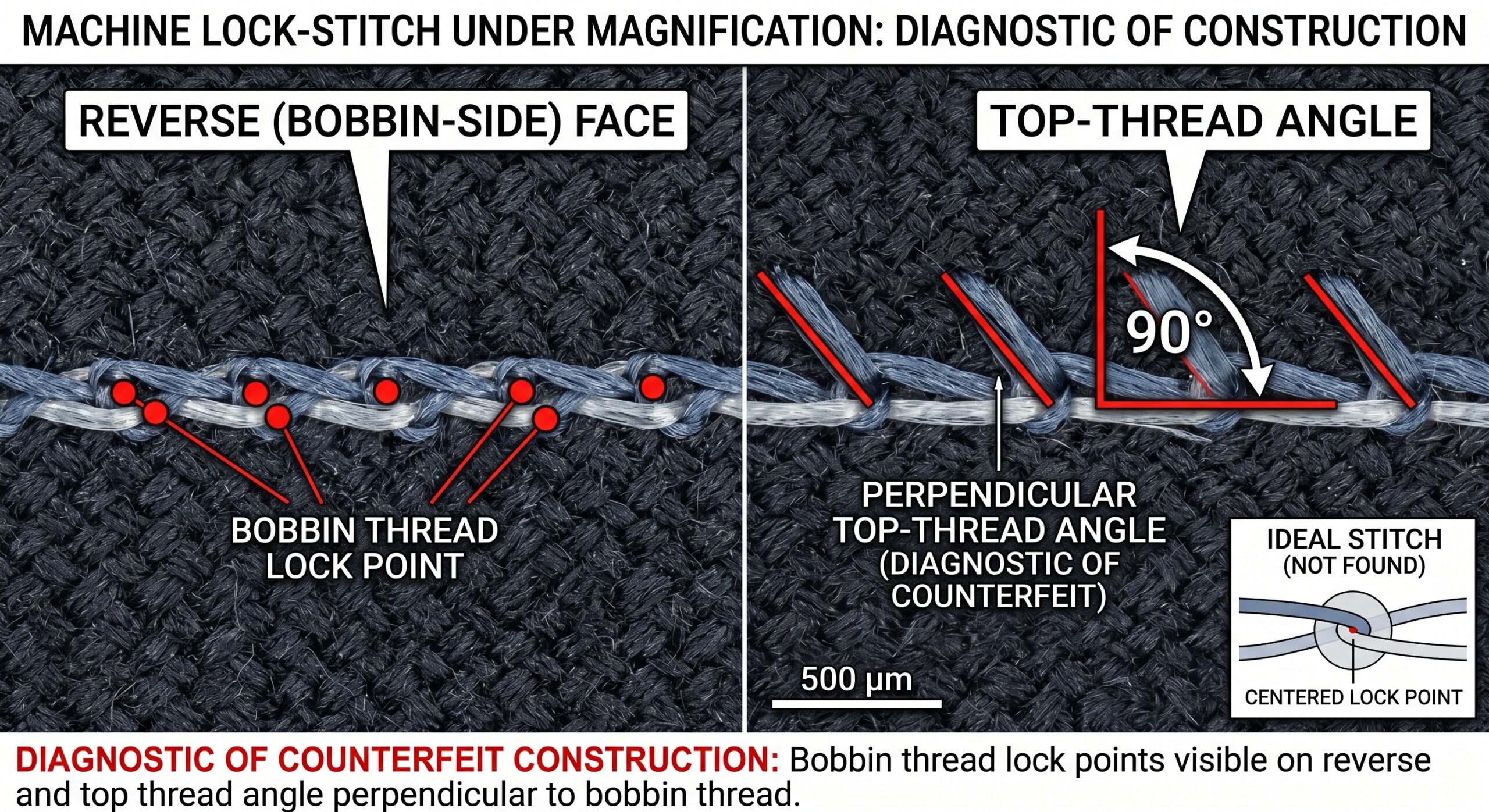
The reverse-face test is one of the most definitive field authentication methods for stitching. Turn the bag inside-out or find any accessible reverse face of a seam — the interior of a pocket, the underside of the flap fold, or the reverse of a handle drop. On authentic saddle-stitched seams, the reverse face shows the same diagonal thread pattern as the front face, in mirror image. The two-needle process produces symmetrical thread crossing on both faces simultaneously — there is no "back" of the stitch that looks different from the "front." On machine-stitched counterfeits, the reverse face shows the bobbin thread lock pattern — a series of small, compressed thread nubs or a flat horizontal thread line that is structurally and visually distinct from the front face diagonal. This test requires no magnification and can be performed in seconds. For blind stamp location changes that complement this stitching authentication, our piece on Hermès Blind Stamp Location Changes in 2026 covers the stamp markers that authenticate alongside stitching evidence. For foil stamping depth and spacing as a further authentication layer, see Hermès Foil Stamping Depth and Spacing: How to Read the Mark.
The Zone-by-Zone Saddle Stitch Inspection Protocol
The following protocol covers the four primary inspection zones for saddle stitch authentication on a Birkin or Kelly, in order of diagnostic reliability. All observations assume access to a ×10 loupe and a strong directional light source — a phone torch at arm's length is sufficient for field inspection.
Handle Attachment Drop
Examine the stitch line where each handle drop leather meets the body panel. Look for variable stitch density — authentic pieces show visibly tighter spacing here than on the body seam. Check the curve of the attachment junction for consistent diagonal angle maintained through the bend. Any mechanical uniformity at this curve, or a sharp density jump without gradual transition, suggests machine production.
Reverse Face of Any Seam
Access the reverse face of any seam — interior flap fold, inside pocket seam, or handle reverse. Authentic: mirror-image diagonal on both faces. Counterfeit: flat horizontal bobbin thread line or compressed lock nubs on the reverse. This test is definitive and requires no magnification at all in clear light — the two patterns are immediately visually distinct.
Main Body Panel Seam Run
Examine a long straight seam run — the side seam of a Birkin, or the base-to-side-wall join on a Kelly. Under ×10 magnification, check hole spacing consistency across 10–15 stitches. Authentic: spacing variation within ±0.2mm across any 10-stitch run. Counterfeit: typically ±0.1mm variation for machine-stamped holes, which paradoxically reads as too uniform — or ±0.5mm variation where machine stitch feed has inconsistencies.
Seam Termination Points
Examine the start and end of any visible seam. Authentic saddle stitch termination shows a clean finish with no visible knot and no doubled thread cluster — the thread end is drawn into the leather and secured invisibly. Machine back-stitch termination shows a doubled thread mass at the seam end that is visible under magnification and occasionally even to the naked eye in poor-quality fakes.
| Stitch Property | Authentic Hermès Saddle Stitch | Counterfeit Machine Stitching | Test Method |
|---|---|---|---|
| Thread angle | Consistent ~45° diagonal to seam line throughout | Perpendicular or inconsistently angled; approximation attempts fail at full seam length | ×10 loupe, directional light at 45° |
| Hole spacing | Consistent 4–5 per cm; set by pricking iron before piercing | Either mechanically over-uniform or showing feed-related variation | ×10 loupe across 10-stitch run |
| Thread crossing | Two threads cross inside each hole — visible as V-shape entry on both faces | Single top thread with bobbin lock — V-shape absent; lock nubs on reverse | ×10 loupe, oblique light |
| Reverse face pattern | Mirror-image diagonal — identical angle and rhythm to front face | Flat horizontal bobbin thread or compressed lock nubs — structurally distinct from front | Visual inspection, no magnification required |
| Stitch density variation | Increases at structural stress zones (handle attachments) by craftsperson judgment | Mechanically uniform throughout — cannot vary density without programming change | Compare handle attachment to body seam density |
| Thread material | Waxed linen — visible wax sheen under magnification; visibly twisted strand structure | Polyester or nylon — no wax sheen; smooth filament visible under magnification | ×10 loupe under direct light |
| Tension consistency | Even across full seam; slight relief above groove; no puckering | Variable tension produces micro-puckering or flat over-tight sections | Raking light across seam surface |
| Seam termination | Thread drawn invisibly into leather; no visible knot or thread mass | Machine back-stitch produces visible doubled thread cluster at seam end | Visual inspection at seam start/end points |
| Break behaviour | One broken stitch isolated — seam integrity unaffected at adjacent stitches | One broken stitch can initiate seam run from break point | Structural test (long-term ownership evidence) |
The Saddle Stitch Angle Is the Most Reliable Accessible Authentication Marker on Any Hermès Bag — Learn It Before You Buy
Among all the authentication markers on a Hermès bag, saddle stitch angle assessment sits in a unique category: it is highly reliable, requires no specialist equipment, and cannot be faked at the structural level regardless of how sophisticated the counterfeiting operation. The two-needle saddle stitch process produces a thread crossing geometry inside each hole, a reverse-face mirror diagonal, variable density at stress zones, and a waxed linen thread material — none of which machine lock-stitch can replicate in a single operation at scale.
The inspection protocol has four zones in order of diagnostic reliability: handle attachment density variation, reverse-face diagonal test, body seam angle consistency, and seam termination condition. A piece that passes all four is not guaranteed authentic — authentication is always a multi-marker process — but a piece that fails any one of them is almost certainly counterfeit, and the reverse-face test alone is sufficient to exclude the majority of fakes currently circulating at any price tier.
Bottom Line: The reverse-face diagonal test — no magnification required, five seconds to perform — is the single most accessible and reliable saddle stitch authentication check available; combine it with handle attachment density assessment and you will identify the stitching layer of counterfeit construction in the majority of pieces you inspect.
Popular Searches
Explore our most searched Hermès authentication and stitching combinations
The most counterfeited Birkin specification — saddle stitch angle at the handle attachment zone is the primary stitching authentication target for this combination on the secondary market.
⬆ TrendingThe sellier's exterior stitch line is among the most visually prominent authentication markers in the Hermès range — every stitch is fully exposed and readable under loupe inspection.
★ Collector FavouriteCompact Birkin formats are among the most frequently counterfeited — the smaller scale makes stitch density and angle assessment more challenging but also more diagnostic at the handle attachment zone.
◆ Ultra RareThe retourne construction's interior seam accessibility makes the reverse-face diagonal test particularly easy to perform — the interior surface of a retourne Kelly provides clean access to multiple seam reverses.
⬆ Rising DemandClemence's soft temper creates more pronounced leather layering at the handle attachment zone — making the density increase and curve-angle maintenance of authentic stitching particularly legible here.
🔥 Most SearchedThe base seam termination on a retourne Kelly is one of the most accessible seam-end inspection points on any Hermès bag — invisible thread end on authentic; back-stitch cluster on counterfeit.
Frequently Asked Questions
Authentic Hermès saddle stitching runs at a consistent diagonal angle of approximately 45 degrees relative to the seam line — the thread crosses the seam at this angle in both directions, creating the characteristic diagonal visual rhythm of the stitch line. This angle is set by the awl used to pierce the pre-stitching holes, which is drawn across the leather at the same consistent angle before any thread is applied. Any deviation from this consistent diagonal — whether angled too steeply, too shallowly, or inconsistently — is a counterfeit marker. For the full authentication guide see the Authentication Guide hub.
Authentic Hermès saddle stitching runs at approximately 4 to 5 stitches per centimetre on standard bag panels, increasing to 5–6 at structural stress zones such as handle attachment points. This spacing is consistent because the awl holes are pre-marked using a pricking iron before any thread is applied. Counterfeit stitching, even when attempting to replicate the stitch count, typically shows variation in hole spacing that is visible under close inspection. See full stamp authentication context at Hermès Blind Stamp Location Changes in 2026.
At casual visual inspection, machine stitching can approximate the appearance of saddle stitching — the thread colour, weight, and stitch count can be replicated. However, the fundamental structural difference is not in the thread but in the lock mechanism: saddle stitch uses two independent threads passing through each hole from opposite sides, while machine lock-stitch locks a bobbin thread against a top thread. This difference is visible on the reverse face — authentic shows a mirror diagonal; machine shows bobbin lock points. It also becomes apparent when a stitch breaks: saddle stitching holds; machine stitching can run. For foil stamp authentication see Hermès Foil Stamping Depth and Spacing.
The handle attachment zone is the single most reliable first-inspection point. Authentic pieces show visibly higher stitch density at the handle drops compared to the main seam runs — the craftsperson adds stitches at structural vulnerability points that machine stitching cannot variably replicate. The reverse face of any accessible seam is the second target: authentic shows a mirror-image diagonal; counterfeit shows a bobbin thread pattern. These two tests together will identify the stitching layer of counterfeit construction in the majority of pieces. Browse all authentication guides at the Authentication category.
