
Water Damage on Hermes Barenia Leather: Prevention & Repair
A forensic analysis of why Barenia's vegetable tannage makes it uniquely vulnerable to water, how tide marks form at the fibril level, and the exact remediation window and protocol that determines your outcome.
Water damage on Hermès Barenia leather is the care event that Barenia owners fear most — and with material justification. Barenia Faubourg's vegetable tannage makes it uniquely reactive to moisture: the plant-derived tannins that drive its extraordinary patina development are the same molecules that cause the characteristic tide-mark rings when water contacts the surface and evaporates unevenly. The ring is not cosmetic contamination. It is a permanent redistribution of tannin molecules within the fibril network — a chemistry event that has altered the leather's surface at the molecular level. Understanding this distinction is the first step toward an effective response: because knowing what has actually happened tells you precisely how much time you have to act, what remediation is possible, and what prevention strategy will stop it from happening again.
This article provides the complete material-science explanation for why Barenia tide marks form, a minute-by-minute timeline of what happens after water contact, the panel-dampening remediation technique that is the only effective at-home intervention, and the prevention protocol that protects your Barenia in every weather condition you are likely to encounter.
Why Barenia Is Uniquely Vulnerable to Water Damage: The Tannin Chemistry
To understand why water damages Barenia leather in a way it does not damage Togo or Clemence, the starting point is the fundamental chemical difference between vegetable tannage and chrome tannage — the two processes that stabilise the hide's collagen structure after curing.
Chrome tannage — used for Togo, Clemence, Epsom, and Swift — uses chromium salt compounds that form irreversible cross-links with the collagen proteins in the leather's fibril structure. Once these cross-links are formed, the chrome compounds are essentially inert: they do not react with water, do not migrate through the fibril network, and do not concentrate at drying boundaries. When water contacts a chrome-tanned leather, it may temporarily soften the surface or cause a slight colour change, but as it dries the leather returns largely to its original state because no reactive molecules have been displaced.
Vegetable tannage — used for Barenia Faubourg — uses plant-derived tannin molecules (polyphenolic compounds from sources including oak bark and quebracho) that stabilise the collagen by bonding loosely to the fibril proteins across the hide. The critical difference is that these bonds are reversible and the tannin molecules retain mobility within the fibril network throughout the leather's life. They are also hygroscopic — they attract and bind water molecules — which is the property responsible for Barenia's extraordinary patina development when skin oils penetrate the fibril network alongside water, but also the property responsible for tide marking when water contact is sudden and uneven.
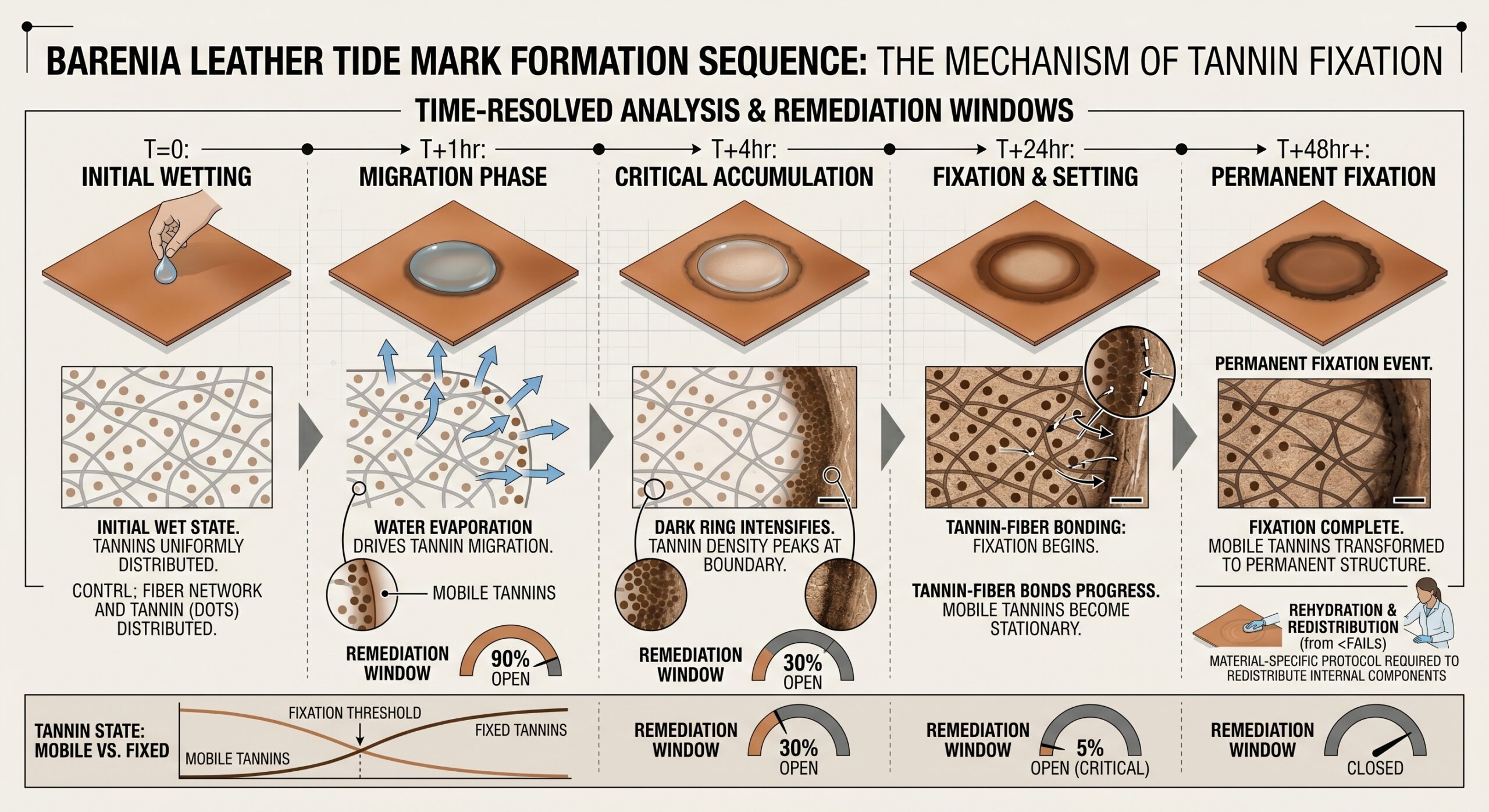
When water lands on Barenia's surface, it enters the fibril network and begins driving the mobile tannin molecules ahead of it as it spreads laterally. The water moves from the wet centre toward the drier surrounding area, carrying tannins with it. As the outermost edge of the wet zone begins to evaporate first, the water retreats from the boundary inward — but the tannin molecules it has carried to the edge cannot retreat with it because the boundary zone has begun to dry. They concentrate at the drying boundary in increasing density, producing the characteristic darker ring — the tide mark — as their accumulated oxidation produces a colour deeper than the surrounding leather that was not reached by the water migration. The full Barenia patina and tannin chemistry context is in our Barenia Faubourg Patina Progression guide; the complete care framework is at the Care & Storage Guide hub.
"The tide mark is not dirt. It is tannins — the same molecules that make Barenia beautiful — concentrated at a drying boundary. Knowing this tells you exactly what remediation can and cannot achieve."
The Water Event Timeline: What Happens in the First Hour and Why It Determines Your Options
The timeline of a Barenia water event is not linear — the critical remediation window is front-loaded into the first thirty minutes, after which the chemistry of tannin fixation progressively narrows your options. Understanding this timeline precisely determines whether you respond correctly or compound the damage through delayed or incorrect intervention.
Water Enters the Fibril Network Immediately
The moment water contacts Barenia's grain surface, it begins penetrating the open fibril pathways. The tannin molecules in the wet zone begin moving laterally with the water front. The grain surface darkens immediately and evenly within the wet zone — this is the temporary, reversible colour change of water-saturated vegetable-tanned leather, not the tide mark itself.
Optimal Remediation Window — Act Now
The tannin concentration gradient is still mobile. The entire wet zone is uniformly saturated and the drying boundary has not yet begun to form. The panel-dampening technique — evenly dampening the entire affected panel surface — is maximally effective at this stage because it removes the concentration differential by making the whole panel uniformly wet, preventing the tannins from concentrating at any single boundary. This is the ideal moment to act.
Good Remediation Window — Act Immediately
The outer edge of the wet zone has begun drying and the first tannin molecules are starting to concentrate at the boundary. The tide mark is beginning to form but has not fixed. Panel-dampening at this stage is still highly effective — the boundary tannin concentration is reversible because the molecules are still mobile. Even distribution of moisture across the panel will disperse the concentration and prevent the ring from setting.
Closing Window — Partial Remediation Still Possible
The drying boundary has advanced significantly and tannin concentration at the ring edge is increasing. The outer ring is becoming visible as a darker zone against the surrounding dry leather. Panel-dampening at this stage will interrupt the fixation process and can significantly reduce the final ring intensity, but complete elimination is less certain. Act immediately — do not delay further to gather materials.
Tide Mark Setting — Remediation Becomes Progressively Harder
After thirty minutes, the drying boundary tannin concentration is increasingly fixed. Panel-dampening may still reduce the mark's intensity but will not eliminate it. After several hours, the tide mark is largely permanent at the current intensity — it may fade slightly over time as the surrounding leather continues its patina development, but it will not disappear without professional intervention. At this stage, professional assessment is the appropriate route.
Fully Set — Professional Service Required
The tide mark is fully fixed. The tannin concentration at the ring boundary has oxidised and stabilised, producing a permanently darker zone than the surrounding leather. At-home intervention will not significantly improve the outcome. Hermès spa service can assess the mark and apply professional conditioning treatment that, over multiple sessions, may partially reduce but rarely eliminates a fully set Barenia tide mark.
The Panel-Dampening Remediation Technique: The Only Effective At-Home Intervention
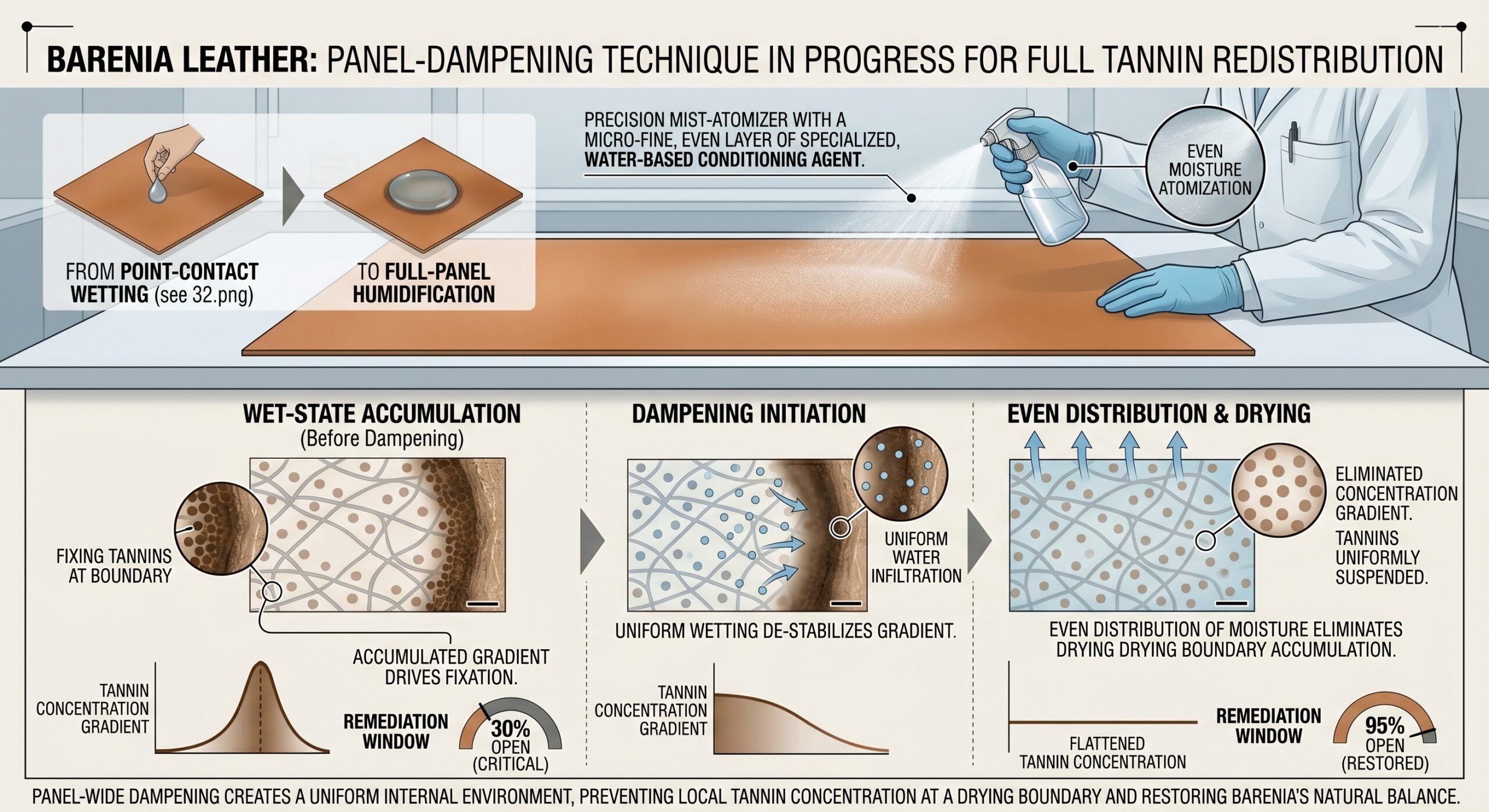
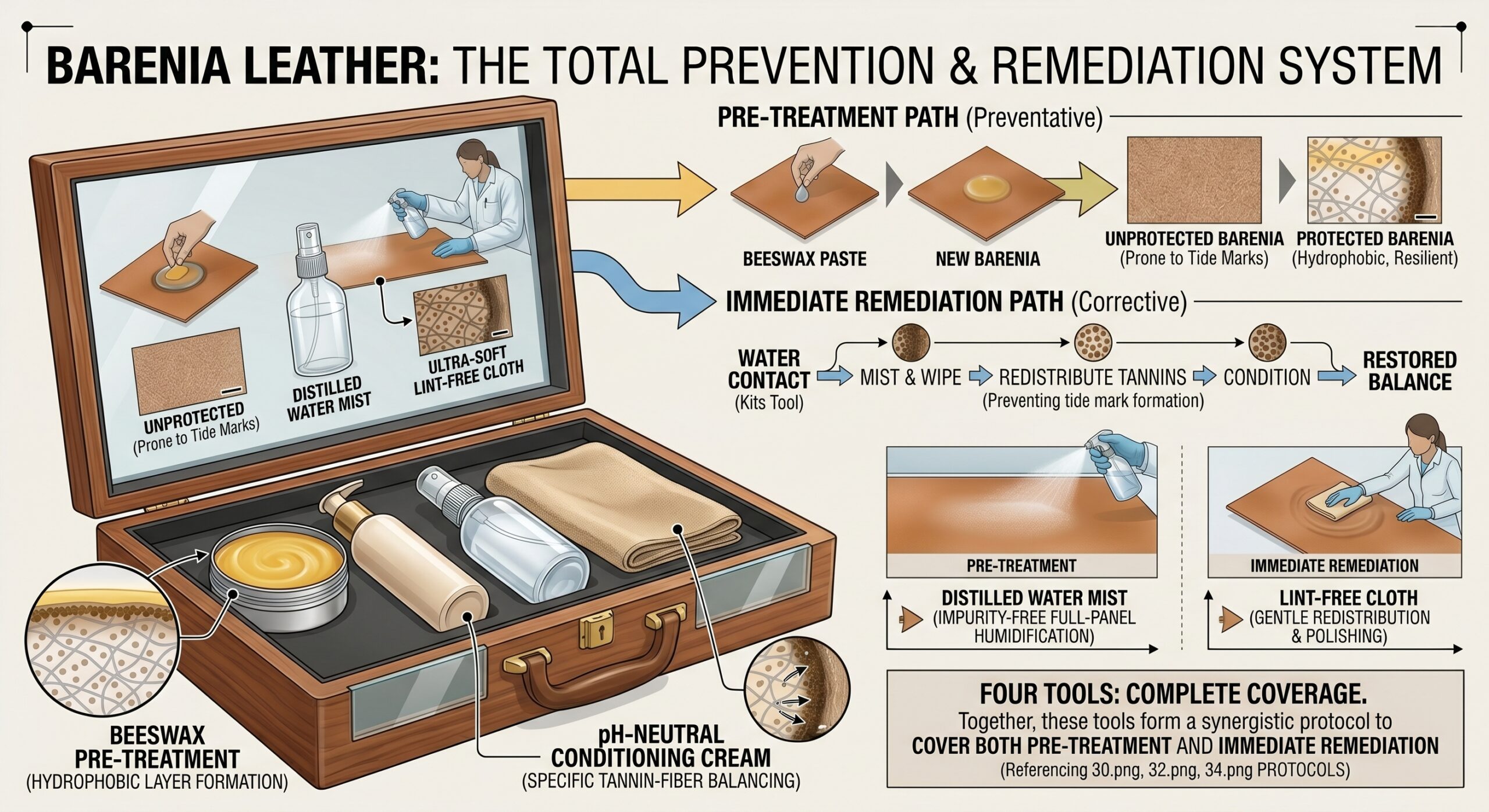
The panel-dampening technique is the single most effective at-home response to a Barenia water event within the remediation window. Its logic is counterintuitive — adding more water to a water-damaged leather — but it is materially correct: the technique works by eliminating the concentration differential that causes the tide mark, not by cleaning or treating the mark itself.
Assess the Affected Zone Immediately
Look at the wet zone on the Barenia surface. Identify the full extent of the darkened area and whether a lighter ring is beginning to form at its outer edge. Check whether the affected zone is on a single leather panel or spans multiple panels and a seam. The technique works best on a single flat panel — if the water has spanned a seam or reached the bag's base, the approach requires adaptation to treat each panel independently.
Dampen a Clean Lint-Free Cloth with Distilled Water
Use distilled water rather than tap water — mineral content in tap water can leave its own residue in the fibril network as it evaporates. The cloth should be damp throughout but not dripping — when pressed against your palm it should leave a visible damp mark but not transfer free water droplets. A barely damp cloth will not penetrate the fibril network sufficiently; an overly wet cloth risks over-saturating the panel.
Dampen the Entire Affected Panel — Not Just the Wet Zone
Using light, even strokes, dampen the entire leather panel that contains the water spot — not just the spot itself. Work from the centre of the panel outward with consistent pressure and stroke length. The goal is uniform moisture distribution across the full panel surface, including the currently dry zones surrounding the water spot. This eliminates the concentration gradient by making the entire panel uniformly wet — the tannins have no differential to migrate toward.
Allow to Dry Flat in Still Air
Place the bag on a clean flat surface in still room air — no fan, no sunlight, no heat source of any kind. Allow the dampened panel to dry completely at room temperature, which typically takes two to four hours depending on humidity. The flat surface prevents the wet leather from distorting under gravity while drying. Do not stand the bag upright during this stage — gravity will drive the moisture toward the base and may create a new concentration gradient at the lower panel edge.
Condition After Full Drying
Once the panel is completely dry — test by pressing a dry fingertip to the surface; it should feel neither cool nor damp — apply a light, even coat of pH-neutral conditioning cream using circular strokes across the full panel. This replenishes the surface lipids that the dampening process has partially redistributed, restores even surface tone, and provides a lipid baseline in the fibril network that reduces the risk of uneven tonal change during the remaining drying period. Allow the conditioner to absorb fully before using or storing the bag.
Three Responses That Will Make the Tide Mark Worse
Three common owner responses to a Barenia water event actively worsen the outcome. Do not use heat — a hairdryer or placing the bag near a radiator accelerates evaporation unevenly, which concentrates the tannins at the drying boundary faster and more severely than natural drying would. Do not blot only the wet spot — pressing a dry cloth against just the water spot draws the wet tannins into the dry cloth at the spot boundary, creating a sharper concentration gradient at the spot edge. And do not apply conditioning cream to only the tide mark zone — a spot application of conditioner introduces a new moisture differential into the fibril network, potentially creating a new ring at the conditioner boundary as it dries.
Prevention Protocol: Protecting Barenia Before the Rain
Prevention is the only strategy that fully eliminates the tide mark risk — remediation addresses events that have already occurred, while prevention stops them from occurring at all. The prevention protocol for Barenia has three components: pre-treatment, carry discipline, and ongoing conditioning maintenance.
Pre-treatment is the most impactful single intervention. A very light application of a natural beeswax-based product — applied to the full Barenia grain surface and buffed to a barely visible sheen — temporarily fills the open fibril pathways that water would otherwise penetrate. The beeswax does not waterproof the leather in the industrial sense: it creates a temporary lipid barrier that slows water entry enough to extend the response window from immediate penetration to a few seconds of contact, giving you time to blot the water before it enters the fibril network. This pre-treatment should be applied before any carry in conditions where water contact is likely, and reapplied as needed since natural carry gradually removes the wax layer. Avoid silicone-based waterproofing sprays: silicone fills the fibril pathways permanently and will significantly impede the natural tannin migration that drives Barenia's patina development — one of the leather's primary value propositions. Our ranked review of the best conditioners and protection products for Barenia is at Best Leather Conditioners for Hermès Barenia: Ranked & Reviewed.
Carry discipline in wet conditions means making active decisions about when to carry Barenia based on weather. If rain is forecast, carry a different bag — not because Barenia cannot survive occasional water contact when pre-treated, but because the risk-reward ratio does not favour active carry in significant rain when another option is available. For incidental carry — a brief moment in light rain or a single water droplet — pre-treatment combined with the readiness to apply the panel-dampening technique within five minutes of the contact event provides adequate protection. The key is preparation: having a clean lint-free cloth and distilled water accessible when carrying Barenia in unpredictable conditions is the carry discipline that prevents a minor incident from becoming a permanent mark.
Conditioning maintenance is the long-term prevention layer. Regular conditioning with a pH-neutral cream maintains an even lipid baseline in the fibril network that reduces the differential concentration effect when water does contact the leather — a well-conditioned fibril network has less capacity for rapid tannin migration than a dry, dehydrated one. For the full patina and conditioning guidance context alongside this water protection protocol, see our companion article on Hermès Swift vs Box Calf Scratch Recovery, which covers how different leather finish types respond to environmental events across the full leather range. Browse all care guidance at All Topics.
- Apply beeswax pre-treatment before every carry in potentially wet conditions — the only intervention that slows initial water penetration into the fibril network
- Carry a clean lint-free cloth and small bottle of distilled water in your bag when carrying Barenia — the remediation protocol requires immediate action and these materials must be at hand
- Avoid silicone waterproofing sprays — they block patina development permanently and should never be used on vegetable-tanned leather
- Condition every six to eight weeks during active carry — a well-hydrated fibril network is less vulnerable to the rapid tannin migration that causes tide marks
- Store in a cool, stable-humidity environment — extreme humidity swings can cause tannin migration and tonal variation in storage even without water contact
- Never use tap water for remediation — mineral content in tap water can leave secondary residue in the fibril network; always use distilled water
- Monitor corners and seams after wet carry events — water tends to pool at seam joins and corner points, making these the highest-risk zones for tide mark formation even when the body panels are pre-treated
| Leather | Water Sensitivity | Damage Mechanism | Remediation Window | Prevention Priority |
|---|---|---|---|---|
| Barenia Faubourg | Very High — permanent tide marks from uneven drying | Tannin migration and concentration at drying boundary — chemistry event, not soiling | 15–30 minutes for effective panel-dampening; set after 30 min+ | Critical — beeswax pre-treatment and conditioning maintenance essential |
| Togo | Moderate — spotting possible but less dramatic than Barenia | Chrome tannage means no tannin migration; surface oil displacement produces temporary spotting | Hours — chrome-tanned spotting remediation is less time-critical | Moderate — conditioning reduces spotting risk; no beeswax pre-treatment needed |
| Clemence | Moderate — similar to Togo but larger grain valleys trap water more | Same chrome-tannage mechanism as Togo; larger grain produces slightly more visible temporary spotting | Hours — not urgent; blotting and natural drying usually sufficient | Moderate — same conditioning principle as Togo |
| Epsom | Low — compressed fibril surface repels moisture effectively | Water beads on compressed cross-hatch surface; very limited fibril penetration | Not typically needed — surface wipe with dry cloth usually sufficient | Low — compressed surface provides inherent water resistance; no special pre-treatment required |
| Swift | Moderate — semi-matte finish susceptible to spotting | Chrome-tanned; surface finish disruption from water but no tannin migration; spots fade as leather dries | Hours — blotting and natural drying; conditioning after drying reduces residual mark | Moderate — light conditioning maintains surface uniformity; no beeswax pre-treatment required |
| Box Calf | Low — box-pressed compression repels moisture similarly to Epsom | Water beads on compressed gloss surface; wiping immediately removes most water before fibril penetration | Not typically needed — wipe clean immediately; gloss surface protects fibril access | Low — gloss surface provides inherent water resistance; immediate wiping is sufficient protocol |
Act Within Five Minutes or Accept the Consequence — Barenia's Water Sensitivity Has No Middle Ground
Barenia Faubourg's water sensitivity is not a flaw — it is the physical cost of the vegetable-tannage chemistry that makes it the most beautiful aging leather in the Hermès range. The same tannin mobility that produces the extraordinary pellicule and amber depth of a well-aged Barenia piece is the chemistry that concentrates at a drying water boundary and produces a tide mark. You cannot have one without accepting the other as a permanent risk that requires permanent management.
What the material science makes clear is that the management is both precise and achievable. The panel-dampening technique is effective — within the remediation window — precisely because it addresses the tide mark's mechanism rather than treating its appearance. Beeswax pre-treatment is effective because it addresses the entry pathway before the water event occurs rather than managing its aftermath. Together, these two interventions cover the full risk spectrum for active Barenia carry, and conditioning maintenance sustains the fibril baseline that makes both interventions more effective. The owners who experience persistent Barenia water damage are overwhelmingly those who carry without pre-treatment, respond too slowly, or use incorrect remediation methods. All three failure modes are entirely preventable with the knowledge in this article.
Bottom Line: Act within fifteen minutes with the panel-dampening technique for any Barenia water contact event, apply beeswax pre-treatment before every carry in uncertain conditions, and condition every six to eight weeks — these three disciplines together make Barenia water damage a manageable risk rather than an inevitable one.
Popular Searches
Explore our most searched Barenia water protection and care combinations
Beeswax pre-treatment on a Birkin 30 Barenia before uncertain weather — the most searched Barenia care query, reflecting how many active Barenia owners carry without this essential protective step.
⬆ TrendingThe retourne Kelly's smooth exterior panel is the most amenable surface for the panel-dampening technique — the absence of raised exterior seams allows even moisture distribution across the full panel.
★ Collector FavouriteFully set Barenia tide marks that have been present for hours or days require professional assessment — collectors who know the limits of at-home remediation protect the integrity of the spa service outcome.
◆ Ultra RareThe Evelyne's perforated back panel creates specific water vulnerability zones where moisture enters through the perforations and pools at the seam joins — a water risk profile unique to this Barenia model.
⬆ Rising DemandThe sellier Kelly's exposed exterior seams at the corners create water ingress pathways that are not present on retourne construction — pre-treatment discipline is more critical for sellier Barenia than retourne.
🔥 Most SearchedThe compact Birkin 25 Barenia is carried actively by owners who tend to use their bags in real-world conditions — carrying a lint-free cloth and distilled water is the practical care discipline that protects this specification.
Frequently Asked Questions
Water damage on Barenia exists on a spectrum. Minor water spots can often be significantly reduced or eliminated using the panel-dampening remediation technique — immediately and evenly dampening the entire affected panel to remove the tannin concentration gradient, then allowing it to dry flat away from heat. This works best within fifteen minutes of the water contact event. Tide marks that have dried and set over hours are considerably harder to address — the tannin migration has had time to fix into the fibril structure. Significant marks present for days require professional assessment. See the full care guide at the Care & Storage Guide hub.
Barenia Faubourg is vegetable-tanned — its plant-derived tannins remain chemically active and hygroscopic within the fibril network throughout the leather's life. When water contacts the surface, it drives tannin molecules ahead of it as it spreads; when the water evaporates, the tannins concentrate at the drying boundary, producing the darker ring. Chrome-tanned leathers like Togo and Epsom do not have this reactive tannin chemistry and are significantly less susceptible to tide marking. See the full patina and tannin science at Hermès Barenia Faubourg Patina Progression.
The most effective pre-treatment for Barenia water protection is a very light application of a natural beeswax-based product applied to the full grain surface before carrying in conditions where water contact is likely. Beeswax temporarily fills the open grain pathways that water would otherwise penetrate, slowing its entry into the fibril network. Avoid silicone waterproofing sprays — they permanently block the patina development that is central to Barenia's value proposition. Regular pH-neutral conditioning also provides partial protection by maintaining an even lipid baseline. See our ranked conditioner review at Best Leather Conditioners for Hermès Barenia.
The remediation window after a Barenia water event is approximately fifteen to thirty minutes for the most effective intervention. During this period, the water is still mobile within the fibril network and the tannin concentration gradient has not yet fixed at the drying boundary. Dampening the full affected panel within this window redistributes moisture evenly and prevents the ring from setting. After thirty minutes, the boundary tannins begin to fix and remediation becomes progressively less effective. After several hours of drying, the tide mark is largely set. For the full tannin migration context see the All Topics category.
