
Hermes Zipper Pull Alignment and Weight: Full Authentication Guide
The complete forensic protocol for authenticating Hermès zipper pulls — weight density, vertical hang alignment, movement quality, and the engraving markers that counterfeits consistently fail to replicate.
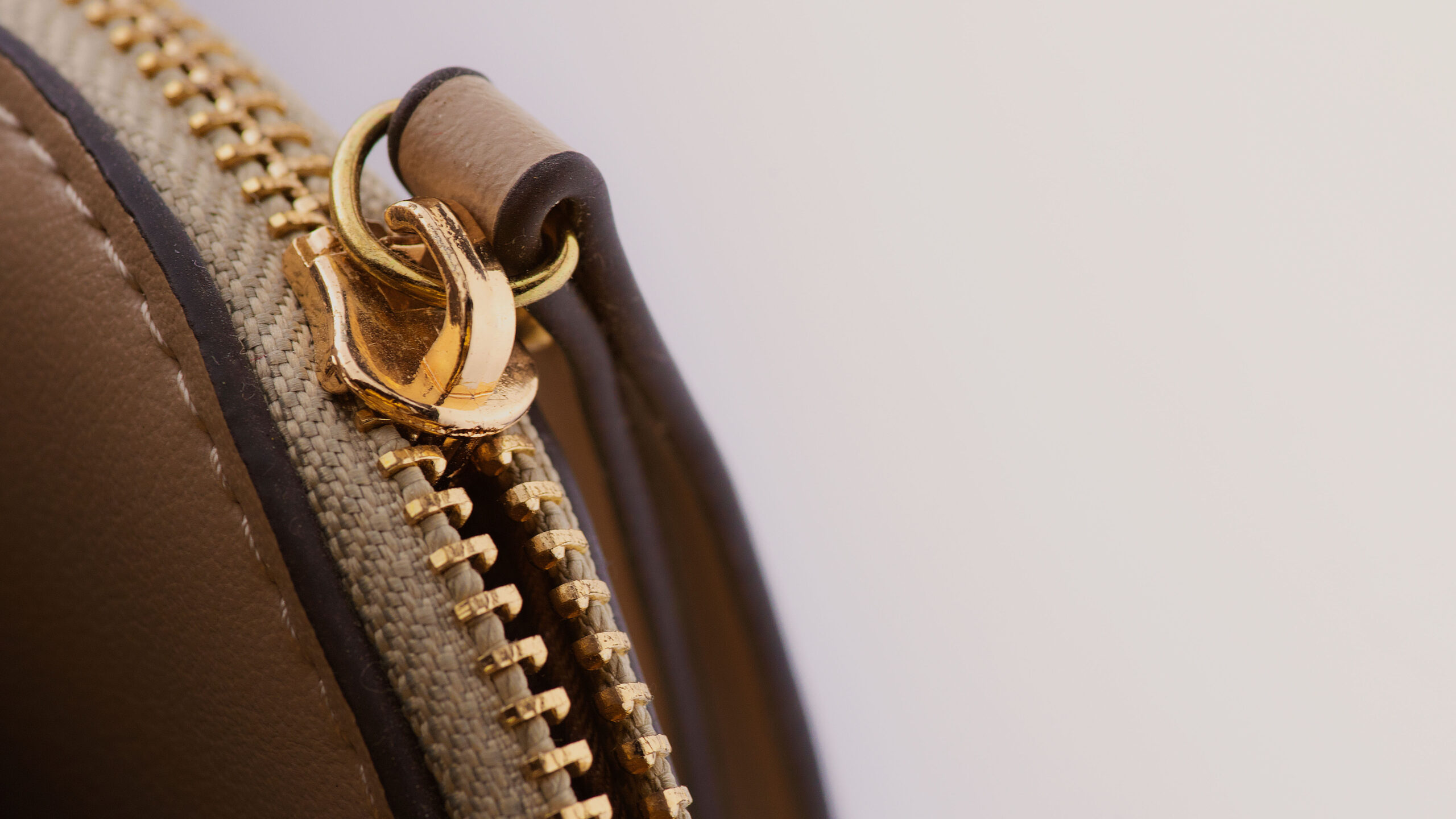
The Hermès zipper pull — the small pull tab attached to the slider on pocket zippers, interior zippers, and the Kelly bag's interior pocket — is among the most overlooked authentication markers in the specialist's toolkit. Most buyers focus on the exterior hardware: the turn-lock, the closure bar, the handle drops. The zipper pull receives less attention precisely because it is smaller and less visually prominent than the bag's primary hardware. But its weight, alignment, movement quality, and engraving characteristics are all forensically significant — and the counterfeit industry's consistent failure to replicate all four markers simultaneously makes the zipper pull one of the most reliable multi-factor authentication points available on any Hermès bag that features one.
This guide covers the four primary zipper pull authentication markers in detail, explains how the zipper track and slider movement quality provides an independent authentication signal, and delivers a systematic protocol for incorporating zipper assessment into a complete secondary market authentication workflow.
Why the Zipper Pull Is an Authentication Marker Worth Learning — and Why It Is Underused
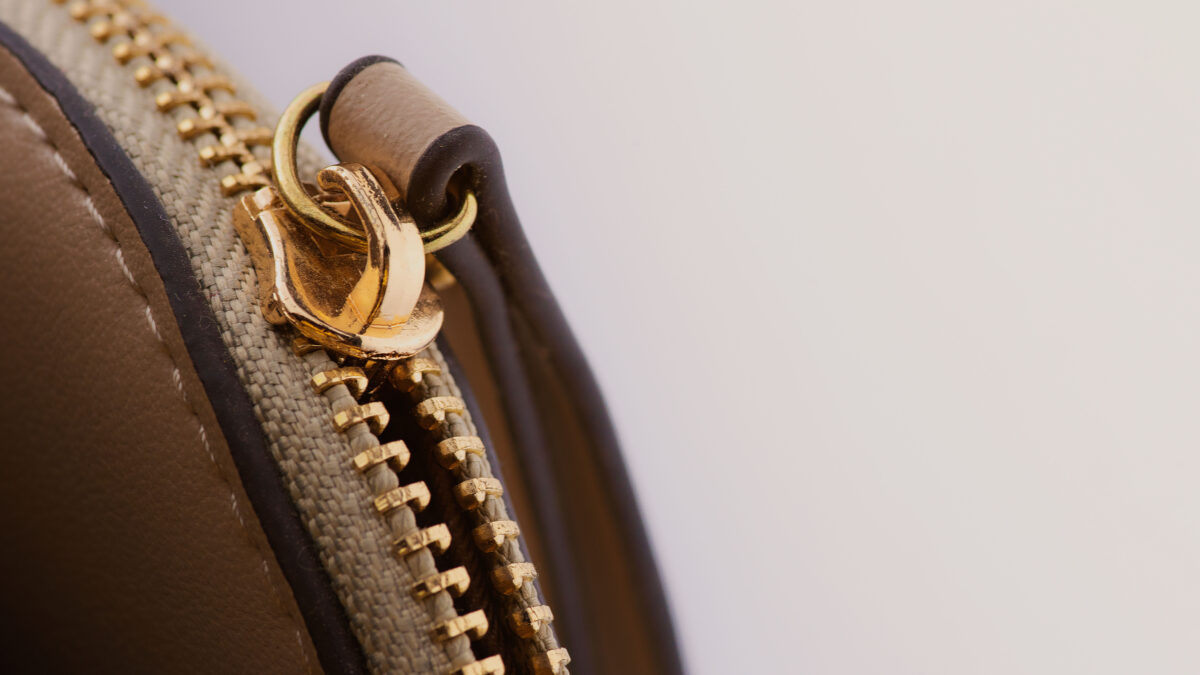
The zipper pull's underuse as an authentication marker reflects a common bias in secondary market assessment: buyers concentrate their scrutiny on the hardware components they can see most clearly and most often — the turn-lock toggle, the exterior closure hardware, the handle drops. The zipper pull, tucked against the bag's interior pocket or requiring the bag to be opened to access fully, requires a deliberate act of inspection that many buyers skip.
This skip represents a significant missed opportunity. The zipper pull is small enough that counterfeit producers sometimes invest less production precision in it than in the more prominently examined exterior hardware components — creating an asymmetry where the interior pull may fail on markers that the exterior hardware passes. The weight, in particular, is a marker that a buyer can assess in seconds without any specialist equipment: the solid brass density of an authentic Hermès zipper pull produces a heft that zinc alloy counterfeit pulls cannot replicate at the same dimensions. A buyer who has held an authentic pull once will recognise the difference immediately on any subsequent piece.
The pull also has an alignment marker — its vertical hang when the zipper is closed — that requires no magnification and no specialist knowledge to read. If the pull hangs off-centre or at a consistent angle when the zipper is at rest on a flat surface, the attachment ring geometry is incorrect, and this is a counterfeit indicator that is visible to the naked eye. For the full authentication context covering all hardware and craftsmanship markers, the Authentication Guide hub provides the complete framework.
"The zipper pull is the authentication marker that counterfeits invest the least in. Its weight, hang, and engraving together form a test that almost nothing currently in circulation passes completely."
The Four Primary Authentication Markers on Every Hermès Zipper Pull
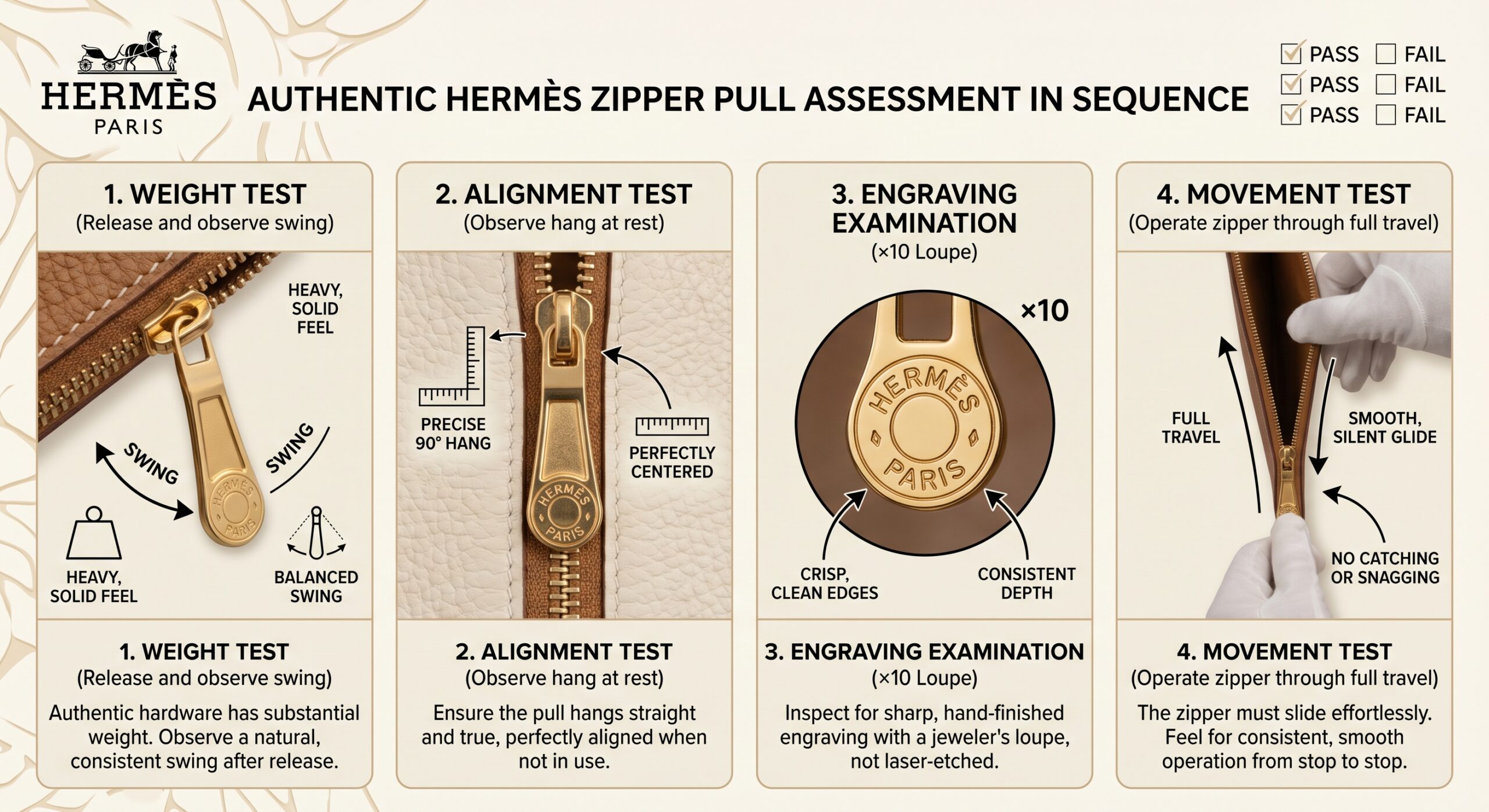
Authentic Hermès zipper pulls are constructed from solid brass before plating. When held between thumb and forefinger and gently released, the pull swings with a pendulum weight that reflects genuine solid metal mass. The density is noticeably substantial relative to the pull's visible dimensions — it feels heavier than its size would suggest to someone accustomed to commercial zipper pulls.
When the zipper is closed and the bag is placed on a flat surface, the pull should hang perfectly centred and vertical — not tilted left or right and not rotated away from the bag's plane. The attachment ring connecting the pull body to the slider should have consistent geometry with no thicker or thinner side. Authentic pulls return to this centred hang after every disturbance.
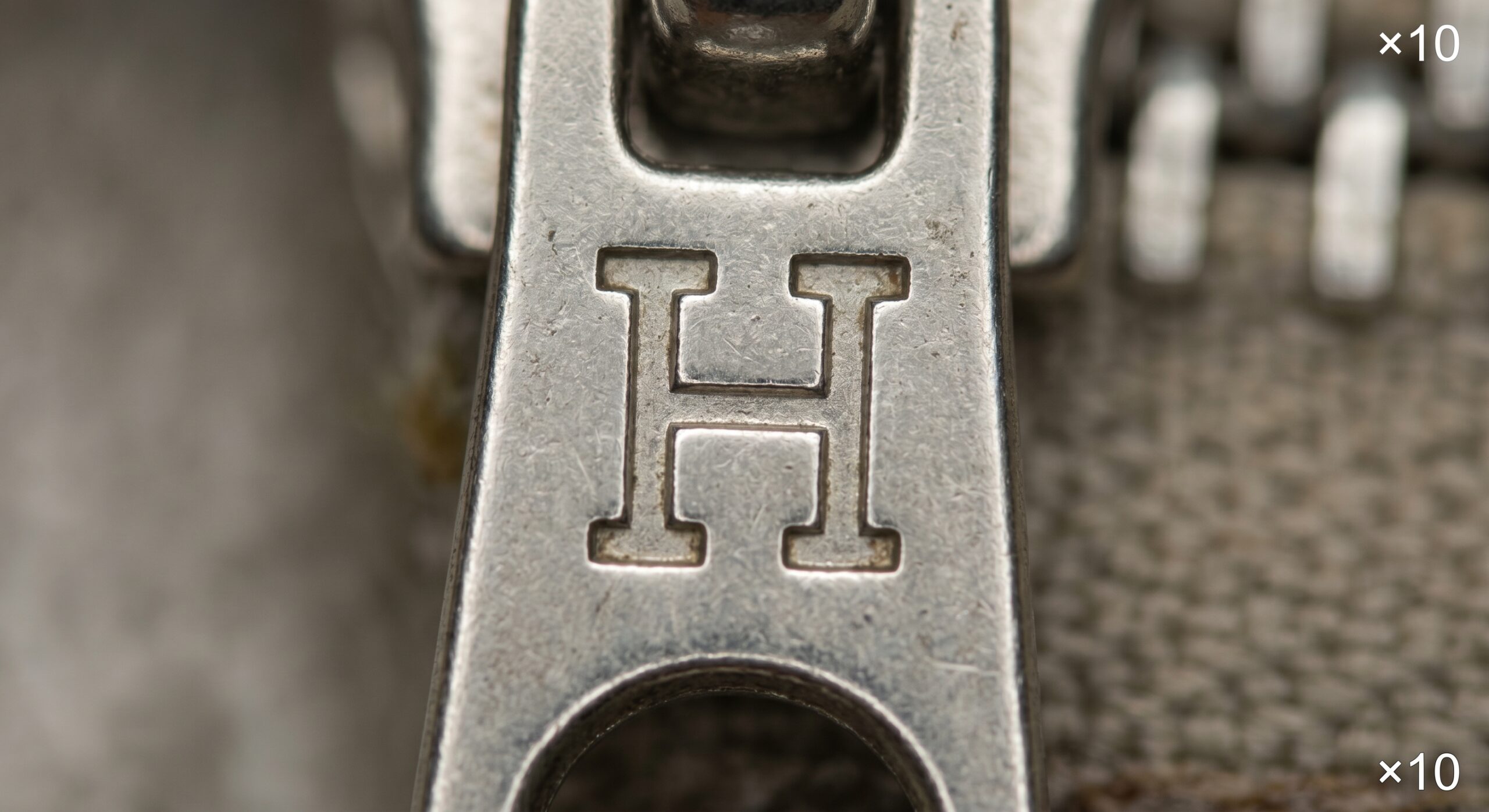
The branding element on the Hermès zipper pull — typically a simple 'H' or the brand initial — is impressed directly into the metal surface using a die, producing a clean indentation with no paint fill, no applied pigment, and no printed text. The impression has consistent depth across the full character with sharp edge definition. The 'H' letterform on the pull uses the same characteristic Hermès crossbar positioning (slightly above centre) as the foil stamp on the leather.
The plating on authentic Hermès zipper pulls follows the same hand-finished substrate geometry as the bag's primary hardware — the edges and transitions show the rolled-light pearling quality produced by the pre-plating hand-finishing process. Under a ×10 loupe at 45 degrees to a directional light source, the pull edges show a rolling rather than snapping light transition across the transitions between faces.
- Weight test — hold the pull between two fingers, release gently, observe the swing: solid brass swings with perceptible gravitational weight; zinc alloy floats with minimal momentum
- Alignment test — place the bag flat, close the zipper fully, observe the pull hang: authentic hangs vertical and centred; counterfeit hangs off-centre or tilted at a consistent angle
- Engraving test — examine under ×10 loupe: authentic shows clean die impression, no paint fill, consistent depth; counterfeit shows paint in the channels, uneven depth, or incorrect character geometry
- Pearling test — apply 45-degree directional light and observe edge transitions: authentic shows rolling-light highlight; counterfeit shows geometric snap transition from face to edge
- Attachment ring geometry — examine the ring connecting pull body to slider: authentic shows consistent ring radius and uniform thickness throughout; counterfeit often shows a slightly oval or thicker-on-one-side ring
The Zipper Track and Slider: Movement Quality as an Independent Authentication Signal
The zipper pull is only one half of the zipper authentication assessment. The track, teeth, and slider mechanism provide an equally significant and often overlooked authentication signal — the movement quality of the zipper in operation.
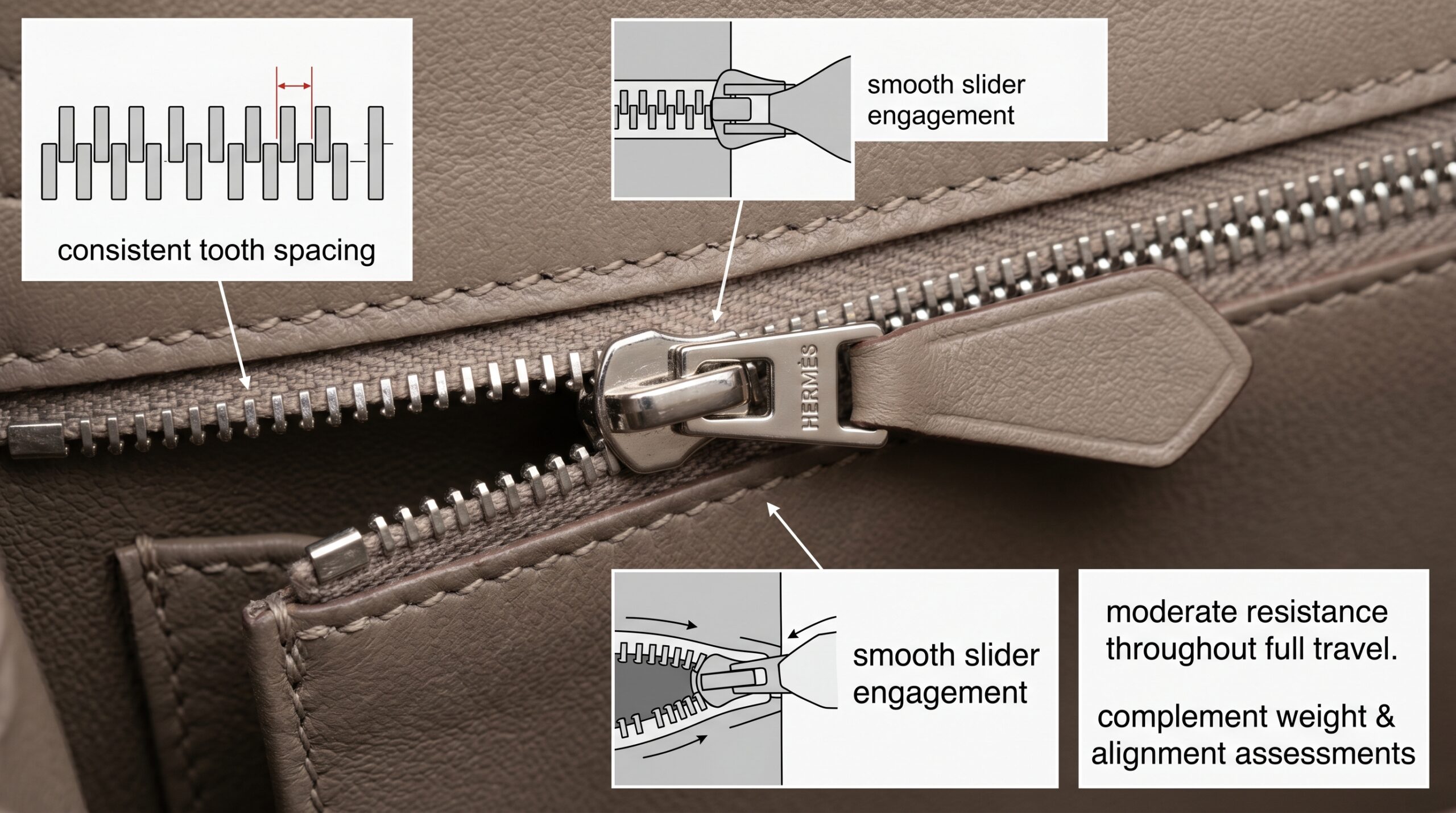
Hermès specifies custom zipper hardware rather than off-the-shelf commercial alternatives. The brass zipper teeth on authentic bags are individually fine-pitched and consistently spaced, producing a smooth, moderate-resistance movement as the slider engages and releases each tooth. The slider mechanism is machined to Hermès's tolerances, which produces a movement character that is distinct from commercial zippers in two specific ways: the resistance is consistent throughout the full travel of the slider (no dead spots or tight zones), and the resistance level is moderate — neither freely sliding under zero effort nor requiring significant force to move.
The Three Zipper Movement Failure Modes That Indicate Counterfeit Construction
Three movement characteristics consistently identify counterfeit zippers in Hermès bags: free-sliding with essentially no resistance (indicates commercial low-quality slider with oversized tolerance gaps around the zipper teeth — common in entry-level counterfeit production); grinding or catching (indicates teeth spacing irregularity from lower-quality die-stamping, or slider channel misalignment from imprecise assembly); and a sharp, mechanical click at each tooth engagement rather than a smooth glide (indicates a slider mechanism with harder tooth-contact geometry than Hermès's custom specification). Authentic Hermès zipper movement reads as smooth, moderate, and consistent — the mechanical equivalent of the leather and hardware quality surrounding it.
On the Bolide bag, which is the primary Hermès bag model where a zipper closure is the main structural feature rather than a secondary interior element, the zipper track and movement quality are among the most heavily weighted authentication markers in specialist assessment. Counterfeit Bolides consistently reveal themselves through zipper movement quality even when their exterior leather and hardware presentation passes initial scrutiny. The pocket zippers on Birkin and Kelly interiors are smaller tracks with the same authentication markers in miniature, providing a useful cross-reference point that complements the exterior hardware assessment. For saddle stitch authentication that should be cross-referenced with zipper assessment, see Hermès Authentic Saddle Stitch Angle vs Machine Stitching. For blind stamp location that provides the third authentication layer, see Hermès Blind Stamp Location Changes in 2026.
The Complete Zipper Authentication Protocol for Secondary Market Buyers
The zipper authentication protocol integrates into a complete assessment as the fourth layer — following hardware pearling, saddle stitch angle, and blind stamp — providing a cross-reference that either confirms or challenges the conclusions from the other three assessments. A piece that passes three authentication layers but fails on zipper pull weight or alignment requires immediate re-examination of the other three markers.
The protocol has five steps that can be completed in under two minutes per zipper element. For the Birkin and Kelly, the primary zipper element is the interior pocket zip; for the Bolide, it is the main closure zip. Begin with the weight test: hold the pull between thumb and forefinger, release gently, and observe the swing characteristic — solid brass swings with clear gravitational momentum; zinc alloy has minimal swing. This test requires no tools and takes three seconds. If the pull fails the weight test, the assessment can typically end here — the pull is almost certainly counterfeit, and the bag warrants no further investment of authentication time.
If the weight test passes, proceed to alignment: place the bag flat, close the zipper, and observe the pull hang from a distance of approximately 30cm. It should hang vertical and centred. Any consistent tilt or off-centre position is a counterfeit indicator. The engraving test follows: under ×10 loupe, examine the branding character on the pull face. No paint fill should be present in the impression channels; the depth should be consistent across the full character; the H crossbar should be positioned slightly above centre matching the foil stamp geometry. Finally, operate the zipper: open and close it three to four times along its full travel, noting whether the resistance is smooth and moderate throughout or shows any of the three counterfeit movement failure modes (free, grinding, or clicking). Browse the full authentication category at Authentication for the complete multi-marker assessment framework that this protocol contributes to.
| Authentication Marker | Authentic Hermès Pull | Counterfeit Pull | Test Method |
|---|---|---|---|
| Pull construction material | Solid brass — noticeably dense relative to visible dimensions | Hollow cast or zinc alloy — lighter than authentic at same dimensions | Hold between fingers; release and observe swing weight |
| Hang alignment at rest | Perfectly centred and vertical when zipper closed on flat surface | Consistent off-centre hang or tilt — asymmetric attachment ring geometry | Place bag flat, close zipper, observe pull hang from 30cm |
| Attachment ring geometry | Consistent radius, uniform thickness throughout full ring circumference | Slightly oval or thicker on one side — die-casting imprecision | ×10 loupe, check ring at multiple points around circumference |
| Branding engraving | Clean die impression — no paint fill, consistent depth, sharp edges | Paint-filled channels; inconsistent impression depth; printed rather than impressed text | ×10 loupe under oblique light — paint fill is immediately visible |
| 'H' crossbar position | Slightly above centre — matching Hermès foil stamp H geometry | Centred crossbar — standard commercial H letterform | ×10 loupe; compare to foil stamp H on same piece |
| Edge pearling quality | Rolling-light highlight at edge transitions — hand-finished substrate beneath plating | Geometric snap light transition — die-cast substrate, no hand-finishing | 45° directional light; rotate pull and observe edge highlight |
| Zipper movement (track) | Smooth, moderate, consistent resistance throughout full travel | Free-sliding (low quality), grinding (tooth spacing), or clicking (hard engagement) | Operate zipper three to four times, noting resistance character |
| Zipper teeth spacing | Fine, consistent pitch — even spacing throughout full track length | Irregular tooth spacing — more visible under loupe at the ends of the track | ×10 loupe along track; check tooth spacing consistency at multiple points |
The Zipper Pull Weight Test Takes Three Seconds and Fails the Majority of Counterfeits — Make It the First Thing You Check
Among all the authentication markers covered in this guide, the zipper pull weight test occupies a unique position: it requires no specialist equipment, no magnification, and no training beyond understanding what solid brass feels like in the hand — and it fails the majority of counterfeit zipper pulls currently in circulation because the density difference between solid brass and zinc alloy is immediately palpable once you know what you are testing for.
The four-marker protocol — weight, alignment, engraving, pearling — is comprehensive and covers all the failure modes that current counterfeit zipper pulls exhibit. Combined with the movement quality assessment of the zipper track, it provides a zipper-layer authentication signal that is both accessible and highly reliable. A piece that passes all five zipper assessment points, alongside the exterior hardware pearling, saddle stitch angle, and blind stamp assessment, has passed the most complete accessible authentication protocol available to a non-specialist secondary market buyer.
Bottom Line: Hold the zipper pull, release it, and feel the swing — solid brass swings with perceptible weight that zinc alloy cannot replicate; this three-second test eliminates the majority of counterfeits before any loupe or magnification is required, making it the most efficient single starting point in zipper authentication.
Popular Searches
Explore our most searched Hermès zipper pull authentication combinations
The interior pocket zipper pull is among the least examined authentication points on the most counterfeited Birkin specification — the weight test identifies counterfeit pulls in three seconds without any tools.
⬆ TrendingThe Kelly's interior pocket zipper pull alignment test — placing the bag flat and observing the pull hang — is a 10-second authentication check that counterfeit pieces fail at the attachment ring geometry stage.
★ Collector FavouriteThe Bolide's main zipper closure is the primary authentication target for this model — smooth, moderate-resistance movement throughout the full travel distinguishes authentic custom-spec hardware from commercial counterfeit track.
◆ Ultra RareThe compact Birkin 25's interior zipper pull is smaller-scale than the 30 and 35 — the four-point authentication protocol applies at this scale but requires a ×10 loupe for the engraving and pearling assessments.
⬆ Rising DemandPalladium's silver-white plating makes the clean die impression of the 'H' engraving more visible than gold — the absence of paint fill and consistent impression depth are particularly legible under loupe on palladium surfaces.
🔥 Most SearchedPaint-filled engraving channels are the most immediately visible counterfeit indicator on Hermès zipper pulls — visible to the naked eye in good light and requiring no magnification on the most common current fakes.
Frequently Asked Questions
Authentic Hermès zipper pulls have four primary authentication markers: weight (a noticeably substantial feel relative to their size due to solid brass construction), alignment (the pull hangs perfectly centred and vertically straight when the zipper is closed), movement (slides with consistent, smooth moderate resistance along the zipper track — not loose or grinding), and engraving (a clean, sharp 'H' impression with no paint fill and consistent depth). Hold the pull between two fingers, release it gently, and observe the swing — solid brass swings with perceptible weight; counterfeit zinc alloy floats with minimal momentum. See the full authentication guide at the Authentication Guide hub.
Authentic Hermès zipper pulls are constructed from solid brass before plating — not hollow-cast or zinc alloy as in most counterfeit productions. The material density produces a weight that is noticeably substantial relative to the pull's visible size: when held between thumb and forefinger and gently released, the pull should swing with a pendulum weight that reflects genuine metal mass rather than floating light. Precise gram weights vary by pull format, but the subjective density test — solid brass feels meaningfully heavier than hollow zinc alloy of the same dimensions — is reliably executable without specialist equipment. For blind stamp context see Hermès Blind Stamp Location Changes in 2026.
Yes. On an authentic Hermès bag, the zipper pull is designed and attached to hang perfectly centred relative to the zipper track when the zipper is closed on a flat surface. The pull should hang straight — not tilted left or right — and the attachment ring should have consistent thickness and radius. Any pull that hangs consistently off-centre or tilts at rest is a counterfeit indicator. Authentic pulls may shift their angle during carry, but at rest they return to vertical centre. For saddle stitch authentication context see Hermès Authentic Saddle Stitch Angle vs Machine Stitching.
Hermès uses its own specified zipper hardware rather than off-the-shelf commercial zippers. The zipper track uses fine brass teeth that are individually set with consistent spacing, and the slider mechanism is machined to Hermès's tolerances. The result is a movement quality that is smooth, consistent, and requires moderate resistance — not freely sliding under zero effort, nor grinding or catching. On bags like the Bolide, the zipper movement is a primary authentication point because counterfeits consistently fail to replicate this movement quality. Browse all authentication guidance at the Authentication category.
