
Hermes Clochette Leather Splitting: Fake vs Authentic Signs
A forensic guide to reading clochette leather splitting correctly — how authentic full-grain splitting progresses, what counterfeit splitting reveals at the substrate level, and how to turn split leather into an authentication advantage.
The Hermès clochette — the small leather case for the cadenas padlock and key that attaches to the bag's front strap by a D-ring — is among the most forensically rich components on any Hermès bag for authentication purposes. This is partly because it is a small, hand-stitched leather piece made from the same full-grain hide as the bag body, and partly because it experiences the most concentrated mechanical stress of any leather element on the bag. The fold line that allows the clochette to open and close is a flex zone that accumulates fatigue over years of handling — and when splitting eventually develops at this fold, the material it reveals tells an immediate and unambiguous story about what the clochette is made of. Understanding that story transforms what looks like a condition problem into one of the most reliable authentication tests available on a secondary market piece.
This guide maps the authentic splitting progression across four stages, explains what the counterfeit substrate reveals when splitting occurs, and provides a protocol for integrating clochette assessment into a complete authentication workflow that uses the clochette's condition as a forensic asset rather than a red flag.
What the Clochette Is and Why It Develops Splitting Over Active Use
The clochette is a small, precisely proportioned leather envelope designed to house the Hermès cadenas padlock and its key. It is attached to the bag's front closure strap by a gold, palladium, or ruthenium-plated D-ring, and it opens at the top to allow the padlock and key to be removed or replaced. The clochette is stitched on three sides using the same waxed linen saddle stitch as the bag's primary seams, at the same 4–5 stitches per centimetre density, with the top left open as the access point.
The fold line that allows the clochette to function — the horizontal crease across the leather body that opens as the access point is spread — is the mechanical stress centre of the piece. Each time the clochette is opened to access the padlock and key, the leather at this fold line is subjected to a controlled tensile stress as the two halves of the clochette separate. The leather's fibril network at the fold point must flex, absorb the tensile load, and return to the closed position. Over years of use, this cyclic tensile stress gradually fatigues the finish layer at the fold, then the surface grain, and eventually the upper fibril layer — producing the characteristic splitting that is visible on many actively used authentic pieces after several years of ownership.
This splitting is not a manufacturing defect — it is a predictable mechanical wear pattern in a specific structural zone that experiences stress no other part of the bag encounters with the same frequency and character. On authentic full-grain leather clochettes, the split progression follows a consistent sequence that is materially legible to the trained eye. For the full authentication framework, the Authentication Guide hub covers all markers from hardware to stitching to leather construction.
"A split clochette on an authentic Birkin is not a problem — it is an opportunity. What the split reveals tells you more about the bag's material authenticity than almost any other single observation."
How Authentic Clochette Splitting Progresses: The Four-Stage Model
Authentic Hermès clochette leather is the same full-grain bovine hide as the bag body, in the same leather type (Togo, Epsom, Clemence, etc.), processed to the same quality standards. Its splitting behaviour at the fold line follows a predictable four-stage progression determined by the fibril architecture of the specific leather type.
Finish Layer Cracking at the Fold Line
The first visible splitting sign is a hairline crack in the finish layer along the fold line — visible under oblique light as a very fine linear disruption in the surface coating. No leather material has separated; only the topcoat finish layer has cracked from repeated flex fatigue. This stage is early and reversible in character: conditioning cream applied specifically to the fold area restores surface lipids that slow further finish layer fatigue. Authentic finish cracking is clean, linear, and follows the fold geometry precisely.
Grain Surface Cracking — Fibril Layer Becomes Visible
As the finish crack deepens through the grain surface, the upper fibril layer becomes visible in the crack channel. On authentic leather, this exposed fibril material is the same grain body as the clochette's outer surface — same colour family, same texture character, same material. The crack at this stage has a clean profile: the split edges are defined, not ragged or fibrous. Under ×10 loupe, the fibril structure visible at the crack walls is consistent and coherent — genuine hide fibrils with organised structure, not the disordered material of bonded or split leather.
Fibril Separation — Split Deepens into the Leather Body
Further flex fatigue separates the fibril layer at the fold point into two distinct surfaces — the outer grain face and the inner fibril body. The split now shows clear depth. On authentic leather, both surfaces of the split show consistent full-grain material: the outer face retains its grain pattern and finish; the inner face shows the organised fibril matrix of the hide body, slightly lighter in tone (less UV and oil exposure) but with the same coherent structure as the outer face. No backing material, fabric, or adhesive layer is present between the two split surfaces.
Full Thickness Split — Hermès Spa Service Appropriate
At Stage 4, the split has progressed through the full thickness of the leather at the fold point. The clochette can now flex open at the split in addition to the designed opening at the top. At this stage, Hermès spa service is the appropriate response: the artisan can reassemble and restitch the fold area, restoring structural integrity. The split on authentic leather at Stage 4 shows consistent full-grain material throughout — no backing, no adhesive, no non-leather substrate — confirming authenticity even at maximum damage.

How Counterfeit Clochette Splitting Differs: The Substrate Revelation Test
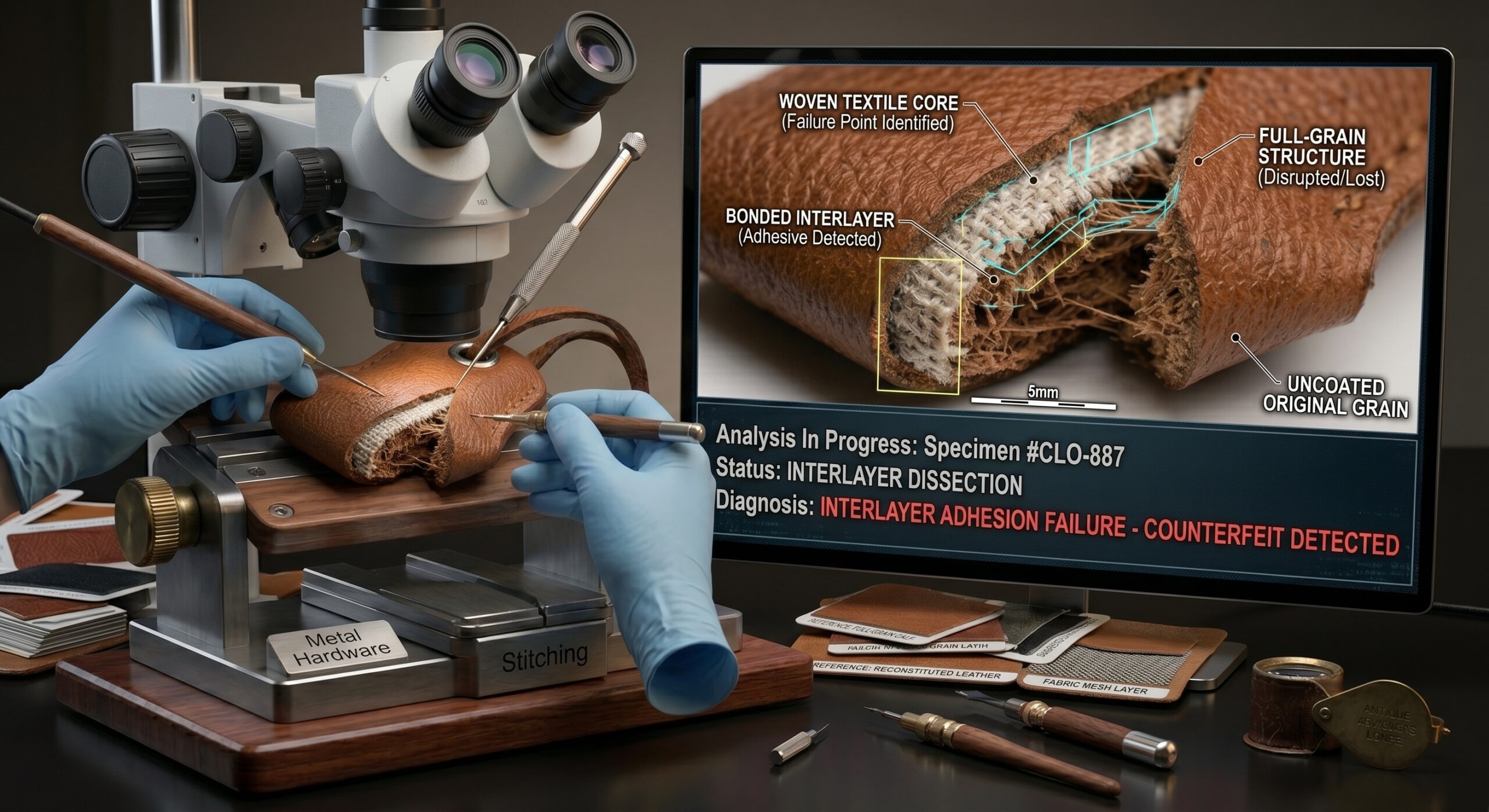
The most valuable authentication information that clochette splitting can provide is not about the split itself — it is about what the split reveals. Counterfeit clochettes are produced from inferior materials because the clochette is a small, easily overlooked component that many buyers and even some secondary market assessors do not examine carefully. The material savings on a clochette — replacing full-grain leather with bonded leather, split leather, or PU-coated fabric — are small in production cost terms but massive in authentication terms, because these inferior materials cannot replicate the fibril-level splitting behaviour of genuine full-grain hide.
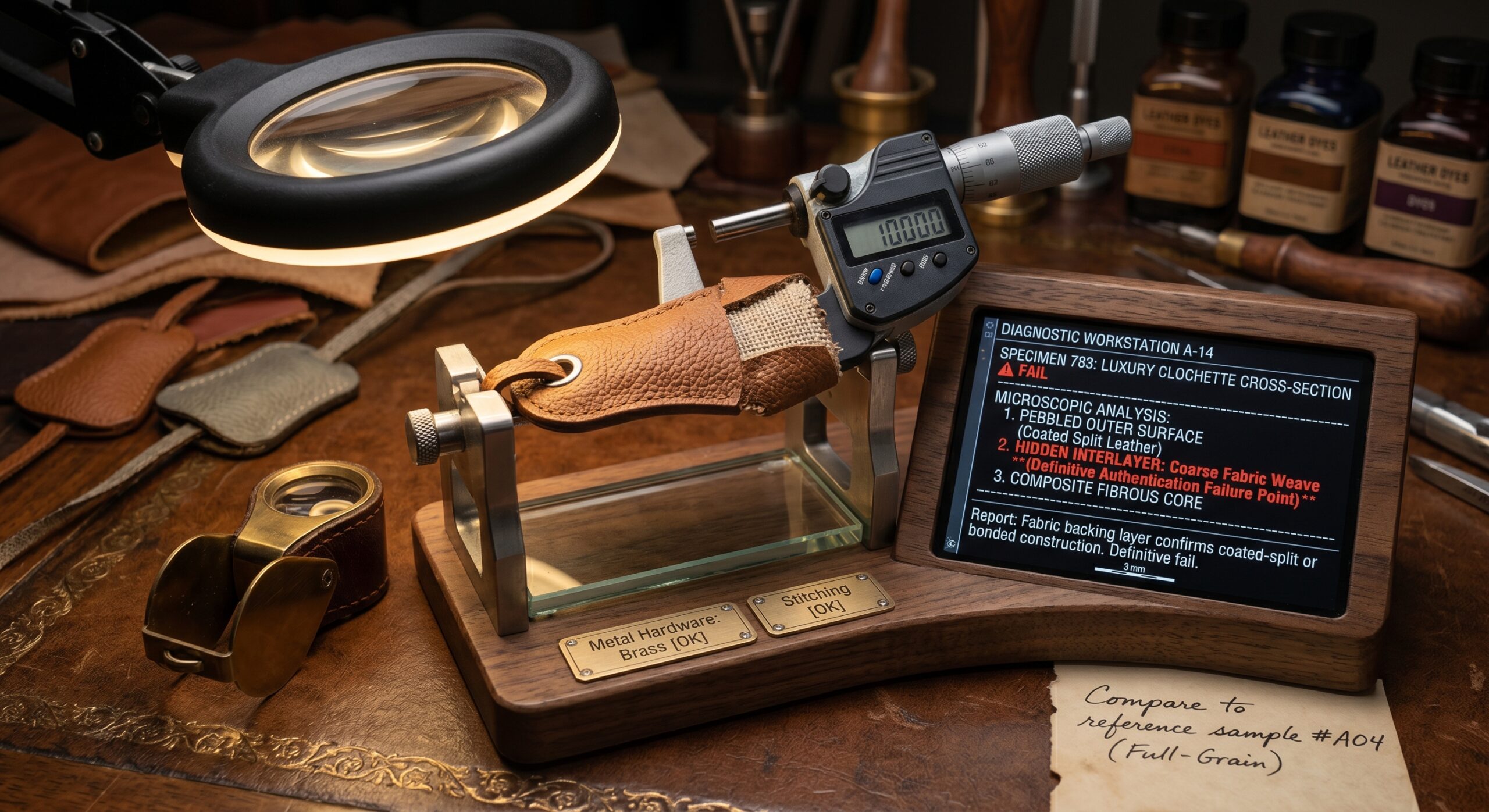
The substrate revelation test is straightforward: when clochette splitting has occurred, examine the material at the split faces under ×10 magnification. The four most common counterfeit substrate types each reveal a specific signature that is immediately distinguishable from authentic full-grain leather.
What Genuine Leather Reveals
What Inferior Materials Reveal
The Smell Test: An Overlooked Clochette Authentication Signal
Authentic full-grain Hermès leather has a specific olfactory character — the mild, clean smell of quality tanned bovine hide, sometimes with a trace of the wax used in the saddle stitch thread. This smell is present in the clochette interior, particularly in older pieces where the leather has had years to develop its character. Counterfeit clochettes made from bonded leather or PU-coated fabric produce distinctly different odours: bonded leather has a glue-adjacent smell from the adhesive used in its production; PU materials have a plastic or chemical smell that is entirely absent from authentic full-grain hide. This test is most useful in the clochette interior — the enclosed space concentrates the leather smell — and provides a useful cross-reference to the visual substrate test when splitting has occurred.
- Inner face material matching — both split faces of authentic splitting show the same leather material; counterfeit splitting shows a layer junction between different materials
- Fibril structure coherence — authentic inner face shows organised collagen fibril structure under ×10 loupe; bonded leather shows disordered fibrous backing; PU shows fabric weave
- No adhesive layer — authentic full-grain leather is a single material; counterfeit alternatives require adhesive bonding between layers, visible as a thin film at the split boundary
- Split edge character — authentic splitting has clean, defined edges; bonded leather delamination produces powdery, shedding edges as the adhesive fails
- Colour consistency at depth — authentic inner face is slightly lighter (less surface treatment) but the same colour family as the outer face; PU materials show a stark colour jump between the outer coating and the substrate
- Smell test (clochette interior) — authentic leather smells of tanned hide; bonded leather smells of adhesive; PU materials smell of plastics chemistry
Using Clochette Condition in the Full Authentication Assessment
Integrating the clochette into a complete authentication assessment requires understanding it as both a condition indicator and an authentication data point — these are distinct readings that contribute to different parts of the assessment.
As an authentication data point, the clochette substrate test is most valuable when splitting has already occurred — because the split, however unfortunate as a condition issue, provides direct visual access to the material beneath the surface that no non-destructive inspection can otherwise achieve. A buyer examining a secondary market piece with clochette splitting should treat the split as an authentication gift: open the split carefully with a fingernail to maximise visibility of the inner faces, and examine under ×10 loupe. If the inner material is consistent full-grain leather — same fibril texture, no layer junction, no adhesive, no fabric — the piece has passed one of the most material-specific authentication tests available. If the inner material shows any of the counterfeit substrate signatures, the piece is a fake regardless of every other marker that may have passed inspection.
As a condition indicator, clochette splitting is assessed separately from the authentication reading. On an authenticated piece, the split stage determines the condition impact: Stage 1–2 splitting is a minor condition note that reduces grade only marginally; Stage 3 splitting is a moderate condition concern that warrants a modest price reduction; Stage 4 splitting is a significant condition issue that warrants factoring in the cost of Hermès spa service. For the complementary hardware authentication markers that should be combined with clochette assessment, see Hermès Pearling on Hardware: What It Is and How to Spot Fakes. For zipper pull weight and alignment as a parallel small-component authentication test, see Hermès Zipper Pull Alignment and Weight: Full Authentication Guide. Browse the full authentication category at Authentication.
| Assessment Point | Authentic Clochette Splitting | Counterfeit Clochette Splitting | Test Method |
|---|---|---|---|
| Inner face material | Full-grain leather — same material as outer face, consistent at all depths | Bonded backing, PU-coated fabric, or split leather — distinctly different from outer surface | ×10 loupe at split faces; look for layer junctions and material inconsistency |
| Fibril structure at crack walls | Organised, coherent collagen fibril network — recognisable as genuine hide at any magnification | Disordered fibrous backing (bonded); fabric weave (PU); disorganised surface (split leather) | ×10 loupe; compare crack-wall texture to outer surface grain body |
| Adhesive layer presence | None — authentic full-grain leather is a single material, no bonding agent present | Thin adhesive film visible at layer boundary — colour and texture distinct from both outer and inner materials | ×10 loupe at split boundary; adhesive typically appears as a dull, slightly yellowed film |
| Split edge character | Clean, defined edges — authentic fibril separation is precise | Powdery or shedding edges (bonded leather delamination); peeling layers (PU delamination) | Observe edges after gentle opening of split; shedding material indicates bonded substrate |
| Colour at inner face | Same colour family as outer face, slightly lighter (less surface treatment) — consistent throughout depth | Stark colour change between outer coating and substrate — dramatically different tones | Visual inspection; authentic inner face is a tone variant of the outer, not a different material colour |
| Smell (interior) | Clean tanned hide smell — mild, organic, leather-specific | Adhesive smell (bonded); plastic chemistry smell (PU); both distinctly non-leather | Smell clochette interior — the enclosed space concentrates the characteristic odour of whatever material is used |
| Split stage relationship to use history | Correlates with use history — more splitting at Stage 3–4 on actively carried pieces with years of use | Splitting often appears earlier and on less-handled areas — inferior substrate delaminates from flex stress sooner | Assess split stage relative to bag's apparent use history; premature or inconsistent splitting on new-looking bags is a counterfeit indicator |
Clochette Splitting Is Not a Red Flag — It Is an Authentication Window. Learn to Read What the Split Reveals.
The clochette's splitting behaviour is among the most misread signals in secondary market Hermès assessment. Buyers who see splitting on a clochette and immediately reduce the bag to a lower authentication category are making an error — the split itself tells you nothing about authenticity. What the split reveals tells you everything. Full-grain leather beneath a clochette split confirms authentic material in a way that no surface inspection can, because it provides direct access to the substrate that counterfeit construction cannot replicate.
The protocol is simple: when you encounter clochette splitting on a secondary market piece, open the split carefully, examine the inner faces under a ×10 loupe, and read the substrate. Coherent fibril structure, consistent colour, no adhesive layer, no fabric backing — authentic. Any departure from these conditions — powdery edges, fabric weave, adhesive film, dramatic colour change — is a definitive counterfeit indicator, regardless of the quality of every other marker on the piece. The smaller and less conspicuous a component, the more honestly it reveals the material quality behind the surface presentation.
Bottom Line: When a Hermès clochette splits, treat it as an authentication gift — open the split, examine the inner faces under ×10 loupe, and read the substrate: full-grain leather beneath confirms authentic; any non-leather backing material confirms counterfeit, regardless of all other markers.
Popular Searches
Explore our most searched clochette authentication and condition combinations
The most commonly split clochette on the secondary market — Birkin 30 clochettes on actively carried pieces develop fold line splitting after three to five years, providing authentication access to the inner material.
⬆ TrendingKelly clochettes split along the same fold geometry as Birkin pieces — the substrate revelation test applies identically, and the clochette's tight proportions make the inner face assessment particularly straightforward under loupe.
★ Collector FavouriteEarly-stage clochette splitting (finish and grain layer only) on an authenticated piece is a minor condition note that should be factored into price negotiation rather than treated as an authenticity concern.
◆ Ultra RareBonded leather backing revealed at a clochette split is the single most definitive counterfeit indicator available on a Hermès bag — it confirms non-authentic material construction at the first material assessment point.
⬆ Rising DemandFull-thickness authentic clochette splitting is restorable at Hermès spa service — buyers who factor in the spa service cost when negotiating Stage 4 split pieces can acquire authenticated bags at meaningful discounts.
🔥 Most SearchedThe clochette interior smell test is the most accessible non-visual authentication method — genuine tanned hide versus adhesive or PU chemistry is immediately distinguishable to any buyer who has smelled authentic leather.
Frequently Asked Questions
Yes — authentic Hermès clochette leather can develop splitting at the fold line over time, particularly on pieces actively carried for several years. The clochette fold line experiences repeated flex stress each time it is handled, and splitting is a predictable mechanical wear pattern that initiates at the outer finish layer before progressing to the grain and fibril body. In genuine full-grain Hermès leather, splitting reveals the same leather material beneath the surface — confirming authentic construction. This is an expected wear pattern that does not indicate counterfeit construction. See the full authentication guide at the Authentication Guide hub.
The key difference lies in the material revealed at the split. Authentic Hermès clochette is full-grain throughout — when the outer finish layer splits, the grain body beneath is visible as the same leather material. Counterfeit clochettes from bonded leather, split leather, or PU-coated fabric reveal a distinctly different inner material: bonded leather shows a fibrous, felt-like backing; PU shows a woven fabric substrate; split leather shows a rougher inner surface with visible layer junctions. The revealed inner material is the most reliable single authentication marker when clochette splitting has occurred. For saddle stitch context see Hermès Authentic Saddle Stitch Angle vs Machine Stitching.
The authentic Hermès clochette is a small, precisely-formed leather case for the cadenas padlock and key, produced from the same leather as the bag body — matching grain character, colour, and finish exactly. The stitching that closes its three sides uses the same waxed linen saddle stitch as the bag's primary seams at the same density. The top opening is wide enough to access the padlock but not excessively generous. The clochette's proportions are specific to the bag format and consistent across production batches. For foil stamp context see Hermès Foil Stamping Depth and Spacing.
Clochette splitting on an authentic piece is a condition issue, not an authenticity failure. If the split reveals genuine full-grain leather beneath — same grain character as the outer surface — the piece is authentic and the clochette requires conditioning or Hermès spa service for advanced splits. The split stage should be factored into condition grade and price negotiation. If the split reveals a fibrous backing, fabric substrate, or PU film, the piece is counterfeit regardless of all other markers. Browse all authentication guidance at Authentication.
