
Authentic Hermes Resin Edge Glazing Thickness: What to Look For
The forensic expert's guide to reading Hermès edge glazing — bead profile, colour-match precision, component-specific thickness, and the four failure modes that identify counterfeit application across every leather edge.
The resin edge glazing on a Hermès bag — the smooth, coloured bead applied along every exposed leather edge to seal the cut fibril ends and protect the leather from edge delamination — is one of the most consistently overlooked authentication markers in standard secondary market assessment. Most buyers examine the stitching, the hardware, and the foil stamp. The edge glazing, running along every handle edge, every panel edge, every gusset edge, and every closure tab edge, is examined by almost nobody — which is precisely why it is one of the most reliably informative. Authentic Hermès edge glazing is applied to a specific bead profile, tinted to match the leather colour precisely, and cured to a smooth, unbroken surface that runs consistently along every edge without pooling at corners or thinning on straight runs. Counterfeit edge glazing fails on at least one and usually all four of these dimensions.
This guide maps the exact bead profile and thickness standards of authentic Hermès edge glazing across different bag components, explains the colour-matching precision that is itself an authentication marker, and provides a systematic five-point inspection protocol that integrates edge glazing assessment into a complete authentication workflow.
What Hermès Edge Glazing Is and Why It Matters for Authentication
Edge glazing — also called edge paint or edge finishing — is the protective and aesthetic treatment applied to the cut edge of every leather component in a Hermès bag. When leather is cut to shape, the cut edge exposes the fibril cross-section of the hide: a raw surface of cut collagen fibrils that, without treatment, would be vulnerable to abrasion, moisture, and the progressive delamination of the leather's grain face and flesh side. Edge glazing seals this raw cut surface with a resin compound that bonds to the fibril ends, creating a protective coating that prevents delamination, provides a finished edge aesthetic, and contributes to the durability of the leather component.
The reason edge glazing is an authentication marker is that Hermès's approach to it is significantly more demanding than the approach used in counterfeit production. Three specific properties of Hermès edge glazing are distinctive enough to serve as authentication signals: the precise bead profile maintained across every edge, the colour-matching of the resin to the specific leather colour, and the consistent surface quality of the cured resin throughout the full edge length. These three properties together require a level of material investment and application skill that counterfeit production does not replicate — and the gaps are legible to any buyer who knows what to look for. For the full hardware and craftsmanship authentication context, the Hardware & Craftsmanship Guide hub covers pearling, edge glazing, and all construction quality markers.
"Run a fingernail very gently along the edge glazing of any Hermès bag. Authentic glazing is smooth and continuous — no ridges, no bubbles, no interruptions. That smoothness takes skill and time to produce. Counterfeits almost never have it."
The Authentic Bead Profile: Thickness, Cross-Section, and Surface Quality
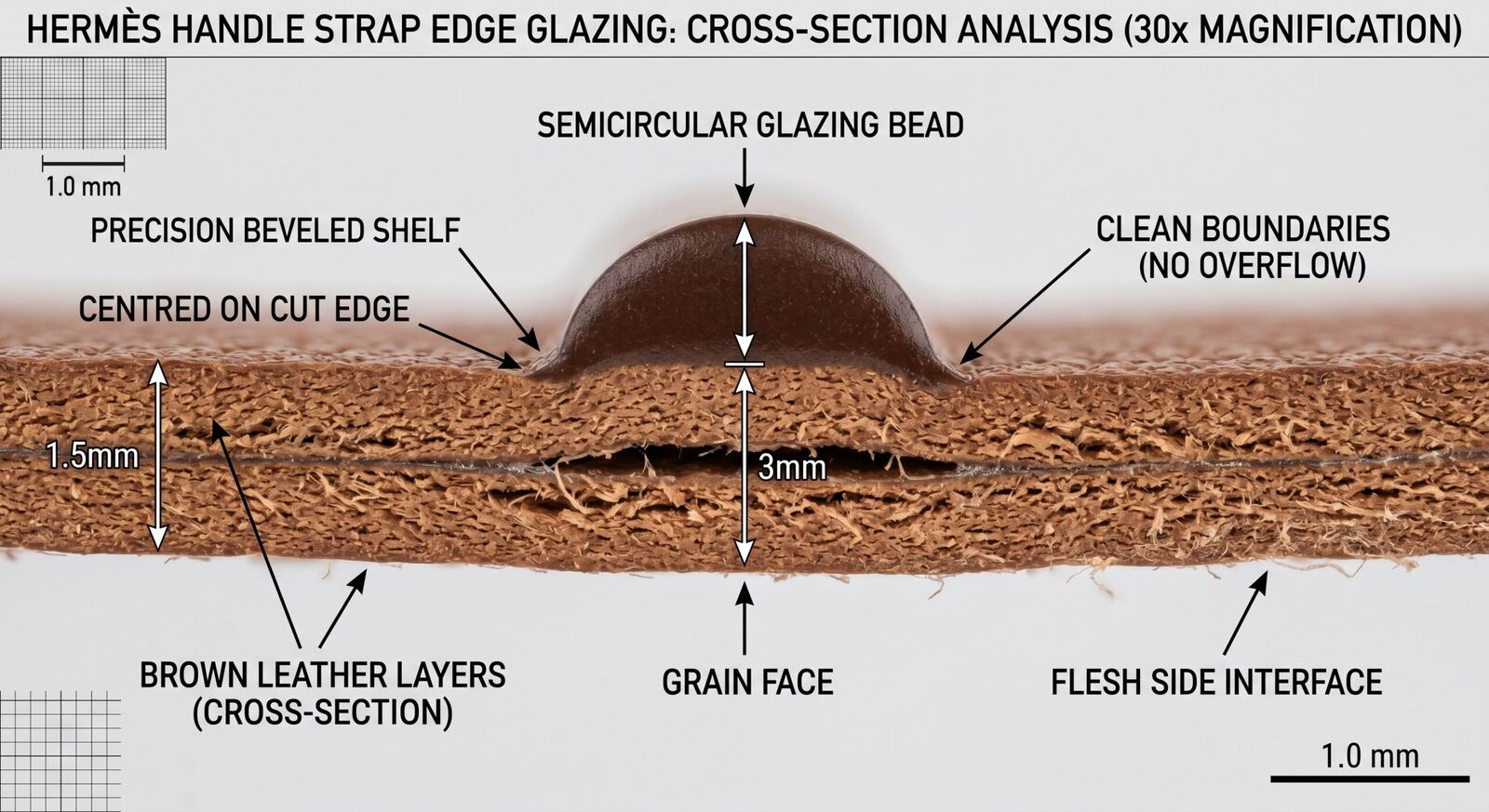
The authentic Hermès edge glazing bead has a specific profile that is consistent across all bag components of equivalent leather thickness, applied by skilled craftspersons using a controlled application technique. Understanding this profile — and recognising the two primary deviation types that indicate counterfeit production — is the foundation of edge glazing authentication.
Consistent semicircular cross-section, centred on edge thickness. 1.0–1.5mm width on main panels. Smooth, unbroken surface throughout full edge length.
Bead too thin — barely covers the cut fibril ends. Flat rather than semicircular profile. Fibril texture visible through thin resin layer. Insufficient fibril sealing.
Bead too wide — overflows onto grain face and/or flesh side. Dome rather than semicircular profile. Pooling at corners, thinning on straight runs. Visible overflow lines.
The authentic bead is consistently semicircular in cross-section: viewed from the end of a leather strap or handle edge, the glazing presents as a smooth dome that is centred on the leather's edge thickness, extending equally toward the grain face and the flesh side without reaching or touching either. This centring requires the craftsperson to apply the resin at the correct quantity and viscosity for the specific leather thickness being glazed — a skill that cannot be approximated by machine and is one of the reasons edge glazing quality distinguishes hand-finished from mass-produced leather goods.
The surface of the authentic bead is smooth and continuous under ×10 magnification — no bubbles from air trapped during application, no rough texture from incorrect resin viscosity, no ridge lines from brush or applicator marks, and no interruptions along the full length of the edge. This surface continuity is most legible on the longer straight-run edges — the main panel edges, the handle strap edges — where any surface defect in the glazing would be visible as a break in the otherwise consistent surface. For the comparison with saddle stitch quality that should be assessed alongside edge glazing, see Hermès Authentic Saddle Stitch Angle vs Machine Stitching. For the hardware pearling that provides the complementary metal craftsmanship marker, see Hermès Pearling on Hardware: What It Is and How to Spot Fakes.
Colour Matching: The Most Immediately Visible Authentication Signal in Edge Glazing
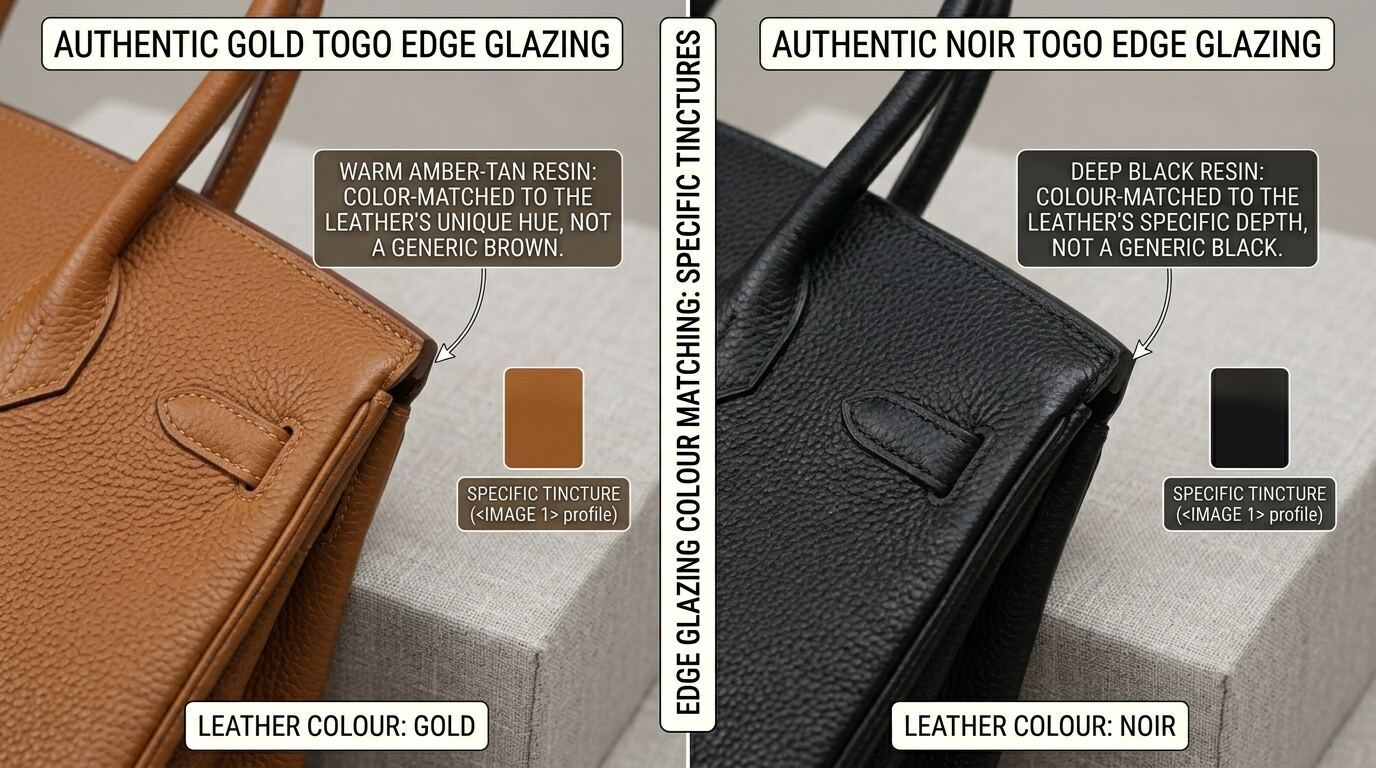
Hermès tints its edge glazing resin to match each specific leather colour as closely as possible. This colour-matching requirement is both a craftsperson skill and a material investment — it means that every leather colour requires its own tinted resin batch, custom-prepared to match the specific pigment formulation of that leather's dyestuff. The result is that the edge glazing on an authentic Hermès Gold Togo bag reads as a warm amber-tan, closely but not identically matching the leather's face colour. On Noir, the glazing is a deep, saturated black. On Craie, a near-white cream. On Bleu Saphir, a deep marine blue tone.
Why Colour Mismatch Is the Fastest Single-Pass Edge Glazing Authentication Failure
Counterfeit Hermès bags almost universally apply edge glazing using generic resin colours rather than leather-matched tints — typically a dark brown or black glaze applied regardless of the bag's leather colour. This produces an immediately visible mismatch on any pale or warm-toned leather: a Craie Epsom Birkin with dark brown edge glazing, a Gold Togo with black edge glazing, or a Rose Sakura with generic tan glazing. The colour mismatch is visible from arm's length on pale-tone leathers and requires no magnification to assess. It is the fastest single-pass edge glazing authentication check available — scan the handle edge, note the glazing colour, compare to the leather: if the glazing is significantly darker or a completely different hue from the leather, the assessment is done. The piece has failed on colour alone, and no further edge glazing assessment is needed.
The colour match on authentic pieces is precise but not necessarily identical to the leather face colour — the resin's optical properties after curing are slightly different from the leather's finish layer, and some slight tonal variation is expected. What is not present on authentic pieces is a systematic colour family mismatch: dark brown glaze on pale leather, black glaze on warm amber leather, or generic tan glaze on a saturated colour. Any of these systematic mismatches is a definitive counterfeit indicator regardless of the profile quality of the bead.
- Colour family match — glazing should be in the same colour family as the leather: warm amber for Gold tones, cream for pale leathers, deep saturated tone for bold colours; any systematic departure is a counterfeit indicator
- Bead profile consistency along the full edge length — view from the side along the full handle edge: authentic glazing maintains consistent width and height throughout; counterfeit glazing pools at corners and thins on straight runs
- Surface continuity — run a fingernail very lightly along the bead: authentic glazing is smooth and continuous with no ridges, bubbles, or interruptions; counterfeit glazing shows surface defects from incorrect resin viscosity or rapid curing
- Overflow check — view the edge from above: authentic glazing does not overflow onto the grain face or flesh side; any visible line of resin on the leather surface adjacent to the edge indicates over-application
- Corner and curve consistency — examine a corner point: authentic glazing maintains its semicircular profile through curves without pooling at the corner point; counterfeit glazing bulges at corners and thins immediately before and after
- Adhesion integrity — examine under ×10 loupe at a straight run: authentic glazing is fully adhered along its full length with no lifting at the edges of the bead; counterfeit glazing shows edge lifting or micro-separation where the resin has not bonded fully to the leather fibril ends
The Edge Glazing Inspection Protocol: Five Assessment Points in Under Three Minutes
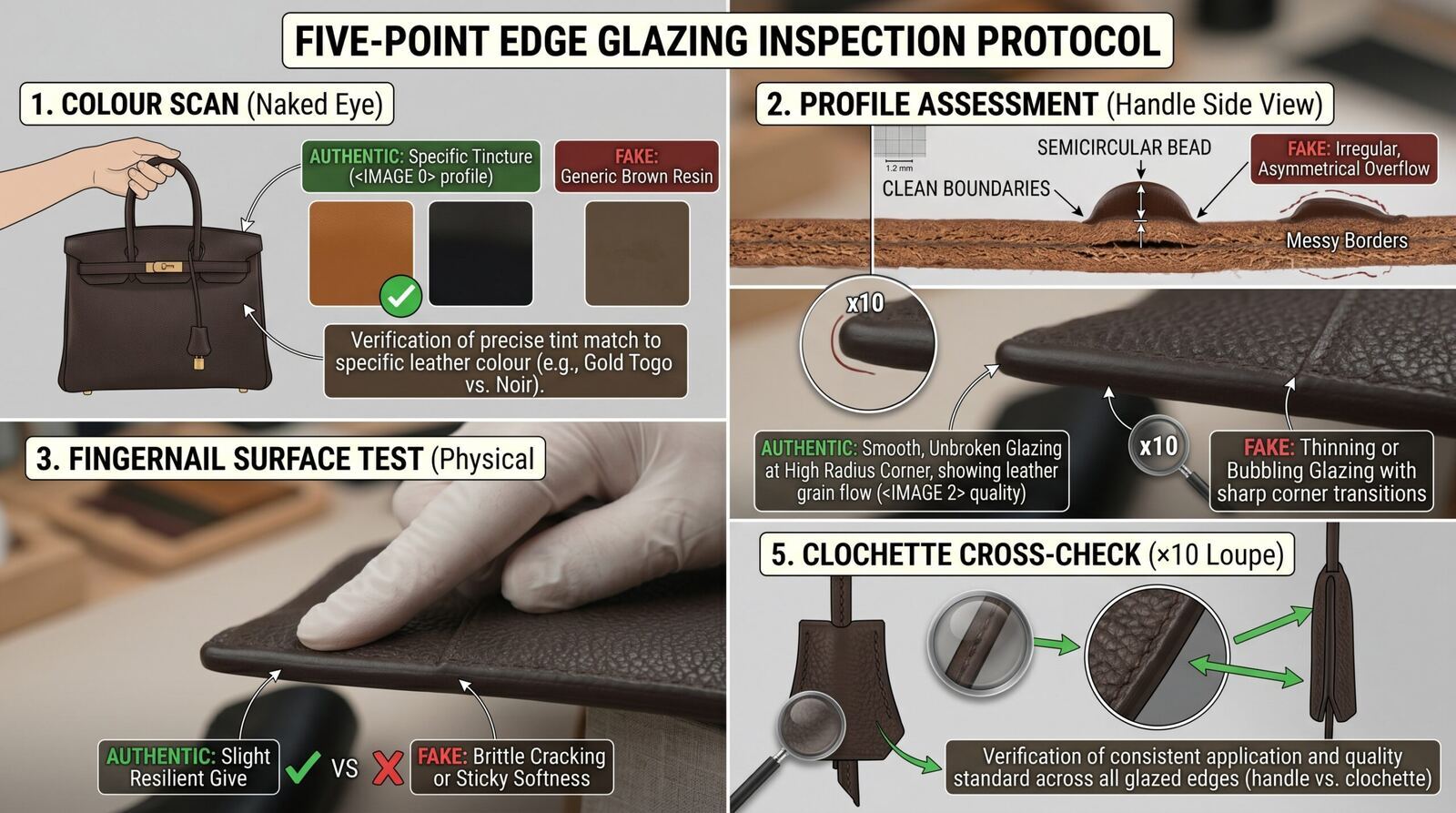
The edge glazing inspection protocol integrates into the full authentication assessment as a craftsmanship quality layer that cross-references with the hardware pearling and saddle stitch assessments. A piece that passes hardware pearling and saddle stitch angle but fails on edge glazing profile or colour has a quality inconsistency that warrants re-examination of the other markers.
Point 1 — Colour scan (naked eye, five seconds). Scan the handle edge glazing from arm's length. Identify the glazing colour. Compare to the leather colour. If the glazing is a clearly different colour family from the leather (dark on pale, black on warm amber), the piece has failed on colour. If the colour family matches, proceed.
Point 2 — Profile assessment (naked eye, handle edge). View the bag's handle from the side, looking along the full length of the handle edge. The glazing bead should appear as a consistent, even stripe of the same width throughout the full handle length. Any visible pooling at the handle ends or thinning in the middle indicates profile inconsistency. Also check whether the bead sits centred on the edge thickness or overflows onto the grain or flesh face.
Point 3 — Surface quality (fingernail test). Run a fingernail very lightly along the handle edge glazing on the longer straight run — the fingernail should glide smoothly with no ridges, bumps, or surface variations. Any surface texture that catches the fingernail indicates rough curing, bubbled resin, or applicator marks in the glazing surface.
Point 4 — Corner and curve check (×10 loupe). Examine the glazing at a corner point — where the handle strap meets the handle drop, or at the closure tab's end curve. Under the loupe, the bead should maintain its consistent semicircular profile through the curve. Any pooling, distortion, or profile change at the corner indicates application skill deficit consistent with counterfeit production.
Point 5 — Clochette edge cross-check (×10 loupe). Examine the glazing on the clochette's three stitched edges. The same colour, the same bead profile, and the same surface quality should be present on the clochette as on the main bag body — any deviation between the clochette's glazing quality and the bag body's glazing quality indicates component inconsistency that is a counterfeit marker. Browse the full authentication category at Authentication for the complete marker framework that contextualises this protocol.
| Authentication Point | Authentic Hermès Glazing | Counterfeit Glazing | Test Method |
|---|---|---|---|
| Resin colour match | Tinted to match the specific leather colour — warm amber for Gold tones, deep black for Noir, cream for Craie | Generic dark brown or black regardless of leather colour — immediately visible on pale and warm-tone leathers | Naked eye from arm's length — colour family mismatch visible without tools |
| Bead profile (straight run) | Consistent semicircular cross-section, centred on edge thickness, 1.0–1.5mm width on main panels | Variable width — pooling where application slowed, thinning where application accelerated; profile varies along the run | View along full handle edge from the side — consistent vs variable bead width visible at this angle |
| Bead centring on edge | Bead centred — does not overflow onto grain face or flesh side at either edge of the bead | Overflow onto grain face and/or flesh side visible as a line of resin adjacent to the edge — over-application is the most common failure | View edge from above — any resin line on the leather face indicates overflow |
| Surface quality (cured bead) | Smooth, continuous surface with no air bubbles, rough texture, ridges, or applicator marks throughout full length | Rough, bubbled, ridged surface from incorrect resin viscosity, rapid curing, or machine application — visible and tactile | Fingernail test: smooth glide = authentic; any catch or variation = counterfeit surface quality |
| Corner and curve behaviour | Consistent semicircular profile maintained through curves — no pooling at corners, no thinning before or after | Pooling at corner points producing a dome of excess resin; thinning on the straight run immediately before or after the corner | ×10 loupe at corner point — compare bead width at corner to adjacent straight run width |
| Adhesion integrity | Fully adhered along full length — no lifting at bead edges, no micro-separation from leather fibril ends | Edge lifting visible under loupe at straight-run sections — resin has not bonded fully to fibril ends due to incorrect application conditions or wrong resin chemistry | ×10 loupe at straight run — examine bead edges for lifting or separation from leather surface |
| Coverage completeness | 100% of all exposed cut leather edges glazed — no component has an unglazed edge | Some edges glazed, others not — cost-saving measure in counterfeit production; often visible on smaller components (clochette, closure tab ends) | Inspect all components: handles, drops, gussets, tabs, and clochette — all edges should be glazed consistently |
| Clochette consistency | Same colour, profile, and surface quality on clochette edges as on bag body — consistent application throughout all components | Glazing quality on clochette often lower than on main bag body — smaller component receives less production investment in counterfeit production | Compare clochette edge glazing directly to main panel edge glazing under same lighting and magnification |
Edge Glazing Is the Craftsmanship Marker That Requires No Specialist Equipment and Fails Counterfeits in Five Seconds — Start With the Colour Scan
Of all the craftsmanship authentication markers on a Hermès bag, edge glazing is the most accessible and the most consistently informative. The colour scan — five seconds, naked eye, arm's length — eliminates the majority of counterfeits before any loupe is raised, because counterfeit producers consistently use generic dark glaze regardless of the leather colour. On any pale or warm-toned leather, this mismatch is immediately visible and requires no specialist knowledge to read.
The five-point protocol that follows the colour scan provides a complete craftsmanship quality assessment — profile consistency, surface quality, corner behaviour, and clochette cross-check — that together form one of the most reliable authentication layers available without specialist equipment. A piece that passes all five edge glazing assessment points, alongside hardware pearling, saddle stitch angle, and blind stamp assessment, has completed the most comprehensive accessible authentication protocol available to any secondary market buyer.
Bottom Line: Scan the edge glazing colour first — generic dark glaze on pale or warm-toned leather is an immediate counterfeit indicator visible without tools; then run the five-point profile protocol to confirm craftsmanship quality that together with hardware and stitching assessment forms the most complete non-specialist authentication available.
Popular Searches
Explore our most searched edge glazing authentication and craftsmanship combinations
Gold Togo is the most common specification where counterfeit dark-brown generic glaze is immediately visible against the warm amber leather — the colour mismatch on this combination is detectable at arm's length in any lighting.
⬆ TrendingCraie Epsom is the specification where colour-matching demands on the edge glazing are highest — the near-white leather requires a carefully tinted cream resin that no generic glaze colour can approximate.
★ Collector FavouriteNoir Epsom edge glazing is where the bead profile is most legible — the dark glaze against the dark leather requires oblique light assessment of the bead cross-section rather than colour-scan, making the profile test the primary check on this tone.
◆ Ultra RareDistinguishing genuine edge glazing adhesion wear on an aged authentic piece from the micro-separation characteristic of counterfeit glazing — aged authentic glazing lifts at the ends after decades; counterfeit glazing lifts within months.
⬆ Rising DemandThe clochette edge glazing cross-check is the most underused secondary market authentication point — quality inconsistency between clochette and bag body glazing is the clearest evidence of component-source mixing in counterfeit production.
🔥 Most SearchedGlazing overflow onto the grain face is the most common profile failure on counterfeit bags — visible as a thin line of resin along the leather face adjacent to the edge, indicating over-application at the wrong resin viscosity.
Frequently Asked Questions
Authentic Hermès edge glazing presents as a smooth, consistently profiled bead that sits centred on the leather's edge thickness, neither overflowing onto the grain face nor the flesh side. The bead profile under magnification shows a clean semicircular cross-section with smooth, unbroken surface continuity throughout the full length of every edge. The colour matches the bag's leather colour precisely — Hermès tints the resin for each specific leather colour. At corners and curves, the bead maintains its consistent profile without pooling or thinning. See the full hardware and craftsmanship guide at the Hardware & Craftsmanship Guide hub.
Authentic Hermès edge glazing on main panel edges is approximately 1.0–1.5mm wide, sitting centred on the leather's cut edge. On thinner components like handle drops, closure tabs, and clochette, the bead is proportionally narrower — approximately 0.6–1.0mm — scaled to the component's leather thickness. The profile is consistently semicircular: not flat (under-applied), not dome-shaped with overflow (over-applied). Under ×10 magnification, the bead shows no air bubbles, no rough surface texture, and no separation from the leather edge. For blind stamp authentication see Hermès Blind Stamp Location Changes in 2026.
Yes — Hermès tints its edge glazing resin to match each specific leather colour as closely as possible. On Gold Togo, the glazing reads as a warm amber-tan. On Noir, a deep black. On Craie, a near-white cream. This colour-matching is itself an authentication marker: counterfeit edge glazing frequently uses generic dark brown or black resin regardless of leather colour, producing a visible mismatch that is immediately apparent on pale or warm-toned leathers. For foil stamp colour reference see Hermès Foil Stamping Depth and Spacing.
Counterfeit Hermès edge glazing fails in four consistent ways: colour mismatch (generic dark glaze on pale or warm-toned leathers); profile inconsistency (bead width varies along its length, pooling at corners and thinning on straight runs); surface quality defects (rough, bubbled, or cracked glaze surface from incorrect resin chemistry or rapid curing); and edge coverage failure (glazing overflows onto the grain face, or is so thin it barely covers the cut edge). All four failure modes are visible to the naked eye; under ×10 magnification they become unambiguous. Browse all authentication content at Authentication.
