Hermès Hardware & Craftsmanship Guide: Pearling, Edge Glazing & Authentication
How to read genuine Hermès metalwork — from palladium pearling under magnification to resin edge glazing tolerances and zipper pull authentication markers.
Hermès hardware is a forensic authentication field in itself. The pearling effect — a micro-scale surface texture visible on authentic palladium hardware under magnification — is one of the most reliable authentication markers on the bag exterior. Resin edge glazing on authentic pieces measures within a consistent thickness tolerance that counterfeit production cannot replicate at scale. Zipper pull weight and alignment are not assembly variables — they are quality control specifications with measurable tolerances.
This hub covers Hermès hardware through a craftsmanship and authentication lens — the production standards that define genuine hardware, the degradation patterns that occur on authentic pieces over time, and the specific markers that distinguish genuine Hermès metalwork from counterfeit production. For buyers, collectors, and authenticators: this is the reference you need before examining any piece in person.
4
Primary hardware authentication markers covered in this guide
3
Hardware finishes: palladium, gold, brushed palladium
12–24
Months before counterfeit plating failure becomes visible
Palladium Pearling: The Most Reliable Surface Authentication Marker
Pearling is the term used by Hermès authenticators to describe the micro-scale surface texture of genuine Hermès palladium hardware. Under 10x magnification — achievable with a jeweller’s loupe or a modern smartphone camera on macro mode — authentic palladium hardware shows a consistent, fine-grained granular lustre across its surface. This is not a machining mark or a finishing defect. It is a controlled surface characteristic produced by Hermès’s proprietary hardware polishing and plating process.
The pearling effect arises from the interaction between the base metal substrate and the palladium plating process. Hermès uses a thick palladium plating application over a high-quality base metal, and the polishing sequence applied before and after plating creates the characteristic micro-texture. Counterfeit hardware is produced to a visual specification — it looks correct from a normal viewing distance — but it is finished differently. Counterfeit palladium is either mirror-smooth (over-polished) or shows irregular surface marks (under-polished). Neither replicates the consistent micro-texture of genuine pearling.
“Pearling is not a visual effect you can fake by looking at a photograph. It is a tactile and optical characteristic produced by a specific production process — and it is absent from every counterfeit piece I have examined.”
- Examine hardware under 10x magnification — a jeweller’s loupe works; so does a modern smartphone macro
- Genuine pearling: consistent micro-granular surface texture across the entire hardware face
- Counterfeit failure mode 1: mirror-smooth surface — no texture visible under magnification
- Counterfeit failure mode 2: irregular surface marks — polishing lines or pitting visible under magnification
- Check the turnlock, D-rings, and hardware screws separately — pearling should be consistent across all pieces
Resin Edge Glazing: Thickness Specification and Counterfeit Deviations
Hermès resin edge glazing — the sealed, coloured finish applied to the cut leather edges of straps, handles, and bag panels — is a production specification, not a decorative choice. Authentic edge glazing is applied within a consistent thickness tolerance, producing a clean, rounded bead of resin that seals the leather fibres at the cut edge and prevents fraying. The bead profile is semi-circular in cross-section, sits slightly proud of the leather face without overflowing onto it, and maintains consistent adhesion at corners — one of the most technically demanding aspects of the application.
Leather Expert Note
The corner adhesion specification is where counterfeit edge glazing almost universally fails. Applying resin glaze around a 90-degree corner requires a controlled application tool, correct resin viscosity, and the right ambient temperature during curing. Counterfeit production optimises for speed, not precision — the result is either cracking at corners within months, or visible over-application that pools at the corner rather than maintaining the profile of the straight sections.
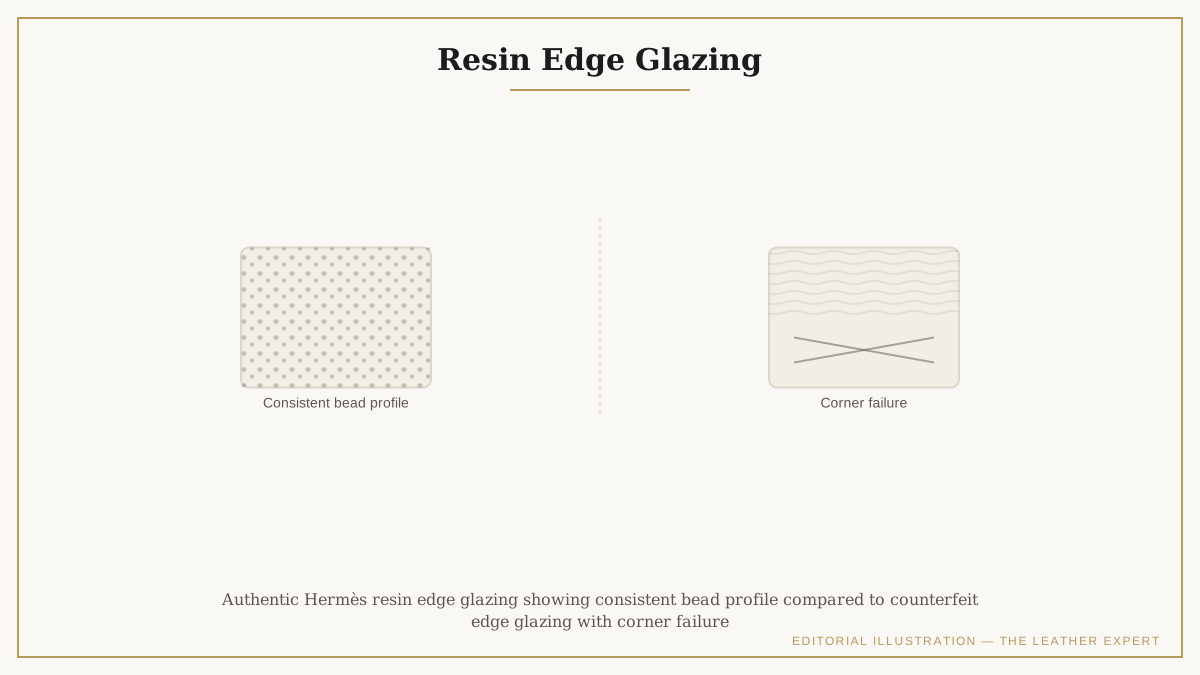
- Authentic bead profile: semi-circular cross-section, slightly proud of leather face, no overflow onto surface
- Authentic corners: consistent bead profile maintained through 90-degree corners — no cracking, no pooling
- Counterfeit failure 1: flat, paint-like application — glazing sits flush with or below the leather edge
- Counterfeit failure 2: irregular bead — width varies along the edge, particularly at handle joins
- Counterfeit failure 3: corner pooling — resin accumulates at inside corners rather than maintaining bead profile
- On pre-owned pieces: authentic glazing cracks cleanly if it fails; counterfeit glazing peels or chips
Zipper Pull Alignment and Weight: Authentication Tolerances
Hermès zipper pulls are a production specification — weight, alignment, engraving depth, and hang angle are all controlled to measurable tolerances in genuine bags. The pull itself is cast from a higher-density metal alloy than counterfeit production uses, producing a characteristic weight when held. When the bag is held upright and the zipper is partially open, the authentic pull hangs at a specific angle — perpendicular to the zipper tape with no lateral deviation from the centre of the tab.
Engraving depth on the pull — where the Hermès name or emblem appears — is measurably deeper on authentic hardware. Counterfeit engraving is typically shallower, produced by a lower-pressure process that leaves text legible but without the sharp-edged depth of genuine engraving. Under raking light (light held at a low angle to the hardware surface), authentic engraving creates distinct shadow lines at the base of each character; counterfeit engraving does not.
- Weight test: authentic pull is noticeably heavier than counterfeit — hold both if possible
- Alignment: pull should centre precisely on zipper tab — no lateral deviation when bag is held upright
- Engraving depth: examine under raking light — authentic shows distinct shadow lines at character bases
- Engraving crispness: character edges should be sharp and clean — counterfeit engraving shows rounded or eroded character edges
- Pull swing: authentic pull swings and settles smoothly — counterfeit pulls often bind on the tab due to imprecise fitting
How Authentic Hardware Ages vs How Counterfeit Hardware Degrades
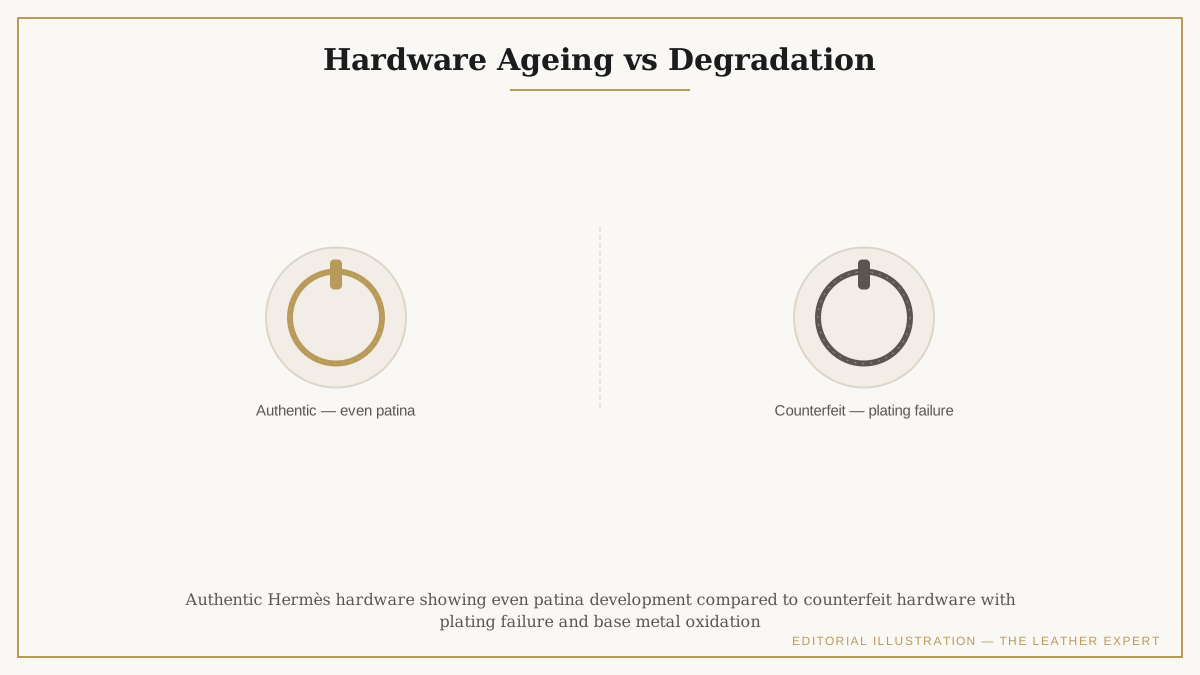
Understanding hardware ageing is essential for pre-owned authentication — and the difference between authentic and counterfeit hardware degradation is diagnostic. Authentic Hermès palladium hardware develops a consistent, even patina over years of use. The finish dulls uniformly across the surface without pitting, flaking, or colour shift. High-contact areas — the turnlock’s rotating disc, the D-ring’s inner curve, the clasp’s closure point — show the earliest patina development, but the transition from polished to patinated is gradual and even.
Counterfeit hardware, which uses a thin palladium or rhodium plating over lower-grade base metal (typically zinc alloy or low-grade brass), shows fundamentally different degradation characteristics. Plating lifts first at high-contact points — turnlock edges, D-ring joints, screw heads — because the adhesion between plating and substrate is weakest where the metal flexes or experiences point-load contact. Base metal oxidation appears as yellowing (brass substrate) or greenish tinting (zinc alloy substrate) visible beneath and around lifted plating areas. Surface texture degrades from smooth to rough as plating wears through. These failure patterns are observable within 12–24 months on heavily used counterfeit pieces; authentic hardware shows no equivalent failure under identical conditions.
| Hardware Element | Authentic Hermès | Counterfeit | How to Test |
|---|---|---|---|
| Palladium Surface | Consistent micro-granular pearling texture under magnification | Mirror-smooth or irregular — no consistent micro-texture | 10x loupe or smartphone macro |
| Resin Edge Glazing | Semi-circular bead, consistent thickness, clean corners | Flat, pooled at corners, or irregular width | Visual + corner examination |
| Zipper Pull Weight | Heavy, dense metal alloy | Light, hollow or low-density alloy | Handle comparison if possible |
| Zipper Pull Alignment | Centred precisely on zipper tab, no lateral deviation | Off-centre or binding on tab | Hold bag upright, observe hang angle |
| Engraving Depth | Deep, sharp-edged characters with shadow lines under raking light | Shallow, rounded or eroded character edges | Raking light at low angle |
| Hardware Ageing | Even patina development, no plating lift or colour shift | Plating lifts at contact points, base metal yellowing/greening | Examine turnlock edges and D-ring joints |
Hardware Is a Forensic Field. Treat It Like One.
The most common authentication error is examining Hermès hardware only at normal viewing distance. At 30cm, authentic and high-quality counterfeit hardware look nearly identical — the differences are in the micro-scale surface texture, the precision of tolerances, and the specific degradation patterns that only become visible under magnification or raking light.
Pearling is your first test. If the palladium surface shows consistent micro-granular texture under a loupe, you are looking at hardware that has been produced to Hermès’s specification. If the surface is mirror-smooth or shows irregular marks, set the piece aside regardless of what else looks correct — the hardware tells you everything you need to know about the production standard of the entire bag.
Edge glazing is your second test. Look at the corners of every strap and handle. Consistent bead profile around corners — with no cracking, pooling, or width variation — confirms a production standard that counterfeit finishing cannot replicate at speed. This test requires nothing but a careful eye and adequate light.
Bottom Line: Authentic Hermès hardware is produced to engineering tolerances, not visual approximations. Every marker in this guide is measurable. Use them.
Popular Searches
Most searched Hermès hardware authentication topics
🔥 Most Searched
Hermès Pearling on Palladium Hardware
What pearling looks like, how to see it with a loupe, and why no counterfeit hardware replicates it — the definitive authentication marker explained.
★ Expert Reference
Hermès Resin Edge Glazing Thickness
The exact bead profile specification for authentic edge glazing, with counterfeit failure modes illustrated — corner cracking, flat application, and pooling.
⬆ Trending
Zipper Pull Alignment & Weight Guide
How to assess zipper pull weight, alignment tolerance, and engraving depth — the full authentication protocol for Hermès zip-closure hardware.
◆ Full Reference
Authentic Hardware Ageing vs Counterfeit Degradation
The observable differences between how authentic palladium patinas and how counterfeit plating fails — plating lift timelines, base metal oxidation, and contact point wear.
⬆ Rising
Full Hermès Authentication Hub
The central authentication reference — saddle stitch angle, blind stamp dating, foil stamping depth, clochette splitting, and exotic scale matching.
🔥 Most Searched
Hermès Leathers & Materials Guide
The companion reference to this hardware guide — every major Hermès leather type analysed by fibril density, tannage, and long-term behaviour.
Frequently Asked Questions
Pearling is a micro-scale surface texture visible on authentic Hermès palladium hardware under magnification. It results from Hermès’s proprietary polishing process, which creates a subtle granular lustre across the hardware surface. Counterfeit hardware is either mirror-smooth or shows irregular surface marks — neither replicates the consistent micro-texture of genuine pearling. It is one of the most reliable authentication markers on the exterior of a Hermès bag.
Authentic Hermès resin edge glazing is applied within a consistent thickness tolerance — presenting as a clean, rounded bead that is neither too thin nor over-applied. Counterfeit edge glazing commonly shows one of two failure modes: applied too thinly, producing a flat, paint-like edge finish; or over-applied, creating an irregular bead that obscures the leather edge. Authentic glazing also maintains consistent adhesion at corners — a specification that counterfeit finishing cannot replicate at scale. For the full specification, see our article on Hermès resin edge glazing thickness.
Authentic Hermès zipper pulls have a specific weight and hang characteristic — they are heavier than counterfeit pulls and hang with a precise alignment on the zipper tab. The engraving depth on the pull is measurably deeper on authentic hardware: examine under raking light and look for distinct shadow lines at each character base. Counterfeit pulls are lighter, often off-centre, and show shallower engraving with rounded character edges. See the full guide at Hermès zipper pull alignment and weight.
Authentic palladium hardware develops a consistent, even patina over time — the finish dulls uniformly without pitting, flaking, or colour shift. Counterfeit hardware, using lower-grade base metals with thin plating, shows plating lift at high-contact points (turnlock edges, D-ring joints) within 12–24 months of heavy use, followed by base metal oxidation appearing as yellowing or greenish tinting beneath the lifted plating. These degradation patterns are diagnostic — authentic hardware does not fail this way under any conditions of normal use.