
Why Hermes Ostrich Leather Handles Darken (And How to Slow It)
A forensic explanation of the follicle chemistry that makes ostrich handle darkening inevitable, how to distinguish desirable patina from problematic staining, and the three interventions that slow the process without eliminating it.
The darkening of Hermès ostrich leather handles is among the most common care concerns raised by ostrich bag owners — and among the most misunderstood. The process is often described as a flaw in the leather, a sign of poor quality, or evidence of owner negligence. It is none of these things. It is an entirely predictable consequence of ostrich leather's distinctive follicle structure — the raised bumps that give the leather its immediately recognisable appearance are the openings of feather follicle channels, and those channels are the primary pathway through which skin oils, environmental particulate, and moisture enter the leather body. Handles, as the highest skin-contact zone on any bag, receive this input at a rate far exceeding any other surface — and the result, whether it develops slowly over years of careful ownership or quickly over months of intense daily carry, is handle darkening that is both explainable and, within limits, manageable.
This article explains the follicle-level mechanism behind ostrich handle darkening, provides a framework for distinguishing desirable even patina from problematic blotchy staining, and delivers three practical interventions that slow the darkening process without attempting to prevent it entirely — because prevention is neither possible nor, in the right circumstances, desirable.
The Follicle Structure That Makes Ostrich Leather Uniquely Prone to Handle Darkening
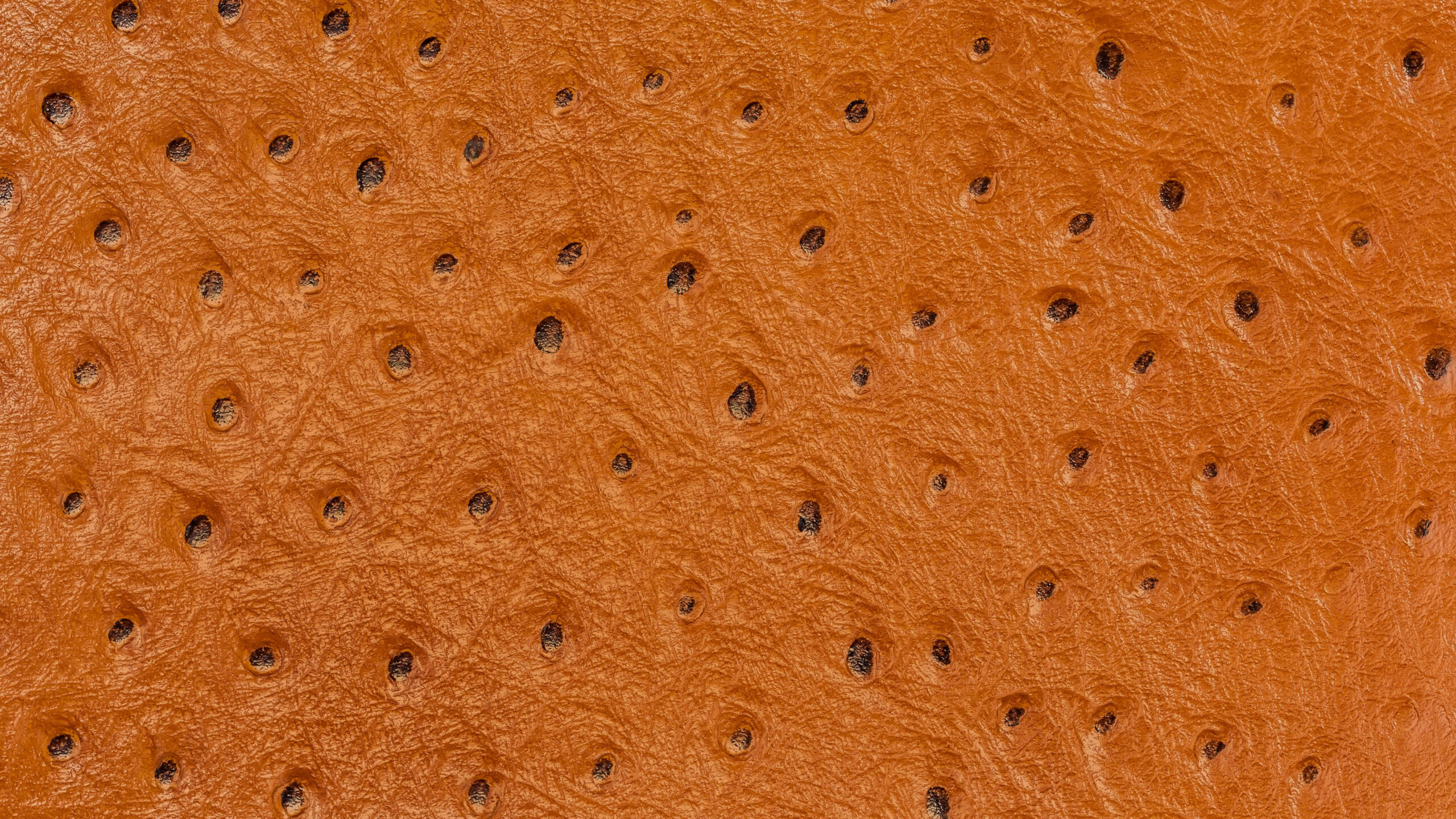
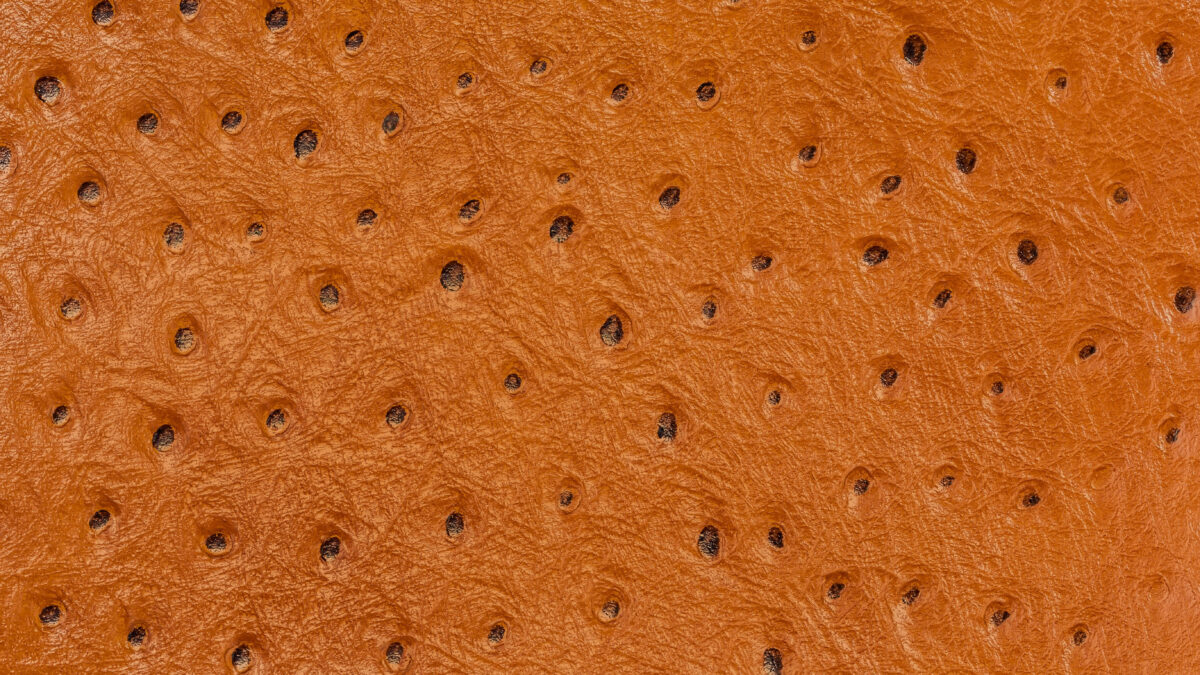
Ostrich leather's distinctive appearance — the raised, circular bumps distributed across the leather surface — is not embossed or processed. Each bump is the natural remnant of a feather follicle channel in the ostrich hide: the opening where a feather grew during the bird's life. When the feather is removed during hide preparation and the leather is tanned, the follicle channel remains as a slightly raised, hollow cone structure whose opening is exposed at the leather surface. These are not cosmetic features — they are functional structures that persist through the tanning process and remain open in the finished leather.
The follicle channel opening is the key to understanding ostrich's darkening behaviour. Unlike smooth bovine leather where the only pathway for skin oil absorption into the leather body is through the grain surface itself — a relatively slow process mediated by the surface finish layer — ostrich leather provides direct, open channel access to the leather's interior fibril network at every follicle point. Skin oils deposited on the leather surface at handle grip zones do not need to penetrate the grain surface: they enter the follicle channel openings and reach the fibril body directly, absorbing into the leather with significantly less resistance than any smooth-surface leather presents. This is why ostrich darkens faster and more dramatically at contact zones than Togo, Clemence, or any bovine leather — the skin oil absorption pathway is orders of magnitude more accessible. For the full colour and patina context, the Hermès Colours Guide hub covers all leather types' chromatic behaviour.
Follicle Channel Oil Absorption
Skin oils from the hand enter the open follicle channel openings at each bump point — no surface finish penetration required. The oils travel along the channel walls into the fibril body, depositing lipid material that darkens the leather in a ring pattern around each follicle opening. At handle grip zones where skin contact is most concentrated, dozens of follicle channels receive oil simultaneously with each handling event.
Friction-Driven Penetration at Grip Zones
Handle grip applies compressive and shear forces to the leather surface — mechanically driving skin oils already present on the surface into the follicle channels under pressure. This friction-driven penetration is significantly more efficient than passive contact absorption, explaining why the specific grip zone on each handle darkens faster than the adjacent handle areas that receive contact without grip compression.
UV Oxidation at the Carry Surface
The handle zones on a carried bag are among the most UV-exposed leather surfaces — they are typically horizontal and face the sky during outdoor carry. UV oxidation drives colour development in the oil-saturated follicle zones at a faster rate than in the less-exposed body panels. The interaction of high oil content (from mechanisms 1 and 2) and high UV exposure (from carry position) produces accelerated colour development specifically at handle grip zones.
"Ostrich handles darken because they are being used exactly as they were designed to be used. The follicle channels that cause the darkening are the same channels that give ostrich its unmistakable texture — you cannot have one without accepting the other."
The Three Mechanisms in Practice: Why Handle Darkening Concentrates at Specific Zones
Understanding why ostrich handle darkening concentrates at specific zones — and why the pattern differs between hand-carried and arm-carried pieces — requires mapping each mechanism to the carry geometry.
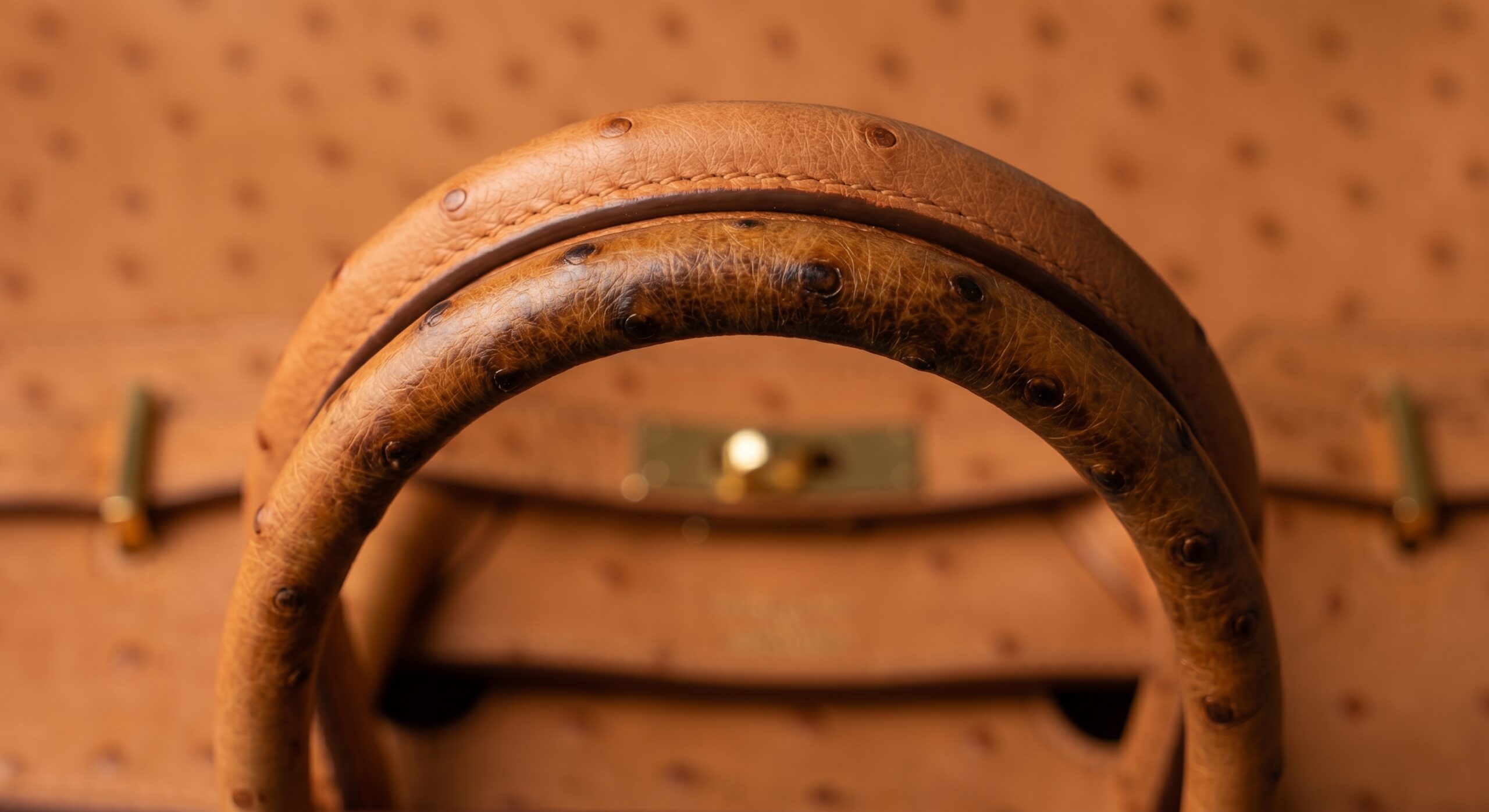
For hand-carried ostrich bags (Birkin, Kelly), the primary grip zone is the central handle underside where the palm contacts the leather most consistently, and the inner face of the handle drop at the ends where the fingers wrap around during carry. These two sub-zones receive the highest skin oil input via mechanism 1 (follicle absorption) and mechanism 2 (friction-driven penetration simultaneously). The top of the handle — where the leather faces upward during hand carry — receives mechanism 3 (UV oxidation) preferentially. The combined result is a darkening pattern that is most concentrated at the underside grip centre, with secondary darkening at the handle drop ends and UV-accelerated darkening across the handle top surface. This pattern is recognisable and consistent across actively carried authentic ostrich Hermès bags and should be distinguished from the random, boundary-defined staining produced by product contamination.
The grain surface between follicle points — the flat inter-follicle leather — darkens more slowly than the follicle zones because it does not have the direct absorption pathway of the open channel. This produces the characteristic darkening gradient visible on many used ostrich pieces: darker at the follicle points, lighter at the inter-follicle surface, creating a spotted or dappled darkening pattern in the early stages before the cumulative darkening eventually equalises across the full handle zone. For the comparison with Barenia patina development — another follicle-chemistry-driven process, though through a different mechanism — see our Barenia Faubourg Patina Progression guide.
- Handle underside grip centre darkens first and fastest — highest simultaneous skin oil absorption and friction compression at this zone
- Handle drop inner face darkens as a secondary zone — finger wrap contact during carry applies consistent skin oil pressure to this surface
- Handle top surface shows UV-accelerated darkening — horizontal carry position maximises UV exposure at this zone; darkening is more even here than at the grip zones because skin contact is minimal
- Inter-follicle surface darkens more slowly than follicle points — no direct channel access; smooth surface relies on standard oil absorption through the finish layer
- Body panels adjacent to handle attachment darken minimally — low skin contact, no grip compression, lower UV exposure than horizontal handle surface
- Asymmetric darkening between left and right handles indicates carry asymmetry — one handle darkening faster than the other is consistent with hand dominance in carrying; this is normal and not a staining indicator
Patina vs Staining: Reading Ostrich Handle Darkening Correctly
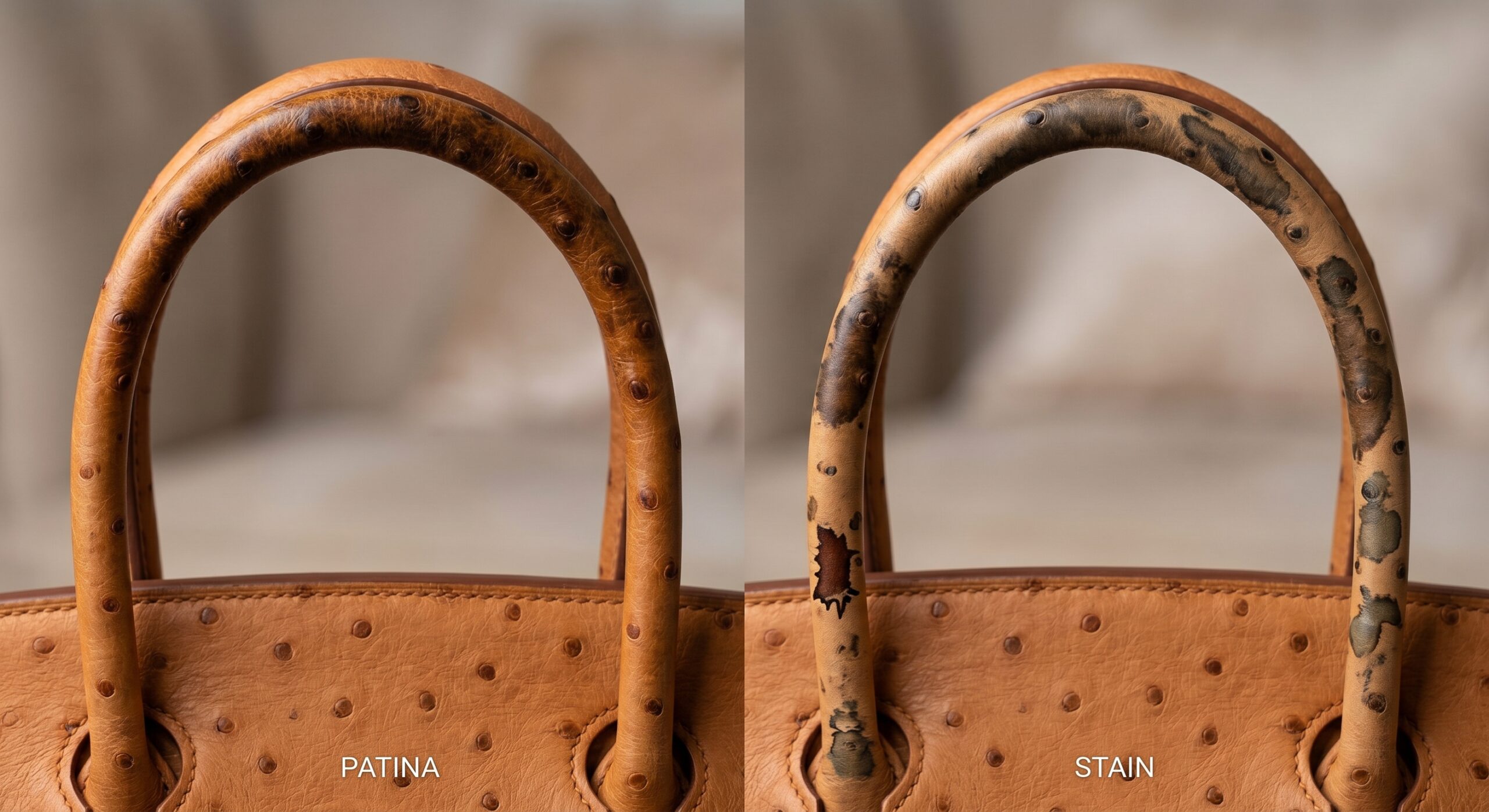
The most important distinction in ostrich handle darkening assessment is between desirable even patina and problematic blotchy staining. These two outcomes look superficially similar — both involve areas of the handle leather being darker than adjacent zones — but their causes, their secondary market implications, and the appropriate care responses differ completely.
How Ostrich Handle Darkening Is Graded on the Secondary Market — and Why Warm Tones Are More Forgiving
Secondary market graders assess ostrich handle darkening on two axes: evenness (how uniformly distributed is the darkening) and tone relationship (does the darkening work with the bag's base colour or against it). On warm-toned ostrich pieces — Gold, Noisette, Fauve, Caramel — even handle darkening deepens the colour in the same chromatic family, producing an aged richness that most specialist buyers read as desirable rather than as a condition flaw. On pale ostrich pieces — Craie, Rose Dragée, pale blues — even handle darkening creates a tonal contrast between the grip zone and the body panels that is harder to read as desirable and more likely to be treated as a condition concern. The same darkening pattern, on the same quality piece, grades differently depending on the base colour's relationship to the darkened tone.
Three Interventions That Slow Handle Darkening Without Eliminating It
No intervention eliminates ostrich handle darkening entirely — the follicle channel absorption mechanism is inherent to the leather's structure and cannot be neutralised without destroying the properties that make ostrich desirable. The objective of care is not prevention but management: slowing the darkening rate, promoting even rather than blotchy development, and maintaining the leather's overall quality while the natural ageing process proceeds at the handle zones.
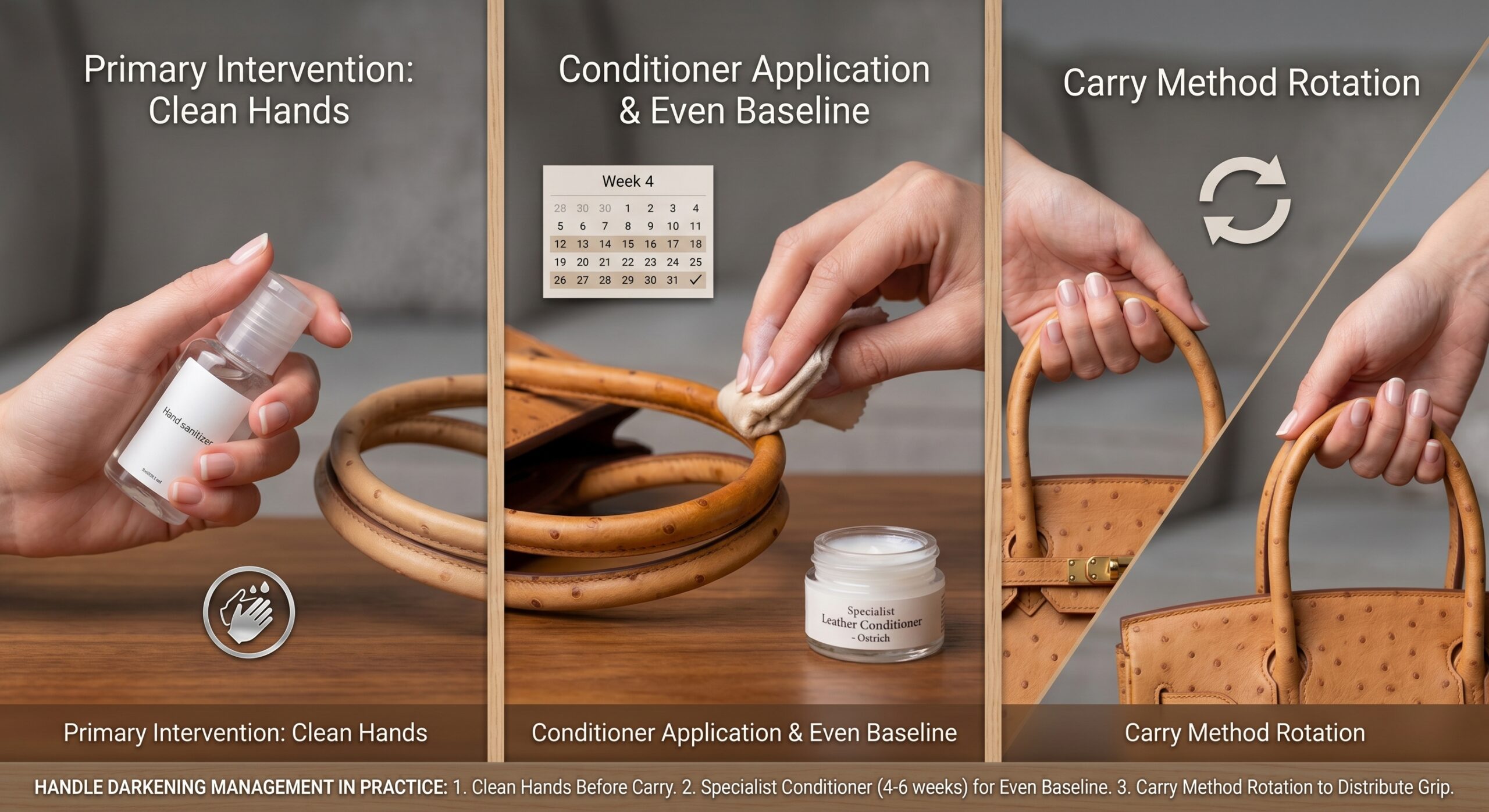
Intervention 1 — Clean hands before every carry. This is the single highest-impact intervention available and requires no specialist product. Skin oils are the primary darkening fuel at the follicle channels; reducing their volume at the point of contact directly reduces the absorption rate. Washing and thoroughly drying hands before handling eliminates the majority of transferable skin oils and dramatically slows follicle absorption at the handle grip zones. This is particularly important on pale ostrich pieces where the visual contrast of darkening is greatest. The intervention costs nothing and takes thirty seconds.
Intervention 2 — Regular specialist conditioning of the handle zones. A very light application of a specialist ostrich leather conditioner applied to the handle zones every four to six weeks creates a consistent lipid baseline in the follicle channel walls. This serves two purposes: it maintains the leather's supple character by preventing fibril dehydration at the most heavily used surface, and — critically — it reduces the differential absorption rate between conditioned and unconditioned follicle zones. Unconditioned follicle channels absorb new skin oil deposits rapidly because the dry channel walls have high absorption capacity; channels that already carry a lipid baseline absorb new oils more slowly and more evenly, promoting even darkening rather than spotted darkening. For the best conditioner options for Hermès leathers, see our ranked review at Best Leather Conditioners for Hermès Barenia: Ranked & Reviewed.
Intervention 3 — Carry method rotation. Alternating between hand carry and arm carry (for Kelly and Birkin formats that accommodate both) distributes skin oil contact across a larger surface area of the handle, preventing the extreme concentration at the palm grip zone that produces the most rapid darkening. Even within hand-carry mode, varying the grip position slightly — allowing the bag to rest forward in the hand rather than always at the same centre-palm point — distributes the wear across more follicle channels. This intervention is the most practical for daily carry and can meaningfully slow the development of a visible grip-zone darkening mark without changing the bag's use pattern significantly. Browse all colour and patina guidance at Leather Science.
| Leather | Darkening Rate at Handles | Primary Mechanism | Patina Quality | Management Priority |
|---|---|---|---|---|
| Ostrich | High — visible after 12–24 months active carry without conditioning | Direct follicle channel oil absorption at every bump point — most accessible oil pathway of all Hermès leathers | Even darkening is warm and desirable; blotchy darkening from product contact is a condition concern | High — clean hands before carry; specialist conditioning every 4–6 weeks; carry rotation |
| Barenia Faubourg | High at all contact zones — handle darkening part of broader patina development | Vegetable tannin migration driven by skin oil and UV — tannin oxidises at oil-deposit zones | Handle darkening is desirable and expected — deepening amber tone is the core of Barenia's value proposition | High — conditioning maintains even lipid baseline; beeswax for water protection |
| Togo | Moderate — handle darkening visible after 2–4 years of active carry | Surface grain oil absorption — slower than ostrich follicle channels; pebbled surface distributes contact | Even handle darkening adds warmth and depth — widely read as desirable patina on warm tones | Moderate — conditioning every 3–4 months; handle zone receives same treatment as body panels |
| Clemence | Moderate — similar to Togo but larger grain valleys absorb oil slightly faster | Same surface absorption mechanism as Togo; slightly faster due to open pebble structure | Even handle darkening is normal and generally uncontested; Clemence's soft aesthetic accommodates aging | Moderate — same conditioning approach as Togo |
| Epsom | Low — compressed sealed surface resists oil absorption | Compressed fibril surface has minimal oil absorption capacity — handle darkening is very slow | Minimal patina at handles — one of Epsom's key advantages for pale colour longevity | Low — conditioning focuses on corner protection; handle zone care is minimal |
| Shiny Alligator | Low — glazed compressed scale surface resists oil absorption | Glazed scale surface limits oil entry — darkening is minimal but fingerprint dulling is the primary care concern | No desirable patina — handle darkening on shiny alligator is exclusively a condition concern | High for daily dry-cloth wiping (fingerprint oils); low for darkening prevention specifically |
Ostrich Handle Darkening Is Inevitable, Chemistry-Driven, and Manageable — Own It Correctly or Choose a Different Leather
The follicle channel structure that makes ostrich leather beautiful is the same structure that makes its handle darkening inevitable. These are not separable properties — the open channels that produce the raised bump texture are the oil absorption pathways that produce the darkening. Any buyer who chooses ostrich must accept this as part of the leather's character, exactly as any Barenia buyer accepts the patina development and water sensitivity that make Barenia both exceptional and demanding.
What is manageable is the difference between desirable even patina and problematic blotchy staining. Clean hands, regular specialist conditioning of the handle zones, and carry method rotation together slow the darkening rate meaningfully and — more importantly — promote the even distribution that characterises quality patina rather than the sharp-bounded unevenness of product staining. An ostrich Hermès bag at Year 5 with even handle darkening and well-maintained body panels is a more beautiful object than the same bag at Year 1 in factory condition. Own the process: it is the only version of this leather that is available.
Bottom Line: Ostrich handle darkening is follicle-chemistry-driven and inevitable — manage it with clean hands before every carry, specialist conditioning every four to six weeks, and carry method rotation to promote even rather than blotchy darkening, which is the difference between desirable patina and a condition concern.
Popular Searches
Explore our most searched ostrich handle darkening and care combinations
Gold ostrich in the Birkin 30 is the specification where handle darkening is most forgiving — the warm gold tone accepts darkening in the same chromatic family, and even Year 3–4 darkening is broadly read as desirable patina.
⬆ TrendingPale Craie ostrich is the specification where handle darkening is most visually prominent — the tonal contrast between Craie's near-white tone and even moderate handle darkening is significant, making conditioning discipline most critical on this colour.
★ Collector FavouriteNoisette ostrich at Year 5 with even handle darkening is among the most beautiful aged ostrich specifications available — the warm amber deepening that develops on Noisette's base tone produces a richness that no other colour achieves.
◆ Ultra RarePale pink ostrich is the most demanding handle-darkening management case in the range — Rose Sakura's delicate tone cannot absorb even moderate handle darkening without a significant condition impact, making clean-hands discipline non-negotiable.
⬆ Rising DemandThe specialist conditioning protocol for ostrich handle zones — applied every four to six weeks to the handles specifically rather than the full bag, creating the even lipid baseline that promotes gradual, even patina over blotchy staining.
🔥 Most SearchedThe direct comparison most ostrich and alligator owners want — ostrich darkens dramatically faster at handles due to the open follicle channels; alligator's compressed scale surface offers significantly better handle darkening resistance.
Frequently Asked Questions
Ostrich handles darken faster than body panels for three intersecting reasons: the handles receive far more concentrated skin oil contact at the follicle channel openings, grip pressure mechanically drives skin oils deeper into the follicle channels, and the horizontal carry position of the handles maximises UV exposure. All three mechanisms are significantly amplified at handle zones relative to body panels, producing concentrated darkening visible on most actively carried ostrich bags after 12–24 months of regular use. See the full colours guide at the Hermès Colours Guide hub.
Ostrich handle darkening exists on a spectrum from desirable to problematic. Even, gradual darkening that develops symmetrically across both handles at the grip zones — deepening the base colour in the same chromatic family — is generally read as patina by specialist buyers and can support secondary market value on warm-tone ostrich pieces. Blotchy, asymmetric darkening with sharp boundaries from product contamination is read as staining and reduces condition grade. The key distinction is evenness: even darkening is a quality signal; uneven darkening with sharp edges is a condition concern. For the related Togo patina comparison see How Hermès Togo Leather Changes Colour Over Time.
Three interventions slow handle darkening on Hermès ostrich leather: clean hands before every carry (the single highest-impact intervention — reduces skin oil transfer to follicle channels); specialist ostrich conditioner applied to the handles every four to six weeks (creates an even lipid baseline that promotes even rather than blotchy darkening); and carry method rotation between hand carry and arm carry (distributes grip-zone skin oil contact across a larger surface area). No intervention eliminates darkening completely; all three slow it and promote the evenness that characterises desirable patina. For conditioner selection see Best Leather Conditioners for Hermès Barenia.
Yes — ostrich leather darkens substantially more than alligator or crocodile at equivalent carry intensity. The open follicle channels in ostrich leather provide much larger oil absorption pathways than the compressed scale surface of glazed alligator or the natural keratin surface of matte crocodile. The raised follicle bumps are direct pathways for skin oils to enter the leather body. Handle darkening on an ostrich Birkin or Kelly develops faster and more dramatically than on crocodile or alligator equivalents. Browse all leather science at Leather Science.
