
Hermes Swift vs Box Calf Leather: Scratch and Scratch Recovery
A forensic comparison of how two of Hermès's most refined smooth leathers receive, display, and — in one case — recover from surface scratches across years of carry.
Of all the questions that separate a material-literate Hermès buyer from one buying on aesthetics alone, the comparison of Hermes Swift vs Box Calf leather scratch behaviour is among the most consequential. Both are smooth, unembossed leathers with a fine, tight grain and an exceptional surface quality that displays colour and stitching detail with unmatched clarity. Both appear deceptively similar at a glance in the boutique. But their scratch mechanics — how each leather receives a surface abrasion, what happens at the fibril level, and crucially whether recovery is possible — are radically different. Getting this wrong means discovering, six months into ownership, that your bag is either more forgiving or far less forgiving than you expected.
This article pulls apart both leathers at the material level: examining the role of their respective finish systems, the difference that box-pressed compression makes to fibril mobility, and what a scratch actually looks like — and what can be done about it — on each leather. You will leave with a precise understanding of which leather demands which ownership discipline, and which one is the better match for your carry reality.
Swift and Box Calf: Two Smooth Leathers, Two Fundamentally Different Finish Philosophies
Swift and Box Calf share a superficial visual kinship that makes them easy to conflate in casual descriptions of Hermès leather. Both are smooth-surfaced, both display a fine natural grain with no embossing, and both produce the kind of clean, colour-saturated surface that makes Hermès bag photography so compelling. The divergence is in what happens beneath that surface — specifically in the finishing process applied after tannage.
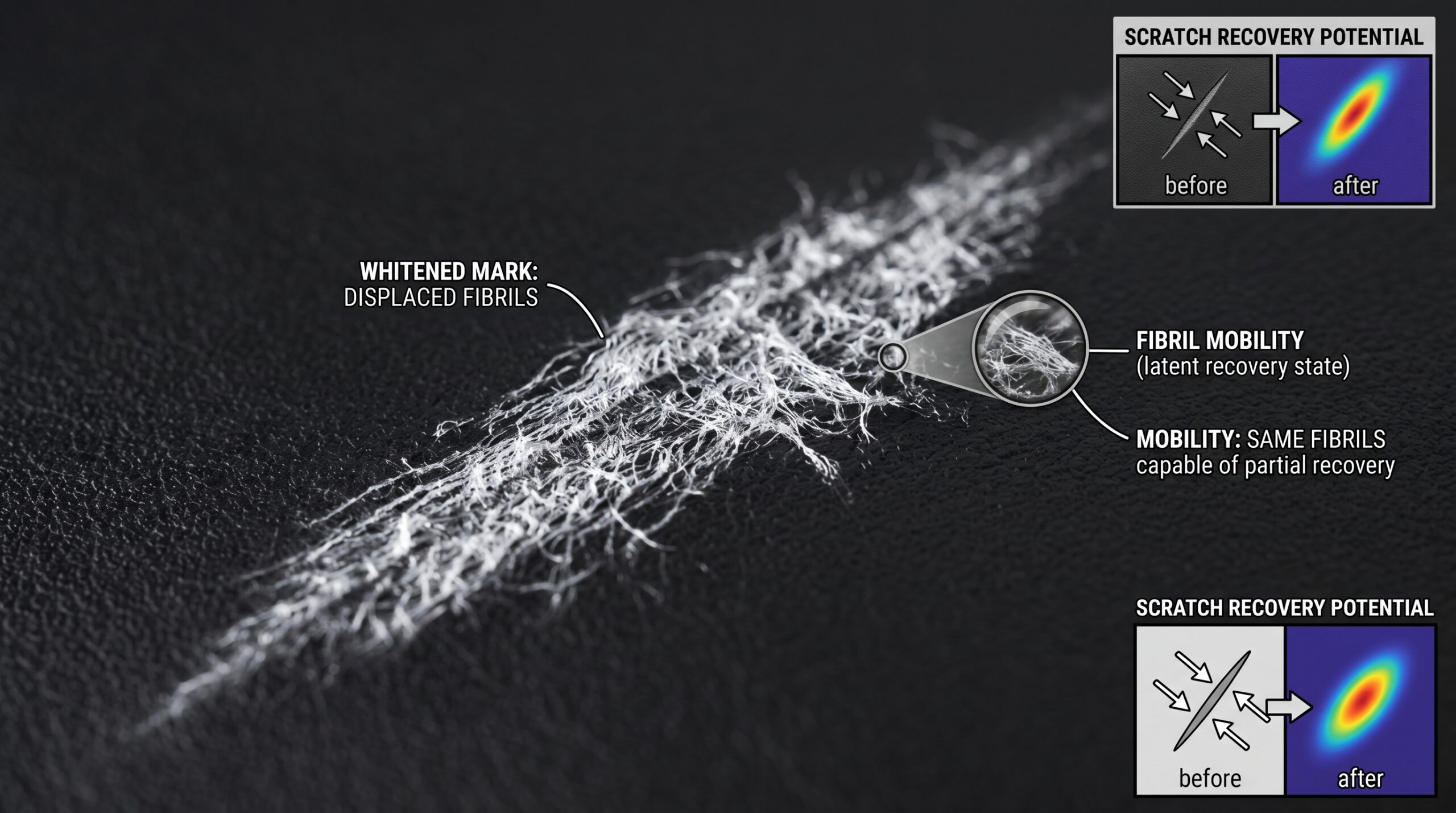
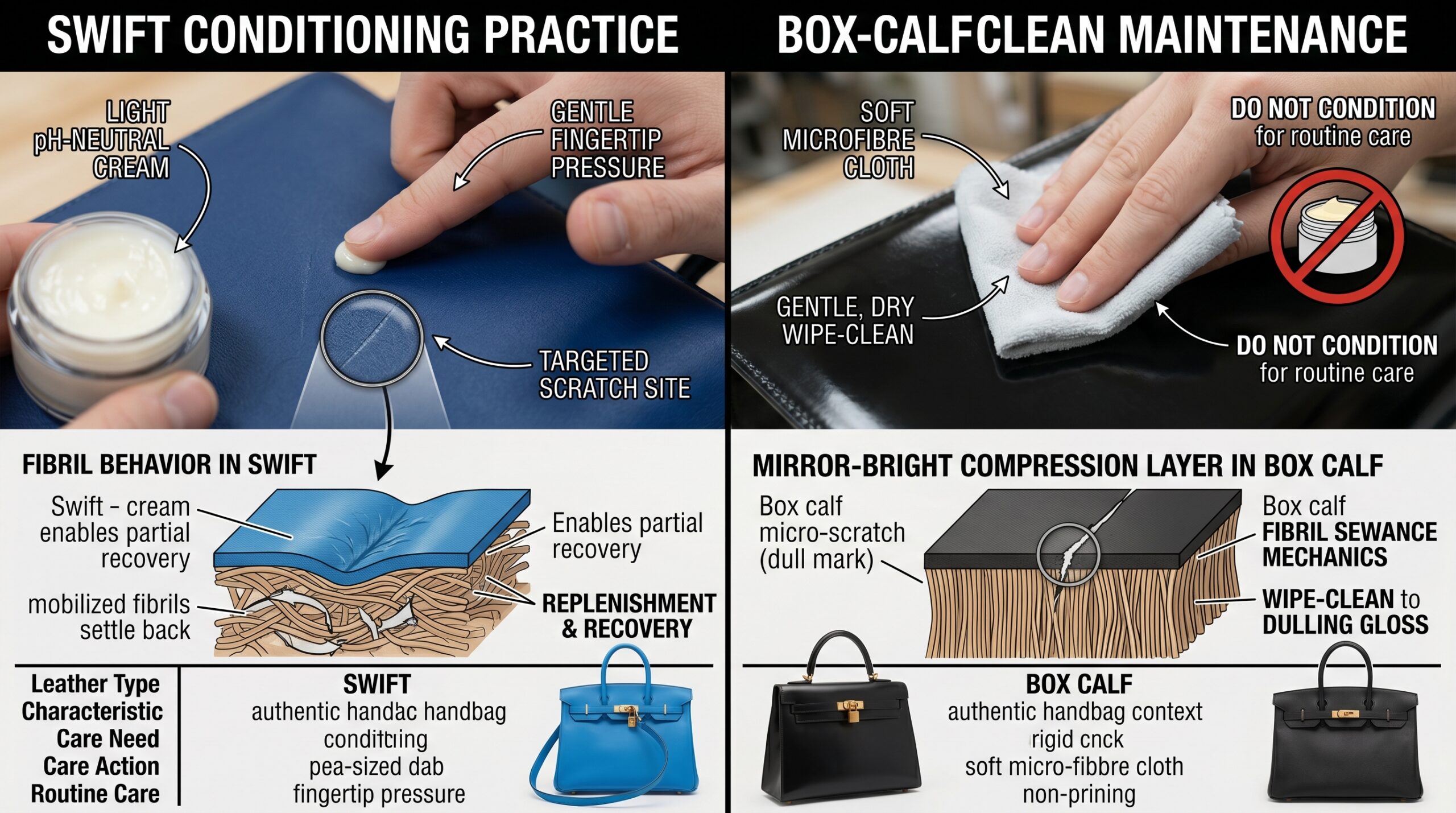
Swift is a chrome-tanned calfskin with a semi-matte finish. The hide is selected for its fine, tight fibril structure — the close-grained character that makes the surface appear smooth — and processed to retain a degree of natural flexibility. The finish applied over the tanned hide is relatively thin: a semi-matte topcoat that protects the natural grain face without adding significant mechanical thickness or compressing the underlying fibrils. This means the fibrils beneath the finish retain a degree of mobility — they can respond to heat and pressure, a property that underpins Swift's scratch recovery capability.
Box Calf is a different proposition entirely. It begins from a similarly fine-grained calfskin but undergoes the box-pressed finishing process that defines its character: the hide is passed between high-pressure rollers that compress the entire grain surface to a high gloss, creating the mirror-bright, lacquer-like finish that Box Calf is famous for. This compression does to Box Calf's fibrils what embossing does to Epsom's — it locks them into a rigid, high-density surface matrix. The result is a finish of exceptional visual depth and gloss, but with the same fundamental consequence as Epsom's compressed matrix: fibrils that have been displaced by a scratch cannot rebound.
The Leathers & Materials Guide provides the full reference for how Swift, Box Calf, and the other smooth Hermès leathers compare across tannage, temper, and surface character.
"Swift and Box Calf look nearly identical until the first scratch. After that, the difference in their fibril architecture becomes impossible to ignore — one recovers, the other records."
Swift: How Scratches Form, Register, and — Critically — Recover
A scratch on Swift leather follows a predictable sequence that can be understood in terms of three distinct depth zones. The first zone is the thin semi-matte topcoat: a minor surface contact that disturbs this layer alone will appear as a dull streak against the surrounding finish — a slight sheen disruption that is more visible under raking light than head-on. This is the most common type of Swift scratch, and it is the most recoverable.
The second zone is the natural grain face itself — the tight fibril surface that sits immediately beneath the topcoat. A scratch that penetrates the finish and reaches this layer displaces a small number of surface fibrils, creating a slightly raised or whitened mark as the fibril ends catch the light differently from the surrounding intact surface. Because Swift's fibrils retain mobility — they have not been box-pressed into a rigid matrix — the application of gentle finger-heat and a light conditioning cream can encourage the displaced fibrils to return toward their original orientation. This recovery is not perfect, and it is not guaranteed for every scratch, but it is a genuine and repeatable characteristic of the leather that experienced owners rely on.
- Finish-layer scratches (Zone 1) — dull streaks in the semi-matte topcoat; respond well to fingertip buffing without any product application
- Grain-face scratches (Zone 2) — whitened fibril displacement marks; 70–80% reduction achievable with fingertip heat and pH-neutral conditioning cream in circular motion
- Deep structural scratches (Zone 3) — rare under normal carry; penetrate into the fibril body and are not addressable at home; require Hermès spa assessment
- Swift's fine grain also means scratches appear as thin lines rather than the broad marks seen on coarser-grained leathers — smaller surface area affected per incident
- Colour impact: scratches on deep-tone Swift (Noir, Vert Foncé) are less immediately visible than on pale or bright tones where the fibril whitening contrasts against the pigment
Swift's scratch vulnerability has a corollary advantage that is easy to overlook: because the semi-matte finish is thin and the fibrils mobile, Swift also develops a genuine patina at contact zones over time. Handle attachment areas develop a soft burnished quality — a very slight sheen increase and tonal deepening — that pebbled leathers like Togo develop through oil absorption but smooth leathers achieve through friction. A well-aged Swift piece in a warm colour family like Noisette or Gold develops a surface complexity that is difficult to distinguish from vegetable-tanned leather's patina to the untrained eye. See our detailed Barenia patina study for comparison at Hermès Barenia Faubourg Patina Progression.
Box Calf: The Box-Pressed Matrix and Why Its Scratches Are Effectively Permanent
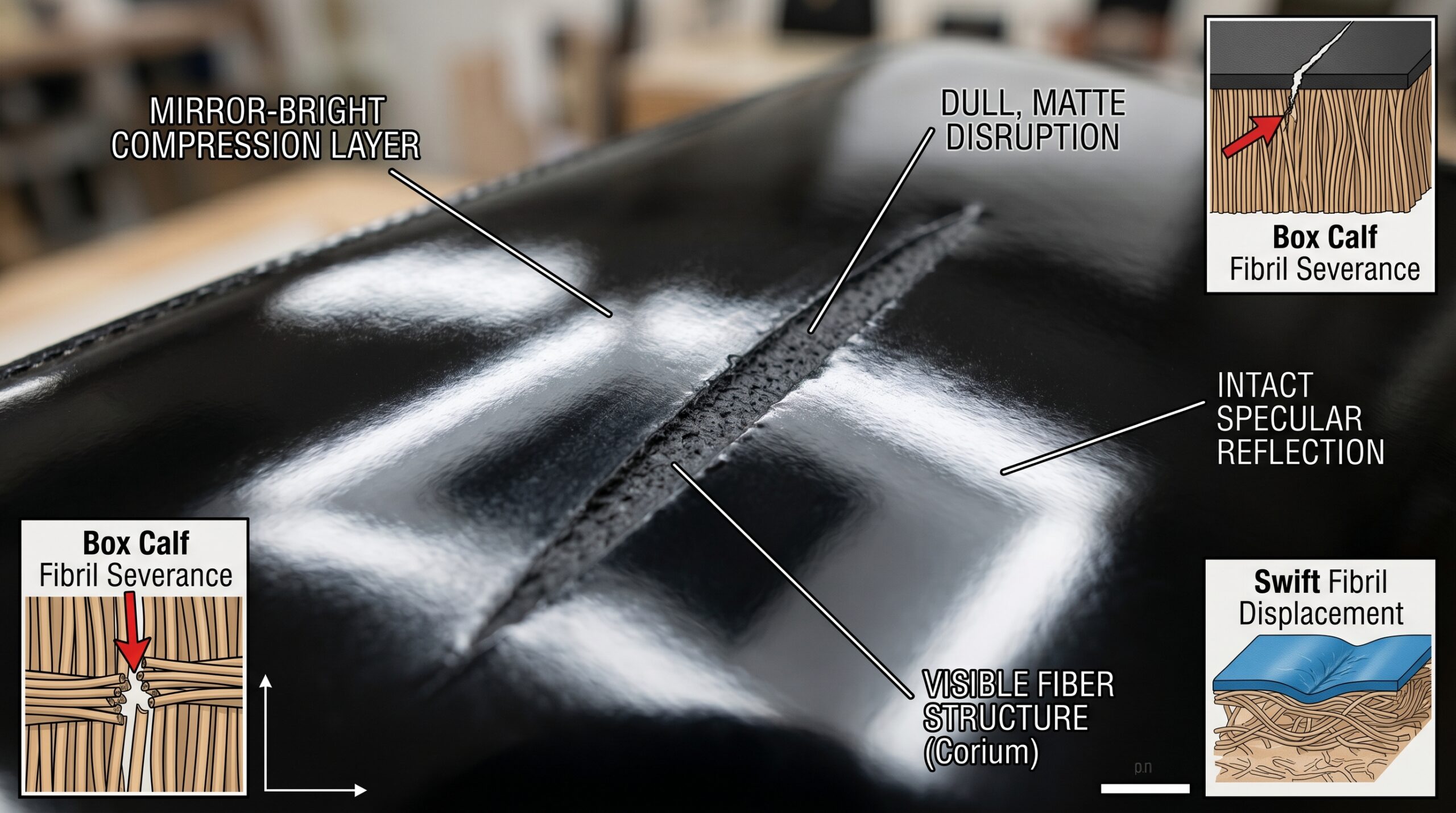
Box Calf's scratch behaviour is the clearest possible demonstration of what box-pressed compression does to fibril mobility. When a scratch contacts Box Calf's surface, it encounters the high-gloss compression layer first — a finish of exceptional hardness and visual depth that has been achieved precisely by eliminating fibril mobility at the surface. A minor scratch that would disturb only the topcoat on Swift and be largely recoverable, on Box Calf displaces compressed fibrils that have no mechanical capacity to return to position. The scratch registers as a dull or whitened disruption in the mirror-bright surface — and it stays there.
The visual impact of a scratch on Box Calf is amplified by the leather's gloss level. High-gloss surfaces create maximum contrast between an undisturbed zone and a scratched one because the angle at which light reflects differs sharply between the smooth gloss finish and the disrupted scratch channel. A scratch that would be a minor imperfection on a matte or semi-matte leather reads as a significant blemish on Box Calf simply because the surrounding undamaged surface is so visually precise.
Why Box Calf's Gloss Cannot Be Locally Restored
The high gloss of Box Calf is achieved through the box-pressing process: mechanical compression under precisely controlled heat and pressure that aligns and densifies the surface fibrils into a reflective matrix. This gloss is not a coating applied over the leather — it is a property of the compressed fibril surface itself. When a scratch displaces these compressed fibrils, the local compression geometry is destroyed. Applying a leather cream or polish to the scratch area will not restore the original compression state — it will add a temporary surface sheen that is both visually different from the surrounding pressed finish and temporary in nature. The only route to restoring Box Calf gloss after significant scratching is professional re-pressing by Hermès, which is rarely offered as a standalone service.
Box Calf's scratch permanence is paired with an exceptional resistance to water damage and surface soiling that Swift does not match. The compressed fibril surface repels moisture more effectively than Swift's semi-matte finish, and surface dust or oils can be wiped from Box Calf with a clean, barely damp cloth without risk of spotting. This makes Box Calf — counterintuitively — a more resilient leather for certain types of environmental stress, even as it records mechanical scratches irreversibly. Our article on water damage on Hermès Barenia leather provides useful context on how moisture interacts differently with varying Hermès finish types.
The secondary market reflects Box Calf's scratch sensitivity clearly. Box Calf pieces graded in near-mint condition — surfaces intact, gloss undisturbed — command premiums that significantly exceed equivalent Swift pieces in similar use grades. A Box Calf Birkin or Kelly that has been carried actively and shows even light scratching will be downgraded more steeply by specialist resellers than an equivalent scratched Swift piece, precisely because the damage is permanent and restoration is not a realistic option.
Choosing Between Swift and Box Calf: A Decision Framework Based on Use Reality
The choice between Swift and Box Calf is ultimately a question of what kind of relationship you want with your bag's surface over time. Both leathers reward careful ownership. Both will develop surface character with use. But the direction of that development — recoverable and patina-building for Swift, gloss-diminishing and permanent for Box Calf — defines two fundamentally different ownership experiences.
Swift is the appropriate choice for buyers who carry their bags actively, expose them to the incidental contact of daily life, and want a leather that remains manageable over years of real use. The recovery capability of Swift's fibrils provides a genuine safety net — not unlimited, not applicable to deep damage, but meaningful for the category of minor scratch that active daily carry inevitably produces. Swift ages into a sophisticated surface character that rewards rather than punishes its owner's use patterns.
Box Calf is the appropriate choice for buyers who are willing to carry their bags with exceptional care and who prize the leather's unmatched visual authority when its gloss surface is intact. A Box Calf Kelly in mint condition is among the most visually commanding pieces in the Hermès range — the high gloss brings the saddle stitch lines into maximum relief and the colour saturation to its peak expression. But this authority comes with a covenant: the bag must be protected from contact with hard surfaces, sharp objects, and any situation that risks surface abrasion. Buyers who cannot maintain this level of care discipline will find Box Calf a source of frustration rather than satisfaction. For the full picture on how leather condition affects long-term value, see our piece on Hermès Epsom leather's long-term study, which covers parallel care considerations for another precision-finish leather. Browse all leather comparisons in the Leather Science category.
| Property | Swift | Box Calf |
|---|---|---|
| Tannage | Chrome — fine-grained calfskin | Chrome — fine-grained calfskin, box-pressed post-tanning |
| Finish type | Semi-matte topcoat — thin, fibrils retain mobility | Box-pressed high gloss — compressed fibril matrix, no mobility |
| Scratch visibility | Moderate — semi-matte finish reduces contrast of damage | High — gloss finish creates maximum contrast at scratch site |
| Minor scratch recovery | Good — fingertip heat and conditioning reduces most surface marks | Poor — compressed fibrils cannot rebound; gloss locally destroyed |
| Patina development | Genuine burnished patina at contact zones over time | Gloss reduction at contact zones — wear rather than patina |
| Water resistance | Moderate — semi-matte finish susceptible to spotting | High — compressed surface repels moisture effectively |
| Temper | Supple — moves with the bag's structure | Firm — box-pressed compression adds structural stiffness |
| Resale sensitivity to scratching | Moderate — recoverable damage limits grade reduction | High — permanent scratching significantly reduces secondary value |
| Care routine | Light conditioning every 3–4 months; scratch recovery as needed | Wipe-clean maintenance; avoid conditioning products on gloss surface |
| Best carry profile | Active daily carry with moderate care discipline | Careful carry; protected storage essential; low-abrasion environments |
Swift Forgives. Box Calf Records. Choose the One That Matches Your Life.
The scratch comparison between Swift and Box Calf resolves to a single material truth: Swift's semi-matte finish and mobile fibrils create a leather that participates in its own recovery, while Box Calf's compressed gloss matrix creates a leather that records every contact with permanent precision. Neither outcome is superior in the abstract — they are different ownership contracts, and both are valid.
Swift is the honest choice for buyers who carry actively and want a leather that ages gracefully under real-world conditions. Its recovery capability means that minor scratches are events rather than permanent records, and its patina development over time creates a surface character that rewards use. Box Calf is the choice for buyers who want the most visually commanding smooth leather in the Hermès range and are prepared to maintain the carry discipline that its permanence demands. A Box Calf piece in mint condition is extraordinary. A Box Calf piece in daily-carry condition is a different story entirely.
Bottom Line: Choose Swift for active carry and forgiving scratch recovery; choose Box Calf only if you can maintain the exceptional surface care discipline its permanent scratch sensitivity requires.
Popular Searches
Explore our most searched Swift and Box Calf leather combinations
Swift Noir's deep black semi-matte surface minimises scratch visibility while the sellier construction keeps the leather's moderate temper under geometric control.
◆ Ultra RareThe most visually definitive Hermès combination — Box Calf's mirror-bright black surface against gold hardware and precise sellier stitching is without parallel in the range.
⬆ TrendingSwift's semi-matte finish slows UV warm shift in pale pink — and its scratch recovery capability makes this colour group practical for active carry in a way Box Calf could not be.
★ Collector FavouriteRouge H in Box Calf reaches a depth and saturation that no other finish can match — for collectors who carry with care and prize visual authority over daily practicality.
⬆ Rising DemandSwift Gold develops a burnished warmth at contact zones over time — a genuine patina trajectory that makes the compact Birkin 25 one of the most rewarding Swift formats to carry actively.
🔥 Most SearchedSwift's suppleness suits the retourne Kelly's softer silhouette — Etain's blue-grey cool tone is well-served by the semi-matte finish, which slows the UV warm shift that affects cooler tones.
Frequently Asked Questions
Both leathers scratch more visibly than pebbled leathers like Togo because their smooth surfaces offer no grain relief to deflect abrasion. Between the two, Swift scratches slightly more readily — its thinner semi-matte finish offers less mechanical resistance than Box Calf's compressed gloss layer. However, Swift has a significant recovery advantage: minor surface scratches on Swift can often be reduced or eliminated by warming the leather with clean fingertip pressure and a light conditioning touch, because the mobile fibrils can partially return to position. Box Calf scratches are effectively permanent. See the full leather reference at the Leathers & Materials Guide.
Minor Box Calf scratches that disturb the gloss layer without breaching the compressed fibril matrix beneath can sometimes be partially reduced by very gently warming the affected area with clean finger pressure and polishing with a dedicated leather cream for smooth high-gloss leather. However, Box Calf's box-pressed finish means that significant scratches which displace the compressed grain surface cannot be restored without specialist intervention. The compressed fibrils do not rebound the way natural-grain leather fibrils can. Hermès spa service is the appropriate route for significant Box Calf damage. For water and environmental damage context see Water Damage on Hermès Barenia Leather.
Swift develops a subtle patina over time, though different in character from pebbled leathers. Its smooth, semi-matte surface allows gradual oil absorption into the fibril layer at contact zones, producing a slight tonal deepening and surface sheen increase at handle attachment points and areas of regular contact. The effect is more refined and less dramatic than Togo's patina — a soft burnishing rather than a tonal shift. In warm colour families like Noisette or Gold, the effect can be genuinely beautiful. For full patina guidance across Hermès leather types browse the Leather Science category.
Both leathers suit the Kelly well but for different reasons. Swift's smooth surface and moderate temper complement both the sellier and retourne constructions, with its slight suppleness allowing the retourne Kelly to move naturally. Box Calf's firm, box-pressed temper works in particular harmony with the sellier Kelly — the compression finish reinforces the rigid silhouette and the high-gloss surface brings the sellier's precise saddle-stitch lines into maximum visual contrast. The trade-off is care discipline: a sellier Box Calf Kelly requires meticulous surface management, and corner wear is more visible than on Swift. See long-term leather behaviour at Hermès Epsom Leather: A Long-Term Study.
