
Hermes Pearling on Hardware: What It Is and How to Spot Fakes
A forensic breakdown of the hand-finishing technique behind authentic Hermès hardware — and the precise visual markers that counterfeit casting cannot replicate.
Among the forensic authentication markers on a Hermès bag, pearling on hardware is simultaneously one of the most reliable indicators and one of the least understood by buyers. It is not a term Hermès uses in its public communications — it is a vocabulary developed by authentication specialists to describe a specific quality of edge finishing on the maison's metal components that results directly from the multi-stage hand-polishing process applied to every piece of hardware before plating. The finish quality it produces is subtle, requires a specific viewing angle to read correctly, and is nearly impossible to replicate through the casting and machine-polishing processes that counterfeit manufacturers use.
Understanding pearling — what causes it, what it looks like under the right light, and where on each hardware component it should and should not appear — transforms hardware inspection from a vague gestalt judgment into a precise forensic procedure. This article gives you that procedure, component by component, alongside the specific failure modes that allow even the best current counterfeits to be identified by their hardware alone.
What Pearling Is and Why Authentic Hermès Hardware Possesses It
Pearling is the authentication specialist's term for a specific optical quality produced at the edges and curved transitions of Hermès hardware by the hand-finishing process applied before plating. To understand why authentic hardware has it and counterfeits do not, it is necessary to understand how Hermès hardware is actually made — and how that process differs from the industrial casting methods used by counterfeit manufacturers.
Authentic Hermès hardware begins as a cast metal blank — typically brass — in the rough form of the final component. This blank undergoes a series of hand-finishing operations: initial file work to remove casting seams and major surface irregularities, followed by progressive stages of hand-polishing using decreasing abrasive grades from coarse to ultra-fine. Each stage works on the surface geometry of the component, gradually rounding the edges from the sharp geometric profile of the cast blank toward the precise, slightly convex cross-section that characterises finished Hermès hardware. The final pre-plating polish, applied by a skilled finisher, achieves a surface smoothness at which microscopic surface facets are eliminated and the metal approaches a mirror state — not a machine-flat mirror, but an organically smooth surface whose slight curvature at edge transitions creates the rolling, pearlescent light response that specialists call pearling.
The plating layer — gold, palladium, or ruthenium — is then applied over this hand-finished substrate. The plating follows the geometry of the substrate precisely: the rounded edges and smooth transitions beneath the plating are preserved in the final surface. What we observe as pearling is the optical effect of the plating layer following the hand-finished curvature of the metal beneath it. For the full context on Hermès hardware construction and its authentication implications, the Hardware & Craftsmanship Guide covers every component in the Birkin and Kelly hardware set.
"Pearling cannot be sprayed on. It cannot be applied in a plating bath. It is the geometry of the metal beneath the plating — and that geometry can only be produced by hand."
Reading Authentic Pearling: Component by Component
Each hardware component on a Hermès bag displays pearling differently because each component has a different edge geometry and functional purpose. Understanding where pearling should appear on each component — and where its absence or inconsistency is a red flag — requires examining them separately.
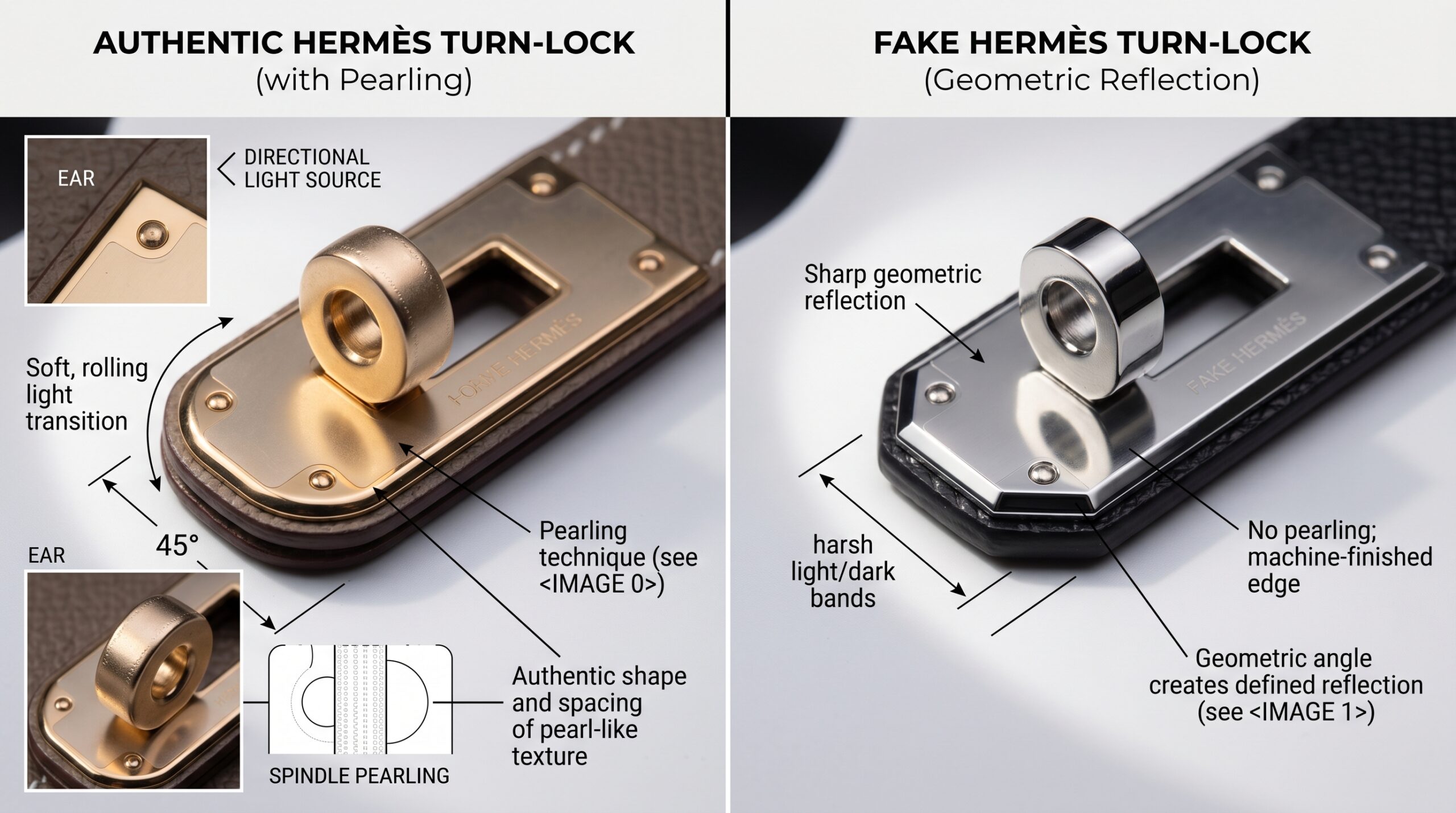
The turn-lock toggle is the primary authentication target for pearling inspection on a Kelly. The toggle is a roughly rectangular plate with rounded corners that rotates through 90 degrees to engage and release the closure. On authentic hardware, every edge of the toggle — the four long sides, the four corners, and the inner face where the toggle contacts the closure bar — displays consistent pearling. Hold the toggle perpendicular to a single light source and rotate it slowly through a full 180 degrees: authentic pearling appears as a smooth, rolling highlight that follows the edge continuously without breaking into flat zones or sharp reflection lines. The inner face of the toggle, where it contacts the closure bar during operation, should show the same rounded profile as the outer face — this is a detail that counterfeit components almost universally fail on.
- Turn-lock toggle — all four edge sides and all four corner transitions must show consistent rolling-light pearling; the inner contact face is the single most reliable counterfeit failure point
- Closure bar — the horizontal bar that the toggle engages must show pearling along its top arris (the upper edge); machine-finished counterfeits typically show a sharper, more geometric reflection at this edge
- Buckle frame — on Birkins and Kellys with strap buckles, the inner frame surface and the outer face corners should both display pearling; the tongue slot interior is where counterfeit quality most commonly deteriorates
- Hardware feet (Birkin) — the four feet show pearling at their base rim where they transition from the flat contact surface to the side wall; this is a small-scale but consistent marker
- Padlock body — the curved back face of the cadenas padlock is among the most clearly pearled surfaces on the entire hardware set; the transition from the flat front engraving face to the curved back should roll light continuously
- Clochette D-ring — the ring itself should show pearling at its inner curve; machine-stamped counterfeit D-rings typically show a flat, sharp inner surface at the ring's curve rather than a rounded profile
How Counterfeit Hardware Fails to Replicate Pearling — and Where to Look
The counterfeit hardware industry has made significant progress over the past decade in surface finish quality, and casual inspection of high-tier fakes now passes scrutiny that would have identified them instantly ten years ago. Weight, basic dimensions, and broad visual appearance can all be approximated to a degree that fools inexperienced buyers. Pearling is one of the few markers that has remained persistently difficult to fake at scale — and understanding why helps identify where to look.
Counterfeit hardware components are produced by die-casting — a process in which molten metal is injected under pressure into a precision mould. Die-casting can produce excellent dimensional accuracy and a reasonable surface quality, but it cannot replicate the hand-finishing geometry that produces pearling. The cast component emerges from the mould with edges that are geometrically sharp at the die's parting line and relatively flat across its faces. Post-casting machine polishing improves the surface smoothness, producing a glossy finish, but it does not fundamentally alter the edge geometry: the edges remain sharper than hand-finished authentic hardware, and the transitions between flat faces and curved zones are more abrupt.
The Three Hardware Zones Where Counterfeits Fail Most Consistently
Based on forensic examination of high-tier counterfeits currently in circulation, three hardware zones show the most consistent and reliable pearling failures. First: the inner contact face of the turn-lock toggle, where casting geometry is preserved because the mould cannot be hand-finished through its interior. Second: the tongue slot interior of buckle components, where machine polishing cannot reach the inner walls. Third: the base-rim transition on hardware feet, where the casting parting line often leaves a residual sharp edge that authentic hand-finishing eliminates. These three zones, inspected under a strong directional light at 45 degrees, will distinguish authentic pearling from counterfeit casting in the majority of pieces currently sold on the secondary market.
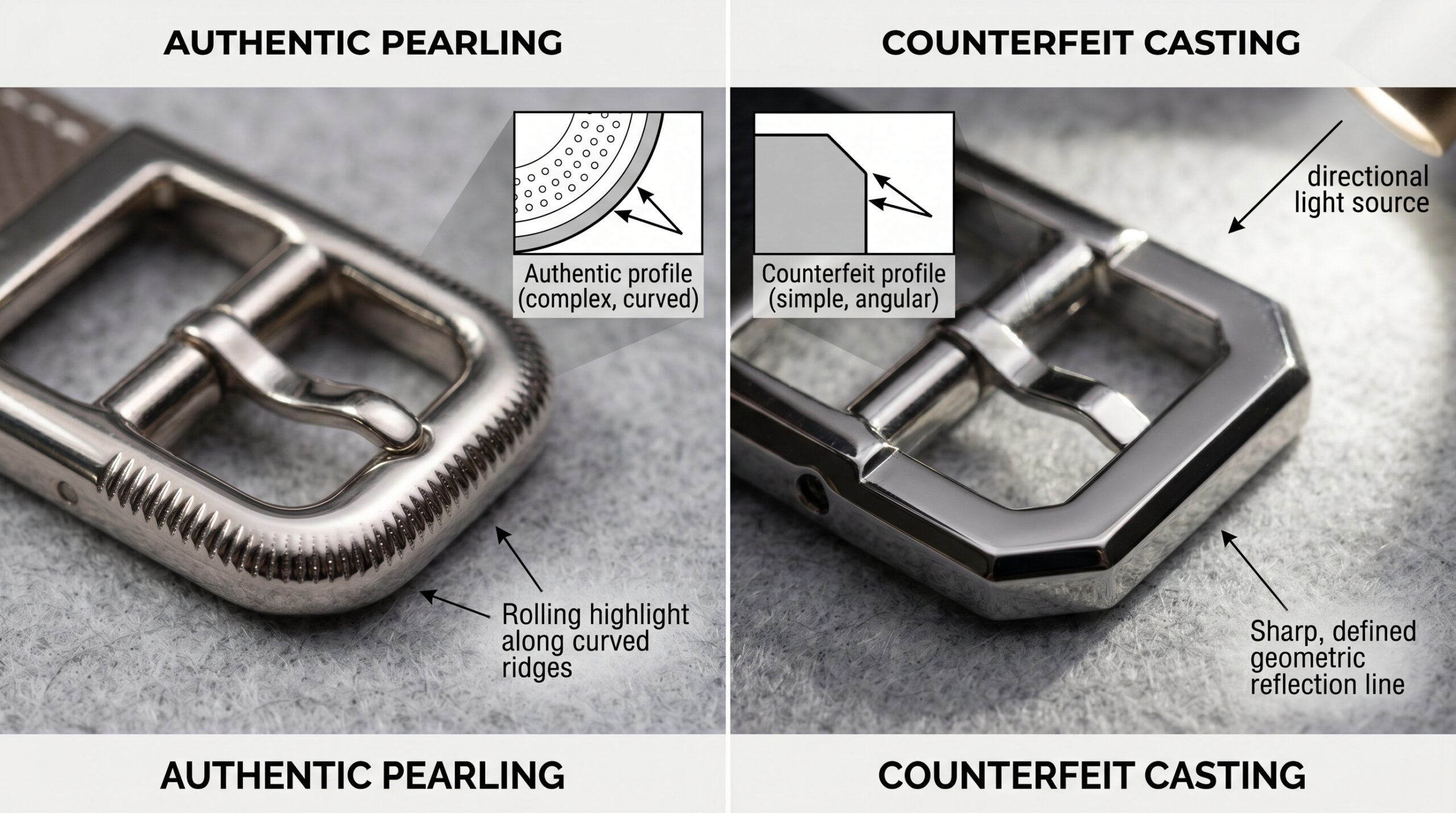
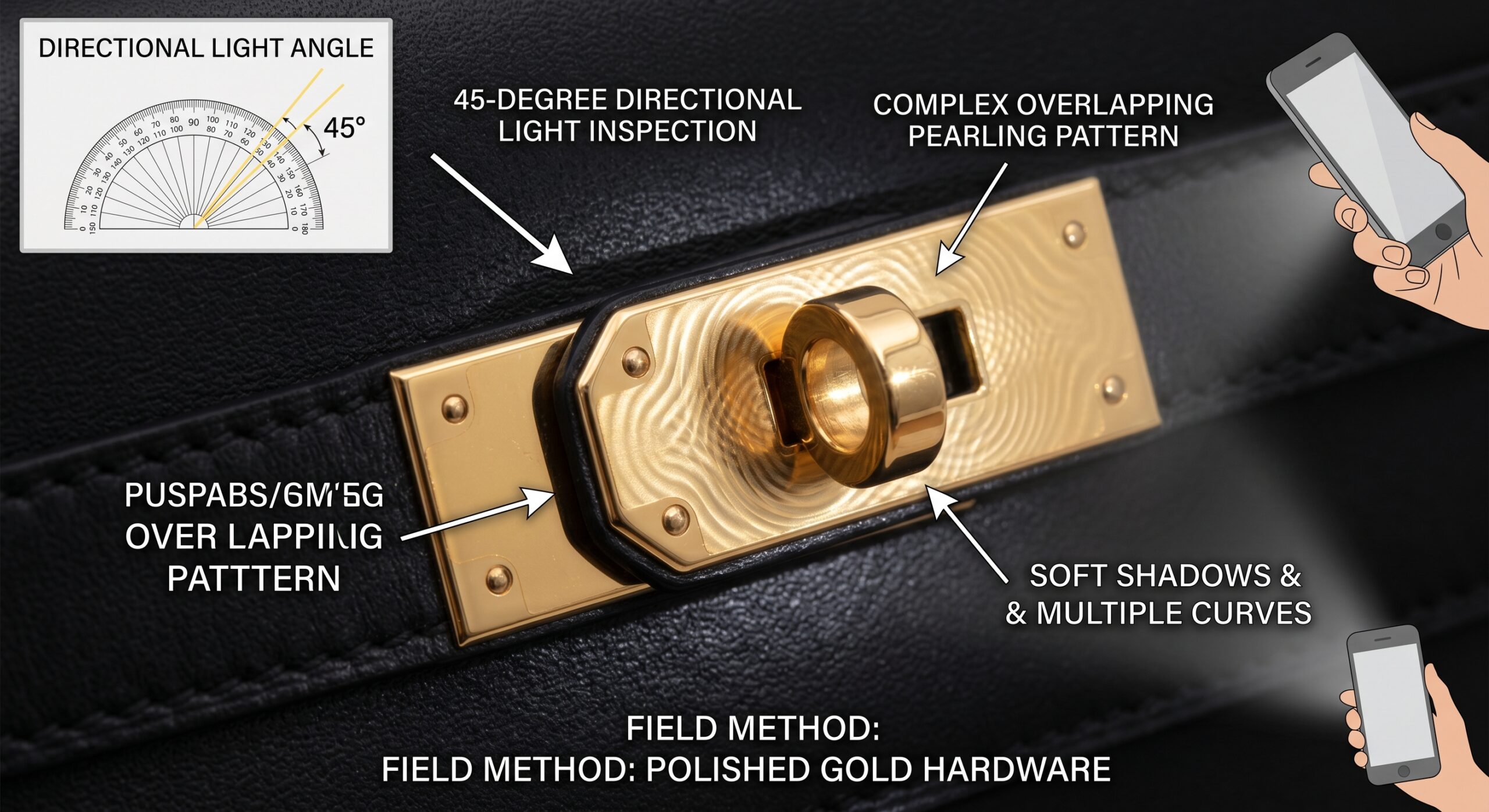
The light-response test is the most practical field method for reading pearling. Position the hardware component at approximately 45 degrees to a single strong directional light — a window in daylight, a phone torch held at arm's length. Rotate the component slowly through approximately 180 degrees while watching the edge transitions. On authentic hardware, the highlight follows the edge as a smooth, moving band of light that never snaps to a sharp line. On counterfeit hardware, the highlight at the edge appears as a thinner, more geometric reflection line that has a distinct boundary with the shadow side — the classic optical signature of a sharp, machine-finished edge rather than a hand-rounded one.
For further authentication markers beyond hardware, our piece on Hermès authentic saddle stitch angle vs machine stitching covers the leather craftsmanship authentication layer that complements hardware inspection. And for the specific authentication protocol around resin edge glazing — another hand-applied detail that counterfeits consistently fail — see Authentic Hermès Resin Edge Glazing Thickness: What to Look For.
The 5-Step Hardware Inspection Protocol for Secondary Market Buyers
The following protocol applies to any secondary market Hermès purchase where hardware authentication is required. It assumes access to the physical piece — photographs, even high-resolution ones, are inadequate for pearling assessment because the optical quality that defines pearling is a dynamic response to moving light that static images cannot capture.
Establish Your Light Source
Position yourself near a single strong directional light — a north-facing window in daylight is ideal, or a phone torch held at arm's length. Avoid overhead lighting, diffuse light, or multiple light sources, all of which flatten the pearling signal by eliminating the light-shadow gradient that makes edge geometry readable. The inspection surface should be dark or neutral-toned so the hardware's highlights stand out clearly.
Inspect the Turn-Lock Toggle at 45 Degrees
Hold the turn-lock at approximately 45 degrees to the light source and rotate it slowly through 180 degrees. Watch for the rolling-light signature on all four edge sides. Then invert the toggle and inspect the inner contact face — this is the face that contacts the closure bar during operation. Authentic pearling should be as consistent on this inner face as on the visible outer surfaces. Any flat or sharp geometry on the inner face is a strong counterfeit indicator.
Examine the Closure Bar and Buckle Tongue Slots
The closure bar's top arris and the buckle tongue slot interiors are the next inspection targets. For the closure bar, hold it perpendicular to the light and check that the top edge rolls light rather than snapping it. For buckle tongue slots, use the phone torch to direct light into the slot interior and check whether the inner wall surfaces are smooth and slightly rounded (authentic) or flat and mould-line-marked (counterfeit).
Check the Hardware Feet Base-Rim Transition
Turn the bag base-up and examine the hardware feet — the four small dome-shaped studs. Authentic Hermès feet show a smooth, rounded transition between the flat contact base and the domed side wall, with no casting seam line and consistent pearling around the full base circumference. Counterfeit feet often retain a faint mould parting line around the base rim, and the base-to-wall transition is sharper than on authentic pieces.
Cross-Reference with the Blind Stamp and Saddle Stitch
Hardware pearling assessment should always be combined with leather-side authentication markers. A bag that passes hardware inspection but has irregular saddle stitch angle, inconsistent blind stamp depth, or incorrect edge glazing bead width requires further scrutiny — authentication is a multi-marker process, not a single-point test. The Hermès clochette leather splitting guide covers the leather-hardware interface authentication that completes the hardware inspection protocol.
| Hardware Component | Authentic Pearling Markers | Counterfeit Failure Markers | Reliability |
|---|---|---|---|
| Turn-lock toggle (outer faces) | Consistent rolling-light highlight on all four edge sides; smooth corner transitions | Sharper edge reflections; flat zones between edge and face; abrupt transitions at corners | High |
| Turn-lock toggle (inner contact face) | Same rounded edge profile as outer face; no flat or sharp geometry | Flat, sharp inner face — casting geometry preserved because mould cannot be hand-finished here | Very High |
| Closure bar (top arris) | Rolling-light highlight along full top edge; smooth radius at bar ends | Sharper top edge; mould line sometimes visible along edge length | High |
| Buckle tongue slot interior | Smooth, slightly rounded inner walls; no casting marks; consistent surface quality throughout | Flat inner walls; casting lines visible; surface quality deteriorates inside slot where machine polishing cannot reach | Very High |
| Hardware feet (base-rim) | Smooth continuous radius at base-to-wall transition; no parting line; consistent pearling around full circumference | Residual casting parting line at base rim; sharper base-to-wall transition; inconsistent radius | High |
| Padlock body (back curve) | Consistent rolling light across full curved back face; smooth face-to-edge transition | Flatter back curve; abrupt face-to-edge transition; sometimes visible mould marks on flat back | Moderate-High |
| Clochette D-ring (inner curve) | Rounded inner curve profile; light rolls continuously around full ring interior | Flatter inner curve; stamping or casting marks on inner ring surface; abrupt inner-to-outer face transition | Moderate |
Pearling Is the Hardware Marker That Counterfeit Manufacturing Cannot Scale — Learn to Read It Before You Buy
Among all the authentication markers on a Hermès bag, hardware pearling occupies a unique position: it is both highly reliable and entirely invisible to buyers who do not know how to look for it. Counterfeits that have invested heavily in surface finish quality, correct engraving depth, and accurate dimensional proportions will still fail the pearling test at the turn-lock inner face and the buckle tongue slot interior — because the hand-finishing that produces authentic pearling is a process that simply cannot be replicated in the die-casting and machine-polishing workflow used by counterfeit producers.
The 45-degree directional light test requires no specialist equipment — just a strong single light source, a steady hand, and the knowledge of what a rolling-light edge transition looks like compared to a geometric reflection snap. Once you have seen authentic pearling in person, the difference from counterfeit hardware is immediate and unmistakable. That knowledge, built into your authentication practice before you commit funds, is among the most valuable material investments you can make as a secondary market buyer.
Bottom Line: Pearling on Hermès hardware is a direct product of hand-finishing that counterfeit die-casting cannot replicate — learn the 45-degree light test, focus on the turn-lock inner face and buckle tongue slots, and this single marker will identify the majority of counterfeits currently in circulation.
Popular Searches
Explore our most searched Hermès hardware authentication combinations
The most counterfeited Hermès combination — gold hardware pearling on the Birkin 30 turn-lock is the primary authentication target for this configuration on the secondary market.
⬆ TrendingPalladium hardware pearling reads with exceptional clarity against Noir Epsom — the silver-white plating over hand-finished brass produces the most visually defined pearling light response in the hardware range.
★ Collector FavouriteCompact Birkin formats are among the most frequently counterfeited — hardware pearling on the 25's smaller-scale turn-lock requires a magnifier for full assessment of inner-face geometry.
◆ Ultra RareBrushed gold hardware — a specific Hermès finish variant — produces a directionally grained surface over the pearled substrate, making pearling assessment require a perpendicular rather than diagonal light approach.
⬆ Rising DemandRuthenium's dark gunmetal plating over the pearled substrate reads differently from gold and palladium — the lower reflectivity makes pearling visible only under strong directional light at precise angles.
🔥 Most SearchedRetourne Kelly hardware sits slightly recessed within the leather's folded seam — this positioning makes pearling inspection of the toggle inner face a particularly reliable authentication marker.
Frequently Asked Questions
Pearling refers to the subtle rounded profile of the edges and transitions on Hermès hardware components — the turn-lock toggle, buckles, feet, and closure bars. On authentic pieces, these edges are hand-finished to a consistent, slightly convex cross-section that catches and rolls light softly rather than reflecting it in a sharp line. The term comes from the pearlescent quality of the light response at these transitions. It is produced by the multi-stage hand-polishing process applied to each hardware component before plating, and it cannot be replicated by machine finishing alone. For the full hardware reference see the Hardware & Craftsmanship Guide.
Hold the hardware component at approximately 45 degrees to a single directional light source such as a window or a lamp. Rotate the piece slowly. On authentic hardware, you will observe a soft, rolling light transition across the edges and curved surfaces — the light does not snap from bright to shadow at a sharp geometric line but transitions gradually across the rounded profile. On counterfeit hardware, which is cast and machine-finished, edges are sharper and the light transition is more abrupt. The comparison is most readable on the turn-lock toggle and the hardware feet. For full stitching authentication methods see Hermès Authentic Saddle Stitch Angle vs Machine Stitching.
The pearling profile — the rounded edge geometry — is a property of the metal substrate beneath the plating layer, not of the plating itself. The geometry does not wear off. What can change over years of use is the plating thickness at the highest-friction points: the toggle contact zone, the buckle tongue slot, and the feet. As plating wears at these points, the base metal beneath will display the same rounded pearling geometry as the plated areas — confirming authentic hand-finishing — rather than the sharp cast lines that counterfeit hardware reveals when its plating wears. For edge glazing authentication context see Authentic Hermès Resin Edge Glazing Thickness.
High-end counterfeit operations have significantly improved their hardware casting quality over the past decade, and some fakes now pass casual visual inspection. However, true pearling — the consistent, hand-finished rounded profile across all edge transitions — remains extremely difficult to replicate at scale. The most reliable indicators that pearling has not been replicated are: inconsistent edge radius across the same component, sharp inner corners at the toggle plate junction, and a light reflection that snaps rather than rolls across transitions. These markers are persistent across even the highest-quality counterfeits currently in circulation. For clochette authentication detail see Hermès Clochette Leather Splitting: Fake vs Authentic Signs.
