
How to Fix Corner Wear on Hermes Epsom Leather
A forensic assessment of Epsom corner chip severity, the precise limits of at-home remediation, and the protocol for knowing when only Hermès spa service will deliver an acceptable outcome.
Corner wear on Hermès Epsom leather is the single most common care question from Epsom owners — and the one with the most consequential answer. Unlike the corner rounding that develops gradually on Togo or Clemence, Epsom's corner wear manifests as chipping: a sudden loss of the compressed fibril surface at the corner point that leaves a visually prominent, geometrically irregular mark against the surrounding precision-embossed cross-hatch. The chip is not progressive in the way that rounding is. It happens in a single impact event, it is immediately visible, and it cannot be reversed at home. What can be managed is the severity assessment that determines your response options — and the prevention protocol that stops the next event before it occurs.
This article provides the complete framework: why Epsom chips rather than rounds, a three-tier severity triage system for corner damage, the precise limits of at-home intervention, and a prevention protocol that any Epsom owner can implement immediately to protect one of the most resale-sensitive surfaces in the Hermès range.
Why Epsom Chips Rather Than Rounds: The Material Science Behind the Vulnerability
The reason Epsom leather chips at corners while natural-grain leathers like Togo and Clemence gradually round is entirely attributable to the difference in fibril architecture between the two leather types — specifically the consequences of Epsom's box-pressing embossing process on the corner zone's capacity to absorb impact energy.
In natural-grain leathers, the fibril network at a corner point is dense but mobile — the fibrils can deform under impact, redistributing the energy across a larger zone before returning partially toward their original orientation. This produces a gradual, rounded profile over multiple impact events: each contact compresses and slightly displaces the corner fibrils, but no single event removes material from the surface. The result is the characteristic gentle rounding that well-used Togo and Clemence corners develop — a softening of the geometric precision that reads as wear but not damage.
Epsom's embossed cross-hatch grain is produced by passing the tanned hide through high-pressure embossing rollers that compress the fibril surface into a rigid, semi-locked matrix. At the flat body panels, this compression produces the structural rigidity that gives Epsom its exceptional shape retention. At the corner point — where the bag's geometry demands that the leather negotiate a 90-degree angle with no relief — the compressed fibril matrix has essentially no capacity for the deformation-and-recovery response that natural-grain leather performs. When an impact event occurs at the corner, the concentrated stress at the matrix exceeds the fibrils' locked position tolerance, and the surface displaces or fractures at the impact point rather than deforming and recovering. The result is a chip: a zone where the compressed cross-hatch surface has been physically displaced, exposing the underlying fibril structure or the base leather layer beneath. For the full Epsom long-term behaviour study, see our piece on Does Hermès Epsom Leather Soften With Use? and the full care framework at the Care & Storage Guide hub.
"Epsom's greatest structural strength — its compressed fibril rigidity — is also its corner's greatest liability. The same matrix that holds the bag's shape cannot absorb a sharp impact at the corner point."
Corner Damage Triage: Assessing Severity Before Acting
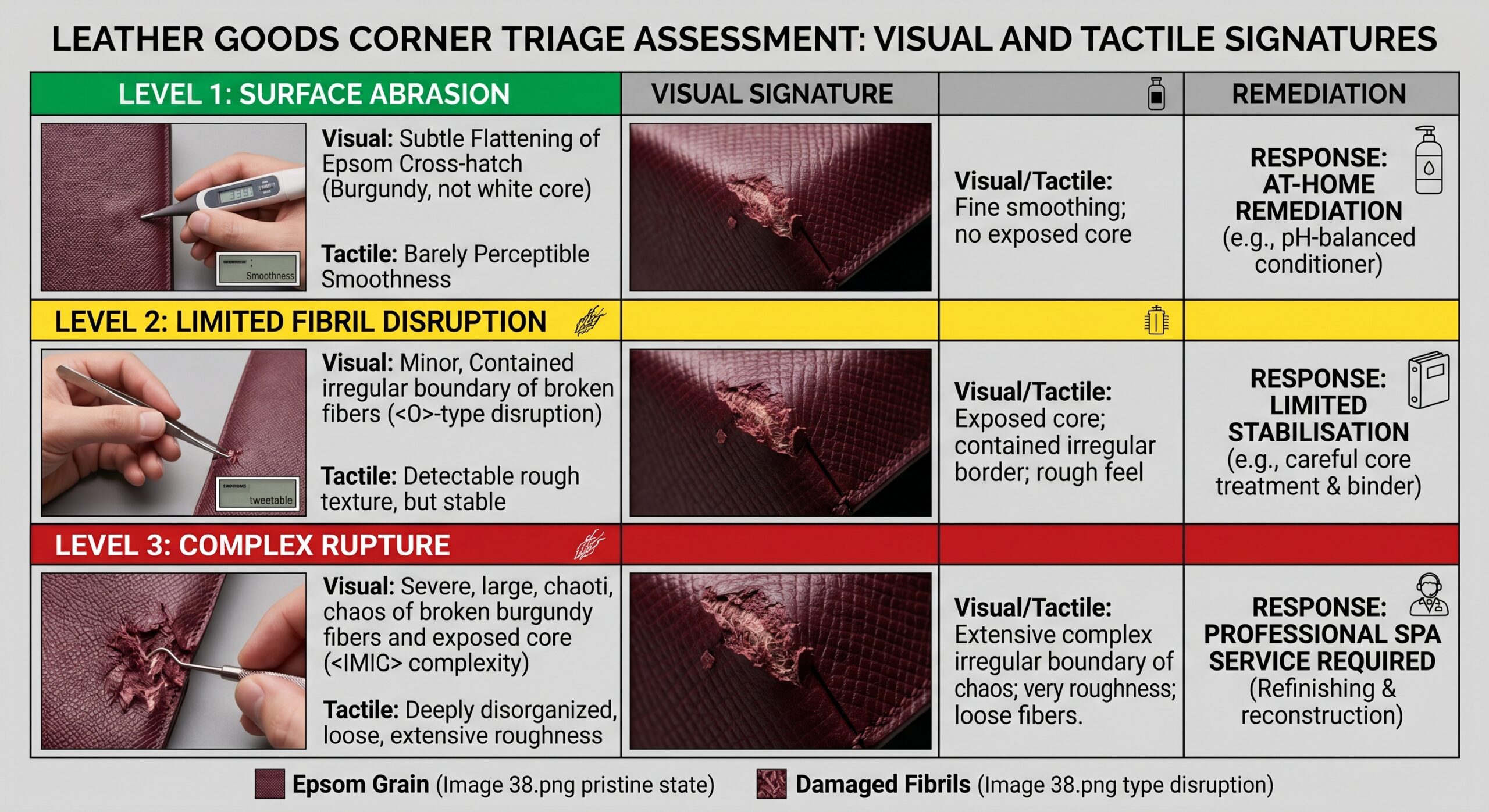
The most important decision in Epsom corner care is made before any product is applied: correctly assessing the severity of the damage. Acting on a moderate or severe chip with at-home remediation that is appropriate only for minor damage can worsen the condition by introducing moisture, product residue, or physical pressure to an already compromised zone. The three-tier triage system below provides a clear decision framework.
- Run a fingernail very gently across the corner point — minor damage feels slightly rough but has no raised edge; moderate damage has a detectable step where the chipped zone meets intact surface; severe damage has a clearly raised or missing edge that catches the fingernail
- Examine the edge glazing — the resin bead that runs along the leather edge — under good light; intact glazing is smooth and continuous; cracked glazing shows hairline fractures; lifted glazing has separated from the leather face and stands slightly proud
- Check the colour at the chip zone — minor: appears whitened or dulled but the same colour family as the panel; moderate: lighter, slightly different tone as upper fibril layer is exposed; severe: significantly lighter or raw-leather coloured as base material is exposed
- Assess whether the chip has reached the body panel — run your eye along the flat panel face from the corner; any disruption to the cross-hatch pattern on the panel itself (not just at the corner arc) indicates the chip has spread beyond the corner point and should be treated as severe
- Photograph before any action — document the corner state before any product is applied; this protects you in any spa service conversation and gives a baseline for monitoring whether the condition changes
At-Home Remediation: The Five-Step Protocol for Minor Corner Damage
Minor Epsom corner damage — compressed surface, no material loss, intact edge glazing — is the only category where at-home remediation is appropriate. The goal is not to restore the original embossed cross-hatch definition (this cannot be achieved without re-embossing equipment) but to stabilise the compressed zone, restore surface flexibility to reduce further brittleness, and improve the visual presentation of the affected area without introducing risk of additional damage.
Clean the Corner Zone
Dampen a lint-free cloth or cotton pad with distilled water only — no cleaning products, no leather cleaner, no solvent. Gently wipe the corner surface to remove any surface particulate, dust, or environmental residue that may have accumulated in the damaged zone. Allow to dry completely in still air at room temperature before proceeding — do not use heat to accelerate drying as this increases brittleness in an already-stressed fibril zone.
Apply Conditioner to the Corner with a Cotton Bud
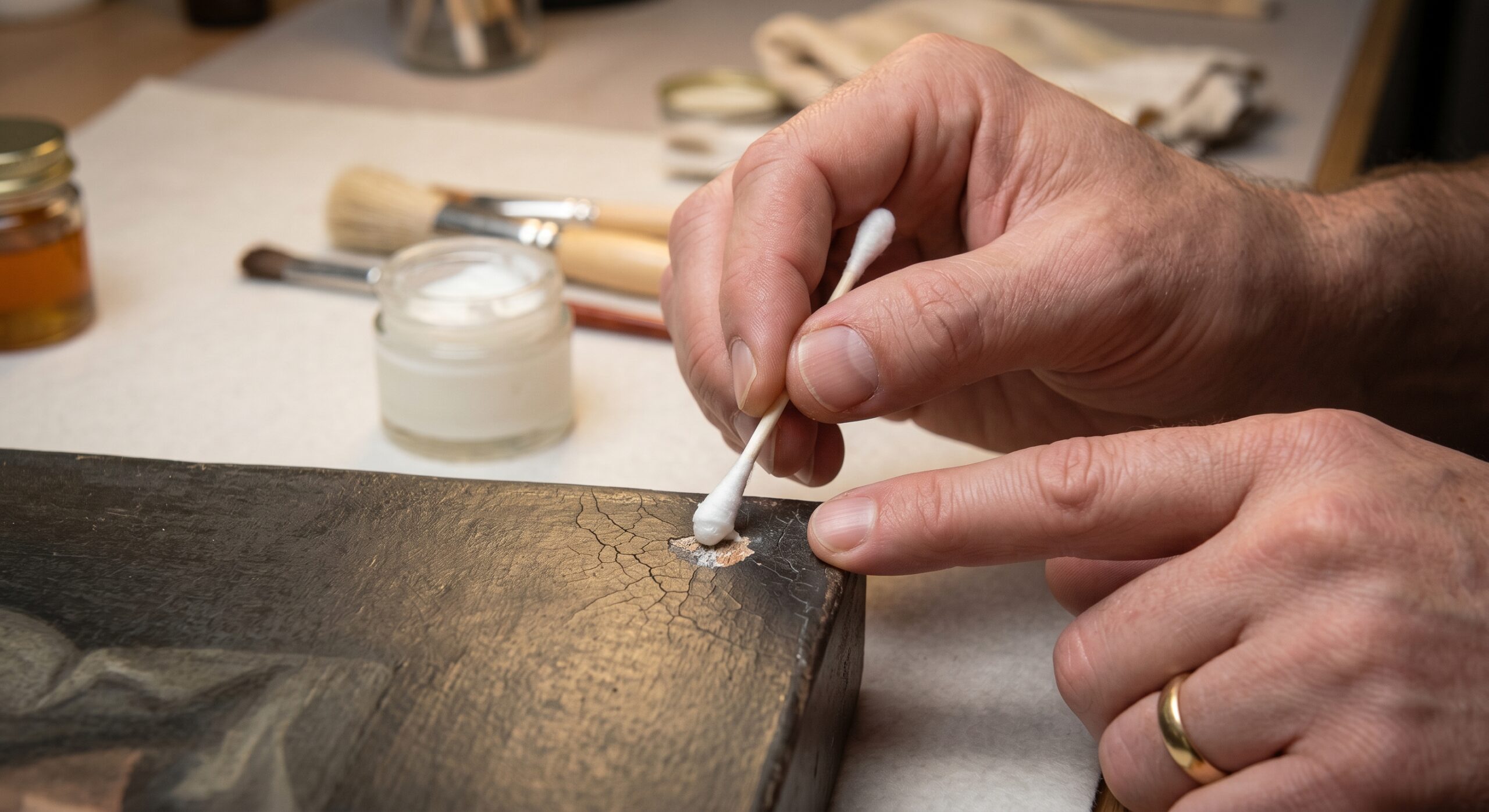
Using a cotton bud, apply a very small amount of a pH-neutral, colourless conditioning cream specifically to the chip zone — not to the surrounding panel. The goal is to reintroduce lipid content to the compressed fibril zone, which reduces brittleness and marginally improves the zone's visual uniformity with the surrounding panel. Do not apply the conditioner beyond the chip boundary. Allow to absorb for ten minutes before any further action.
Apply Gentle Fingertip Warmth
With clean, dry fingertips, apply gentle pressure and warmth to the corner chip zone for thirty to sixty seconds. The body heat transmitted through the fingertip marginally softens the compressed fibril surface, allowing any displaced fibril segments to partially re-compact toward a more even plane. This step produces a very subtle improvement in the visual uniformity of the chip zone — it will not restore the cross-hatch pattern, but it can reduce the whitened, raised appearance of minor displacement marks.
Assess the Edge Glazing
After the conditioning step has been absorbed, inspect the edge glazing carefully. If the glazing is intact and continuous, no edge treatment is required. If the glazing shows any hairline cracking within the minor-damage category (up to 2mm separation), apply a very small amount of specialist edge glazing product — available from leather care suppliers — to the crack line with the tip of a wooden cocktail stick or fine-tip applicator. Allow to cure fully before further handling.
Buff Lightly and Monitor
After all products have been fully absorbed (minimum thirty minutes), buff the corner zone very lightly with a clean, dry microfibre cloth using minimal pressure. Photograph the corner and compare with your pre-treatment photographs. The improvement will be incremental — typically a reduction in the whitened appearance and a slight improvement in surface uniformity. Monitor the corner over the following week for any change. If the chip zone appears to be expanding or the glazing condition deteriorates, discontinue at-home treatment and book Hermès spa assessment immediately.
Four At-Home Interventions That Will Worsen Epsom Corner Damage
Several common instincts for addressing leather damage are actively harmful on Epsom corner chips. Never apply dark leather cream or colour-matched products to a chip zone — the compressed fibril surface will absorb the pigment unevenly, producing a blotchy dark mark that is more visually prominent than the original chip. Never use sandpaper or abrasive products to smooth the chip edge — this removes surface material and cannot restore the embossed pattern. Never apply heat above body temperature to the corner — hairdryer heat will accelerate the dehydration and brittleness of the already-stressed fibril zone. And never press hard on the chip zone with a fingernail or hard object in an attempt to re-compress the surface — this will extend the chip boundary onto adjacent intact surface.
The Epsom Corner Prevention Protocol: Making the Next Chip Event Unlikely
Prevention is substantially more effective than remediation for Epsom corner damage, and the prevention protocol is straightforward to implement once the specific risk factors are understood. Corner chips occur through one of three mechanisms: direct impact with a hard surface (dropping the bag or contact with architectural elements), sustained abrasion from storage contact, and thermal cycling — repeated exposure to temperature extremes that further reduces the already-limited flexibility of the compressed fibril corner zone.
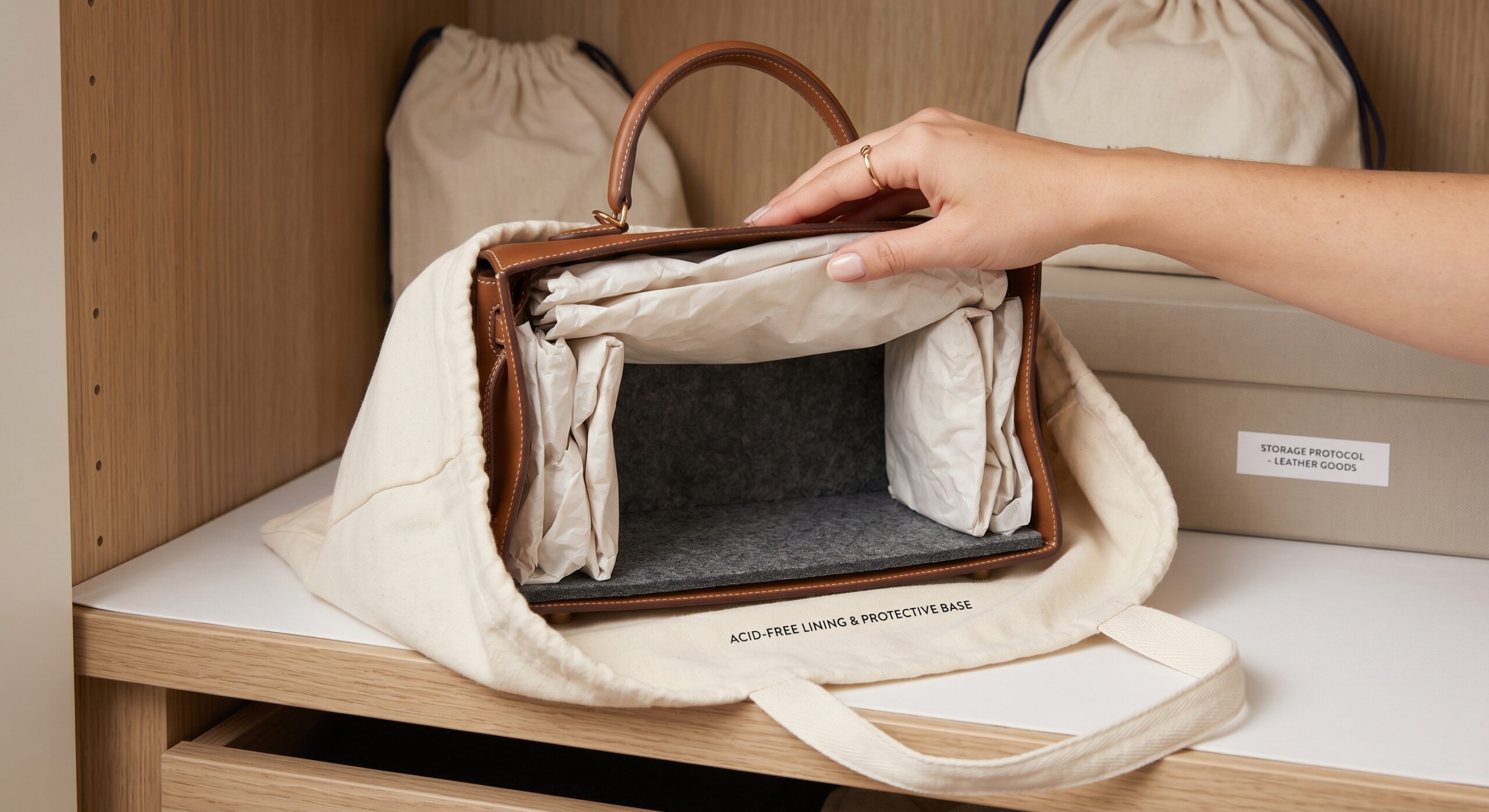
For impact prevention, the most effective single intervention is a base insert — a rigid or semi-rigid liner that sits in the base of the bag when it is set down. This elevates the base leather slightly off contact surfaces and, more importantly, provides structural support that reduces the flex stress at the base corner points when the bag is carried loaded. A base insert also helps Epsom maintain its factory base geometry over the long term by reducing the gravitational load distribution across the base-to-wall corner joins. For a comprehensive comparison of how Epsom's corner vulnerability compares to other leathers in daily carry contexts, see our article on Hermès Togo vs Clemence: Which Slouches More Over Time, which covers the fibril-level differences that determine why different leathers respond differently to the same impact events.
For storage, always stuff the bag with acid-free tissue to the point where the leather panels are at their natural tension without being over-stretched, and store in the dust bag with the corners not in contact with the storage surface. A base of folded acid-free tissue placed beneath the bag inside the dust bag creates a soft buffer that prevents the corner geometry from resting on a hard surface during storage — the mechanism responsible for much of the gradual corner compression that precedes the eventual chip. For best leather conditioner choices for Hermès leathers in general, our ranked review at Best Leather Conditioners for Hermès Barenia: Ranked & Reviewed covers the conditioning principles that apply to all smooth Hermès leathers including Epsom. Browse all care and prevention guidance at All Topics.
| Leather | Corner Wear Mechanism | First Visible Change | Remediable at Home? | Prevention Priority |
|---|---|---|---|---|
| Epsom | Chip — compressed fibril matrix fractures under impact, displaces rather than deforms | Single impact event — can appear immediately after one contact with hard surface | Minor only — conditioning and fingertip warmth; no pattern restoration | Highest — base insert and soft storage essential from day one |
| Togo | Rounding — pebbled grain fibrils compact gradually over multiple contacts | 2–3 years of active carry — progressive, even rounding of corner arc | Yes — gradual rounding reads as character; conditioning maintains suppleness | Moderate — base contact protection helps but rounding is expected and tolerated |
| Clemence | Rounding — larger pebble and softer temper produce faster corner softening than Togo | 12–18 months of active carry in larger formats | Yes — softer fibril structure accommodates rounding as intended aesthetic | Moderate — similar to Togo but accelerated; stuffed storage slows base corner softening |
| Swift | Scuffing — smooth surface shows abrasion at corner as fine scratches in the finish layer | 6–12 months of active carry — finish layer at corner is thin and vulnerable | Partial — fingertip buffing reduces minor scuffing; deeper scratches require spa | Moderate-high — smooth surface shows corner abrasion earlier than pebbled leathers |
| Box Calf | Chip and gloss loss — box-pressed surface chips similarly to Epsom but gloss disruption is more visible | Single impact — gloss surface makes even minor corner contact visible immediately | Minimal — gloss cannot be restored at home; spa service required for any significant damage | Highest — Box Calf corners are even more sensitive to impact than Epsom due to gloss disruption |
| Barenia Faubourg | Darkening and compression — soft surface shows corner patina concentration but no chipping | 3–6 months — corner contact zones darken earlier than body panels as part of normal patina | Yes — corner darkening is part of natural patina and typically desirable on Barenia | Low — corner patina is expected and valued; water protection at corners is more important than impact prevention |
Triage Before You Act, Prevent Before You Need to Triage
Epsom corner chip is the most consequential care failure in the standard Hermès leather range — not because it is the most common, but because it is the most permanent, the most resale-damaging, and the most counterintuitively caused by the very property that makes Epsom desirable. The compressed fibril rigidity that gives Epsom its decade-long geometric stability is identical to the matrix brittleness that produces corner chips. You cannot have one without accepting the other as a risk.
What you can control is triage discipline and prevention consistency. Triage before any intervention prevents the common error of applying at-home remediation to moderate or severe damage that requires spa service — an error that routinely makes the outcome worse rather than better. Prevention through base inserts, soft storage, and temperature-stable environments eliminates the majority of chip events before they occur. An Epsom piece managed this way from day one will reach Year 10 with corner geometry that requires no apology at the secondary market. An Epsom piece carried without protection will show its corner history long before then.
Bottom Line: Triage your Epsom corner damage before acting — minor chips can be partially addressed at home with conditioning and fingertip warmth; moderate and severe chips require Hermès spa service; and prevention through base inserts and soft storage is the only fully effective long-term corner protection strategy.
Popular Searches
Explore our most searched Hermès Epsom care and corner protection combinations
The sellier Kelly's sharp corner geometry makes it the highest-priority corner protection case in the Epsom range — the exterior seam adds an additional point of vulnerability at each corner arc.
⬆ TrendingA base insert in the Epsom Birkin 30 is the single most effective at-home corner protection investment — it elevates the base leather off contact surfaces and reduces flex stress at the base-to-wall corner joins.
★ Collector FavouritePale Epsom Craie's edge glazing is the most visually prominent in the range — any cracking at the corner glazing bead is immediately legible against the pale leather and should be addressed at the hairline stage.
◆ Ultra RarePale pink Epsom amplifies corner chip visibility dramatically — the whitened chip boundary reads with high contrast against the pale salmon tone, making triage accuracy particularly important on this specification.
⬆ Rising DemandEtain's mid-grey Epsom surface shows minor chip compression as a whitened zone that responds well to at-home conditioning — the tonal contrast at the chip boundary is moderate and conditioning reduces visibility effectively.
🔥 Most SearchedSaturated Epsom colors like Bleu Electrique produce the sharpest tonal contrast at chip boundaries — moderate damage on this tone reads as severe in photographs, making in-person spa assessment essential before any grading decision.
Frequently Asked Questions
Minor Epsom corner chips — where the compressed fibril matrix has been disturbed but no material has been lost — can be partially addressed at home. The approach involves gentle cleaning with a barely damp lint-free cloth, targeted conditioning cream application with a cotton bud to the chip zone only, and very gentle fingertip warmth to encourage micro-redistribution of displaced compressed fibrils. These interventions can reduce the visibility of minor chips but cannot restore the original embossed cross-hatch definition — that requires Hermès spa service. Moderate and severe chips should go straight to spa service without at-home intervention. For full care guidance see the Care & Storage Guide hub.
Preventing corner wear on Epsom leather requires consistent attention to two risk categories: impact events and abrasion during storage. For impact prevention, always set the bag down on a soft surface rather than directly on hard floors or table edges; use a base insert when the bag is stationary. For abrasion prevention, store the bag stuffed with acid-free tissue inside its dust bag, with a folded tissue pad beneath the bag to cushion the corners from storage surfaces. The resin edge glazing at the corners should be inspected monthly and treated with specialist edge glazing product if any cracking begins. For water damage prevention context see Water Damage on Hermès Barenia Leather.
Hermès spa service is appropriate for Epsom corner damage in three situations: when the chip has removed material from the leather surface, leaving a visibly recessed zone; when the resin edge glazing has lifted or cracked over more than 5mm of the corner arc; or when the compression damage extends beyond the corner point onto the flat body panel. In all three cases, at-home remediation will not produce an acceptable result and risks worsening the condition. Hermès spa service can re-glaze the corner edge and apply colour-matched treatment to the chip zone, producing results that are substantially more presentable than untreated damage. For conditioner selection see Best Leather Conditioners for Hermès Barenia.
Yes — corner wear on Epsom has a disproportionately large impact on resale value relative to its visual size. A single chipped corner on an otherwise pristine Epsom piece can reduce its secondary market grade from B to D — a price reduction of 20–35% depending on the specification. This is why corner protection is the single most important preventive care investment for any Epsom owner. Specialist resellers weight corner integrity heavily in Epsom-specific condition assessments because chipping is irreversible and cannot be invisibly restored without Hermès spa intervention. For the full resale condition framework see Does Leather Condition Affect Hermès Resale Price?
