
Best Leather Conditioners for Hermes Barenia: Ranked & Reviewed
A forensic ranking of the conditioner categories that respect Barenia's vegetable tannage chemistry and those that actively damage it — with the application protocol that makes the right product work correctly.
Choosing the right conditioner for Hermès Barenia leather is not the same decision as choosing a conditioner for Togo, Clemence, or any chrome-tanned Hermès leather. Barenia Faubourg is vegetable-tanned — a tannage chemistry that makes it more reactive to care products than any chrome-tanned leather, more sensitive to the wrong product type, and more rewarding of the right approach. A conditioner that is perfectly appropriate for Togo may interfere with Barenia's tannin mobility, block its pellicule development, or introduce surface residues that collect particulate and alter the leather's natural colour trajectory. The stakes of product selection are genuinely higher with Barenia — and most of the commonly recommended leather conditioners in the market are formulated for chrome-tanned leather without any specific consideration of vegetable tannage chemistry.
This guide ranks conditioner categories from ideal to avoid based on their compatibility with Barenia's vegetable tannage, explains the chemistry behind each rating, and delivers the application protocol that makes the correct product work correctly — including frequency, method, and the most common application mistakes that negate the benefit of even the best conditioner choice.
Why Barenia Conditioning Is Different from Every Other Hermès Leather
The reason conditioning Barenia requires a different approach from conditioning Togo or Epsom lies entirely in the tannage chemistry difference between vegetable-tanned and chrome-tanned leather. In chrome-tanned leathers, the chromium salt cross-links that stabilise the collagen fibril structure are chemically inert — they do not react with conditioning products, do not respond to lipid addition in the same way as vegetable tannins, and do not interact with the surface chemistry of most commercial leather conditioners in any significant way. Chrome-tanned leather conditioning is relatively forgiving because the fundamental chemistry of the leather is stable and unresponsive to most product types.
In Barenia's vegetable tannage, the polyphenolic tannin molecules that stabilise the collagen structure remain chemically mobile and reactive throughout the leather's life. They attract and respond to moisture, UV light, and — critically — lipid compounds introduced from external sources including skin oils, environmental exposure, and conditioning products. A conditioning product applied to Barenia does not simply replenish surface moisture as it might on Epsom: it introduces lipid compounds that interact directly with the mobile tannin molecules, potentially driving tannin migration, altering the rate and character of patina development, and — if the product chemistry is incompatible — creating tannin-product complexes that produce surface residues, tonal changes, or blockage of the natural patina process. This is why product selection for Barenia is genuinely consequential in a way that it is not for chrome-tanned Hermès leathers. The full care context is at the Care & Storage Guide hub.
"On Togo, the wrong conditioner is a minor inconvenience. On Barenia, it can permanently alter the patina trajectory that took years to develop. The chemistry is different. The stakes are higher."
Conditioner Categories Ranked: From Ideal to Actively Harmful
Rather than naming specific commercial products that may change formulation without notice, this ranking addresses conditioner categories defined by their active ingredient chemistry. Any product in the top-ranked categories is appropriate for Barenia; any product in the avoid category should not be used regardless of its effectiveness on other leather types.
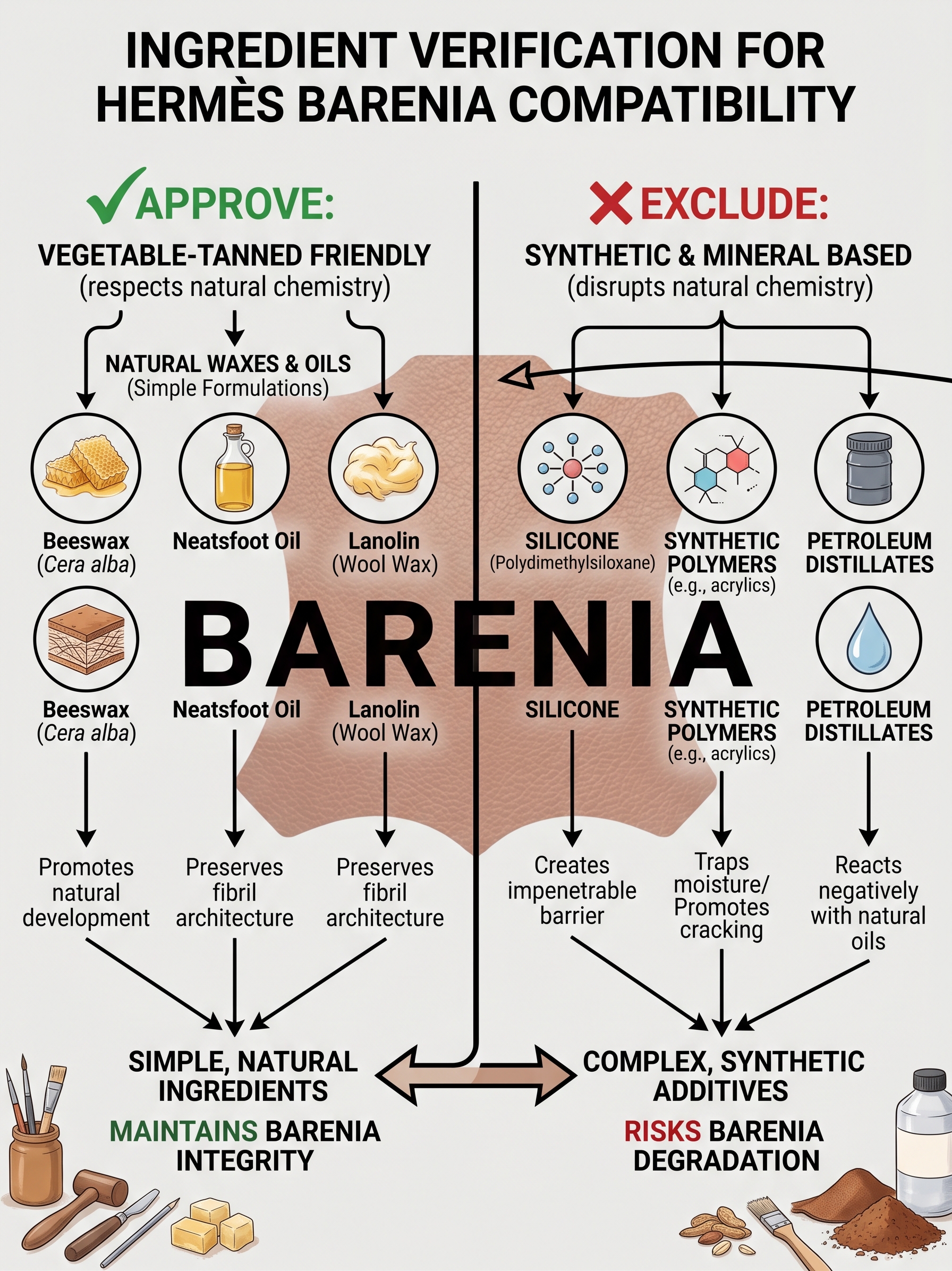
Beeswax-based conditioners — those whose primary active ingredient is refined beeswax, either in a pure form or emulsified in a minimal natural carrier — are the most compatible product type for Barenia's vegetable tannage chemistry. Beeswax is a natural ester compound that integrates smoothly into the vegetable tannin-fibril matrix without disrupting tannin mobility. It provides temporary water resistance by filling the open grain pathways at the surface without sealing them permanently, and it does not interfere with the UV oxidation process responsible for Barenia's most visible patina development. Application is light — a very small amount on a soft cloth, buffed across the full panel surface — and the product absorbs quickly, leaving no tacky residue. Beeswax products are also the correct choice for pre-carry water protection on Barenia, as described in our water damage guide.
The key requirement for Barenia use is that the beeswax product contains no synthetic additives — specifically no silicone, no synthetic polymer thickeners, and no petroleum-derived components. Pure beeswax emulsions with a natural oil carrier (jojoba, sweet almond, or similar) meet this requirement. Products that list synthetic ingredients alongside beeswax should be assessed against the Avoid criteria below.
Neatsfoot oil is rendered from the shin bones and feet of cattle — a natural triglyceride oil that has been used in leather conditioning for centuries. It is highly compatible with the collagen fibril structure of vegetable-tanned leather, penetrating the fibril network effectively and restoring lipid content without introducing incompatible chemistry. For Barenia, neatsfoot oil is an effective conditioning choice with one important caveat: it is oil-dark in character, meaning application always produces noticeable temporary darkening — significantly more than beeswax products — and repeated application over time produces a progressive deepening of the leather's base tone that is more pronounced than beeswax conditioning produces.
This darkening character makes neatsfoot oil appropriate for Barenia conditioning on darker tone pieces (Natural, Fauve, Noisette) where additional depth is welcome, and less appropriate for pale Barenia pieces where maintaining tone lightness is a priority. Use very sparingly — one drop on a soft cloth for the full bag is typically sufficient. Pure neatsfoot oil is preferred over compound neatsfoot (which may contain petroleum distillates). Allow full absorption overnight before carry.
Lanolin-based leather creams — those using wool-derived lanolin as the primary conditioning agent in a light, pH-neutral emulsion — are broadly compatible with Barenia's vegetable tannage when the formulation is free of solvents, silicone, and synthetic polymer additives. Lanolin is a natural wax ester with lipid properties similar to the sebum produced by mammalian skin, making it well-matched to the lipid replenishment needs of the leather's fibril network. It penetrates the fibril network more slowly than neatsfoot oil but more evenly, producing less pronounced temporary darkening and a more consistent surface result across varied application patterns.
The key selection criterion is formulation simplicity: a pure lanolin cream with minimal additives is appropriate; a complex formulation with multiple synthetic additives, fragrances, or solvent carriers (identifiable by the word "petroleum distillate" or "naphtha" in the ingredient list) should be avoided. The cream should feel light and quickly-absorbing when rubbed between fingers — a heavy, slow-absorbing cream typically indicates polymer or silicone content.
Standard commercial leather conditioners — the majority of the mainstream leather care market — are formulated for chrome-tanned leather. They may contain synthetic polymers that fill and smooth the chrome-leather surface effectively but sit as an incompatible film on the vegetable-tanned Barenia surface. They may contain silicone that temporarily improves surface water resistance but blocks the UV and skin-oil pathways responsible for Barenia's patina development. And they may contain mildly acidic or alkaline pH-adjusting agents that are appropriate for chrome leather chemistry but disruptive to vegetable tannin stability.
These products are not catastrophically damaging to Barenia in a single application — a Barenia piece that has received one application of a standard cream conditioner will not be ruined. But repeated use of a chrome-leather conditioner on Barenia can gradually reduce the leather's patina-development capacity, introduce surface residues that collect particulate and alter the surface tone, and produce a synthetic-feeling surface character that departs from the natural warmth of well-conditioned vegetable-tanned leather. If this is what is currently in your care kit, switch to Category 1 or 2 for future conditioning.
Silicone-based leather products and silicone-containing waterproofing sprays are the most damaging conditioning choice for Barenia and should never be used. Silicone creates a non-breathable molecular film over the leather's grain surface that physically blocks the UV and moisture pathways responsible for Barenia's tannin oxidation and patina development. The silicone film is also non-reversible by standard cleaning: once applied, it cannot be removed without solvents that are themselves damaging to vegetable-tanned leather. The result of a single silicone application to Barenia is a permanently reduced patina development capacity — the leather will still age, but the character of that ageing will be altered by the silicone barrier in a way that cannot be corrected at home.
The same applies to standard fabric waterproofing sprays, which almost universally contain silicone or fluorocarbon compounds. The desire to protect Barenia from water is entirely understandable — see our water damage guide — but silicone is not the answer. Beeswax pre-treatment (Category 1) provides effective temporary water protection without silicone's permanent patina-blocking consequences. Any product that advertises "waterproof" or "water resistant" should be assumed to contain silicone unless the ingredient list explicitly states otherwise.
The Conditioning Mistakes That Damage Barenia — and the Chemistry Behind Each One
Beyond product type selection, conditioning technique mistakes produce their own damage category on Barenia — independent of the product used. These are the four most common application errors and their specific consequences.
Why Localised Conditioning — Applying to Only a Spot or Zone — Creates Lasting Tonal Unevenness on Barenia
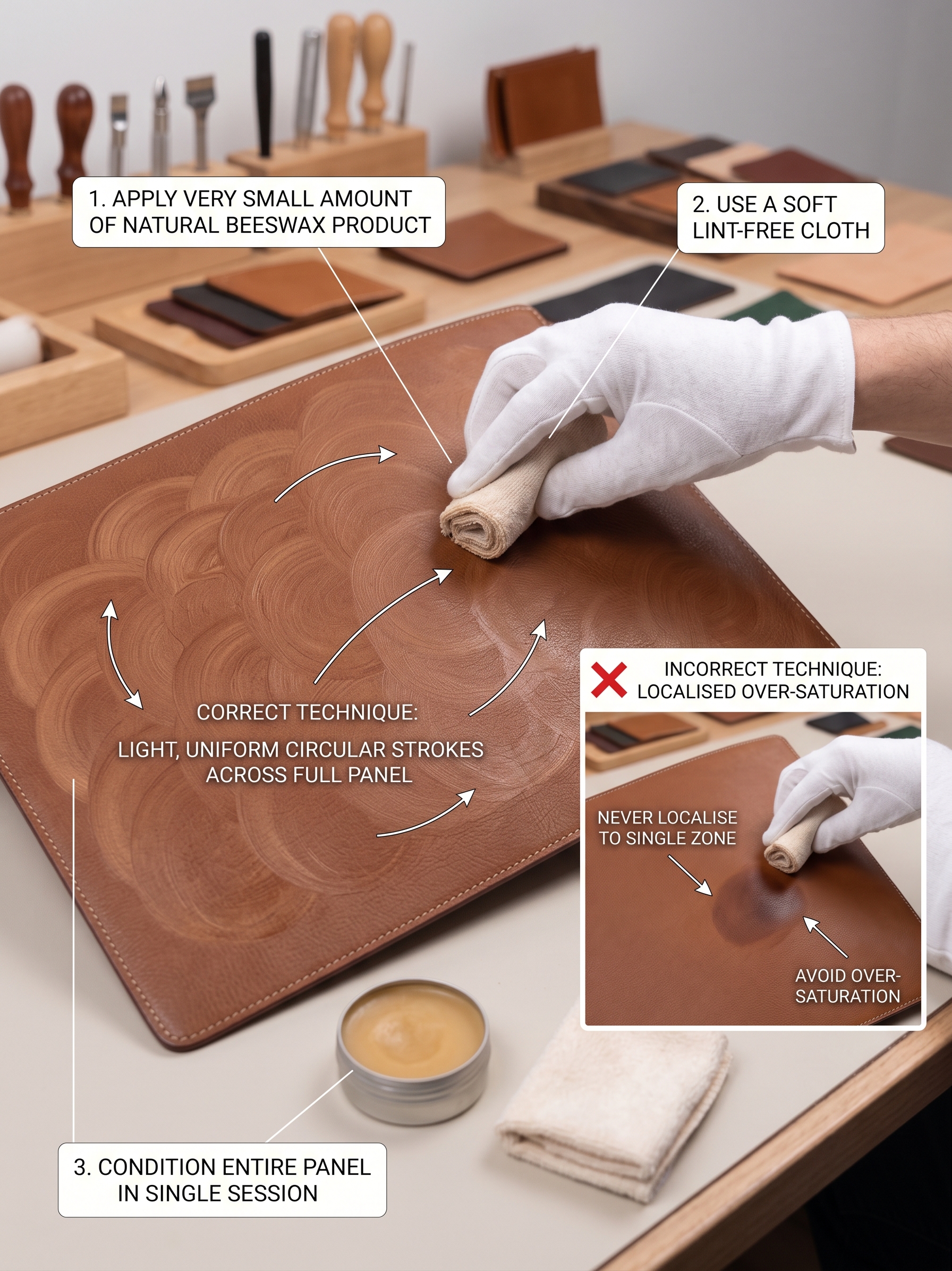
The most common conditioning application mistake on Barenia is treating only the area that appears dry or dull — applying conditioner to a single zone (a handle, a corner, a body panel quadrant) rather than the full leather surface. On chrome-tanned leathers, localised conditioning is less consequential because the chrome cross-links prevent significant tannin migration from the treated zone to adjacent untreated areas. On Barenia, localised conditioning introduces a lipid differential between the treated zone and surrounding leather. The tannin molecules in the treated zone absorb the lipid compounds and temporarily darken more than adjacent zones. This tonal differential, if the conditioning is repeated in the same localised pattern, can become a persistent tonal variation as the treated zone develops its patina at a different rate from the untreated surroundings. Always condition the full panel.
- Localised application — applying to one zone only produces temporary darkening that can become persistent tonal unevenness with repeated conditioning; always condition the full panel in a single session
- Over-application — too much conditioner at one time saturates the fibril network beyond its absorption capacity, leaving surface residue that attracts particulate; use less than you think is needed and allow full absorption before assessing whether more is required
- Application before full drying after water contact — conditioning a Barenia surface that is still slightly damp from a water event drives moisture deeper into the fibril network and can intensify tide mark formation; always allow complete natural drying before conditioning
- Conditioning on top of product residue — applying conditioner over the residue of a previous silicone or polymer product compounds the incompatible chemistry rather than correcting it; if there is existing residue from an inappropriate product, professional assessment is the appropriate route before any further conditioning
- Using fingers to apply — the skin oils on fingers are themselves a conditioning input that can produce uneven application; use a soft, clean, lint-free cloth or cotton pad for all product application
The Correct Barenia Conditioning Protocol: Application Method, Frequency, and Seasonal Adjustment
The conditioning protocol for Barenia integrates the right product choice with the correct application method and the appropriate frequency for the bag's carry intensity. Following all three elements correctly produces the consistent lipid baseline in the fibril network that maintains even patina development and protects the leather's surface quality over the long term.
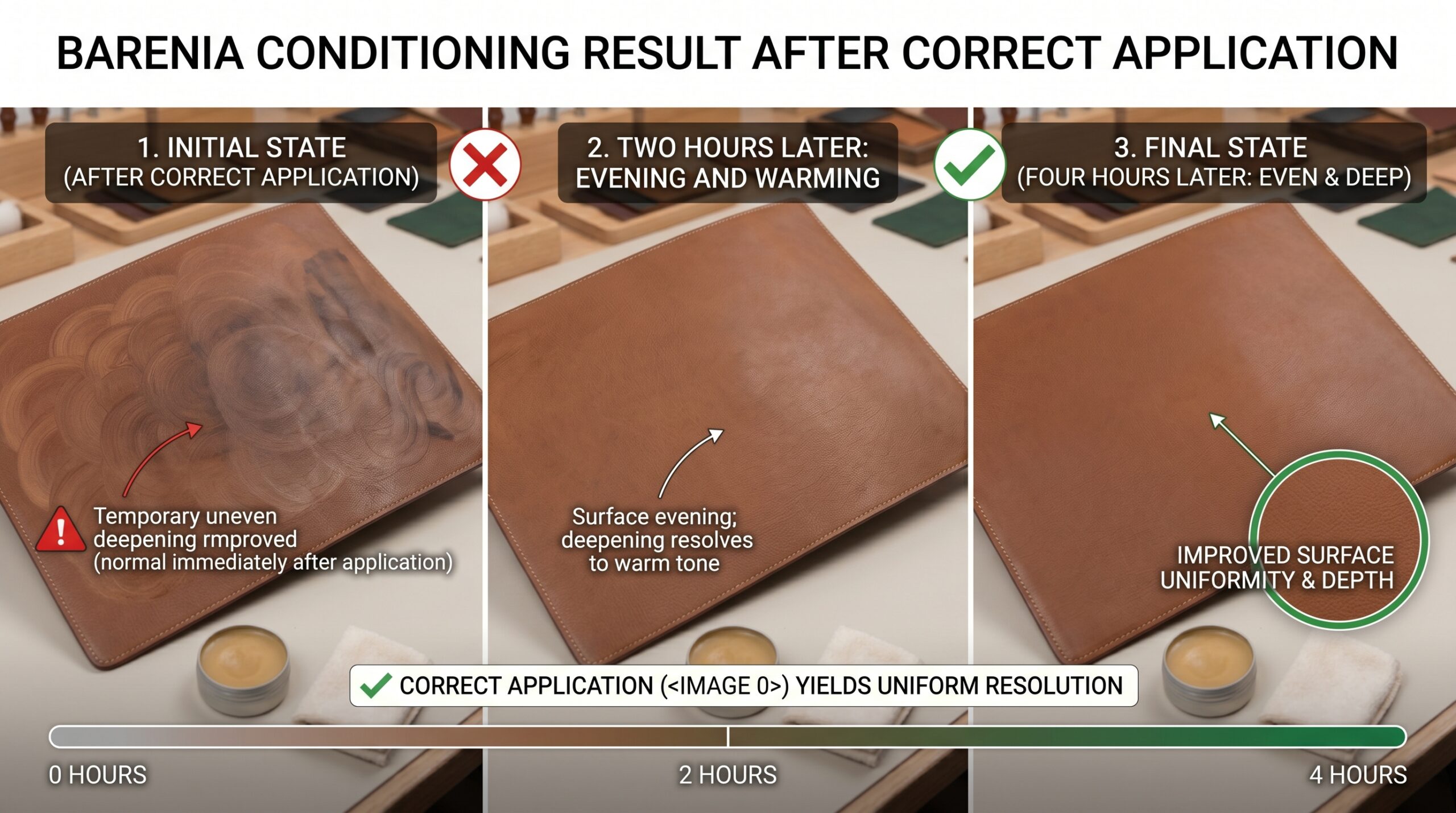
Application method. Place a very small amount of beeswax product or lanolin cream — approximately the size of a small pea — onto a soft, clean lint-free cloth or folded cotton pad. Rub the cloth between your fingers briefly to warm and distribute the product across the cloth surface. Apply to the full leather panel in light, even circular strokes, working from the centre of each panel outward toward the edges. The pressure should be light — you are distributing the product across the surface, not pressing it in. Once the full panel is covered, allow thirty minutes of still-air absorption time at room temperature. Do not use the bag or place it in storage during this absorption period. After thirty minutes, buff lightly with a clean, dry portion of the same cloth to remove any surface excess. The leather should appear slightly deeper in tone than before conditioning — this temporary darkening resolves to a warm, even tone within two to four hours.
Frequency during active carry. Every six to eight weeks for a bag carried multiple times per week. This is significantly more frequent than the three to four month conditioning interval appropriate for Togo or Clemence, reflecting Barenia's greater sensitivity to fibril lipid content levels. A Barenia bag carried daily that is conditioned every six to eight weeks maintains a consistent fibril hydration level that supports even patina development. The same bag without regular conditioning develops fibril dehydration that produces tonal unevenness — areas of differential dryness that patina at different rates.
Seasonal adjustment. In winter months when indoor heating reduces ambient humidity and increases leather dehydration, shorten the conditioning interval to every four to five weeks. In summer months with higher ambient humidity and more UV exposure, the six to eight week interval remains appropriate. After any water contact event that required the panel-dampening technique from our Barenia water damage guide, condition the affected panel immediately once it is fully dry. For corner wear prevention context see How to Fix Corner Wear on Hermès Epsom Leather which covers conditioning principles that apply across leather types. Browse all care content at All Topics.
| Conditioner Type | Active Ingredient | Barenia Compatibility | Darkening Effect | Recommendation |
|---|---|---|---|---|
| Pure beeswax emulsion | Beeswax + natural oil carrier (jojoba, almond) | Excellent — respects vegetable tannage and provides water protection | Minimal — slight temporary tone deepening, resolves quickly | First choice for all Barenia conditioning and pre-carry water protection |
| Pure neatsfoot oil | Rendered cattle shin bone oil — natural triglyceride | Good — deep fibril penetration, vegetable tannage compatible | Noticeable — significant temporary darkening; appropriate for dark tones only | Good for Natural, Fauve, Noisette Barenia; avoid on pale or bright-tone pieces |
| pH-neutral lanolin cream | Wool-derived lanolin in water-based emulsion | Good — compatible chemistry, even surface penetration | Mild — less darkening than neatsfoot; more than beeswax | Good for all Barenia tones when formulation is solvent-free and silicone-free |
| Standard chrome-leather cream | Synthetic polymer + emulsifiers; may include silicone | Caution — formulated for different tannage chemistry; may introduce incompatible compounds | Variable — depends on specific formulation | Switch to Cat. 1–3; one-time use is not catastrophic but repeated use is inadvisable |
| Conditioning wax with synthetic additives | Wax base + synthetic polymer + fragrance | Poor — synthetic additives incompatible with vegetable tannin chemistry | Unpredictable — surface residue risk | Avoid — use pure beeswax instead |
| Silicone waterproofing spray | Silicone or fluorocarbon polymer | Incompatible — permanently blocks patina development pathways | Surface sheen — misleading as "conditioning" | Never use on Barenia — damage is non-reversible by home methods |
| Petroleum jelly / Vaseline | Petroleum-derived mineral hydrocarbons | Incompatible — does not bond to fibril structure; surface film only | Temporary sheen — no genuine conditioning effect | Never use — attracts particulate, blocks patina, difficult to remove |
| Mink oil | Rendered mink fat — natural triglyceride | Moderate — natural triglyceride compatible but strong darkening effect | Significant — comparable to or greater than neatsfoot oil | Use with extreme caution on pale tones; neatsfoot oil is preferable if darkening is acceptable |
Use Pure Beeswax for Barenia — It Is the Only Product That Conditions, Protects, and Respects the Patina Chemistry Simultaneously
Of all the conditioner categories assessed here, pure beeswax emulsion is the only one that addresses all three care objectives for Barenia simultaneously: it replenishes fibril lipid content (genuine conditioning function), it provides temporary water protection by filling open grain pathways (the most critical Barenia care need), and it does this without introducing any chemistry that interferes with the vegetable tannin mobility responsible for patina development. No other readily available product category achieves all three.
The application protocol matters as much as the product choice. Full panel application, light quantity, thirty minutes of absorption time, and the correct six to eight week frequency during active carry together produce a consistently conditioned Barenia surface that develops its patina evenly and maintains the surface quality that makes aged Barenia the most beautiful of all Hermès leathers. Silicone and petroleum products are not alternatives — they are the specific choices that prevent this outcome permanently. The selection is simple once the chemistry is understood: natural wax and oils for Barenia, and everything else for the other leathers in the range.
Bottom Line: Use pure beeswax emulsion — ideally without synthetic additives — as the primary conditioner and water protection product for Hermès Barenia Faubourg; apply across the full panel every six to eight weeks during active carry; never use silicone, petroleum products, or standard chrome-leather conditioners on vegetable-tanned leather.
Popular Searches
Explore our most searched Barenia conditioning and care combinations
Natural Barenia in the Birkin 30 is the specification where conditioning frequency matters most — Natural's pale honey tone shows fibril dehydration unevenness earlier than darker Barenia tones, making the six to eight week interval non-negotiable.
⬆ TrendingNeatsfoot oil on dark Barenia tones (Fauve, Noisette) produces a deep conditioning penetration that enhances the leather's warm character — the darkening effect that makes it inappropriate for pale tones is desirable on these specifications.
★ Collector FavouriteThe most searched Barenia care mistake — understanding why silicone permanently blocks patina development converts what seems like an obvious protective measure into the most destructive single product choice for this leather.
◆ Ultra RarePre-carry beeswax application on Barenia Fauve before uncertain weather is the single most valuable Barenia care intervention — thirty seconds of protection application that dramatically reduces the risk of tide mark formation during carry.
⬆ Rising DemandConditioning Barenia after the panel-dampening remediation technique — applied as soon as the leather is fully dry, to the full panel, with beeswax or lanolin cream — restores the lipid baseline disturbed by the water event and promotes even subsequent drying.
🔥 Most SearchedThe lanolin cream ingredient check — how to identify which commercial lanolin creams contain silicone or solvent additives that make them inappropriate for Barenia, and which are clean formulations that meet the vegetable tannage compatibility standard.
Frequently Asked Questions
The best conditioners for Hermès Barenia Faubourg are those formulated for vegetable-tanned leather — specifically products that use natural wax and oil bases (beeswax, neatsfoot oil, lanolin) without silicone, synthetic polymers, or high-solvent content. Pure beeswax emulsion is the first choice: it conditions the fibril network, provides temporary water protection, and does not interfere with Barenia's patina development chemistry. Avoid standard chrome-leather conditioners — they are formulated for a different tannage and can interfere with vegetable tannin mobility. See the full care guide at the Care & Storage Guide hub.
During active carry, Hermès Barenia should be conditioned every six to eight weeks — significantly more frequent than chrome-tanned leathers which need conditioning every three to four months. Barenia's vegetable tannage makes it more responsive to lipid content changes, and a dehydrated fibril network shows tonal unevenness more quickly. In storage without active carry, every three to four months is appropriate. After any water contact event requiring the panel-dampening technique, condition as soon as the leather is fully dry. For water damage protocol see Water Damage on Hermès Barenia Leather.
No — Vaseline and petroleum jelly are petroleum-derived products incompatible with vegetable-tanned leather chemistry. They do not bond with the collagen fibril structure in the way natural waxes and oils do, instead coating the surface with a non-penetrating film. Over time, petroleum-based products can interfere with the tannin mobility that drives Barenia's patina development, create a molecular barrier blocking environmental inputs that drive the patina process, and attract dust and particulate to a sticky surface film that is difficult to remove without further-damaging solvents. For patina development context see Barenia Faubourg Patina Progression.
Yes — conditioning Barenia produces a temporary darkening that typically resolves within thirty to sixty minutes as the product absorbs and lipid content equilibrates. This temporary darkening is more pronounced on Barenia than chrome-tanned leathers because Barenia's reactive tannin chemistry amplifies the visible effect of lipid addition. The critical factor is evenness: conditioning applied evenly across the full panel produces even temporary darkening that resolves to an even tone. Localised conditioning produces uneven darkening that may take longer to resolve and can contribute to long-term tonal unevenness. Always condition the full panel in a single session. Browse all care content at All Topics.
