
Hermes Togo vs Clemence Leather: Which Slouches More Over Time?
A fibril-level analysis of why these two pebbled leathers behave so differently under load — and which one belongs in your next bag.
The question of Hermes Togo vs Clemence leather slouch sits at the intersection of tannery science and daily use reality. Both leathers are chrome-tanned, both carry a pebbled grain, and both appear in the Birkin and Kelly ranges — yet the structural difference between them is significant enough that choosing the wrong one for your carry style will produce a bag that disappoints within two years. The distinction is not about quality: Clemence is not inferior to Togo. It is about temper, fibril architecture, and hide origin — three variables that determine exactly how much a bag will soften and spread under the weight of daily contents over a decade of use.
This article examines both leathers at the material level, traces the slouch mechanics specific to each, and provides a buyer's framework for matching leather to lifestyle — because the Birkin that holds its architectural geometry after five years of daily carry is the one whose leather was correctly specified from the outset.

Why Two Pebbled Leathers Behave So Differently: Hide Origin and Tannage
To understand why Togo and Clemence diverge so markedly in long-term behaviour, it is necessary to go back to the hide itself — specifically, to the section of the animal from which each leather is cut. This is the primary determinant of structural difference, and it is a distinction that most buyers never encounter in commercial descriptions of either leather.
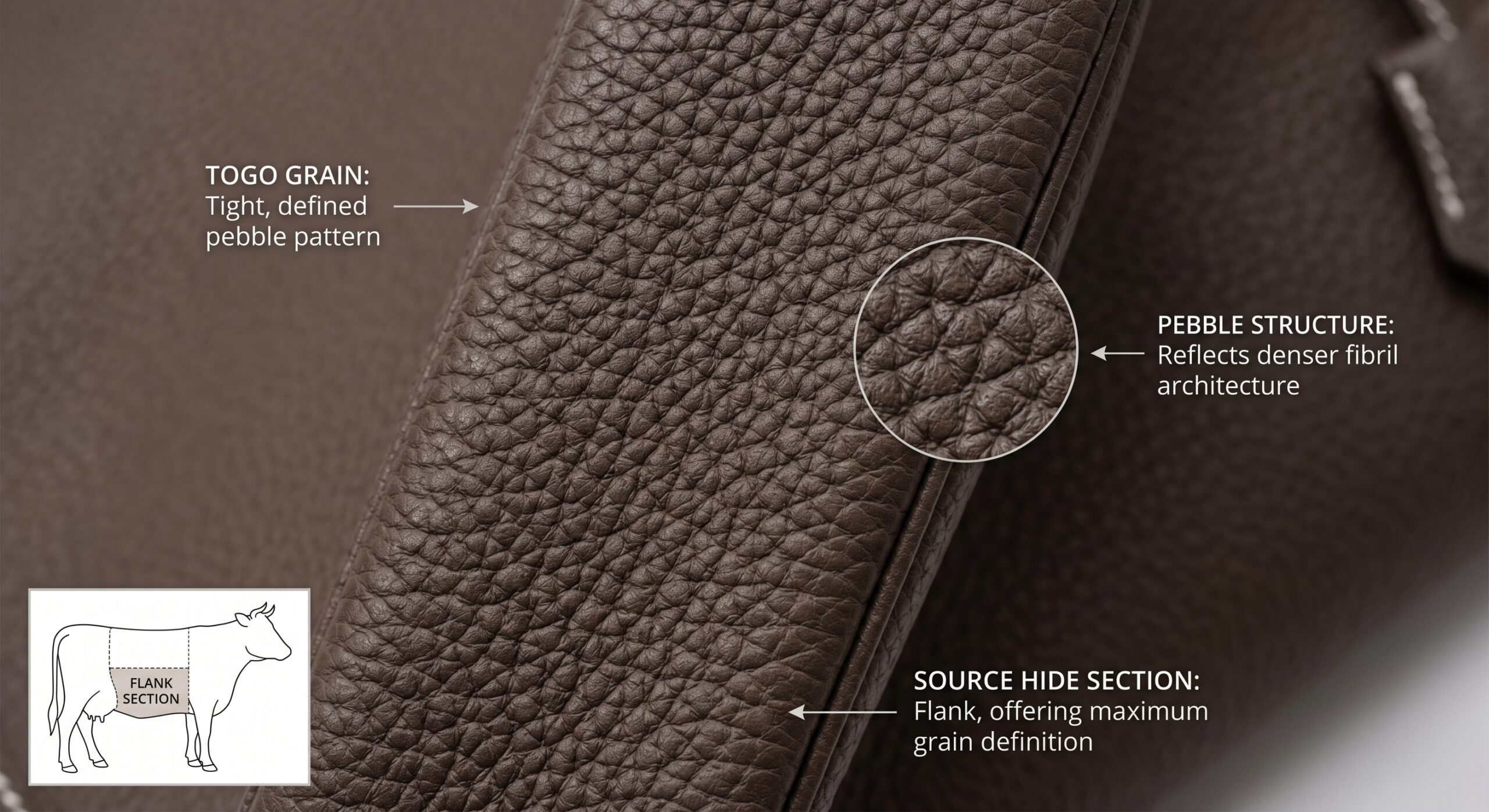
Togo is cut from the flank of a young bull. The flank is a moderately active muscle zone, which means the collagen fibril network in this section of the hide is relatively tight and interwoven — a product of the physical activity the animal's flank muscles perform. When chrome tannage stabilises this fibril network, it locks in a structure that has inherent tensile resistance. The subsequent drum-tumbling finish that creates Togo's characteristic pebbled grain softens the surface without fundamentally loosening the fibril architecture beneath. The result is a leather with a moderately supple hand at the surface but a firm core temper that resists prolonged deformation under load.
Clemence is cut from the lower flank and belly area — a less active zone where the hide is naturally thicker and the fibril network is looser and more widely spaced. This section of the hide produces leather with greater mass per unit area — hence Clemence's noticeably heavier hand compared to Togo — but with a fibril architecture that has less inherent tensile resistance. Chrome tannage stabilises this looser network, and the drum-tumbling process that creates Clemence's slightly larger, more rounded pebble compared to Togo's tighter grain produces a leather that is genuinely supple throughout its full thickness, not just at the surface.
For the full reference on Hermès leather types and their structural origins, the Leathers & Materials Guide covers tannage, grain structure, and behavioural profiles across all major skins in the Hermès range.
"Both leathers begin in the same tannery process. What makes them different is where on the animal the hide was cut — a detail that determines everything about how the bag will age."
Togo: Fibril Density, Grain Architecture, and Why It Holds Its Shape
Togo's shape-retention properties derive directly from its fibril density. The tighter collagen network in the flank section means that when load is applied to a Togo panel — the weight of a filled Birkin pressing down on the base leather, or the tension of a filled side gusset — the fibrils redistribute the stress across a larger number of interwoven contact points. This is the same principle that makes tightly woven fabric more resistant to stretching than loosely woven fabric of the same material: more contact points per unit area means more distributed resistance.
In practical terms, a Togo Birkin 30 loaded to approximately 1.5kg of contents will show minimal base deformation over the first two to three years of regular use. The base corners maintain their angle, the side walls hold their vertical line, and the top opening retains its rectangular profile. This shape retention is not indefinite — no leather maintains factory geometry permanently under load — but Togo's natural fibril architecture slows the relaxation process substantially compared to Clemence.
- Flank origin produces a tighter fibril network with greater tensile resistance per unit area — the structural foundation of Togo's shape-retention advantage
- Drum-tumbling creates a tighter, more defined pebble than Clemence — the closer pebble spacing also contributes to surface scratch resistance as the grain peaks deflect minor abrasions
- Finished panel thickness averages approximately 1.0mm — lighter than Clemence, which reduces the gravitational self-load the leather must support across larger panels
- Moderate surface suppleness combined with firm core temper — the leather moves comfortably in hand without the panels softening under their own weight
- Base deformation under 1.5kg load: minimal to none in first two years of regular carry — base corners retain their angle without internal support structures
Togo's one structural vulnerability is scratch visibility. The tighter grain peaks catch scratches more cleanly than Clemence's rounder pebbles, and surface abrasions are slightly more visible on Togo. However, the dense fibril network means the scratch is confined to the surface finish layer and does not penetrate to the grain body — making most Togo scratches addressable with a gentle leather conditioner and finger-heat buffing. See our detailed treatment of color change and patina development on Togo in the companion article How Hermès Togo Leather Changes Color Over Time.
Clemence: Temper, Mass, and the Mechanics of Signature Slouch
Clemence's slouch is not a flaw — it is a designed outcome of the leather's fibril architecture, and one that many owners choose deliberately. Understanding the mechanics of how and where Clemence relaxes under load allows buyers to make an informed decision rather than discovering post-purchase that their bag has changed shape in a way they did not anticipate.
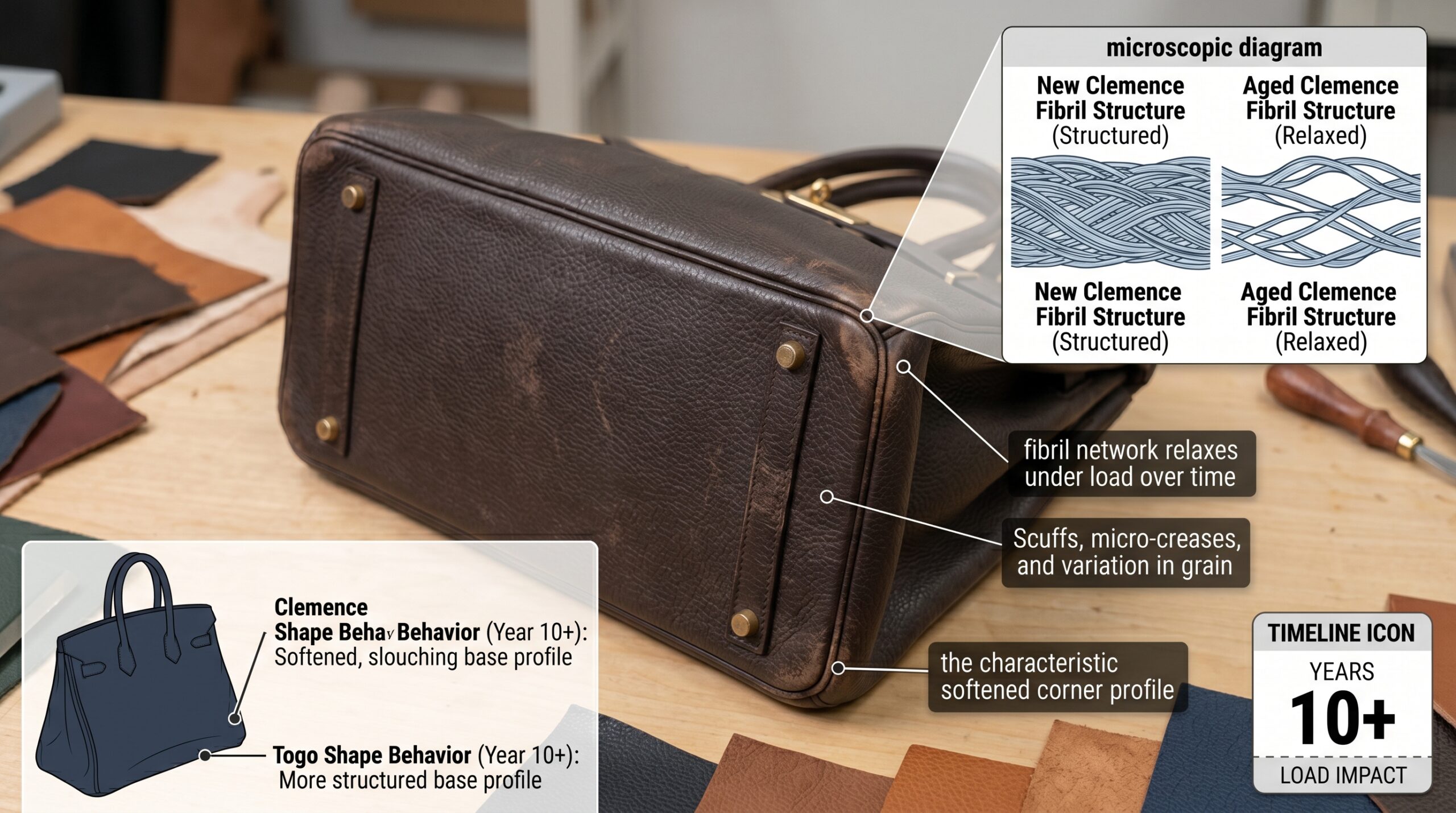
The primary slouch mechanism in Clemence operates at the base panel and the lower side walls. Under load, the looser fibril network in the belly-section hide cannot resist the downward gravitational pressure of the bag's contents as effectively as Togo's denser structure. Over time — the rate depending directly on how heavily the bag is loaded and how frequently it is carried — the base panel begins to flatten and spread slightly beyond the original factory dimensions. The lower corners soften from a crisp right angle toward a more rounded profile. The side walls, particularly in the lower third, develop a gentle outward bow.
Why Clemence's Greater Mass Accelerates Its Own Slouch
Clemence's heavier panel weight — approximately 1.2mm versus Togo's 1.0mm average — creates a self-loading effect that Togo does not experience to the same degree. The leather panels themselves contribute gravitational stress to the bag's base and gussets, which compounds the load from the contents. In a Clemence Birkin 35, the panel mass alone is sufficient to initiate very gradual base softening even when the bag is carried empty — a process that accelerates significantly once contents are added. This is not a quality defect: it is a direct consequence of the denser, heavier hide section used for Clemence production.
What Clemence delivers in exchange for its slouch tendency is a tactile and visual character that no other Hermès leather replicates. The fully supple hand means the bag moves with the body rather than against it — a quality that owners who carry their bag against the hip particularly value. The larger, rounder pebble grain catches light differently from Togo's tighter texture, creating a softer, more matte surface quality. And the relaxed silhouette that develops over years of carry has its own aesthetic authority: a well-aged Clemence Birkin communicates genuine use history in a way that a structurally preserved Togo bag does not.
The weight difference is also relevant for daily carry. A Clemence Birkin 30 runs approximately 80–120 grams heavier than its Togo equivalent — a difference that is negligible at rest but cumulative over a full day of carry. For buyers sensitive to bag weight, particularly in the larger 35 or 40 formats, Togo's lighter panel mass is a practical consideration beyond its shape-retention advantage. Our article on the weight difference between Togo and Epsom in the Birkin 30 provides precise measurements for the most common comparison.
Choosing the Right Leather for Your Carry Habits: A Decision Framework
The Togo vs Clemence decision is ultimately a lifestyle question filtered through material knowledge. Neither leather is universally superior — the correct choice depends on three factors: how much you carry in the bag, how often you carry it, and what aesthetic outcome you want after five or ten years of ownership.
For buyers who carry heavily — laptop, water bottle, daily essentials consistently adding up to 1.5kg or more — and who carry daily, Togo is the structurally appropriate choice. Its denser fibril network and lighter panel mass mean it will maintain recognisable bag geometry for significantly longer than Clemence under the same load conditions. This matters both for daily satisfaction and for resale value: a Togo Birkin with clean base geometry commands a meaningfully higher secondary market price than an equivalent Clemence piece with pronounced slouch, even when the leather condition is otherwise comparable.
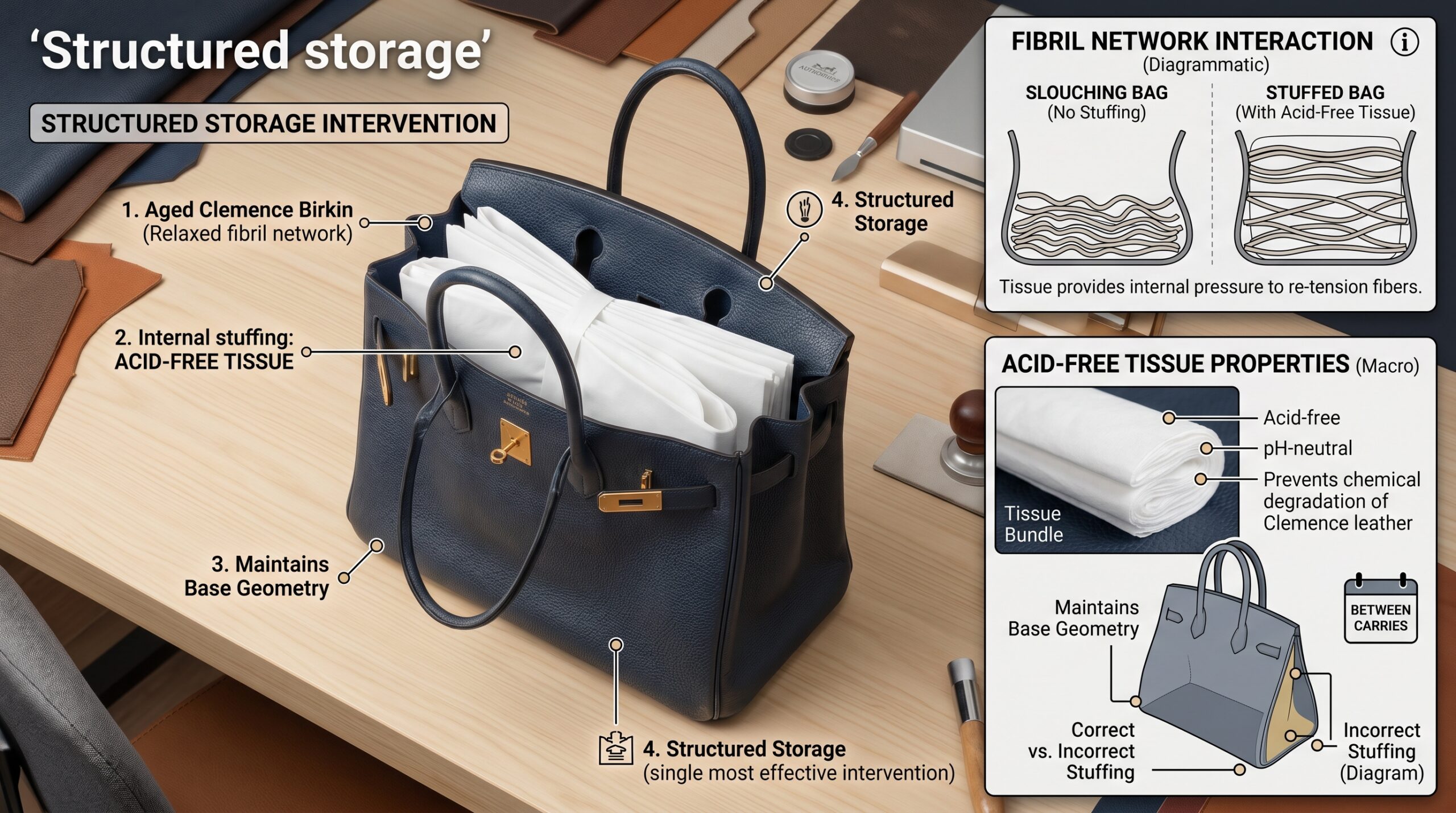
For buyers who carry lighter loads and who value the tactile and visual character of fully supple leather, Clemence is not a compromise — it is a deliberate material choice with its own rewards. The key is to manage the bag's storage discipline from the outset: stuffing the bag with acid-free tissue when not in use prevents the leather from settling into a collapsed shape between carries, slowing the slouch progression significantly. A Clemence Birkin that is stored stuffed and carried moderately loaded can maintain a largely intact silhouette for several years before any significant base softening becomes visible.
For buyers considering the impact of leather choice on long-term value, our companion piece on whether Epsom leather softens with use provides a useful third data point — Epsom being the most structurally rigid option in the standard Birkin/Kelly range and the clearest contrast to Clemence's suppleness. Browse all leather comparisons in the Leather Science category.
| Property | Togo | Clemence |
|---|---|---|
| Hide origin | Upper flank of young bull — tighter fibril network | Lower flank and belly — looser fibril network, greater hide mass |
| Tannage | Chrome — stabilises tight fibril structure | Chrome — stabilises looser, heavier fibril structure |
| Finished thickness | ~1.0mm average | ~1.2mm average — measurably heavier panel |
| Temper | Moderate suppleness at surface; firm core — self-supporting | Fully supple throughout — requires contents or stuffing to hold shape |
| Grain appearance | Tighter, more defined pebble — slightly smaller grain units | Larger, rounder pebble — softer visual texture, more matte surface |
| Slouch under 1.5kg load | Minimal in first 2–3 years; gradual softening thereafter | Noticeable base softening within 12–18 months of daily heavy carry |
| Scratch resistance | Good — but tighter pebble makes scratches more visible | Slightly better — rounder pebble deflects minor abrasion more effectively |
| Weight (Birkin 30) | Lighter — approximately 80–120g less than Clemence equivalent | Heavier — panel mass contributes to cumulative carry fatigue in larger sizes |
| Patina development | Even tonal shift — pebble valleys accumulate oils gradually | Similar mechanism but surface quality change more visible due to fuller suppleness |
| Best for | Daily heavy carry; structured aesthetic; shape-retention priority | Lighter carry; tactile luxury priority; relaxed aesthetic preferred |
Clemence Slouches More — By Design. The Right Choice Depends Entirely on How You Carry.
Clemence will always slouch more than Togo under equivalent load conditions, and the gap widens with bag size and carry frequency. This is not a manufacturing variance or a quality issue — it is the direct, predictable consequence of Clemence's looser fibril architecture and heavier panel mass. A buyer who understands this going in, and who values the tactile and visual qualities that Clemence's suppleness produces, will be entirely satisfied with how their bag ages.
A buyer who expects Clemence to hold Togo-level geometry under heavy daily use will be disappointed within two years. The material science does not bend to expectation. The solution is simple: choose Togo if structured geometry matters to you over the long term. Choose Clemence if a relaxed, supple, lived-in aesthetic is your goal — and discipline your storage habits to slow the process to a rate you can live with.
Bottom Line: Clemence slouches meaningfully more than Togo under load — choose Togo for shape retention and daily heavy carry, Clemence for tactile luxury and a relaxed aesthetic you want to age into.
Popular Searches
Explore our most searched Togo and Clemence leather combinations
The benchmark combination — Togo's firm temper keeps the 30 format structurally intact through years of daily carry while Gold's warm patina deepens beautifully.
⬆ TrendingClemence Etain's blue-grey suppleness develops a characterful drape in the 30 format — the size best suited to Clemence's natural slouch tendency.
★ Collector FavouriteThe Kelly's rigid chassis compensates for Togo's natural suppleness — producing a structured black Kelly that maintains factory geometry over decades of use.
◆ Ultra RareClemence's supple drape in the compact 25 format creates a particularly satisfying hand feel — Bleu Saphir's saturated tone ages without the warm-shift risk of pastels.
⬆ Rising DemandFor the larger 35 format, Togo's denser fibril structure is essential — Fauve's warm cognac tone rewards the shape retention with increasingly rich patina over years.
🔥 Most SearchedThe Kelly's structural chassis allows Clemence's full suppleness to express itself in the handle and body without compromising the bag's overall geometry — a pairing that rewards tactile owners.
Frequently Asked Questions
Slouch in Clemence is not inevitable in the catastrophic sense — it is a graduated softening that occurs over time as the leather's loose fibril network relaxes under load. A lightly used Clemence Birkin may show minimal slouch for several years. However, a heavily loaded bag carried daily will show base and side-wall softening within twelve to eighteen months. The rate is directly proportional to how much weight the leather must support. For a full comparison of how leather weight varies between Togo and Epsom, see our article on the weight difference between Togo and Epsom Birkin 30.
Clemence is consistently heavier than Togo. The difference originates in the hide section: Clemence is cut from the lower flank and belly area, where the hide is thicker and has a higher fibril mass per unit area. In a Birkin 30, the weight differential between Togo and Clemence versions is approximately 80–120 grams — meaningful when the bag is worn daily. Togo's upper-flank origin produces a lighter, slightly less dense fibril structure. For precise measurements see Togo vs Epsom Birkin 30 Weight Difference.
A Clemence Birkin that has developed significant slouch can be improved but not fully restored to factory geometry. Hermès spa service can recondition the leather and reblock the bag's shape using controlled humidity and pressure — a process that partially re-tensions the fibril network. However, once the leather's temper has relaxed to the point where the base corners no longer hold their angle, the change is largely permanent. Prevention through stuffing the bag when not in use is far more effective than restoration. See the full leathers guide at Hermès Leathers & Materials Guide.
For the larger Birkin 35 format, Togo is generally the more structurally appropriate choice. The 35's greater panel area amplifies any slouch tendency — a fibril network that holds adequately in a Birkin 30 will show more pronounced base softening in the larger size because the unsupported span is greater. Togo's firmer temper and tighter grain provide more self-supporting rigidity across the larger panel. Clemence in the 35 will develop a notably relaxed, draped silhouette over time, which some owners actively prefer. Explore all leather type comparisons in the Leather Science category.
