
Hermes Exotic Skin CITES Certificate: What It Means for Resale
The complete buyer's and seller's guide to CITES documentation on Hermès exotic skin bags — which species require it, what missing documentation costs, and how it affects international secondary market liquidity and pricing.
The CITES certificate is the most consequential piece of paper that accompanies a Hermès exotic skin bag — more consequential, in terms of the bag's resale liquidity and international marketability, than any condition report, authentication certificate, or original receipt. The Convention on International Trade in Endangered Species of Wild Fauna and Flora governs the commercial movement of products made from species listed under its appendices, and Hermès's crocodile and alligator skins fall squarely within this framework. A Porosus crocodile Birkin or Mississippiensis alligator Kelly without its original CITES documentation can be owned within a single country without legal issue — but the moment an international sale, consignment, or border crossing is contemplated, the absence of this documentation reduces the bag's effective market to the domestic buyers of whatever country it currently resides in. For the world's most liquid exotic skin market, this restriction is a significant value and liquidity penalty that every buyer and seller in this category should understand before a transaction is completed.
This article provides the complete framework: what CITES is, which Hermès leathers require its documentation, precisely how missing documentation affects secondary market value across different transaction types, and the documentation checklist that every buyer of an exotic skin Hermès piece should run before completing a purchase.
What CITES Is and Why It Applies to Hermès Exotic Skin Bags
The Convention on International Trade in Endangered Species of Wild Fauna and Flora — universally abbreviated as CITES — is an international agreement between governments that regulates the international trade of animals and plants, and products made from them, to prevent over-exploitation from threatening their survival. It operates through a system of appendices that classify species according to their conservation status and the level of trade regulation they require.
Species listed under Appendix I are those threatened with extinction — commercial trade in Appendix I species or their products is generally prohibited. Species listed under Appendix II are not necessarily threatened with extinction but may become so if trade is not controlled — commercial trade in Appendix II species and their products is permitted but requires documentation issued by national CITES Management Authorities confirming that the trade will not be detrimental to the species' survival and that the specimens were legally acquired.
Both crocodilian species used by Hermès — Crocodylus porosus (Porosus crocodile, the species used for the most prestigious Hermès exotic skin pieces) and Alligator mississippiensis (American alligator, used for both matte and shiny alligator bags) — are listed under CITES Appendix II. Their farming for luxury goods is legal under CITES because it is conducted through regulated ranching and farming operations with species management oversight, but every piece of finished product made from these skins must be accompanied by appropriate export and import documentation when it crosses international borders. Hermès, as a producer in France (a CITES signatory), provides CITES documentation with every crocodile and alligator bag it sells — this documentation is the buyer's proof of legal acquisition and the legal basis for any subsequent international transfer. For the full investment and resale context, the Investment Guide hub covers all value-affecting factors alongside documentation.
"The CITES certificate is not bureaucracy. It is the deed of title for an exotic skin bag's international market access. Without it, the bag exists only in the domestic market of wherever it currently sits."
Which Hermès Leathers Require CITES Documentation and Which Do Not
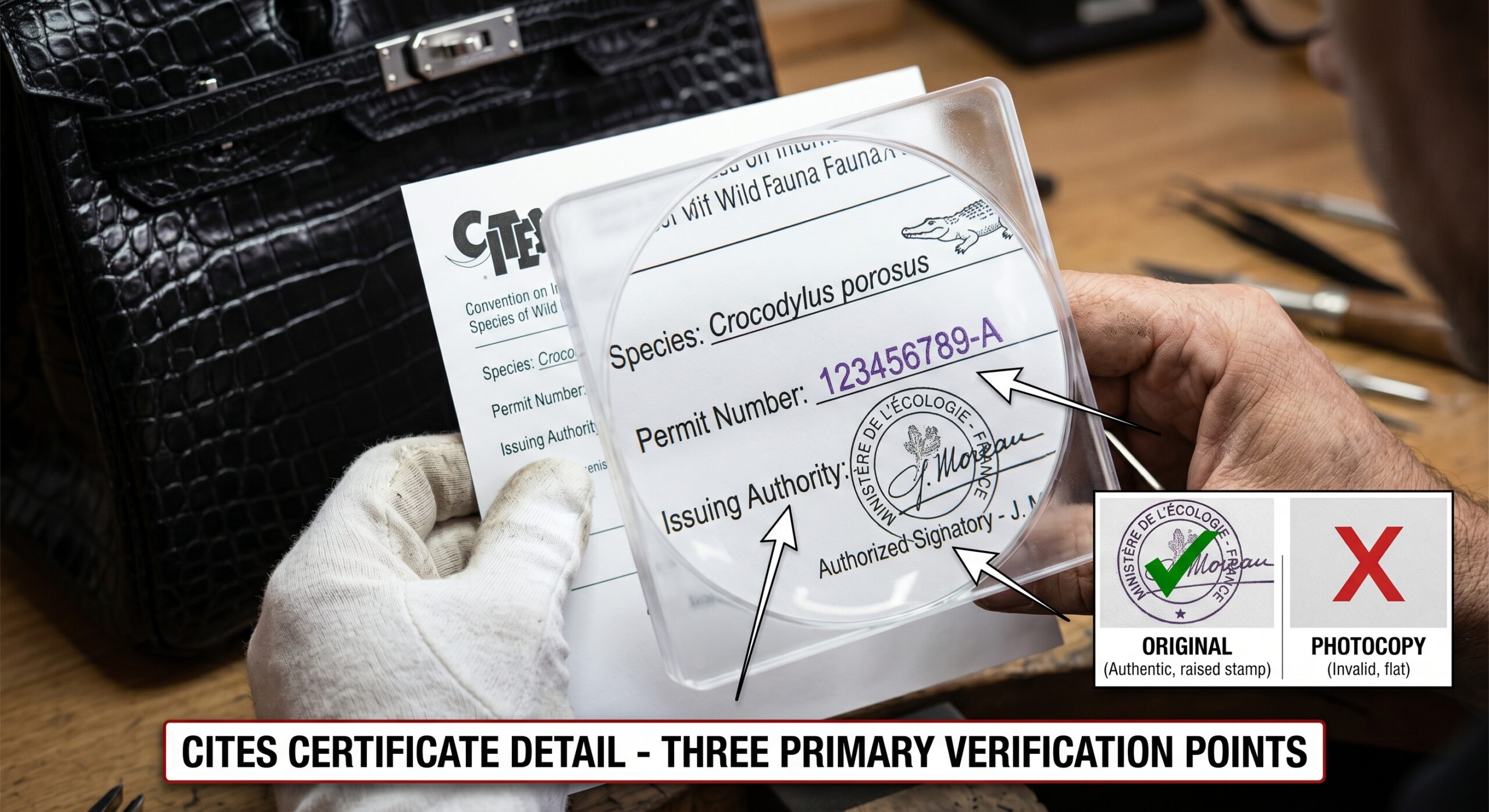
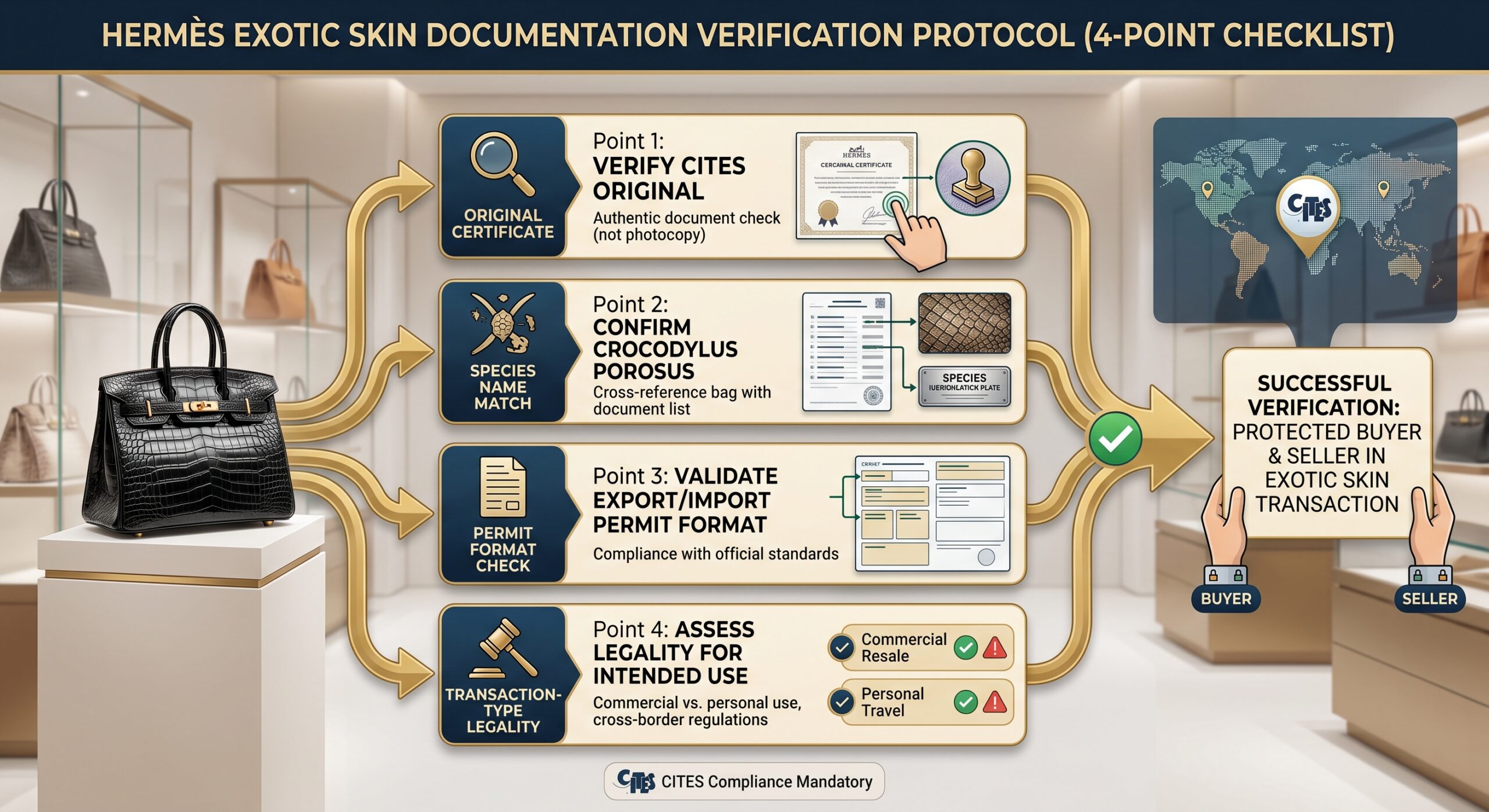
The practical implication of this species table is straightforward for secondary market buyers: any Hermès bag described as crocodile or alligator requires CITES documentation for legal international transfer. Before completing any purchase of a crocodile or alligator Hermès bag, request to see the original CITES certificate and verify the following: the species name matches the bag (Crocodylus porosus for Porosus crocodile; Alligator mississippiensis for alligator); the certificate is an original document, not a photocopy; and the certificate format matches the standard of the issuing country's CITES Management Authority. For scale matching and species authentication that complements CITES verification, see Symmetrical Scale Matching on Hermès Exotic Skins: Expert Method.
How CITES Documentation Affects Resale Value and International Liquidity
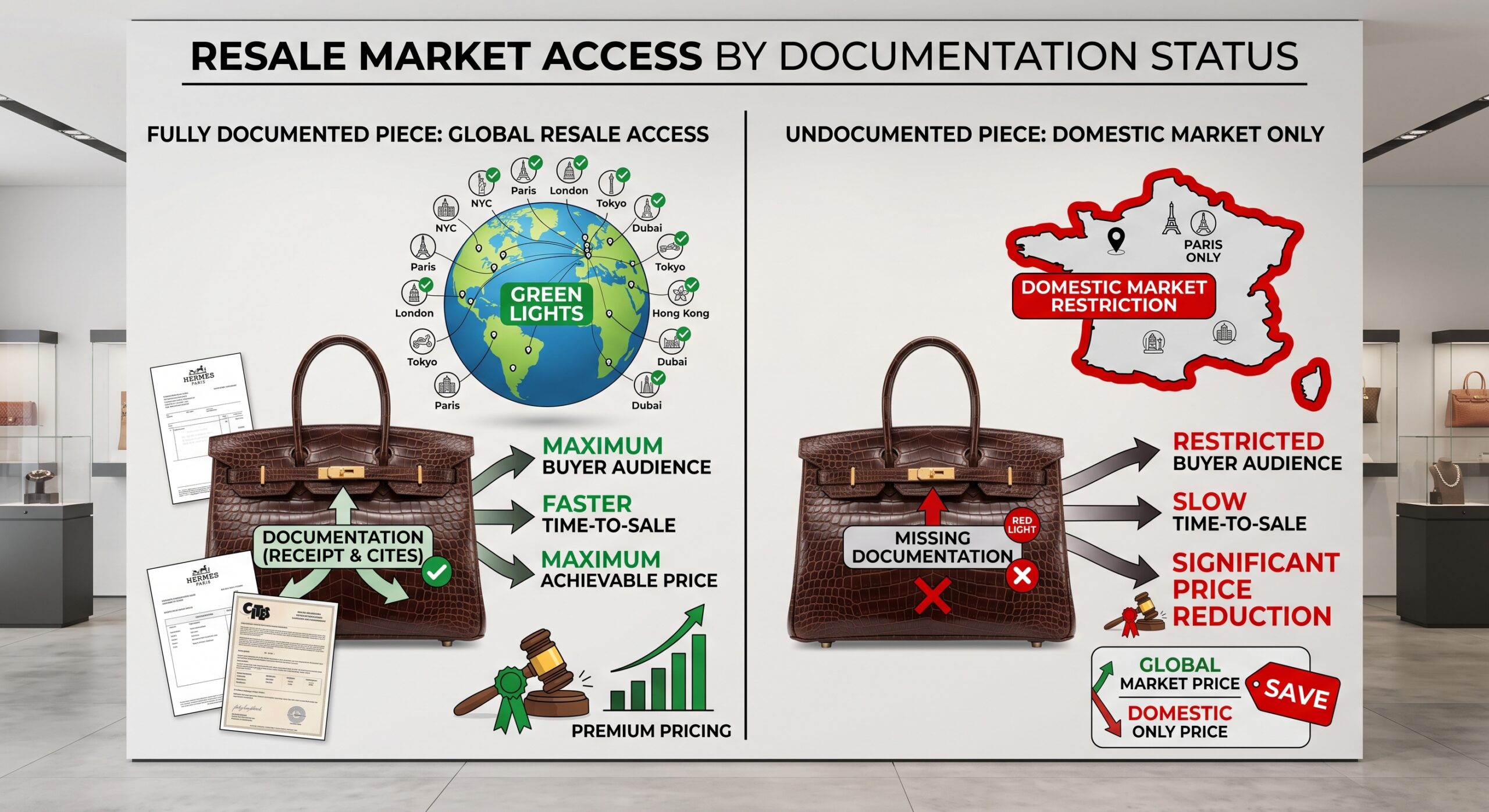
The financial impact of CITES documentation status on exotic skin Hermès resale value operates through two channels: the direct effect on the achievable price at sale, and the indirect effect on liquidity — the range of buyers who can legally participate in the transaction.
Why the Missing CITES Premium Is Largest at the Top of the Exotic Skin Market
The CITES documentation premium is not uniform across the exotic skin range — it is largest for the most valuable and most internationally traded specifications. A Porosus crocodile Birkin 25 in a rare colour with complete original CITES documentation, sold through an international specialist or major auction house, has access to buyers across all 183 CITES signatory countries. The same piece without documentation is effectively restricted to the domestic buyer pool of its current location. At the price levels at which top-tier Porosus pieces transact — often six figures in primary markets — the difference between global and domestic buyer pools is not a 15–25% value premium but a potential buyer pool reduction that affects both achievable price and time-to-sale. Auction houses will not accept undocumented exotic skin pieces for international sale, regardless of any other factor including physical condition or authentication.
For buyers, the practical consequence is simple: never purchase a crocodile or alligator Hermès bag internationally without seeing original CITES documentation. The documentation is not optional provenance material — it is the legal basis for your ownership of a piece that can be internationally transacted. Purchasing without it means accepting, knowingly or unknowingly, a restriction on the future liquidity of the piece. For the matte versus shiny alligator context that affects value alongside documentation, see Matte vs Shiny Alligator Hermès Bags: Maintenance Differences. For the leather condition factors that interact with documentation in overall value assessment, see Does Leather Condition Affect Hermès Resale Price?
Buying and Selling Hermès Exotic Skins: The Documentation Checklist
The documentation checklist for any exotic skin Hermès transaction covers four areas: verification of the certificate's existence and authenticity, species matching between the certificate and the bag, transaction-type legality assessment, and country-specific permit requirements. Running this checklist before any transaction — buy or sell — prevents the most common and most costly documentation errors in the exotic skin secondary market.
- Request original CITES certificate — never accept a photocopy as primary documentation; a photocopy is acceptable as a reference alongside the original but cannot substitute for it in any legal transaction context
- Verify species name on certificate matches bag — Crocodylus porosus for Porosus crocodile; Alligator mississippiensis for alligator (both matte and shiny); any mismatch between the certificate's species name and the bag's described species is a transaction risk
- Check certificate format — CITES certificates follow international standard formats; the issuing country's Management Authority name, the permit number, the species listed quantity (individual specimens), and the origin declaration should all be present
- Confirm transaction type and country requirements — domestic transactions (buyer and seller in the same country) do not require a CITES permit for crocodilian products; international transactions require export permits from the sending country and may require import permits from the receiving country, depending on that country's CITES implementation
- Assess re-export permit need — if the bag has already been exported once from its country of original purchase, a re-export certificate (not the original export certificate) is required for its next international transfer; confirm which document accompanies the piece
- Verify permit is current — CITES export permits typically have validity periods (often six months for commercial purposes); a permit that has expired cannot be used for a new transaction; re-issuance requires reapplication through the national CITES Authority
- For auction consignment — confirm the auction house's CITES compliance process before consigning; major international auction houses have in-house CITES compliance teams and will not accept pieces for international sale without verifying documentation completeness
| Leather Type | Species | CITES Appendix | Documentation for International Sale | Resale Liquidity Impact |
|---|---|---|---|---|
| Porosus Crocodile | Crocodylus porosus | Appendix II | Export permit from France; import permit required by some countries — always required for international commercial transfer | Highest impact — undocumented pieces restricted to domestic market; documented pieces access all 183 signatory countries |
| Alligator (Matte & Shiny) | Alligator mississippiensis | Appendix II | US Fish & Wildlife export permits required from US; CITES re-export certificate required for pieces already exported from US — always required for international transfer | Same impact as Porosus — documentation is mandatory for international liquidity; US-sourced pieces have additional regulatory layer |
| Ostrich | Struthio camelus (farmed) | Not listed | No CITES documentation required — standard commercial customs documentation only | No CITES impact — full international liquidity without documentation constraint |
| Lizard | Varanus species (various) | Appendix I or II (species-dependent) | Species-dependent — some require CITES documentation; Hermès sourcing documentation should specify species; verify before international transaction | Moderate — species verification required; most Hermès lizard sourcing is appropriately documented |
| All Bovine Leathers | Bos taurus (domestic cattle) | Not listed | No CITES documentation required — domesticated livestock exempt from CITES regulation | No CITES impact — Togo, Clemence, Epsom, Barenia, Swift have full international market access without documentation requirement |
CITES Documentation Is Not Optional Provenance — It Is the Legal Infrastructure of an Exotic Skin Bag's International Value
The Hermès exotic skin secondary market is genuinely international — the buyers for a Porosus crocodile Birkin 25 in a rare colour are distributed across Europe, Asia, the Americas, and the Middle East, and the price that a seller can achieve reflects access to that entire global buyer pool. CITES documentation is the legal mechanism that makes this global access possible. Without it, the piece's effective market contracts to the domestic buyer pool of whatever country it currently resides in — a contraction that, depending on the piece's specification and the depth of the domestic market, can represent a 25–45% reduction in achievable price alongside the significant liquidity penalty of a much smaller buyer pool and longer time-to-sale.
For buyers, the implication is absolute: never purchase a crocodile or alligator Hermès bag internationally without original CITES documentation, regardless of the discount offered to compensate for missing documentation. The discount rarely reflects the full future resale cost of the documentation gap — and it leaves the buyer in the legally constrained domestic market position when resale time eventually comes. Treat the CITES certificate as equal in importance to the bag itself: if it is missing, the transaction price should reflect the domestic-market-only value, not the international market premium.
Bottom Line: Always require original CITES documentation before purchasing any Hermès crocodile or alligator bag internationally — it is the legal basis for the piece's global market access, and its absence represents a 25–45% reduction in resale value and a restriction to domestic-only liquidity that no condition premium or authentication certificate can compensate for.
Popular Searches
Explore our most searched CITES and exotic skin resale combinations
The highest-stakes CITES verification scenario — a Porosus Birkin 25 without original documentation can lose 25–45% of its international market value; the verification checklist for this specification is the most consequential documentation review in the exotic skin secondary market.
⬆ TrendingAlligator pieces that have already been exported from the US require re-export certificates rather than original export permits for subsequent international transfers — the most commonly confused documentation requirement in the alligator secondary market.
★ Collector FavouriteUnderstanding the precise resale value impact of missing CITES documentation — domestic-only restriction, buyer pool contraction, and the 25–45% value gap relative to fully documented equivalent pieces at international specialist resellers.
◆ Ultra RareAt the top of the market — Porosus crocodile in rare colours with complete CITES documentation and original Hermès receipt — where full provenance commands the maximum international premium over any undocumented equivalent.
⬆ Rising DemandMajor auction house CITES compliance requirements for exotic skin consignment — documentation that auction houses require before accepting crocodile or alligator pieces for international sale, and how to prepare a piece for consignment correctly.
🔥 Most SearchedThe most common CITES knowledge gap — ostrich leather requires no CITES documentation for any international transaction; crocodile and alligator always require it; understanding which is which prevents costly purchase errors.
Frequently Asked Questions
A CITES certificate is the legal documentation that permits the international commercial trade of products made from CITES-listed species. For Hermès bags, certificates are required for all crocodilian leather products — Porosus crocodile and Mississippiensis alligator. The certificate confirms that the skins were legally sourced from a CITES-regulated farm and that the bag can be legally exported and imported by signatory countries. Without a valid CITES certificate, a crocodile or alligator Hermès bag cannot be legally sold across international borders in most circumstances. See the full investment guide at the Investment Guide hub.
A missing CITES certificate significantly restricts what can legally be done with a Hermès crocodile or alligator bag. The piece can still be sold domestically within its current country — domestic sale within a single country does not require a CITES export permit. However, it cannot be legally transported across international borders for sale, consignment, or personal import without a new permit from the national CITES authority. Missing documentation reduces secondary market value by 25–45% and restricts the buyer pool to domestic buyers only. For resale value context see Does Leather Condition Affect Hermès Resale Price?
CITES documentation is required for all Hermès bags made from crocodilian leather — Porosus crocodile (Appendix II) and Mississippiensis alligator (Appendix II). Ostrich leather does not require CITES documentation as domesticated ostrich is not listed under the Convention. Lizard leather may require documentation depending on the specific species used. Standard bovine leathers — Togo, Clemence, Epsom, Barenia, Swift, Negonda — require no CITES documentation for any international transaction. When purchasing a crocodile or alligator Hermès bag on the secondary market, always request and verify the original CITES documentation. See scale matching authentication at Symmetrical Scale Matching on Hermès Exotic Skins.
Yes, significantly. A Hermès crocodile or alligator bag with complete original CITES documentation commands a 15–25% premium over an equivalent undocumented piece at international specialist resellers. This premium reflects the broader international liquidity that documented pieces have — they can be sold globally without restriction and consigned to international auction houses. Undocumented pieces are effectively restricted to domestic sale, limiting the buyer pool and achievable price. At the top of the exotic skin market, the documentation premium can be even more substantial. Browse all investment and resale guidance at All Topics.
