
Hermes Chevre Mysore vs Coromandel: Which Is Right for You?
A forensic grain-level comparison of Hermès's two goatskin leathers — how breed origin, fibril architecture, and finish produce two distinct ownership experiences from the same animal species.
When Hermès collectors speak of Chevre Mysore vs Coromandel, they are comparing two leathers that share a species — goat, or chèvre — but diverge significantly in breed origin, fibril architecture, surface grain, and the carrying experience they produce over years of ownership. Both are substantially lighter than bovine leathers at equivalent panel thickness, both offer exceptional temper stability, and both carry a scarcity premium that reflects the limited supply of properly graded goatskin hide relative to bovine alternatives. But the choice between them matters — not just aesthetically but materially — and most buyers encounter it without the vocabulary to make it on anything other than visual grounds.
This article provides the forensic framework that converts the choice from aesthetic to material: the fibril-level differences between the two leathers, their divergent scratch resistance and patina behaviour, the construction contexts in which each performs best, and a clear decision framework for matching each goatskin to the specific ownership profile it suits.
What Makes Chevre Leather Different From Bovine at the Fibril Level
The distinction between goatskin (chevre) and bovine leather begins at the animal level and extends through every stage of the leather's material properties. Goatskin hides have a fibril architecture that differs from bovine in two fundamental ways: the individual collagen fibrils are finer in diameter, and they are woven more tightly per unit cross-section than bovine fibrils. This produces a leather that is denser in fibril mass per unit volume at the same panel thickness — which is why chevre is both lighter (thinner panel achieves the same structural performance) and firmer (more fibril cross-links per unit area resist deformation more effectively) than comparable bovine leathers.
The finer fibril diameter in goatskin also produces a naturally finer-grained surface. Where bovine leather requires embossing (as in Epsom) or drum-tumbling (as in Togo) to produce a defined surface texture, goatskin's natural grain is inherently tighter and more precisely patterned — a direct expression of the finer fibril tips at the grain surface. This is why chevre leathers, even in their natural state, display a more precise and geometric surface pattern than most natural-grain bovine leathers. The specific character of that natural pattern — tight and cross-hatched in Mysore, more openly pebbled in Coromandel — is where the two chevre leathers diverge from each other. For the full comparative framework across all Hermès leather types, the Bag Comparisons hub provides the complete material comparison reference.
Mysore
Coromandel
"Both chèvres are goatskins, but the goat's breed determines the fibril architecture, and the fibril architecture determines everything: the grain, the temper, the scratch resistance, the patina. Same species, different leather."
Chevre Mysore: The Tighter Grain and Its Specific Material Consequences
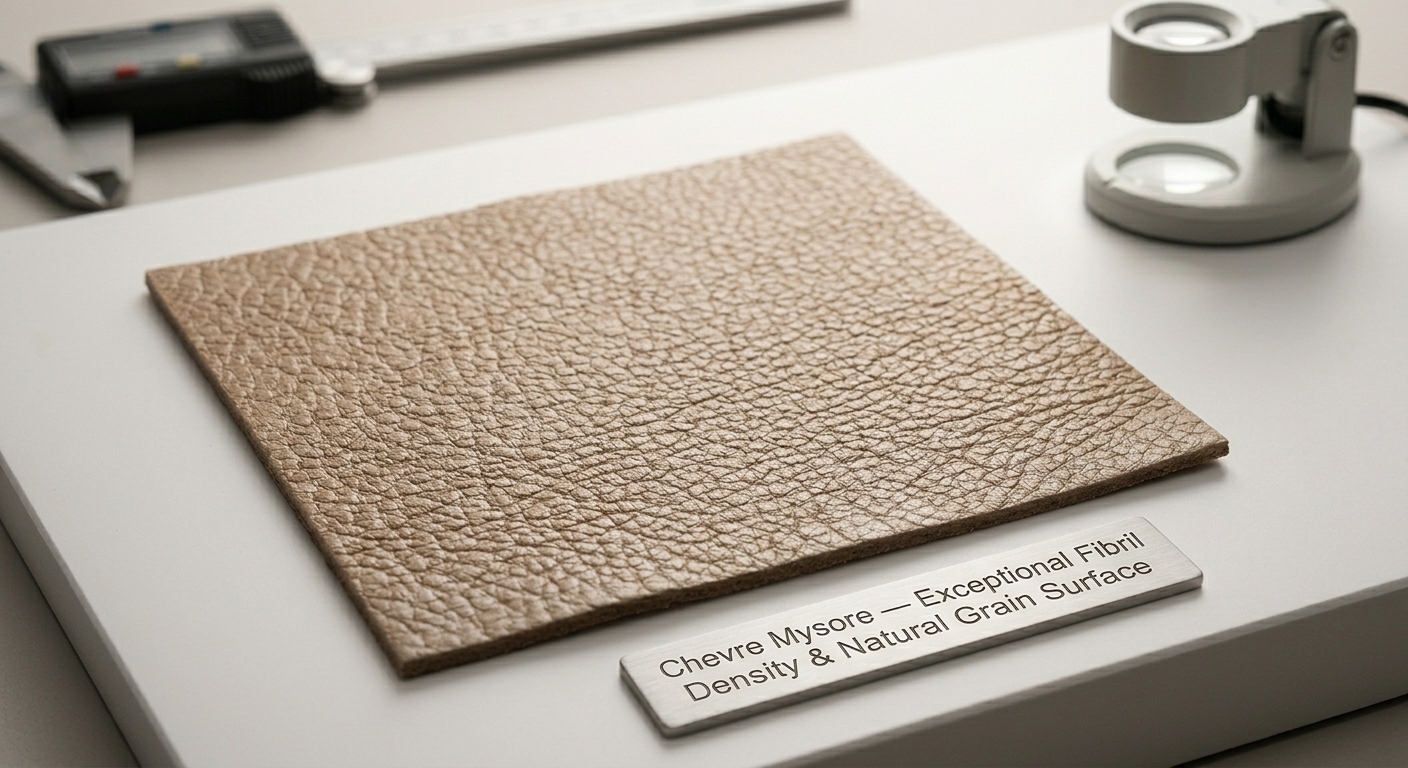
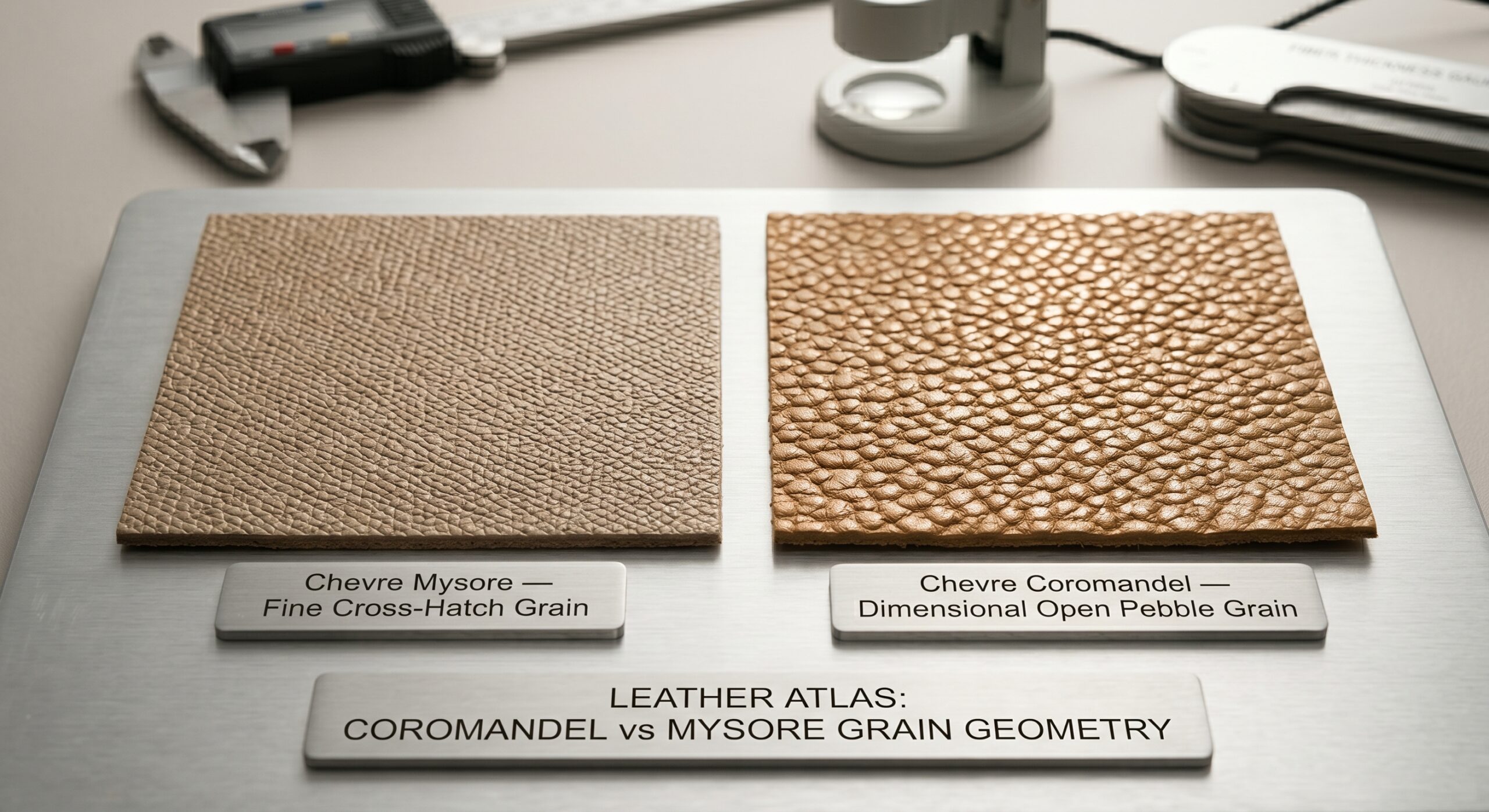
Chevre Mysore originates from the Indian Mysore goat breed — an animal whose hide produces one of the tightest-grained natural leathers available anywhere in the luxury accessories market. The breed's specific fibril architecture, combined with Hermès's exacting hide selection standards for this leather, produces panels whose natural cross-hatched grain pattern is finer and more geometrically precise than Coromandel's — visible as a tighter, more regular surface texture under close inspection.
The practical consequences of this fibril density are significant and consistent. Mysore's scratch resistance is exceptional — among the highest of any Hermès leather including Epsom — because the tightly packed fibril tips at the grain surface collectively deflect minor abrasion across an extremely high number of contact points per unit area. A scratch that would register visibly on Swift, and partially on Togo, often fails to leave a visible mark on Mysore because no single fibril tip absorbs enough stress to displace from its position. This is the same principle that makes tightly woven fabric more resistant to snag damage than loosely woven fabric of the same fibre — density distributes the incident force.
- Grain texture — tight, cross-hatched natural pattern specific to the Mysore breed; more geometrically precise than Coromandel's pebble; reads under inspection as almost embossed despite being natural grain
- Temper — firm, approaching board-like rigidity in some examples; significantly stiffer than Coromandel and firmer than most natural-grain bovine leathers of equivalent thickness
- Scratch resistance — highest in the standard Hermès leather range including pebbled bovine leathers; tight grain geometry deflects minor abrasion without transferring stress to individual fibrils
- Colour saturation — exceptional; the tight grain presents an unusually uniform surface to the eye, allowing the applied pigment to read with maximum saturation and minimal surface texture interference
- Patina — very limited; the dense fibril surface resists oil absorption even more effectively than Epsom, developing only a very subtle contact-zone sheen over years of carry
- Weight — approximately 20% lighter than equivalent bovine panels at the same structural performance; one of the lightest leathers in the Hermès range
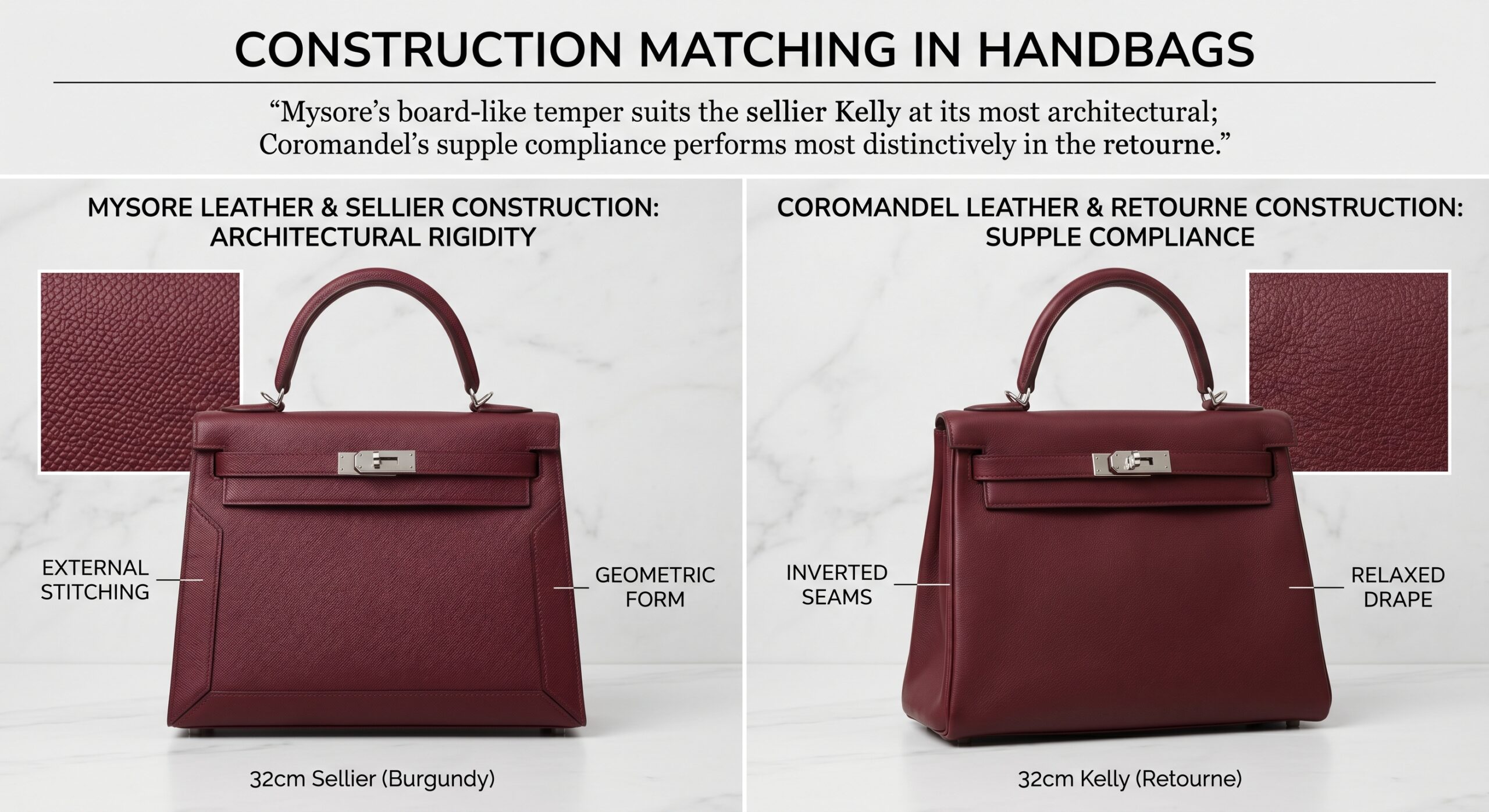
Mysore's specific formal character — precise, architectural, restrained — makes it the natural leather choice for the sellier Kelly construction. The combination of Mysore's firm temper and the Kelly's rigid internal chassis produces a bag with an almost jewel-like precision: flat panels of exceptional tightness, a surface that photographs with extraordinary colour accuracy, and a geometric rigidity that most other leathers require a rigid chassis to achieve. For buyers selecting the Kelly in Mysore, the sellier construction amplifies every one of Mysore's structural advantages. For buyers interested in how the Chevre leathers compare against the broader bovine range, our piece on Togo vs Clemence leather slouch provides the fibril-density comparison framework that also contextualises why chevre is so structurally distinct.
Coromandel: The Open Grain, Supple Temper, and Warmer Surface Character
Coromandel chevre originates from a different goat breed than Mysore — one whose hide produces a leather with a slightly more open grain and a meaningfully more supple temper. The Coromandel grain is still finer and more precise than most natural-grain bovine leathers, which places it firmly in the premium category, but compared to Mysore's tight cross-hatch it reads as softer, more organic, and more tactilely warm. This is not a deficiency — it is a different set of material properties that suits a different ownership profile.
The slightly more open grain of Coromandel means that the leather's surface texture has more visual depth than Mysore's flat cross-hatch — the pebble valleys catch light differently at different angles, producing a surface that appears richer and more dimensional when viewed in motion. This is the visual equivalent of the difference between a perfectly smooth polished surface and a subtly textured one: the texture adds apparent depth even when the tonal colour is identical. For buyers who find Mysore's precise surface too formal or architectural, Coromandel's slight tactile warmth provides a middle ground between Mysore's severity and the more pronounced pebbling of Togo.
Why Coromandel's More Open Grain Also Produces Marginally Better Patina Than Mysore
Coromandel's slightly more open fibril structure at the grain surface allows marginally more oil absorption from skin contact and environmental exposure than Mysore's tightly packed surface. This means Coromandel develops a subtly warmer contact-zone tone over years of carry — a very restrained patina compared to Togo, but more visible than Mysore's near-static surface character. In warm colour families like Gold and Noisette, this Coromandel patina development produces a surface that deepens slightly and appears more lived-in than Mysore at equivalent age. Neither is a dramatic transformation — both chevre leathers remain much more patina-stable than any bovine leather — but the difference is consistent and legible to buyers who pay close attention to their leather's surface evolution.
Coromandel's more supple temper also makes it a better candidate for the retourne Kelly construction than Mysore's firm board-like hand. The retourne's turned construction benefits from a leather that can flex through the turning process and settle naturally into a soft, rounded silhouette — a property that Mysore's exceptional rigidity resists somewhat more than Coromandel's compliance allows. A Coromandel retourne Kelly develops the characteristic rounded softness of retourne construction more naturally than an equivalent Mysore piece. For buyers who want the Kelly's structural advantages combined with a more relaxed, organic aesthetic, the Coromandel retourne combination is the most natural specification. See our full retourne vs sellier construction comparison at Sellier vs Retourne Kelly: How Structure Changes Leather Behaviour. The full chevre leather context sits within our comprehensive overview at Hermès Veau Volupto Leather: Characteristics, Care & Availability.
Choosing Between Mysore and Coromandel: A Decision Framework
The Mysore vs Coromandel decision ultimately rests on four questions: how formal is your preferred aesthetic, how important is maximum scratch resistance, which construction do you prefer, and how much weight do you give to patina development over your ownership horizon?
For buyers who want the most precisely architectural surface character — the leather equivalent of polished steel rather than brushed — Mysore is the answer. Its tight grain, exceptional scratch resistance, and firm temper combine to produce a bag that maintains its factory precision with the least surface evolution of any standard Hermès leather other than Epsom. For buyers who want chevre's structural and weight advantages but prefer a slightly warmer, more organically textured surface that develops a subtle patina over years, Coromandel is the answer. The choice is not about one leather being superior — it is about which material character aligns with your aesthetic preference and carry reality.
For construction matching: Mysore's firm temper makes it the more natural sellier Kelly choice; Coromandel's supple compliance suits both sellier and retourne equally well and actually performs most distinctively in the retourne context. Neither chevre leather is well-suited to the Birkin's open-top format in the same way it suits the Kelly's structured construction — the Kelly's internal chassis works with chevre's lightweight firmness in a way that the Birkin's self-supporting format does not leverage as directly. Browse all leather comparison articles in the Leather Science category for the complete specification matrix.
| Property | Chevre Mysore | Coromandel |
|---|---|---|
| Hide origin | Indian Mysore goat breed — finest fibril diameter, tightest grain | Alternative goat breed — slightly larger fibril diameter, more open grain |
| Grain character | Tight, cross-hatched natural pattern — reads as almost embossed despite being natural | Softly pebbled, more open grain — warmer visual texture, more dimensional under angled light |
| Fibril density | Highest of the two — approximately 2× more compact than Coromandel | High but slightly less compact — still substantially denser than most bovine leathers |
| Temper | Firm to board-like — most rigid natural-grain Hermès leather | Supple — noticeably more flexible hand than Mysore; warmer tactile character |
| Scratch resistance | Exceptional — highest in the standard Hermès range; tight grain deflects rather than absorbs abrasion | Good — substantially better than smooth bovine leathers but lower than Mysore |
| Colour saturation | Maximum — tight grain presents perfectly uniform surface to pigment; exceptional colour accuracy | Rich with slight warmth — open grain adds tonal complexity that bovine pebbled leathers don't match |
| Patina development | Minimal — dense surface resists oil absorption; contact-zone sheen only at multi-year timescale | Subtle — slightly more oil-absorbent grain produces marginally warmer tonal deepening at contact zones |
| Weight vs bovine | ~20% lighter than equivalent Togo/Clemence panels | ~18% lighter than equivalent Togo/Clemence panels — marginally heavier than Mysore due to larger grain |
| Best construction match | Sellier Kelly — firm temper amplifies sellier's architectural precision | Both sellier and retourne Kelly — most distinctive in retourne's softer silhouette |
| Availability | Very limited — Mysore breed supply restricts production; rarely available on request | Limited — more available than Mysore in recent years but still far below bovine alternatives |
Mysore for Precision and Scratch Immunity; Coromandel for Warmth and Tactile Character — Both Are Exceptional Specifications
The Mysore vs Coromandel choice is among the most nuanced leather decisions in the Hermès range precisely because both leathers are excellent — and their differences are of character rather than quality. Mysore offers the most scratch-resistant, most formally precise, and most colour-saturated surface in the standard Hermès catalogue. Coromandel offers a warmer, more tactile, and slightly more patina-developing alternative that shares chevre's structural and weight advantages while delivering a softer, more organic surface character.
The deciding factors are aesthetic and constructional rather than practical: choose Mysore if you want the most architecturally precise chevre, if maximum scratch resistance is a priority, and if you prefer the sellier Kelly's sharp geometry reinforced by a board-like temper. Choose Coromandel if you want chevre's advantages with a slightly warmer surface character, if the retourne Kelly's softer silhouette appeals, or if you want a leather whose subtle patina development over years of carry adds personal history to the surface without the demanding care requirements of vegetable-tanned Barenia.
Bottom Line: Mysore wins on scratch resistance, colour precision, and formal character; Coromandel wins on tactile warmth, subtle patina, and construction versatility — both are exceptional specifications, and the choice between them is one of aesthetic preference rather than material superiority.
Popular Searches
Explore our most searched Chevre Mysore and Coromandel combinations
The definitive Mysore specification — sellier construction's architectural precision combined with Mysore's board-like temper and exceptional scratch resistance produces a Kelly of unmatched formal authority.
⬆ TrendingCoromandel's supple temper in the retourne Kelly 25 produces the warmest, most tactile chevre experience in the range — Gold's warm tone deepens subtly with Coromandel's marginally more open patina development.
★ Collector FavouriteMysore's colour saturation clarity reaches its peak expression in saturated tones like Rouge H — the tight grain presents the deep bordeaux with a richness that no bovine leather can match at equivalent pigment concentration.
◆ Ultra RareMysore in the compact Birkin 25 delivers chevre's structural advantages in the most practically light format — Vert Anis's fresh green reads with exceptional saturation against Mysore's precise grain geometry.
⬆ Rising DemandCoromandel Etain in the Kelly 32 offers the best of both worlds — chevre's structural precision in the larger format, with Coromandel's warmer surface character and the slate-grey tone's subtle patina trajectory.
🔥 Most SearchedThe most common chevre comparison query — buyers who have access to both leathers in the same boutique visit consistently describe Mysore as more formal and Coromandel as warmer, confirming the grain-level character difference.
Frequently Asked Questions
Both are goatskin leathers but originate from different goat breeds, producing measurably different grain structures, tempers, and surface qualities. Chevre Mysore is the finer-grained of the two — its tight cross-hatched natural grain and firm temper produce a leather that is exceptionally scratch-resistant and holds colour saturation with unusual clarity. Coromandel has a slightly more open, softly pebbled grain with a marginally more supple temper — producing a leather with a tactile warmth that Mysore's more formal surface does not replicate. Both are significantly lighter than comparable bovine leathers. See the full comparison guide at the Bag Comparisons hub.
Chevre Mysore is more scratch-resistant than Coromandel. Mysore's tighter cross-hatched grain structure means that surface abrasion contacts multiple grain peaks simultaneously, distributing the scratch stress across a wider surface area. Coromandel's slightly more open pebble grain is somewhat more vulnerable to surface marking, though both chevre leathers are substantially more scratch-resistant than smooth leathers like Swift or Box Calf at comparable panel thickness. For the scratch resistance comparison of smooth Hermès leathers see Hermès Swift vs Box Calf: Scratch and Scratch Recovery.
Chevre Mysore's availability is limited by the specific breed of goat from which it originates — the Indian Mysore breed produces a hide of the exceptional tightness required for Hermès's specification, and the supply of appropriately graded hides is substantially smaller than the supply of bovine hides used for Togo, Clemence, and Epsom. Coromandel is similarly limited but slightly more available than Mysore in recent production years. Both chevre leathers appear in limited allocations and are typically not available as a buyer-specified request. See all leather types at the Leathers & Materials Guide.
Both are chrome-tanned and therefore develop patina through surface-dominant mechanisms — oil absorption and UV oxidation rather than vegetable tannin migration. Coromandel's slightly more open grain allows marginally more oil absorption into the fibril network at contact zones, producing a subtly warmer and more visible patina development over time. Mysore's tighter grain resists oil absorption more effectively, developing only a very subtle contact-zone sheen. Neither develops patina in the depth or character of vegetable-tanned Barenia, but both age gracefully with minimal maintenance. Browse all leather types at Leather Science.
